2 Conduit PVC Sizing and Installation Guide

A conductor package arrives at the warehouse, and the purchase order says only “2-inch PVC conduit.” The field team assumes the raceway has a 2-inch bore, the estimator checks a familiar fill table, and the problem appears later when the actual product has a smaller usable interior or the pull becomes unmanageable around several bends.

That mistake starts with the label. 2-inch PVC conduit is a nominal trade size, not a promise of a 2-inch inside diameter. Schedule, wall thickness, product type, conductor insulation, bend geometry, and installation environment all affect whether the selected raceway will fit the conductors and remain practical to install. The following guide addresses both code-based sizing and the physical realities that can create damaged insulation, failed inspections, and procurement delays.

Table of Contents


Understanding 2-Inch PVC Conduit Basics

A trade size identifies a standardized product category. It doesn't necessarily describe the exact dimension available to conductors. In North American PVC piping, 2-inch nominal conduit has a 2.375-inch outside diameter, while the inside diameter changes with wall thickness and schedule. Published dimensional references list about 2.047 inches inside diameter for Schedule 40 and about 1.881 inches for Schedule 80, a difference of roughly 8% in usable inside diameter between the two variants (published PVC size dimensions).

That distinction matters at three points in a project:

  • Estimating: A conduit allowance based only on the trade-size label can overstate usable space.
  • Engineering: Conductor fill must use the actual raceway interior and the applicable conductor areas.
  • Installation: A compliant fill calculation doesn't automatically guarantee an easy pull through a long run with bends.

A procurement description such as “2-inch PVC” is incomplete. The material request should identify the electrical raceway listing, schedule, product series, intended environment, and fitting compatibility. Electrical conduit isn't interchangeable with plumbing pipe just because both products use terms such as Schedule 40 or Schedule 80.

Why the outside diameter stays relevant

The common outside diameter lets manufacturers produce compatible fittings for the nominal raceway family. The interior is where the procurement risk appears, because thicker walls consume usable bore while preserving the same nominal outside dimension.

This is why a purchase order, submittal, or BOM should carry the exact product designation rather than relying on a warehouse shorthand. A project team reviewing conduit and raceway as core electrical infrastructure should verify the product data before approving substitutions.

Practical rule: Size the raceway from the actual inside diameter and conductor data, then confirm that the selected product and fittings match the specification.

Categories of 2-Inch PVC Raceways

The phrase “2-inch PVC” covers more than one raceway family. A rigid electrical conduit, a PVC-coated metal raceway, and flexible ENT may share a nominal size reference while differing in construction, listing, installation method, and physical behavior.
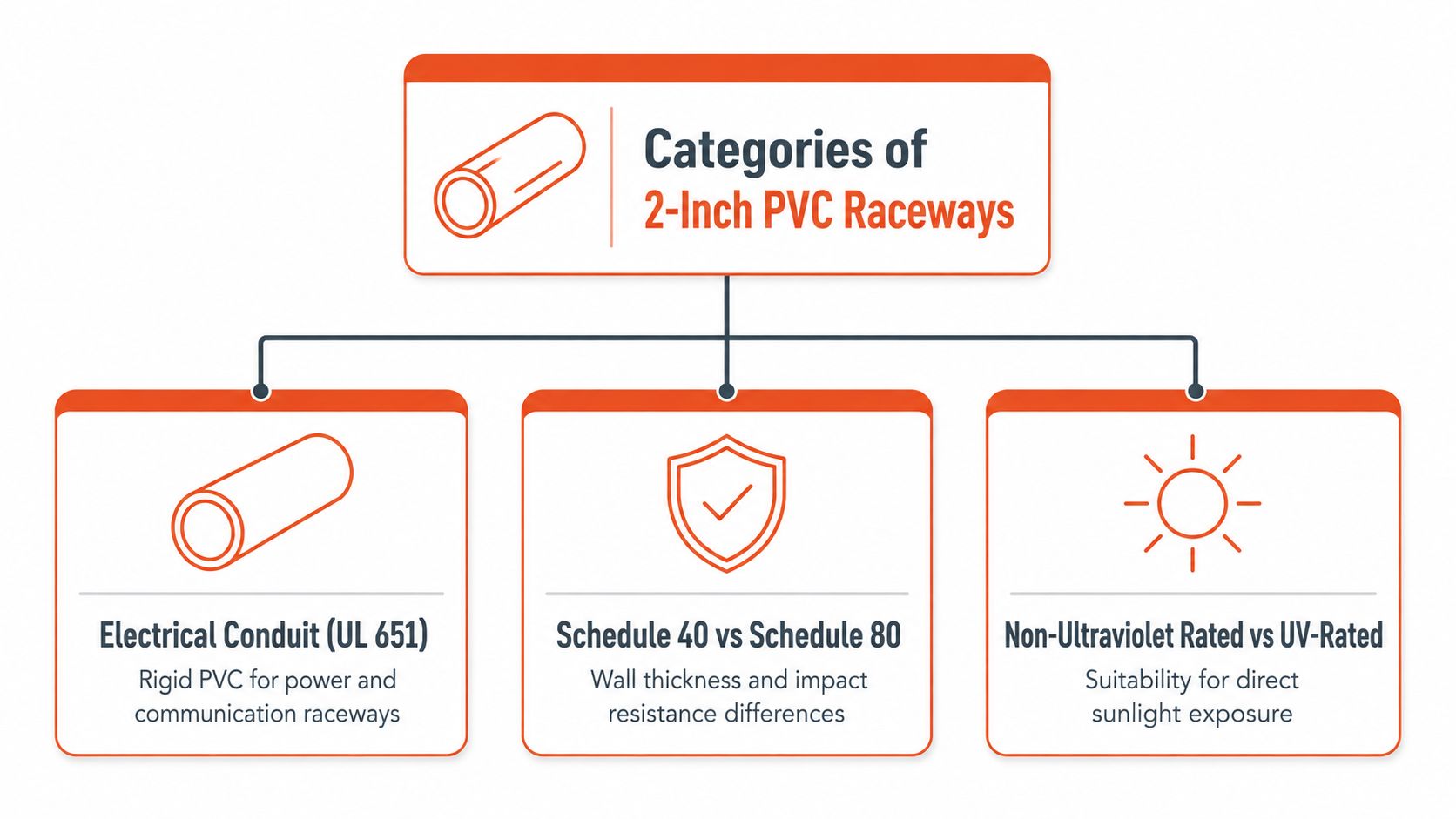
A diagram outlining the categories of 2-inch PVC raceways, including standards, wall thickness, and UV ratings.

Rigid PVC conduit

Standard rigid PVC conduit is the familiar nonmetallic raceway used for underground, encased, and selected above-ground electrical installations. Schedule 40 generally prioritizes a larger usable bore within the same nominal size, while Schedule 80 uses a thicker wall for greater resistance to impact and crushing. Electrical products are commonly specified to recognized requirements including UL 651, NEMA TC-2A, and ASTM 1784, but the governing requirement must come from the project specification and applicable jurisdiction.

Schedule 40 is often a sensible choice where concrete encasement or burial provides the primary protection. Schedule 80 becomes more appropriate where the exposed portion could receive physical impact. The transition between those products should be planned in the BOM rather than improvised at the jobsite.

PVC-coated rigid steel conduit

PVC-coated rigid steel conduit combines a metallic raceway core with a corrosion-resistant exterior coating. It belongs in a different product category from all-plastic PVC conduit and may be selected for corrosive industrial environments where the project requires metallic raceway construction plus protective coating.

One published 2-inch PVC-coated rigid steel product lists a 2.46-inch outside diameter, 2.08-inch inside diameter, 0.19-inch wall thickness, and 9.91-foot length (published PVC-coated rigid steel product data). Those dimensions show why the phrase “2-inch conduit” alone can't support a reliable fill or clearance decision.

Flexible nonmetallic raceway

ENT provides flexibility where routing around equipment, structural details, or short connections makes rigid raceway inconvenient. A published 2-inch Carlon ENT product lists a 2.030-inch nominal inner diameter and 2.375-inch outer diameter (published ENT product dimensions). Its installation requirements and permitted applications must be checked separately from those for rigid PVC.

Comparing Schedule 40 and Schedule 80 Dimensions

Schedule 40 and Schedule 80 share the same nominal trade size and commonly share the 2.375-inch outside diameter, but their wall geometry is materially different. For a 2-inch Schedule 80 product, published manufacturer data lists an inside diameter of about 1.881 inches and a wall thickness of 0.218 inch. Schedule 40 has the thinner wall and therefore the larger usable bore (Wheatland PVC conduit specification data).

Attribute Schedule 40 PVC Schedule 80 PVC
Nominal trade size 2 inch 2 inch
Outside diameter 2.375 inches 2.375 inches
Inside diameter About 2.047 inches About 1.881 inches
Wall thickness Thinner than Schedule 80 0.218 inch
Usable conductor space Larger bore Smaller bore
Typical selection logic Burial or encasement where protection is provided Exposed areas requiring greater impact resistance

The choice is therefore not just “light duty versus heavy duty.” It is a balance between mechanical protection and conductor capacity. Schedule 80 can be the correct specification for an exposed plant-floor riser or another location vulnerable to impact, but its thicker wall reduces the space available for conductors. Using it throughout a run where the environment doesn't require that protection can make the pull harder without solving a real design problem.

Mechanical strength versus working space

Published product information commonly shows around 1,400 pounds of crush strength for both 2-inch Schedule 40 and Schedule 80 variants (PVC electrical conduit market and product context). That benchmark shouldn't replace the manufacturer's current data sheet, but it reinforces an important point: selection involves more than a simple strength ranking.

A project may need Schedule 80 at an exposed transition and Schedule 40 in a protected underground segment. That arrangement preserves a larger bore where it helps installation while reserving the thicker product for the area exposed to damage. Confirm the transition fittings, solvent-welding requirements, and local inspection expectations before releasing the material.

The most expensive conduit error is often not the price difference between schedules. It's discovering after delivery that the selected schedule won't accommodate the planned conductor set or route.

Navigating NEC Conduit Fill and Pulling Tension

NEC Chapter 9 conduit fill rules establish the maximum portion of the raceway interior that conductors may occupy. For one conductor, the limit is 53%; for two conductors, 31%; and for more than two conductors, 40% (NEC Chapter 9 PVC fill guidance). These percentages apply to the actual inside area, not the nominal trade-size name.

A practical calculation follows this sequence:

  1. Identify the exact conduit series and inside diameter.
  2. Determine the cross-sectional area of every conductor, including equipment grounding conductors where installed.
  3. Add the conductor areas.
  4. Compare the result with the applicable fill limit.
  5. Review ampacity, bend geometry, pulling length, and termination space separately.

The fill table answers “does the conductor area fit?” It doesn't fully answer “can the crew pull the conductors without damaging them?”

Why a compliant pull can still fail in practice

Friction rises when conductors press against each other and the raceway wall. Long straight runs, multiple bends, tight sweeps, and changes in elevation can turn a mathematically acceptable installation into a difficult field operation. Schedule 80's smaller bore adds another constraint, even though the nominal size remains 2 inch.

A run near the 40% maximum may pass the fill calculation yet require excessive pulling force or create unacceptable stress at bends. The installation team should evaluate whether upsizing the raceway, dividing the circuit into multiple raceways, revising the route, or adding an accessible pull point will reduce risk. Moving to 2.5-inch or 3-inch conduit can be a practical design decision when the conductor package and route make a 2-inch pull marginal, but the final selection belongs to the engineer and applicable code requirements.

Use the exact conductor insulation type and manufacturer's dimensions when verifying a THHN or THWN package. A PVC conduit fill reference can support the review, but it shouldn't be treated as permission to ignore the selected product's data sheet or the authority having jurisdiction.

A 90-degree change also needs more than a nominal angle on the drawing. The bend radius, total route geometry, and access for pulling all affect installation effort. Use the project-specific fitting and route details when selecting a 90-degree conduit elbow, and don't finalize the raceway solely from a conductor-count lookup.

Essential Fittings and Installation Components

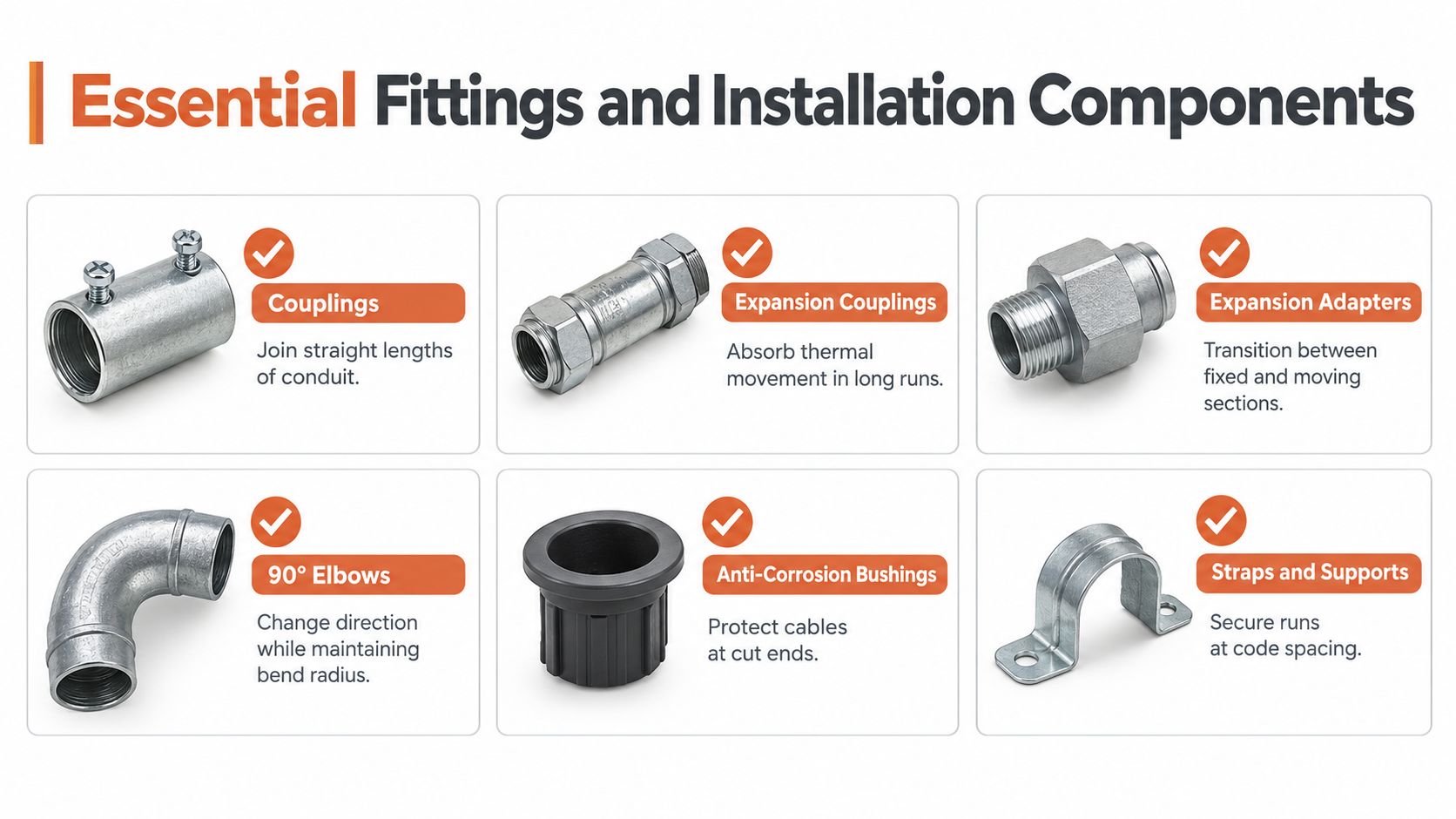
Straight conduit sticks rarely represent the complete material requirement. A missing coupling, transition adapter, or expansion fitting can stop a crew even when the primary raceway has already arrived.A visual guide showing various essential conduit fittings and installation components like couplings, elbows, and straps.
 

Build the fitting package with the conduit

Couplings join straight lengths and must match the conduit system. Don't mix fitting dimensions casually between product families, particularly when the specification requires a particular schedule or listing.

Sweep bends are generally preferable to sharp directional changes where the route permits. They provide a more manageable path for conductors, while a compact elbow may suit a constrained connection. The correct choice depends on the conductor size, pulling method, enclosure entry, and available space.

Expansion fittings accommodate movement on exposed outdoor runs and at transitions between sections with different restraint conditions. Include the required expansion couplings or adapters in the original BOM, rather than assuming they can be added after the raceway is installed.

Protect the cable at transitions

PVC raceway often connects to metallic boxes, cabinets, panel enclosures, or equipment. That transition may require adapters, bushings, locknuts, grounding or bonding components where applicable, and protection at cut ends. The fitting must suit both the raceway material and the enclosure entry.

A practical BOM review should identify:

  • Straight joints: Couplings and solvent-compatible joining materials.
  • Direction changes: Sweep bends and elbows selected for the route.
  • Movement control: Expansion components for locations subject to thermal movement.
  • Enclosure transitions: Adapters, connectors, bushings, and locknuts.
  • Support hardware: Straps, clamps, and approved support components.
  • Spare installation items: End protection and materials needed to prevent debris from entering the raceway.

The schedule of the fitting must match the schedule of the conduit unless the product documentation specifically permits the combination. A useful PVC conduit fittings category can help organize the accessory portion of a material request, but the project specification remains the controlling document.

Installation Considerations and Burial Depths

The warehouse label becomes a field problem at the trench. A crew can install the correct nominal raceway and still fail inspection if it measures cover from the wrong reference point or uses the wrong product at an exposed riser.

NEC Table 300.5 generally requires 18 inches of cover for PVC conduit in typical underground locations. Cover is measured from the finished grade to the top of the conduit, not to the trench bottom or the conduit centerline (PVC conduit burial-depth guidance). The required depth can change with the location, surface protection, traffic exposure, and local amendments, so the inspector and design documents should be consulted before excavation.

Plan the underground section from the top of the raceway

For a 2-inch system, the conduit outside diameter occupies space below the required cover. The trench design should account for the complete assembly, including bedding, conduit, warning or identification requirements where specified, and backfill that won't damage the raceway.

Schedule 40 may suit a protected buried section, while Schedule 80 may be required where the raceway emerges from grade or becomes exposed to physical damage. That change should be shown on the drawings and reflected in the takeoff. It shouldn't be left to the installer to discover after the trench is open.

Treat above-ground sections as a separate exposure

Above grade, the team needs to review support, UV suitability, impact exposure, enclosure entries, and the protection of conductors at every opening. A product intended for a protected location may not be appropriate for direct sunlight or a plant area where carts, tools, or equipment can strike the raceway.

Before backfilling, verify the installed route against the approved drawings and inspection requirements. Record transitions, pull points, and changes in schedule. Those records help maintenance teams later, particularly when a facility adds circuits or troubleshoots a buried feeder.

Field check: Measure cover to the top of the conduit, verify the schedule at every exposed transition, and obtain local approval before the trench disappears.

Cross-References to Alternative Raceway Systems

PVC is useful, but it isn't a universal raceway. A specification that calls for 2-inch PVC should still be challenged against the environment, equipment requirements, and grounding strategy.

EMT may be preferable for indoor exposed routing where a metallic raceway provides a compact installation and the facility's design accepts it. It requires different connectors, tools, handling practices, and bonding considerations than PVC, so a substitution affects more than the straight conduit line item.

Rigid metal conduit is a candidate where the route faces substantial physical abuse or where the engineered system requires a durable metallic raceway. It can also change labor, threading, fitting, corrosion, and support requirements. The estimator should compare the complete installed system rather than comparing the price of one length of PVC with one length of metal conduit.

Situations that justify a design review

PVC may be the wrong selection when the route is exposed to severe impact, when the project's temperature and product-rating requirements exceed the selected PVC system, or when the facility requires a continuous metallic equipment grounding path. Those conditions don't automatically dictate one replacement product, but they do require an engineering review.

Flexible metal conduit can solve a different problem, such as equipment connections where vibration or movement makes a rigid raceway impractical. It also introduces its own fitting, grounding, protection, and permitted-use requirements.

The key procurement question is not “what is the cheapest 2-inch raceway?” It is “which complete raceway system satisfies the environment, conductor route, compliance documents, and installation method?” A substitution should include the conduit, fittings, supports, transition hardware, and documentation needed for approval.

Quick-Reference Sizing and Procurement Guide

A reliable purchase package turns the nominal label into a controlled specification. Before releasing a BOM, have the estimator, engineer, and procurement lead verify the raceway against the actual route and conductor package.
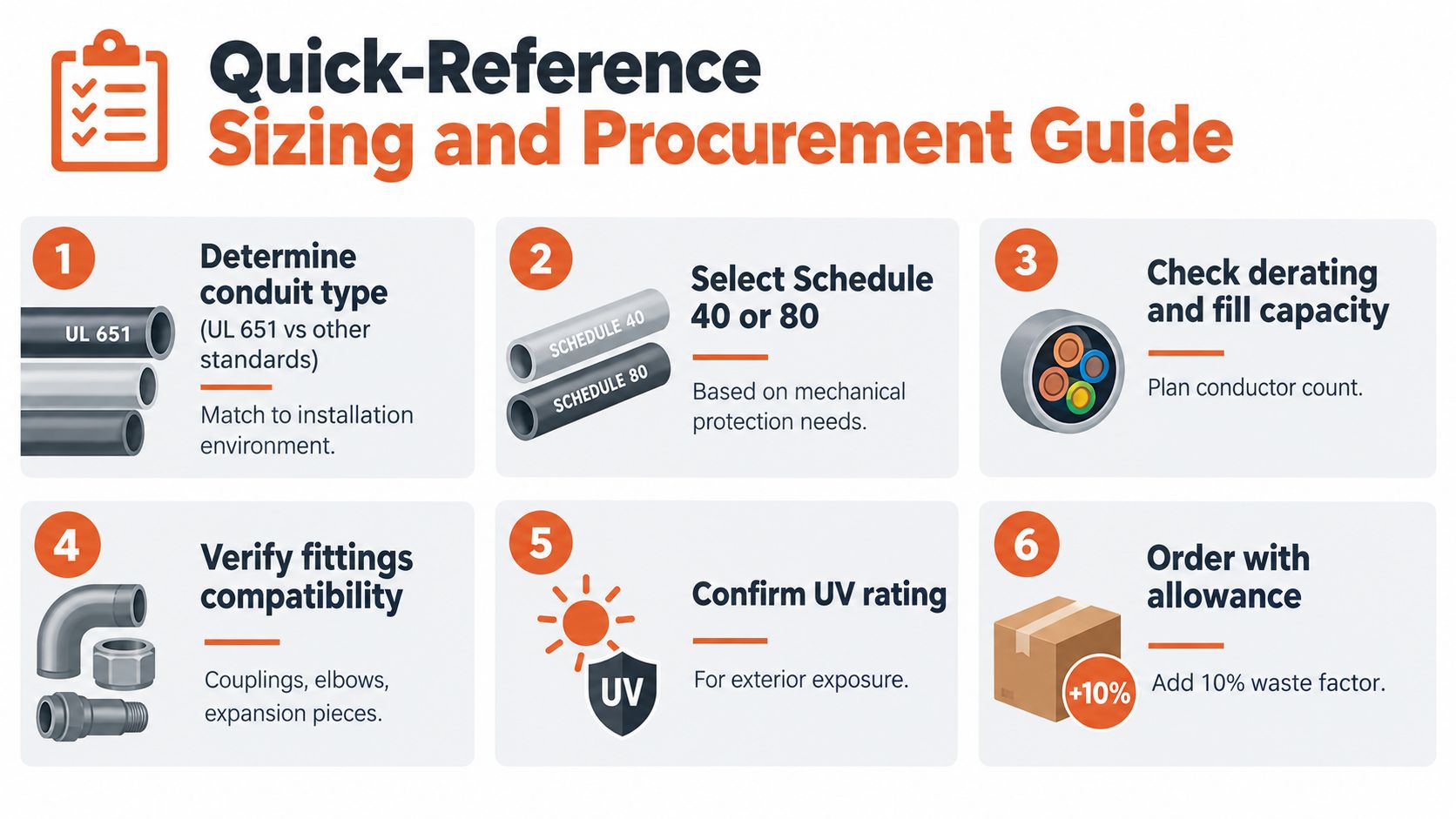
A six-step quick-reference guide for sizing and procuring electrical PVC conduits for construction projects.

Review the technical selection

  • Identify the product family: Confirm whether the request is rigid electrical PVC, PVC-coated rigid steel, ENT, or another raceway type.
  • Confirm the listing and standard: Check the required UL, NEMA, ASTM, or project-specific documentation before accepting an alternative.
  • Select the schedule: Use Schedule 40 or Schedule 80 according to physical protection needs, not habit.
  • Verify usable bore: Compare the manufacturer's inside diameter with the conductor areas and applicable fill limit.
  • Review the route: Account for bends, sweeps, pull points, elevation changes, and the planned pulling method.
  • Check the environment: Confirm burial, sunlight, moisture, impact, temperature, and enclosure-transition requirements.
  • Complete the fitting BOM: Include couplings, elbows, expansion components, adapters, bushings, supports, and end protection.
  • Confirm documentation: Gather product data, submittals, compliance information, and approved-alternative records before delivery.

The infographic includes an allowance for 10% waste, but any project-specific allowance should be set by the estimator from the route, cut plan, and supplier packaging rather than applied blindly. Lead time also deserves attention. Conduit may be available while a particular elbow, expansion fitting, transition, or listed accessory is not.

Use this video as a visual supplement to the written review, not as a replacement for the project specification, current code requirements, or manufacturer instructions.

For industrial and mission-critical work, the procurement review should also identify approved alternatives before a shortage occurs. A distributor can help compare manufacturer documentation, coordinate substitutions, consolidate fittings with the conduit package, and keep a delayed accessory from holding up an otherwise complete installation.


For 2-inch PVC conduit projects, ATEK Distribution can support BOM review, product sourcing, compliance documentation, approved alternatives, and hard-to-source fittings or raceway components. Visit ATEK Distribution to request project-specific procurement assistance and keep your electrical installation moving.

Push-In Connectors vs Wire Nuts: Which Should You Use?

ComparisonWire connectorsNEC 110.14

Push-In Connectors vs Wire Nuts: Which Should You Use?

A practical comparison of push-in wire connectors and twist-on wire nuts for electricians and contractors: conductor types, code compliance, reliability, box space, labor and cost.

Short answer

Push-in connectors are faster to install and easier to inspect than wire nuts, and they are the better choice for solid copper conductors in crowded boxes. Wire nuts cost less per splice, handle a wider mix of wire sizes and stranded conductors, and remain the safer default when you are joining unlike conductors or fixture leads. Both are UL-listed splicing connectors, and both meet the NEC when you install them within their listing.

Key takeaways

  • Solid copper in a crowded box: push-in connectors are faster and more consistent.
  • Stranded wire, fixture leads or mixed sizes: use wire nuts, or lever connectors listed for stranded wire.
  • Both are tested to UL 486C. Code compliance depends on staying inside the listing (NEC 110.3(B)).
  • Connectors do not count toward box fill under NEC 314.16.
  • Aluminum needs a connector marked for aluminum. Standard push-ins and wire nuts are copper only.

This guide from ATEK Distribution compares push-in connectors and wire nuts on the points that decide a real installation: conductor type, speed, reliability, reuse, box space and cost. If you are also weighing lever connectors, see our WAGO vs wire nuts vs Ideal comparison. That article covers lever nuts. This one covers push-in connectors only.

Push-In Connectors vs Wire Nuts at a Glance

Push-in connectors vs twist-on wire nuts
FactorPush-in connectorsTwist-on wire nuts
How it grips the wireInternal spring clamp presses the conductor against a metal contact barTapered metal coil threads onto the twisted conductors
Install methodStrip to the gauge, push straight inStrip, hold conductors together, twist until tight
Solid copperYes, what they are designed forYes
Stranded wireLimited. Many models are solid-only; some accept stranded. Check the listingYes, including solid-to-stranded combinations within the listed range
Visual checkClear housings on many models show the wire seatedNo. You rely on technique and a tug test
Skill dependenceLow. Correct strip length is the main variableHigher. Pre-twist, torque and conductor alignment all matter
ReuseUsually single-use or limited reuse (per manufacturer)Generally treated as single-use once removed
Size in the boxCompact, flat, stack neatlyBulkier, especially larger sizes
Cost per spliceHigherLower
StandardUL 486C (splicing wire connectors)UL 486C (splicing wire connectors)

Swipe the table sideways to see every column.

Which Connector Should You Use? A 30-Second Decision Guide

Work down the list and stop at the first question that applies to your splice:

  1. 1. Are any conductors aluminum?
    Connector marked for aluminumNever a standard copper-only connector
  2. 2. Is it a damp, wet or underground splice?
    Sealed, gel-filled connectorListed for the location (UL 486D)
  3. 3. Will the connection be reopened often?
    Lever connectorDesigned to open and close
  4. 4. Stranded wire, fixture leads or mixed sizes?
    Twist-on wire nutWithin the combinations on the package
  5. 5. Solid copper, especially in a crowded box?
    Push-in connectorFastest, most consistent, easy to inspect

What Is a Push-In Wire Connector?

A push-in wire connector is a small splicing connector with one port per conductor. Inside each port, a spring clamp holds the stripped wire against a metal contact bar that links all the ports together. You strip the conductor to the length marked on the connector, push it in until it stops, and the connection is made. Common examples include the WAGO 2773 series and the Ideal In-Sure line.

Push-in connectors come in 2, 3, 4, 5 and 8-port versions. Because each wire has its own port, you can add or check one conductor without disturbing the others.

What Is a Wire Nut?

A wire nut, also called a twist-on wire connector, is a plastic shell with a tapered metal spring coil inside. You hold the stripped conductors side by side and twist the nut clockwise. The coil draws the conductors together and holds them under pressure. Wire nuts have been the standard splice in North American building wire for decades, and most electricians can install them quickly and reliably.

Wire nut sizes are color-coded, but the color for a given wire range is set by each manufacturer. Always read the conductor combinations printed on the packaging rather than going by color alone.

Push-In vs Wire Nuts: The Key Differences

1. Conductor type: solid vs stranded

This is the most important difference. Push-in connectors are built around solid copper conductors. A stranded wire can splay when pushed into the port, and some strands may not seat under the clamp. Some push-in models are listed for certain stranded conductors, but many are not. If the listing does not name stranded wire, do not use it on stranded wire.

Wire nuts handle stranded conductors, and they handle solid-to-stranded combinations such as a solid branch-circuit conductor joined to a stranded fixture lead, as long as the combination is on the manufacturer’s chart. For light fixtures, ceiling fans and many appliances with stranded pigtails, wire nuts or lever connectors are usually the better fit.

2. Installation speed and consistency

Push-in connectors are faster in most boxes. There is no pre-twisting and no judging how tight is tight enough. The result is also more consistent across a crew, because the spring sets the contact force rather than the installer’s hand. On large jobs with hundreds of device boxes, that consistency matters as much as the time saved.

Wire nuts take slightly longer per splice, and quality depends more on the person installing them. A well-made wire nut splice is very reliable. A rushed one, with one conductor sitting short of the others, is one of the most common causes of loose connections found during service calls.

3. Inspection and troubleshooting

Many push-in connectors have transparent housings, so you or an inspector can see that each conductor is fully seated. Some also include a test port for a meter probe. With a wire nut you cannot see inside the splice, so the check is a firm tug on each conductor after installation.

4. Reuse and removal

Neither type is designed for repeated reconnection. Some push-in connectors allow removal with a twist-and-pull motion, and the manufacturer may permit limited reuse. Others are single-use. Wire nuts can be unscrewed, but once the spring has been loaded and the conductors disturbed, the practical rule is to re-strip the conductors and use a new connector. If you expect to reopen a connection often, for example in control panels or fixture change-outs, a lever connector is the better tool.

5. Box space

Push-in connectors are smaller and flatter than most wire nuts, so crowded device boxes are easier to close. Box-fill calculations under NEC 314.16 count conductors, clamps, support fittings, devices and equipment grounding conductors, not the splicing connectors themselves. Push-ins do not change the calculated fill. They do leave more physical room for the device and folded conductors, which reduces strain on terminations. For deep and extra-capacity boxes, see our electrical boxes range.

6. Cost

Wire nuts cost less per splice. Push-in connectors cost more per unit, but can lower total installed cost on labor-heavy jobs. For a contractor, the right comparison is material plus labor per box, not material alone. ATEK can quote both in contractor quantities so you can run that comparison on your own job.

Are Push-In Connectors as Safe as Wire Nuts?

Yes, when they are used within their listing. Both push-in connectors and twist-on wire nuts are tested to UL 486C, the standard for splicing wire connectors. Problems with either type almost always come from use outside the listing, such as stranded wire in a solid-only push-in, the wrong strip length, conductor combinations not on the chart, or aluminum conductors in a copper-only connector.

The NEC requirements that apply are the same for both:

  • NEC 110.3(B): install listed equipment according to its listing and instructions, which includes the wire range and conductor type printed on the packaging.
  • NEC 110.14: terminations and splices must be identified for the conductor material, and conductors of dissimilar metals must not be mixed unless the connector is identified for it.
  • NEC 300.14: leave enough free conductor at each box (generally at least 6 inches) for splicing and future work.

Code sections are cited from the NEC as published. Confirm the edition your jurisdiction enforces. Minnesota adopted the 2026 NEC on August 17, 2026; see our Minnesota 2026 NEC changes summary.

Push-In Connectors vs Backstab Receptacles: Not the Same Thing

Many people searching “push-in vs wire nuts” are really thinking about backstabbed receptacles, where the conductor is pushed into a hole in the back of an outlet. That is a device terminal, not a splicing connector. Backstab terminals on many receptacles accept only 14 AWG solid copper, and many electricians prefer the side screw terminals or back-wire clamp terminals for better contact. Standalone push-in connectors are a different product, listed to a different standard, and should not be judged by backstab experience.

When to Use Push-In Connectors vs Wire Nuts

Choose push-in connectors for

Solid copper, speed and inspection

  • Solid copper branch-circuit splices in new construction and remodels
  • Pigtailing devices in crowded boxes
  • Large residential or commercial jobs where speed and crew consistency reduce labor cost
  • Work where an inspector or client values a visible, checkable connection

Choose wire nuts for

Stranded leads, mixed sizes and budget

  • Stranded conductors, and solid-to-stranded splices within the listed combinations
  • Light fixtures, fans and appliances with stranded leads
  • Mixed wire sizes outside a push-in connector’s range
  • Budget-driven work where material cost per splice matters most

For connections you may need to reopen, or for fine-stranded control wiring, choose a lever connector instead. Our guide Are WAGO connectors code approved? explains the listing and code questions for lever types.

Special Cases: Aluminum, Grounding and Wet Locations

Aluminum wire

Standard push-in connectors and standard wire nuts are for copper conductors only. Splicing aluminum branch-circuit wiring, or joining aluminum to copper, requires a connector specifically identified for that use and marked for aluminum, such as an AL/CU-rated twist-on connector or a purpose-built aluminum-to-copper pigtail connector. Check the marking before you buy. Using a copper-only connector on aluminum is a known fire risk, and the U.S. Consumer Product Safety Commission publishes guidance on repairing aluminum branch-circuit wiring.

Equipment grounding conductors

Green twist-on connectors, often with a hole in the tip for a pigtail, are made for splicing equipment grounding conductors. Push-in connectors can also join grounding conductors when the listing allows. Either way, the grounding splice must stay continuous if a device is removed, which is why grounds are pigtailed rather than daisy-chained through device terminals.

Damp, wet and underground splices

Neither a standard push-in connector nor a standard wire nut is made for wet locations or direct burial. Outdoors, in landscape lighting, irrigation controls and underground boxes, use sealed connectors filled with gel or silicone that are listed for the location, typically to UL 486D.

Temperature and voltage ratings

Most general-purpose push-in and twist-on connectors are rated for building-wire voltages, commonly 600 V, with a maximum temperature rating printed on the package. The termination temperature limits in NEC 110.14(C) still apply to the circuit, so the connector rating does not raise the ampacity you may use.

How to Install Push-In Connectors and Wire Nuts Correctly

Installing a push-in connector

  1. De-energize and verifyTurn off the circuit and confirm it is de-energized with a tester.
  2. Check the listingConfirm the conductor size, type (solid or stranded) and material are on the connector’s listing.
  3. Strip to the gaugeStrip the conductor to the length shown by the strip gauge on the connector. Too short leaves poor contact; too long leaves bare copper exposed.
  4. Push straight inKeep the conductor straight and push it firmly into the port until it bottoms out.
  5. Look and tugLook through the housing, if clear, to confirm the conductor is fully seated, then tug each conductor to confirm it is held.
  6. Fold in neatlyFold the conductors into the box without placing strain on the connector.

Installing a twist-on wire nut

  1. Pick the right sizeRead the conductor combinations on the package; do not go by color alone.
  2. Strip and alignStrip to the length on the package and hold the conductors side by side with the ends even.
  3. Twist until tightTwist the connector clockwise until the conductors begin to twist together below it and it will not turn further.
  4. Tug testPull each conductor firmly. If any moves, remove the nut, re-strip and start again with a new connector.
  5. Check for bare copperNo bare conductor should show below the skirt of the connector.

Common Mistakes That Cause Connector Failures

  • Wrong strip length. Too short and the clamp bites insulation; too long and bare copper sits outside the housing.
  • Stranded wire in a solid-only push-in. Strands splay and only some make contact.
  • Going by wire nut color alone. Colors differ between brands; the combination chart is what counts.
  • One conductor short of the others in a wire nut splice, so it is held by the coil tip only.
  • Reusing a connector that the manufacturer lists as single-use.
  • Copper-only connectors on aluminum, or standard connectors in wet locations.
  • Skipping the tug test on either type.

Safety note: always de-energize and verify before splicing. Electrical work is regulated in most jurisdictions and may require a licensed electrician and a permit. This guide is general information, not a substitute for the code edition you work to, the manufacturer’s instructions or your inspector.

Buying Push-In Connectors and Wire Nuts for Your Project

ATEK Distribution is a Minneapolis, Minnesota electrical distributor supplying contractors, facility teams and government buyers nationwide since 2018. We are a certified Service-Disabled Veteran-Owned Small Business (SDVOSB), a GSA contract holder (47QSMS25D00A1) and BBB accredited. We source wire connectors, wire, cords and cable, electrical boxes and fasteners and hardware in contractor quantities, and can match connector types to the conductor schedule on your drawings.

Need connectors for a whole job?

Send quantities and conductor sizes. We respond within one business day.

Frequently Asked Questions

Are push-in connectors better than wire nuts?

Push-in connectors are better than wire nuts for solid copper splices in crowded boxes, because they install faster, give a more consistent connection and can be visually checked. Wire nuts are better for stranded wire, fixture leads and mixed conductor sizes. Neither is better in every case. Choose by conductor type first, then by speed and cost.

Are push-in wire connectors code compliant?

Push-in wire connectors are code compliant when they are UL-listed and installed within their listing. The NEC requires listed equipment to be used according to its instructions (110.3(B)) and splices to be identified for the conductor material (110.14). Using a solid-only push-in on stranded wire, or on aluminum, would not comply.

Can you use push-in connectors on stranded wire?

Push-in connectors can be used on stranded wire only if the manufacturer lists that model for stranded conductors. Many push-in models are rated for solid copper only. For stranded wire, the safer choices are wire nuts or lever connectors listed for stranded conductors.

Are push-in connectors reusable?

Push-in connectors are generally not intended for repeated reuse. Some models allow removal with a twist-and-pull and limited reuse per the manufacturer’s instructions; others are single-use. If a connection will be opened regularly, use a lever connector.

Do push-in connectors fail more often than wire nuts?

Push-in connectors do not fail more often than wire nuts when both are installed correctly within their listing. Most failures with either type come from installation errors, such as the wrong strip length, unlisted conductor combinations or stranded wire in a solid-only connector. Push-ins reduce technique-related errors because the spring sets the contact force.

Do wire connectors count toward box fill?

Wire connectors do not count toward box fill under NEC 314.16. The calculation counts conductors, internal clamps, support fittings, devices and equipment grounding conductors. Smaller push-in connectors still help in practice, because they leave more physical room in the box.

Can you use push-in connectors and wire nuts in the same box?

Yes. Nothing in the NEC stops you using push-in connectors on the solid branch-circuit splices and wire nuts on the stranded fixture leads in the same box, as long as each connector is used within its own listing. Many electricians do exactly that.

Can push-in connectors be used on 12 AWG and 20-amp circuits?

Yes, if 12 AWG is inside the connector’s listed wire range, which it is for most general-purpose push-in connectors. The connector must also be rated for the circuit voltage. Check the wire range and conductor count printed on the package before you use it.

References and Standards

  1. NFPA 70, National Electrical Code: 110.3(B), 110.14, 300.14 and 314.16. nfpa.org
  2. UL 486C, Splicing Wire Connectors.
  3. UL 486D, Sealed Wire Connector Systems.
  4. U.S. Consumer Product Safety Commission, guidance on repairing aluminum wiring. cpsc.gov
  5. Manufacturer instructions and listings for the specific connector, including wire range, conductor type and reuse limits.

About the ATEK Distribution Technical Team

ATEK Distribution is a veteran-owned electrical supply distributor in Minneapolis, Minnesota, supplying contractors, facility teams and government buyers since 2018. Our team sources wire, connectors, boxes and distribution equipment for commercial, industrial and federal projects every day.

Last reviewed September 29, 2026. Found an error? Tell us and we will correct it.

Keep reading

Related Electrical Guides

Connectors

WAGO vs Wire Nuts vs Ideal

Lever connectors compared with twist-on wire nuts on vibration, code compliance, cost and reuse.

Read the guide →

Code compliance

Are WAGO Connectors Code Approved?

The UL listings and NEC sections that make lever connectors legal, and where they are not.

Read the guide →

Code updates

Minnesota 2026 NEC Changes

What changed when Minnesota adopted the 2026 NEC, and when the new rules apply to your job.

Read the guide →

Request a quote

Get Contractor Pricing on Wire Connectors

Send your quantities and conductor sizes, or the conductor schedule from your drawings. We quote push-in, twist-on and lever connectors side by side and respond within one business day.

ATEK Has the Fasteners and Connectors You Need

They say you can never be too rich, too fit…or have too many connectors and fasteners. Or something like that.

Connecting two or more electrical components or parts is just about as basic a need as any electrical contractor can have. And to support our amazing contractors, ATEK offers an absolutely massive selection of different kinds of fasteners and connectors. So many in fact that we haven’t been able to get everything up on the website yet. But not to worry.

electrical fasteners and connectrors

ATEK is at its best when we’re out there running down those hard-to-find components and accessories you need to get your project done. Call us anytime you don’t find exactly what you need in our online store. Heck, call us up and talk with our expert consultants and we can make sure what you’re getting IS the right thing for your project. We often have knowledge of new products that might just get your job done better and faster.

ATEK carries electrical fasteners and connectors by brands like:

Hammond, Burndy, and LH Dottie

Smart Circuit Breakers by Leviton: Available Now on ATEK Distrubtion.com


The circuit breakers in most homes aren’t smart, but they are intelligent enough to cut the power if the system experiences an overload. The problem is that these peak events ensure that homes are wired to run at maximum capacity at all times.


A smart circuit breaker empowers a home owner to actually do something about their energy consumption in real time. Controlled from a mobile app, homeowners are able to automate the process of shifting energy from unused appliances to functioning ones, or they can actually do it themselves.

For our contractors, this is a huge value add when convincing a client to upgrade their home’s electrical infrastructure. Telling them they can control their home’s electrical system with the mobile phone is certain to be a game changer.

View our circuit breaker range or, better yet, call us and let us give you the rundown on how these relatively new devices can benefit both residential and commercial clients.

Datacomm Products from ATEK Distribution


ATEK Distribution carries a full line of DataComm products from industry leading manufacturers like Burndy, Mersen, and Milbank. These products can be purchased in a full bundle, or smaller quantities. As prices fluctuate, call us at (651) 900-1476 and we will get your order placed right away.
DataComm products form the heart of your network. Your DataComm infrastructure moves the information that runs your business.
ATEK offers an extensive range of DataComm products such as link connectors, cabling, racks, and networking devices for moving your data. With our extensive network of suppliers, we offer the flexibility to get exact match or equivalent products so your projects don’t stall.
ATEK Distribution is constantly looking to expand our product lines, so if you have a line you want and don’t see it on our website, please don’t hesitate to call directly at (651) 900-1476, and we will work to get you what you need.

ATEK Now Carries American Fittings Corporation Products

American Fittings Corporation Logo

AMERICAN FITTINGS (AMFICO) has lead the industry with integrated design, engineering, manufacturing, and production of quality USA made electrical fittings products for more than 75 years. They are the leading US manufacturer and developer of BAA compliant industrial electrical fittings. And ATEK carries a full line of their products.

They recently expanded their equipment and facilities by 500% in capacity and are committed to manufacturing the NEXT GENERATION of products in the USA. AMFICO is uniquely and strategically positioned to service all your electrical fitting requirements.

Their motto? Think American.

From their site:

“Products Designed with You in Mind – We guarantee that buying our fittings reduces your installation costs, and improves every application. From our unique cord grip kits to our reengineered Myers hubs no manufacturer does it better! With our commitment to fully integrated manufacturing and design your source and support is All-American.”

“We feature 6 FULLY stocked regional warehouses and AMFICO’s National Network of ADP Signature Electrical Distributors providing readily available products throughout the country.”

Call ATEK today and order quality products from American Fittings Corporation. As prices fluctuate, call us at (651) 900-1476, and we will get your order placed right away.