
A conductor package arrives at the warehouse, and the purchase order says only “2-inch PVC conduit.” The field team assumes the raceway has a 2-inch bore, the estimator checks a familiar fill table, and the problem appears later when the actual product has a smaller usable interior or the pull becomes unmanageable around several bends.
That mistake starts with the label. 2-inch PVC conduit is a nominal trade size, not a promise of a 2-inch inside diameter. Schedule, wall thickness, product type, conductor insulation, bend geometry, and installation environment all affect whether the selected raceway will fit the conductors and remain practical to install. The following guide addresses both code-based sizing and the physical realities that can create damaged insulation, failed inspections, and procurement delays.
Table of Contents
- Understanding 2-Inch PVC Conduit Basics
- Categories of 2-Inch PVC Raceways
- Comparing Schedule 40 and Schedule 80 Dimensions
- Navigating NEC Conduit Fill and Pulling Tension
- Essential Fittings and Installation Components
- Installation Considerations and Burial Depths
- Cross-References to Alternative Raceway Systems
- Quick-Reference Sizing and Procurement Guide
Understanding 2-Inch PVC Conduit Basics
A trade size identifies a standardized product category. It doesn't necessarily describe the exact dimension available to conductors. In North American PVC piping, 2-inch nominal conduit has a 2.375-inch outside diameter, while the inside diameter changes with wall thickness and schedule. Published dimensional references list about 2.047 inches inside diameter for Schedule 40 and about 1.881 inches for Schedule 80, a difference of roughly 8% in usable inside diameter between the two variants (published PVC size dimensions).
That distinction matters at three points in a project:
- Estimating: A conduit allowance based only on the trade-size label can overstate usable space.
- Engineering: Conductor fill must use the actual raceway interior and the applicable conductor areas.
- Installation: A compliant fill calculation doesn't automatically guarantee an easy pull through a long run with bends.
A procurement description such as “2-inch PVC” is incomplete. The material request should identify the electrical raceway listing, schedule, product series, intended environment, and fitting compatibility. Electrical conduit isn't interchangeable with plumbing pipe just because both products use terms such as Schedule 40 or Schedule 80.
Why the outside diameter stays relevant
The common outside diameter lets manufacturers produce compatible fittings for the nominal raceway family. The interior is where the procurement risk appears, because thicker walls consume usable bore while preserving the same nominal outside dimension.
This is why a purchase order, submittal, or BOM should carry the exact product designation rather than relying on a warehouse shorthand. A project team reviewing conduit and raceway as core electrical infrastructure should verify the product data before approving substitutions.
Practical rule: Size the raceway from the actual inside diameter and conductor data, then confirm that the selected product and fittings match the specification.
Categories of 2-Inch PVC Raceways
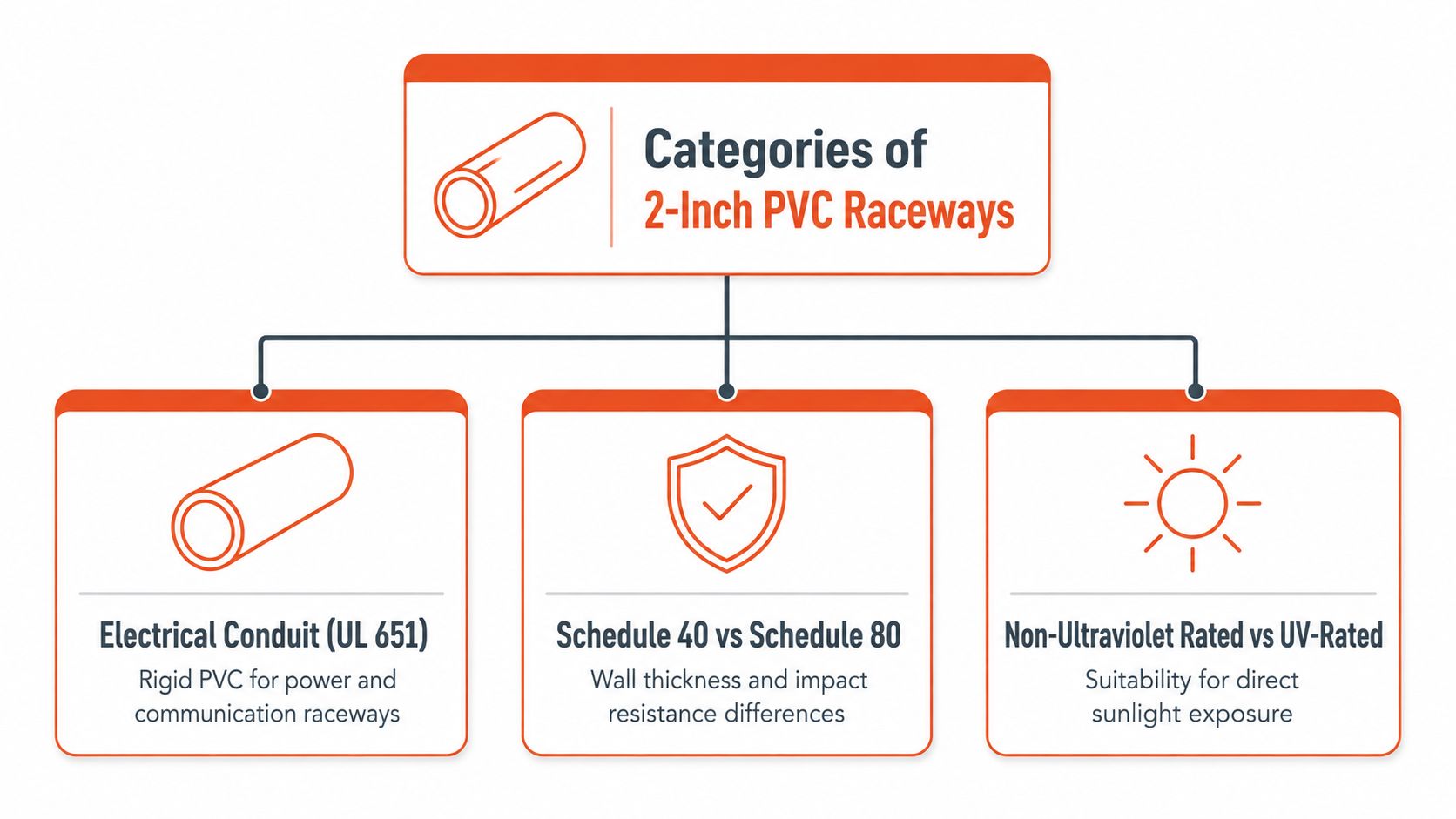
The phrase “2-inch PVC” covers more than one raceway family. A rigid electrical conduit, a PVC-coated metal raceway, and flexible ENT may share a nominal size reference while differing in construction, listing, installation method, and physical behavior.
Rigid PVC conduit
Standard rigid PVC conduit is the familiar nonmetallic raceway used for underground, encased, and selected above-ground electrical installations. Schedule 40 generally prioritizes a larger usable bore within the same nominal size, while Schedule 80 uses a thicker wall for greater resistance to impact and crushing. Electrical products are commonly specified to recognized requirements including UL 651, NEMA TC-2A, and ASTM 1784, but the governing requirement must come from the project specification and applicable jurisdiction.
Schedule 40 is often a sensible choice where concrete encasement or burial provides the primary protection. Schedule 80 becomes more appropriate where the exposed portion could receive physical impact. The transition between those products should be planned in the BOM rather than improvised at the jobsite.
PVC-coated rigid steel conduit
PVC-coated rigid steel conduit combines a metallic raceway core with a corrosion-resistant exterior coating. It belongs in a different product category from all-plastic PVC conduit and may be selected for corrosive industrial environments where the project requires metallic raceway construction plus protective coating.
One published 2-inch PVC-coated rigid steel product lists a 2.46-inch outside diameter, 2.08-inch inside diameter, 0.19-inch wall thickness, and 9.91-foot length (published PVC-coated rigid steel product data). Those dimensions show why the phrase “2-inch conduit” alone can't support a reliable fill or clearance decision.
Flexible nonmetallic raceway
ENT provides flexibility where routing around equipment, structural details, or short connections makes rigid raceway inconvenient. A published 2-inch Carlon ENT product lists a 2.030-inch nominal inner diameter and 2.375-inch outer diameter (published ENT product dimensions). Its installation requirements and permitted applications must be checked separately from those for rigid PVC.
Comparing Schedule 40 and Schedule 80 Dimensions
Schedule 40 and Schedule 80 share the same nominal trade size and commonly share the 2.375-inch outside diameter, but their wall geometry is materially different. For a 2-inch Schedule 80 product, published manufacturer data lists an inside diameter of about 1.881 inches and a wall thickness of 0.218 inch. Schedule 40 has the thinner wall and therefore the larger usable bore (Wheatland PVC conduit specification data).
| Attribute | Schedule 40 PVC | Schedule 80 PVC |
|---|---|---|
| Nominal trade size | 2 inch | 2 inch |
| Outside diameter | 2.375 inches | 2.375 inches |
| Inside diameter | About 2.047 inches | About 1.881 inches |
| Wall thickness | Thinner than Schedule 80 | 0.218 inch |
| Usable conductor space | Larger bore | Smaller bore |
| Typical selection logic | Burial or encasement where protection is provided | Exposed areas requiring greater impact resistance |
The choice is therefore not just “light duty versus heavy duty.” It is a balance between mechanical protection and conductor capacity. Schedule 80 can be the correct specification for an exposed plant-floor riser or another location vulnerable to impact, but its thicker wall reduces the space available for conductors. Using it throughout a run where the environment doesn't require that protection can make the pull harder without solving a real design problem.
Mechanical strength versus working space
Published product information commonly shows around 1,400 pounds of crush strength for both 2-inch Schedule 40 and Schedule 80 variants (PVC electrical conduit market and product context). That benchmark shouldn't replace the manufacturer's current data sheet, but it reinforces an important point: selection involves more than a simple strength ranking.
A project may need Schedule 80 at an exposed transition and Schedule 40 in a protected underground segment. That arrangement preserves a larger bore where it helps installation while reserving the thicker product for the area exposed to damage. Confirm the transition fittings, solvent-welding requirements, and local inspection expectations before releasing the material.
The most expensive conduit error is often not the price difference between schedules. It's discovering after delivery that the selected schedule won't accommodate the planned conductor set or route.
Navigating NEC Conduit Fill and Pulling Tension
NEC Chapter 9 conduit fill rules establish the maximum portion of the raceway interior that conductors may occupy. For one conductor, the limit is 53%; for two conductors, 31%; and for more than two conductors, 40% (NEC Chapter 9 PVC fill guidance). These percentages apply to the actual inside area, not the nominal trade-size name.
A practical calculation follows this sequence:
- Identify the exact conduit series and inside diameter.
- Determine the cross-sectional area of every conductor, including equipment grounding conductors where installed.
- Add the conductor areas.
- Compare the result with the applicable fill limit.
- Review ampacity, bend geometry, pulling length, and termination space separately.
The fill table answers “does the conductor area fit?” It doesn't fully answer “can the crew pull the conductors without damaging them?”
Why a compliant pull can still fail in practice
Friction rises when conductors press against each other and the raceway wall. Long straight runs, multiple bends, tight sweeps, and changes in elevation can turn a mathematically acceptable installation into a difficult field operation. Schedule 80's smaller bore adds another constraint, even though the nominal size remains 2 inch.
A run near the 40% maximum may pass the fill calculation yet require excessive pulling force or create unacceptable stress at bends. The installation team should evaluate whether upsizing the raceway, dividing the circuit into multiple raceways, revising the route, or adding an accessible pull point will reduce risk. Moving to 2.5-inch or 3-inch conduit can be a practical design decision when the conductor package and route make a 2-inch pull marginal, but the final selection belongs to the engineer and applicable code requirements.
Use the exact conductor insulation type and manufacturer's dimensions when verifying a THHN or THWN package. A PVC conduit fill reference can support the review, but it shouldn't be treated as permission to ignore the selected product's data sheet or the authority having jurisdiction.
A 90-degree change also needs more than a nominal angle on the drawing. The bend radius, total route geometry, and access for pulling all affect installation effort. Use the project-specific fitting and route details when selecting a 90-degree conduit elbow, and don't finalize the raceway solely from a conductor-count lookup.
Essential Fittings and Installation Components
Straight conduit sticks rarely represent the complete material requirement. A missing coupling, transition adapter, or expansion fitting can stop a crew even when the primary raceway has already arrived.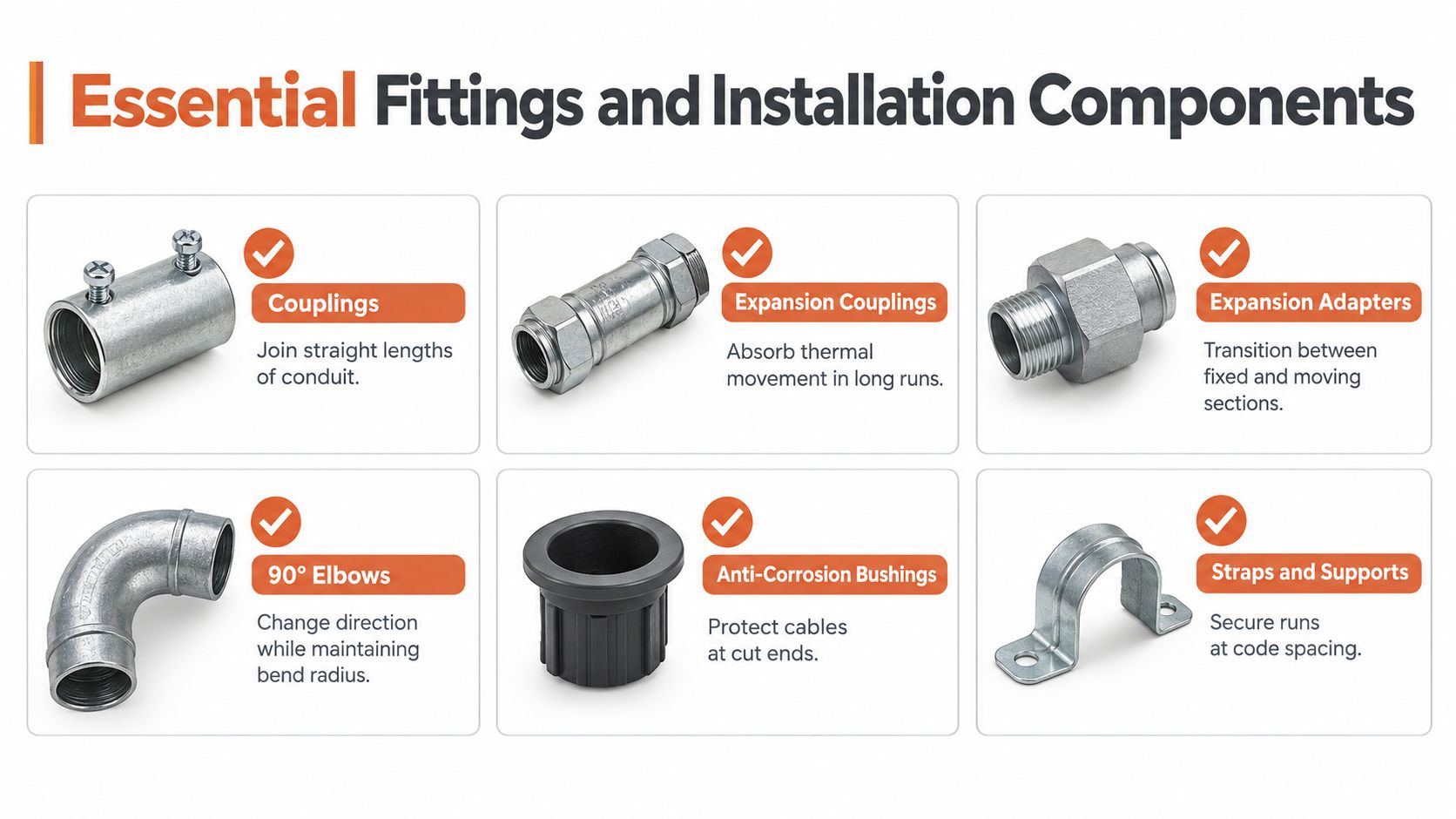
Build the fitting package with the conduit
Couplings join straight lengths and must match the conduit system. Don't mix fitting dimensions casually between product families, particularly when the specification requires a particular schedule or listing.
Sweep bends are generally preferable to sharp directional changes where the route permits. They provide a more manageable path for conductors, while a compact elbow may suit a constrained connection. The correct choice depends on the conductor size, pulling method, enclosure entry, and available space.
Expansion fittings accommodate movement on exposed outdoor runs and at transitions between sections with different restraint conditions. Include the required expansion couplings or adapters in the original BOM, rather than assuming they can be added after the raceway is installed.
Protect the cable at transitions
PVC raceway often connects to metallic boxes, cabinets, panel enclosures, or equipment. That transition may require adapters, bushings, locknuts, grounding or bonding components where applicable, and protection at cut ends. The fitting must suit both the raceway material and the enclosure entry.
A practical BOM review should identify:
- Straight joints: Couplings and solvent-compatible joining materials.
- Direction changes: Sweep bends and elbows selected for the route.
- Movement control: Expansion components for locations subject to thermal movement.
- Enclosure transitions: Adapters, connectors, bushings, and locknuts.
- Support hardware: Straps, clamps, and approved support components.
- Spare installation items: End protection and materials needed to prevent debris from entering the raceway.
The schedule of the fitting must match the schedule of the conduit unless the product documentation specifically permits the combination. A useful PVC conduit fittings category can help organize the accessory portion of a material request, but the project specification remains the controlling document.
Installation Considerations and Burial Depths
The warehouse label becomes a field problem at the trench. A crew can install the correct nominal raceway and still fail inspection if it measures cover from the wrong reference point or uses the wrong product at an exposed riser.
NEC Table 300.5 generally requires 18 inches of cover for PVC conduit in typical underground locations. Cover is measured from the finished grade to the top of the conduit, not to the trench bottom or the conduit centerline (PVC conduit burial-depth guidance). The required depth can change with the location, surface protection, traffic exposure, and local amendments, so the inspector and design documents should be consulted before excavation.
Plan the underground section from the top of the raceway
For a 2-inch system, the conduit outside diameter occupies space below the required cover. The trench design should account for the complete assembly, including bedding, conduit, warning or identification requirements where specified, and backfill that won't damage the raceway.
Schedule 40 may suit a protected buried section, while Schedule 80 may be required where the raceway emerges from grade or becomes exposed to physical damage. That change should be shown on the drawings and reflected in the takeoff. It shouldn't be left to the installer to discover after the trench is open.
Treat above-ground sections as a separate exposure
Above grade, the team needs to review support, UV suitability, impact exposure, enclosure entries, and the protection of conductors at every opening. A product intended for a protected location may not be appropriate for direct sunlight or a plant area where carts, tools, or equipment can strike the raceway.
Before backfilling, verify the installed route against the approved drawings and inspection requirements. Record transitions, pull points, and changes in schedule. Those records help maintenance teams later, particularly when a facility adds circuits or troubleshoots a buried feeder.
Field check: Measure cover to the top of the conduit, verify the schedule at every exposed transition, and obtain local approval before the trench disappears.
Cross-References to Alternative Raceway Systems
PVC is useful, but it isn't a universal raceway. A specification that calls for 2-inch PVC should still be challenged against the environment, equipment requirements, and grounding strategy.
EMT may be preferable for indoor exposed routing where a metallic raceway provides a compact installation and the facility's design accepts it. It requires different connectors, tools, handling practices, and bonding considerations than PVC, so a substitution affects more than the straight conduit line item.
Rigid metal conduit is a candidate where the route faces substantial physical abuse or where the engineered system requires a durable metallic raceway. It can also change labor, threading, fitting, corrosion, and support requirements. The estimator should compare the complete installed system rather than comparing the price of one length of PVC with one length of metal conduit.
Situations that justify a design review
PVC may be the wrong selection when the route is exposed to severe impact, when the project's temperature and product-rating requirements exceed the selected PVC system, or when the facility requires a continuous metallic equipment grounding path. Those conditions don't automatically dictate one replacement product, but they do require an engineering review.
Flexible metal conduit can solve a different problem, such as equipment connections where vibration or movement makes a rigid raceway impractical. It also introduces its own fitting, grounding, protection, and permitted-use requirements.
The key procurement question is not “what is the cheapest 2-inch raceway?” It is “which complete raceway system satisfies the environment, conductor route, compliance documents, and installation method?” A substitution should include the conduit, fittings, supports, transition hardware, and documentation needed for approval.
Quick-Reference Sizing and Procurement Guide
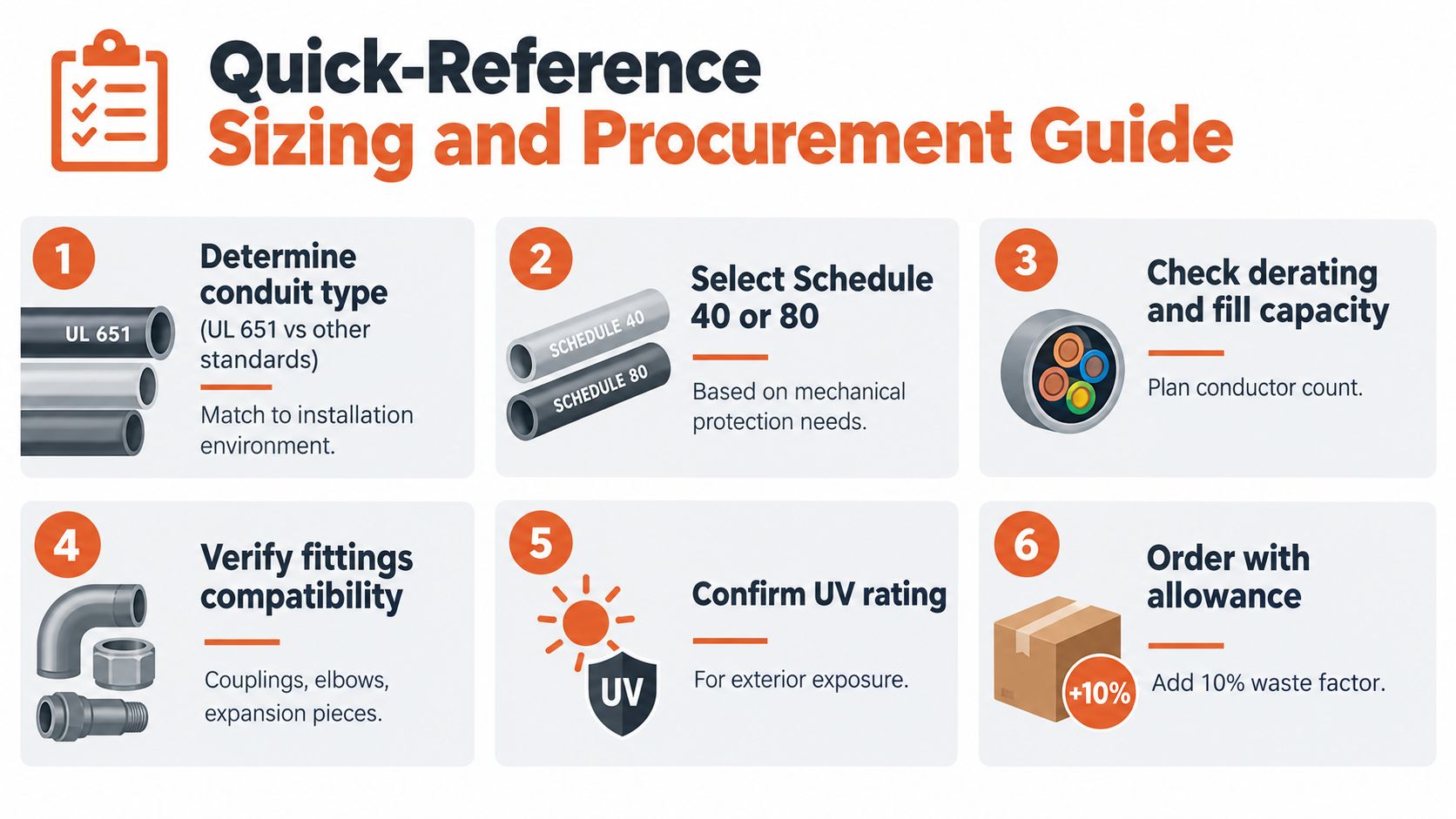
A reliable purchase package turns the nominal label into a controlled specification. Before releasing a BOM, have the estimator, engineer, and procurement lead verify the raceway against the actual route and conductor package.
Review the technical selection
- Identify the product family: Confirm whether the request is rigid electrical PVC, PVC-coated rigid steel, ENT, or another raceway type.
- Confirm the listing and standard: Check the required UL, NEMA, ASTM, or project-specific documentation before accepting an alternative.
- Select the schedule: Use Schedule 40 or Schedule 80 according to physical protection needs, not habit.
- Verify usable bore: Compare the manufacturer's inside diameter with the conductor areas and applicable fill limit.
- Review the route: Account for bends, sweeps, pull points, elevation changes, and the planned pulling method.
- Check the environment: Confirm burial, sunlight, moisture, impact, temperature, and enclosure-transition requirements.
- Complete the fitting BOM: Include couplings, elbows, expansion components, adapters, bushings, supports, and end protection.
- Confirm documentation: Gather product data, submittals, compliance information, and approved-alternative records before delivery.
The infographic includes an allowance for 10% waste, but any project-specific allowance should be set by the estimator from the route, cut plan, and supplier packaging rather than applied blindly. Lead time also deserves attention. Conduit may be available while a particular elbow, expansion fitting, transition, or listed accessory is not.
Use this video as a visual supplement to the written review, not as a replacement for the project specification, current code requirements, or manufacturer instructions.
For industrial and mission-critical work, the procurement review should also identify approved alternatives before a shortage occurs. A distributor can help compare manufacturer documentation, coordinate substitutions, consolidate fittings with the conduit package, and keep a delayed accessory from holding up an otherwise complete installation.
For 2-inch PVC conduit projects, ATEK Distribution can support BOM review, product sourcing, compliance documentation, approved alternatives, and hard-to-source fittings or raceway components. Visit ATEK Distribution to request project-specific procurement assistance and keep your electrical installation moving.