
You're at the supply counter with a material list in one hand and a route drawing in the other. The standard and tight-body fittings both say 90 degree elbow, both match the conduit trade size, and both appear suitable for the turn. The choice only becomes clear when you account for the cable pull, available clearance, utility requirements, and the inspection standard governing the job.
A 90 degree elbow conduit fitting redirects a raceway through a right angle while protecting conductors and preserving a usable path for installation. The catalog angle is only the starting point. Material, trade size, bend radius, body length, joining method, and the total bends in the run all affect whether the fitting works in the field.
Table of Contents
- What a 90 Degree Elbow Conduit Actually Does on a Job
- Conduit Elbow Materials and Their Applications
- Sweep vs Tight Radius Elbows and Why It Matters for Pulling
- Sizing a 90 Degree Conduit Elbow for Your Run
- NEC Bend Limits and Compliance Planning for Conduit Runs
- Installing a 90 Degree Conduit Elbow Correctly
- Use Cases by Application Type and Environment
- Quick Reference, Cross-References, and Key Terms
What a 90 Degree Elbow Conduit Actually Does on a Job
A factory elbow controls more than the direction of a raceway. Its formed curve keeps the opening usable, protects conductors from sharp edges, and gives straight conduit a defined connection at each end. Those details affect whether a pull stays controlled or turns into a struggle at the enclosure.
The buying decision rests on four checks:
- Material: Does the system use EMT, rigid metal conduit, IMC, PVC, or another approved raceway?
- Radius: Is a standard sweep enough, or does the route require a long sweep or compact short-radius fitting?
- Trade size: Does the elbow match the conduit and provide adequate interior space for the conductors?
- Application: Will it be installed indoors, underground, outdoors, in a utility duct bank, or in a classified location?
Factory radius is fixed by trade size. It determines the clearance needed inside a panel, pull box, wall cavity, or equipment enclosure, and it affects the force required to pull conductors through the finished route. Exact steel EMT dimensions belong in the sizing table, but the purchasing decision starts here: a catalog angle does not describe how the elbow will behave during installation. Steel EMT elbow dimensions and bend radii
A field-bent 90-degree turn and a factory elbow may both satisfy the basic description, yet they can differ in consistency, clearance, and pulling performance. A utility inspector may also expect the listed fitting, approved joining method, and documented radius specified for the installation. Confirm those requirements before substituting one option for another.
Field rule: Check the material, trade size, published or stamped radius, listing, joining method, and project specification before the fitting reaches the cart.
If the raceway has not been selected, resolve the material first. If conductors must travel through the bend, evaluate the sweep and total route rather than the angle alone. Enclosure clearance and the complete run's bend count require their own checks.
Conduit Elbow Materials and Their Applications
Material selection comes before radius selection because each raceway family brings different mechanical, environmental, and installation requirements. A PVC elbow may be ideal underground but unsuitable where a metallic raceway is specified. An EMT elbow may be efficient above a commercial ceiling but a poor choice in an exposed, high-abuse area.
Steel EMT
Electrical metallic tubing, or EMT, is thin-wall steel tubing joined with setscrew or compression fittings. It's common in commercial interiors because it's relatively light, easy to route, and practical for exposed or concealed installations in permitted environments. Factory EMT elbows provide consistent geometry, but the installer still needs to confirm that the elbow's coupling style matches the straight conduit and the fittings used elsewhere in the run.
RMC and IMC
Rigid metal conduit, often called RMC or GRC, has a heavier wall and threaded connections. It suits locations where the raceway needs greater mechanical protection, including exterior routes, industrial areas, and portions of hazardous-location installations governed by the applicable NEC requirements. Intermediate metal conduit, or IMC, provides a metallic raceway option with less weight than RMC while retaining a threaded system.
Corrosion protection matters as much as wall strength. Galvanized finishes suit many general installations, while aluminum, stainless steel, or PVC-coated steel may be selected where moisture, chemicals, salt, washdown, or process conditions could attack ordinary steel. The exact fitting must be listed and approved for the environment, not merely described as corrosion resistant.
PVC Schedule 40 and Schedule 80
PVC is widely used underground and in corrosive environments because it doesn't rust and can be solvent-welded into a continuous raceway system. Schedule 40 is common where the project provides adequate protection, while Schedule 80 is selected where the installation needs a heavier wall or the specification requires it.
Manufacturer data for PVC Schedule 40 elbows identifies standard-radius 90-degree fittings listed to UL 651, with a 1-inch trade size elbow using a 5.75-inch bend radius. Larger trade sizes use larger geometry, and the fittings are factory formed for solvent-weld joining in the field. PVC Schedule 40 and Schedule 80 elbow data
For a broader selection of compatible raceway components, review electrical conduit fittings from ATEK Distribution, then verify the listing and project specification for the exact part.
Conduit Elbow Materials at a Glance
| Material | NEC Article | Common UL Listing | Primary Environment | Key Trade-Off |
|---|---|---|---|---|
| EMT | Article 358 | Product-specific metallic raceway listings | Commercial interiors and protected exposed runs | Light and efficient, but less resistant to severe abuse |
| RMC or GRC | Article 344 | Product-specific rigid metal conduit listings | Outdoor, industrial, exposed, and high-abuse areas | Strong and threaded, but heavier and more labor intensive |
| IMC | Article 342 | Product-specific intermediate metal conduit listings | Industrial and exterior installations | Lighter than RMC, with threaded installation |
| PVC Schedule 40 or 80 | Article 352 | UL 651 is typical for listed PVC conduit products | Underground and corrosive environments | Corrosion resistant, but requires compatible solvent-weld installation |
Material transitions need deliberate planning. A PVC underground route entering a building may transition to EMT or another metallic raceway, which creates questions about adapters, bonding, grounding, weather sealing, and fitting compatibility. Treat the elbow as part of the complete raceway assembly, not as an isolated plastic or metal curve.
Sweep vs Tight Radius Elbows and Why It Matters for Pulling
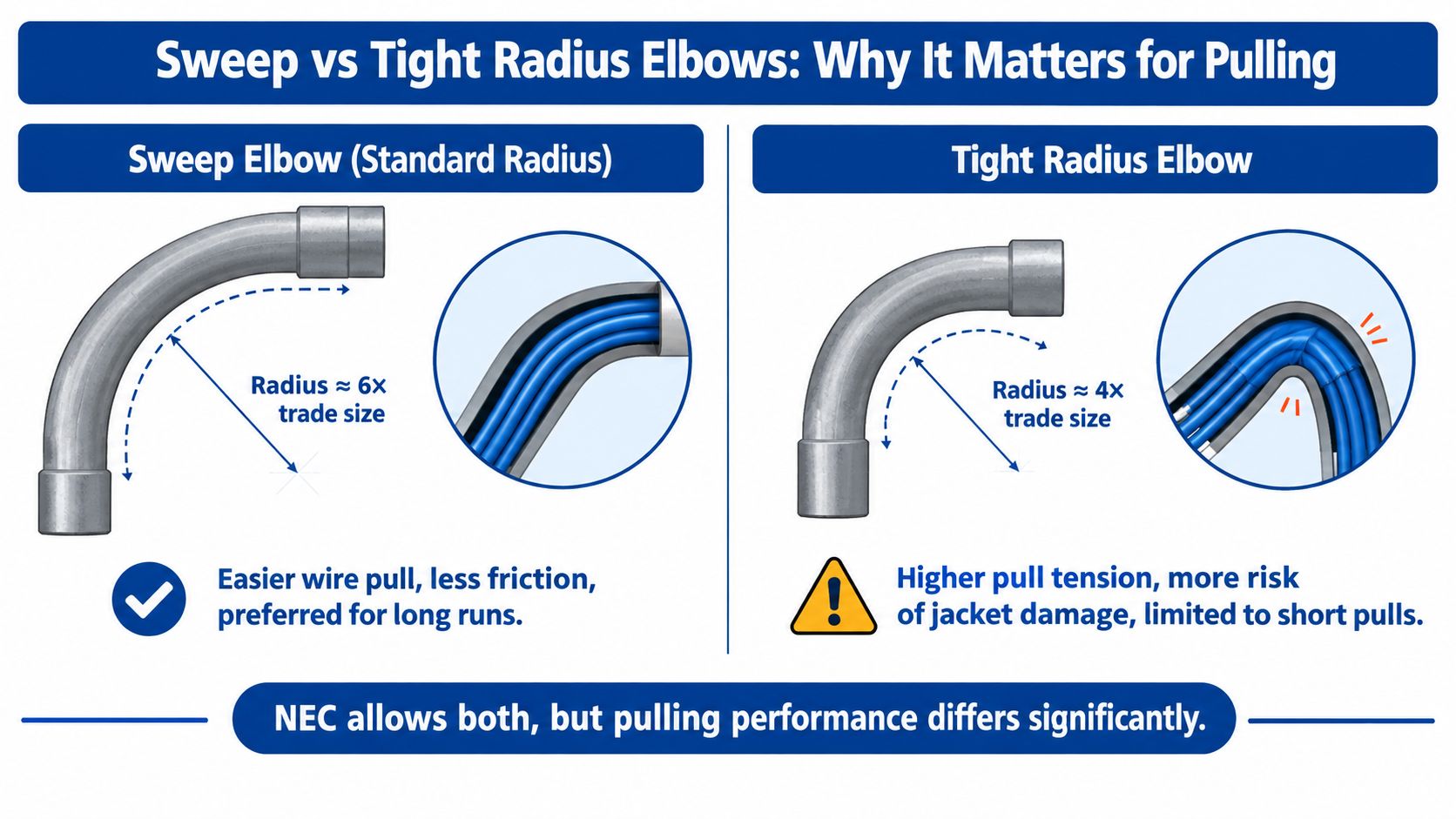
The biggest difference between a sweep elbow and a tight-radius elbow appears when conductors move through the finished raceway. A sweep elbow spreads the direction change over a broader curve. A tight-radius elbow saves space, but forces the conductors around a sharper path and can increase friction, pulling tension, and the chance of jacket or insulation damage.
A commonly used NEC-based training guideline places the inside radius of a 90-degree bend at least six times the conduit inside diameter. The purpose is practical. A smoother curve gives conductors a more gradual path and helps keep the conduit from deforming during bending. Conduit bending guidance and bend-radius principles
What works in ordinary routing
For most commercial and industrial raceways, a standard sweep is the safer default. It gives the pulling crew more room to work, reduces abrupt direction changes, and is easier to justify during inspection when the route has adequate space. Long sweeps are particularly useful where the run carries stiff conductors, larger cables, or a cable jacket that can be damaged by excessive sidewall pressure.
A tight-body elbow has a legitimate place. It can solve a clearance problem at a riser, enclosure, panel, or equipment entry where a broad sweep won't fit. The mistake is treating compact geometry as a universal substitute for a sweep. A fitting that fits the drawing may still make the completed pull unnecessarily difficult.
Where utility specifications change the answer
Code compliance is only the minimum threshold on many utility projects. PG&E specifies a 36-inch vertical radius for 2-inch and 3-inch primary conduit 90-degree bends, while some utility closeout specifications require long-sweep bends with a 60-inch minimum radius for changes of direction over 10 degrees. Those specifications may restrict short-radius manufactured elbows to riser applications. PG&E underground conduit requirements
That difference is why a generic product page isn't enough for utility work. Check the owner's standard, approved material list, duct-bank detail, and pull-box geometry before ordering. For a practical comparison of metallic raceway choices, see EMT versus rigid conduit differences.
Practical decision: Use a sweep unless the available space requires a tighter elbow and the project documents expressly permit it. For primary utility routes, follow the utility radius before relying on a general NEC minimum.
Sizing a 90 Degree Conduit Elbow for Your Run
A 90-degree elbow can fit the specified raceway and still fail the job in practice. Select it by trade size, connection method, bend radius, cable space, and the clearance needed to install and pull the run.
Trade size identifies the conduit system and nominal raceway size. Bend radius defines the curve through the elbow, affecting the physical envelope and the force required to move conductors. Start with the conduit specification, not the cable. A 1-inch EMT run requires an elbow made for 1-inch EMT with the correct connection method. An elbow made for PVC, RMC, or another trade size is not interchangeable just because it produces a 90-degree turn.
Use product geometry in the layout
Standard-radius steel EMT product data provides planning dimensions for the elbow centerline:
| EMT trade size | Bend radius |
|---|---|
| 1 inch | 5.75 inches |
| 1-1/4 inch | 7.25 inches |
| 3 inches | 13 inches |
These are fixed factory dimensions, not measurements an installer can adjust after purchase. Standard-radius steel EMT elbow dimensions
Use the radius to draw the centerline and outside envelope in the plan or coordination model. Add the radius plus half the conduit outside diameter to the centerline to estimate the outside envelope for clash detection. Check that envelope against panel interiors, box walls, framing, cable tray, access doors, and pull-box entries. The fitting may match the raceway while its body still collides with an enclosure or leaves too little straight length for the connection.
Verify conductors and fill
The elbow remains part of the same raceway system for conduit-fill purposes. Confirm conductor count, conductor dimensions, and available internal area under the applicable NEC requirements. Inspect the elbow's internal bore, particularly at the curve and connection, where a tight passage can increase pulling resistance or damage insulation.
A larger bend radius does not increase the conduit's internal area. If the conductors need more room, choose the correct larger trade size. A sweep can make the path easier without solving an undersized raceway.
Count the whole route
Mark every elbow, offset, kick, and field bend on the route drawing. Record the bend angles and the physical envelope, then verify that the planned pull point remains accessible before releasing material.
For a short interior run, elbow body depth may control the choice. On a long underground route, radius and pulling feasibility usually outweigh compactness. Factory elbows and field-bent alternatives may both qualify as 90-degree bends, yet their geometry can produce very different installation results. Choose the fitting that satisfies trade size, fill, clearance, radius, and project specifications together.
NEC Bend Limits and Compliance Planning for Conduit Runs
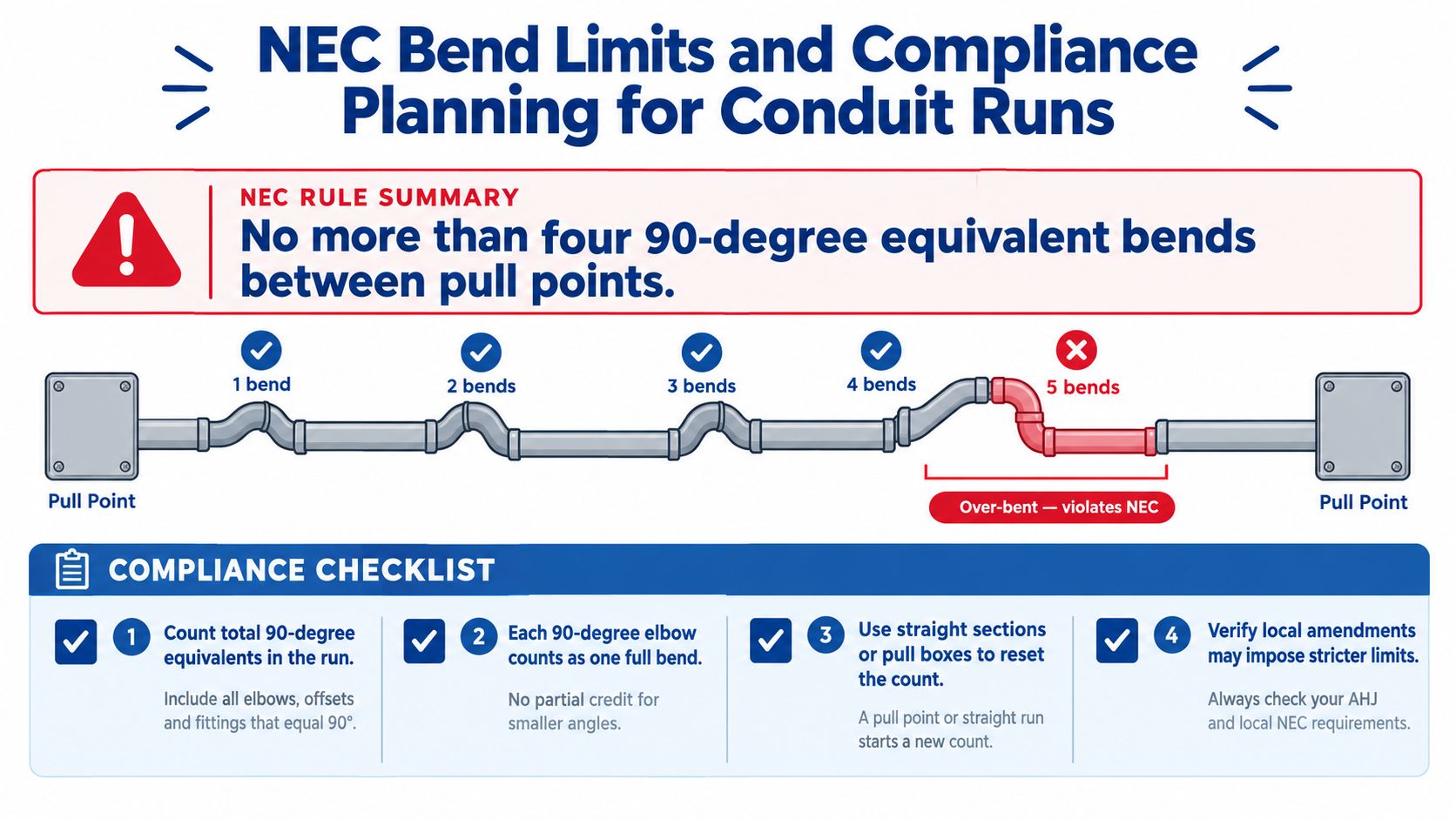
A conduit run can be individually correct at every elbow and still be poorly planned as a system. The controlling issue is the combined bend between accessible pull points, not just whether each fitting makes a clean right angle.
The NEC-based limit is 360 degrees between pull points, equivalent to four 90-degree elbows. A pull point may be a junction box, pull box, conduit body, or another permitted access fitting. NEC-based conduit bend-limit guidance
Track bend equivalents during design
A simple route worksheet prevents a common field failure. Start at the first pull point and list each direction change in order. Add the degrees for factory elbows and every component of field-made bends. Stop the count at the next accessible pull point, then begin a new segment.
This matters when a route combines a 90-degree factory elbow with offsets, kicks, or saddles. A run may look like a series of modest adjustments, but the total angle still accumulates. The installer who counts only the obvious 90-degree fittings can miss the contribution of smaller field bends.
Add access before the route becomes expensive
If the planned segment approaches the allowed bend total, add a pull box or conduit body during design rather than after the conduit is installed. The access point must be located where conductors can be pulled and where the box remains accessible under the project requirements.
Radius adds another layer. A route may stay within the total-degree limit while still requiring a larger utility-approved sweep or a different pull-box arrangement. Review bend accumulation, elbow radius, cable characteristics, and owner requirements together.
Planning habit: Put the bend count on the drawing before the first conduit is cut. It's cheaper to revise a route on paper than to add access after conductors are already staged.
Installing a 90 Degree Conduit Elbow Correctly
A factory elbow installs cleanly when the crew treats orientation, alignment, joining, and support as one operation. Rushing any one of those steps can leave a fitting that looks acceptable but creates trouble during the pull or inspection.
Confirm orientation before fastening
Dry-fit the elbow with the adjoining conduit before tightening anything. Check whether the turn is horizontal, vertical, or transitioning between planes. In a panel or equipment enclosure, rotate the elbow until the body clears the enclosure wall and the straight conduit lands without forcing the raceway sideways.
Cut conduit ends square and ream them thoroughly. A sharp edge inside the raceway can damage conductor insulation, while an unreamed end may prevent the conduit from seating fully in a connector or coupling.
Match the joining method to the material
EMT commonly uses either setscrew or compression fittings. Tighten them according to the fitting manufacturer's instructions. Over-torquing a setscrew can deform thin-wall EMT or damage the fitting, while under-tightening can leave the connection mechanically insecure.
RMC and IMC use threaded joints. Keep threads clean, use the specified sealing or corrosion-protection method, and maintain continuity and bonding as required by the installation. PVC uses solvent-weld connections. Clean and prepare the surfaces properly, apply the compatible cement, fully seat the joint, and allow the manufacturer's required set or cure time, especially in cold conditions.
Use conduit, raceway, and cable support products to coordinate the elbow with the supports and adjoining raceway components.
Support the route and inspect the bore
Install supports near changes of direction in accordance with the NEC, manufacturer instructions, and the project specification. The elbow shouldn't carry the weight of an unsupported conduit run or become a lever against a box connector.
Before pulling conductors, inspect the complete interior path. Confirm that the elbow is seated, joints are secure, cut ends are smooth, the raceway is free of debris, and the conductor arrangement remains within permitted fill. A solvent-welded joint that hasn't set, an elbow installed out of plane, or a deformed EMT connection can turn a routine pull into a replacement job.
Use Cases by Application Type and Environment
The same right-angle geometry behaves differently depending on the surroundings, the owner's standard, and the consequences of a failed pull. Select the elbow after identifying the environment and the required raceway system.
Commercial offices and retail
EMT with standard sweep elbows is a practical choice for many indoor commercial routes, particularly above ceilings and in accessible service areas. The priority is usually efficient installation, clean alignment, and a pull path that doesn't punish the conductors. Compression fittings may suit locations exposed to moisture, while setscrew systems are common in dry interiors where permitted.
Industrial plants and manufacturing
Industrial routes often need more mechanical protection than light-wall EMT provides. RMC or IMC may be appropriate in exposed or high-abuse zones, near equipment, and where the raceway could face impact or harsh operating conditions. Use broad sweeps on longer cable routes, and reserve compact elbows for locations such as riser chases only when the design and specification support that choice.
Healthcare and clean environments
Healthcare, laboratory, and cleanroom projects place extra emphasis on cleanable surfaces, corrosion resistance, and predictable installation quality. Stainless steel, PVC-coated steel, or PVC may be selected according to the room classification, cleaning chemicals, moisture exposure, and owner standard. Avoid assuming that a fitting suitable for a general wet location satisfies a healthcare or cleanroom specification.
Underground and site utilities
PVC Schedule 40 or Schedule 80 sweep elbows are common in underground raceway systems, provided the product is listed for the installation and the route meets the project requirements. The elbow must align with duct-bank, encasement, burial, pull-box, and riser details. Solvent-weld preparation and joint setting deserve the same attention as the excavation and bedding.
Utility and primary distribution
Utility work is specification driven. Long-sweep elbows may be required even when a compact fitting appears to meet a general code rule. Review the utility's approved radius, material, riser limitations, pull-box details, and closeout requirements before procurement.
Hazardous and government facilities
Classified locations require listed fittings and raceway methods appropriate to the applicable hazardous-location rules. RMC with compatible listed fittings is frequently considered for these environments, but the classification and project documents control.
Government work can add sourcing and documentation requirements, including domestic-content provisions where applicable. Confirm listing certificates, submittals, approved manufacturers, and any Buy American Act or Trade Agreements Act requirements before ordering.
Quick Reference, Cross-References, and Key Terms
Buyer quick reference
| Decision | Practical selection | Main check |
|---|---|---|
| Material | EMT, RMC, IMC, or listed PVC | Environment and joining method |
| Radius | Standard sweep, long sweep, or short radius | Pulling performance and owner specification |
| Trade size | Match the raceway system | Conduit fill and enclosure clearance |
| Application | Commercial, industrial, underground, utility, or classified | Listing, inspection, and project requirements |
Related components
- Conduit bodies: Provide an accessible change of direction and may serve as a pull point where permitted.
- Pull boxes: Break up long or heavily bent routes and provide conductor-access space.
- Couplings: Join straight conduit sections to elbows or other fittings.
- Straps and supports: Hold the raceway in position and reduce stress at direction changes.
- Junction boxes: Provide accessible connection or pulling locations when correctly sized and installed.
Key terms
- Trade size: The nominal size designation used to identify the conduit system.
- Bend radius: The radius of the elbow's curved path.
- Sweep elbow: A fitting with a broader curve for easier pulling.
- Short-radius elbow: A compact fitting with a sharper curve and tighter clearance needs.
- Conduit fill: The amount of conductor area occupying the raceway.
- Pull point: An accessible location where conductors can be installed or redirected.
- Solvent weld: A PVC joining method that fuses prepared surfaces with compatible cement.
- Setscrew fitting: A metallic fitting secured with screws that grip the conduit.
- Compression fitting: A fitting that secures conduit through a compression mechanism.
- NEC: The National Electrical Code, subject to the adopted edition and local amendments.
ATEK Distribution can help source conduit elbows, bends, couplings, supports, and related raceway components for EMT, PVC, rigid, and IMC systems, including technical documentation and alternate-product review when specifications or availability create a problem. For project-specific sourcing support, visit ATEK Distribution and send the conduit material, trade size, radius, application, and required listing.