
An electrical enclosure outdoor selection starts with actual exposure, the NEMA or IP rating, material, and complete installed assembly, not a weatherproof label. Use Type 3R for falling rain where other hazards are absent, Type 4 for hose exposure, and Type 4X when corrosion resistance is also needed.
You may be replacing a disconnect with water tracks inside the door, or reviewing a submittal that names the cabinet but leaves every hub and accessory to the installer. The immediate problem isn't finding another box. It's identifying what the existing specification missed before you buy the same failure in a different finish.
Table of Contents
- What Makes an Electrical Enclosure Outdoor
- NEMA Types for Outdoor Exposure
- How IP Ratings Differ from NEMA Types
- Materials That Survive the Atmosphere
- Condensation and Heat Inside the Cabinet
- Site Examples for Mounting and Penetrations
- Specify and Source the Complete Assembly
What Makes an Electrical Enclosure Outdoor
A rooftop junction cabinet mounted tight to a masonry parapet can look acceptable until the cover comes off. The gasket may be intact while corrosion rings the mounting bolts, a field-made top entry leaves a water path above the terminals, and moisture marks the back panel. The nameplate only describes the enclosure; outdoor suitability depends on the complete installed assembly.
Start with the condition of the equipment, using appropriate electrical safe-work procedures before opening or inspecting it. Look for trails below hubs, corrosion around mounting bolts, damaged paint at field cuts, and uneven gasket compression. Those details distinguish water entering through an opening from moisture forming inside. They also show whether the problem began with the enclosure rating, the mounting arrangement, or an accessory.
The installation is part of the requirement
OSHA's general industry electrical rule requires cabinets, cutout boxes, fittings, boxes, and panelboard enclosures in damp or wet locations to prevent moisture or water from entering and accumulating; in wet locations, those enclosures must be weatherproof. 29 CFR 1910.305 also requires at least 6.35 mm, or 0.25 inch, of airspace between the enclosure and its supporting surface, with an exception allowing nonmetallic enclosures directly against concrete, masonry, or tile.
That makes a tighter seal an incomplete answer by itself. A sealed cabinet can trap condensation, while an unrated field penetration, wrong hub, or improper mounting arrangement can void the rating. Select the enclosure type from the dominant site exposure, then verify that the installed assembly preserves it.
Weatherproof means constructed or protected so weather exposure doesn't interfere with successful operation. Rainproof, raintight, or watertight construction can satisfy that purpose when additional conditions such as snow, ice, dust, or temperature extremes aren't factors. A rain-shedding cabinet beside a chemical exhaust isn't automatically suitable just because rain stays out.
Practical rule: Investigate where water travels, not just where it finally collects.
Turn the location into a specification
Before selecting a replacement, record the conditions that the purchase document needs to address:
- Water exposure: Falling rain, wind-driven rain, splash, hose cleaning, or potential inundation.
- Atmosphere: Salt, process chemicals, airborne dust, and nearby exhaust.
- Support conditions: Wall construction, mounting arrangement, drainage, and service access.
- Operating conditions: Internal heat, temperature swings, door-opening frequency, and security.
Use the dominant exposure to choose the enclosure type. Use the remaining conditions to test whether the material, finish, fasteners, drainage, and accessories suit the site. Hose cleaning, for example, presents a different water path than falling rain, while salt or process chemicals make construction materials part of the decision.
Confirm the enclosure type against the NEC edition adopted in the project jurisdiction and applicable local amendments before finalizing the drawing. OSHA requirements don't replace that project-specific code review, manufacturer instructions, or engineering judgment.
The useful procurement description reads like an installed condition. It states the environmental exposure, mounting conditions, required construction, and field penetrations or accessories the supplier must evaluate as one assembly.
NEMA Types for Outdoor Exposure
Outdoor NEMA types by exposure
| Type | Dust | Water | Ice | Corrosion | Typical use |
|---|---|---|---|---|---|
| 3 | Windblown dust | Rain and sleet | External ice | No added corrosion designation | Dusty outdoor equipment |
| 3R | Not dust-tight | Falling rain, sleet, and snow | External ice | No added corrosion designation | General outdoor gear, often with a drain |
| 3S | Windblown dust | Rain and sleet | Must operate when ice-laden | No added corrosion designation | Mechanisms that must work under ice |
| 3X, 3RX, 3SX | Same as the base type | Same as the base type | Same as the base type | Yes | Corrosive-area versions of the base types |
| 4 | Windblown dust | Rain, sleet, snow, splashing, and hose-directed water | External ice | No added corrosion designation | Washdown and hose exposure |
| 4X | Windblown dust | Same water protection as Type 4 | External ice | Yes | Coastal, chemical, salt, and wastewater |
| 6 | Dust protection specified by the type | Hose-directed water and temporary submersion | External ice | No added corrosion designation | Brief submersion at limited depth |
| 6P | Dust protection specified by the type | Hose-directed water and prolonged submersion | External ice | Yes | Prolonged submersion under specified conditions |
Choose the row from site evidence, not the type used on the previous project. This is a selection aid, not a substitute for ANSI/NEMA requirements or the manufacturer's listing, including any applicable submersion conditions.
The Nidec enclosure guide distinguishes Type 3 protection against windblown dust and weather from Type 3R rain protection, and identifies the additional hose-water and corrosion protection associated with Types 4 and 4X. Those differences should drive the specification before price or appearance narrows the product list.
Falling rain isn't washdown
A sheltered exterior wall may justify Type 3R when the actual exposure is falling precipitation. Many such designs shed and drain water rather than seal every seam. Don't caulk a drainage path closed because it looks like an unfinished joint.
Use NEMA 3R junction boxes as candidates for that exposure, then review entry locations and mounting instructions for the particular product. A suitable cabinet can still be the wrong choice beside a dusty transfer point or within reach of a sanitation hose.
Type 3 addresses windblown dust as well as weather. Type 3S adds an important operational distinction: external mechanisms must remain operable when ice-laden. Protecting equipment against damage from external ice formation isn't the same thing as being able to operate a handle through that ice.
Hose water and corrosion change the purchase
Type 4 is the practical step up when splashing or hose-directed water is credible. Type 4X adds corrosion resistance, making it a stronger starting point for wastewater, coastal, chemical-processing, and deicing-salt exposure. Neither designation identifies the exact alloy, coating, or resin you should buy.
Submersion needs a different review. Types 6 and 6P address temporary and prolonged submersion respectively under specified conditions, but they aren't unrestricted flood-service claims. Obtain the manufacturer's applicable limits rather than treating submersible as permission for any depth or duration.
The Electrical Contractor discussion of ANSI/NEMA 250 identifies its scope as enclosures for equipment rated up to 1,000 volts in nonhazardous locations and notes that the 2020 edition superseded the 2018 edition. A copied drawing note therefore deserves an edition check, not automatic reuse.
Buy the environmental performance of the finished enclosure, not the promise of an empty shell.
Require the rating to cover the door, gasket, hubs, and installed accessories. An unrated window or an unapproved knockout modification can invalidate the claimed protection, even if the original nameplate remains attached.
None of these types is, by itself, a flood-depth, wildfire, or ultraviolet-resistance specification. Keep those site hazards explicit rather than trying to hide them inside a higher type number.
How IP Ratings Differ from NEMA Types
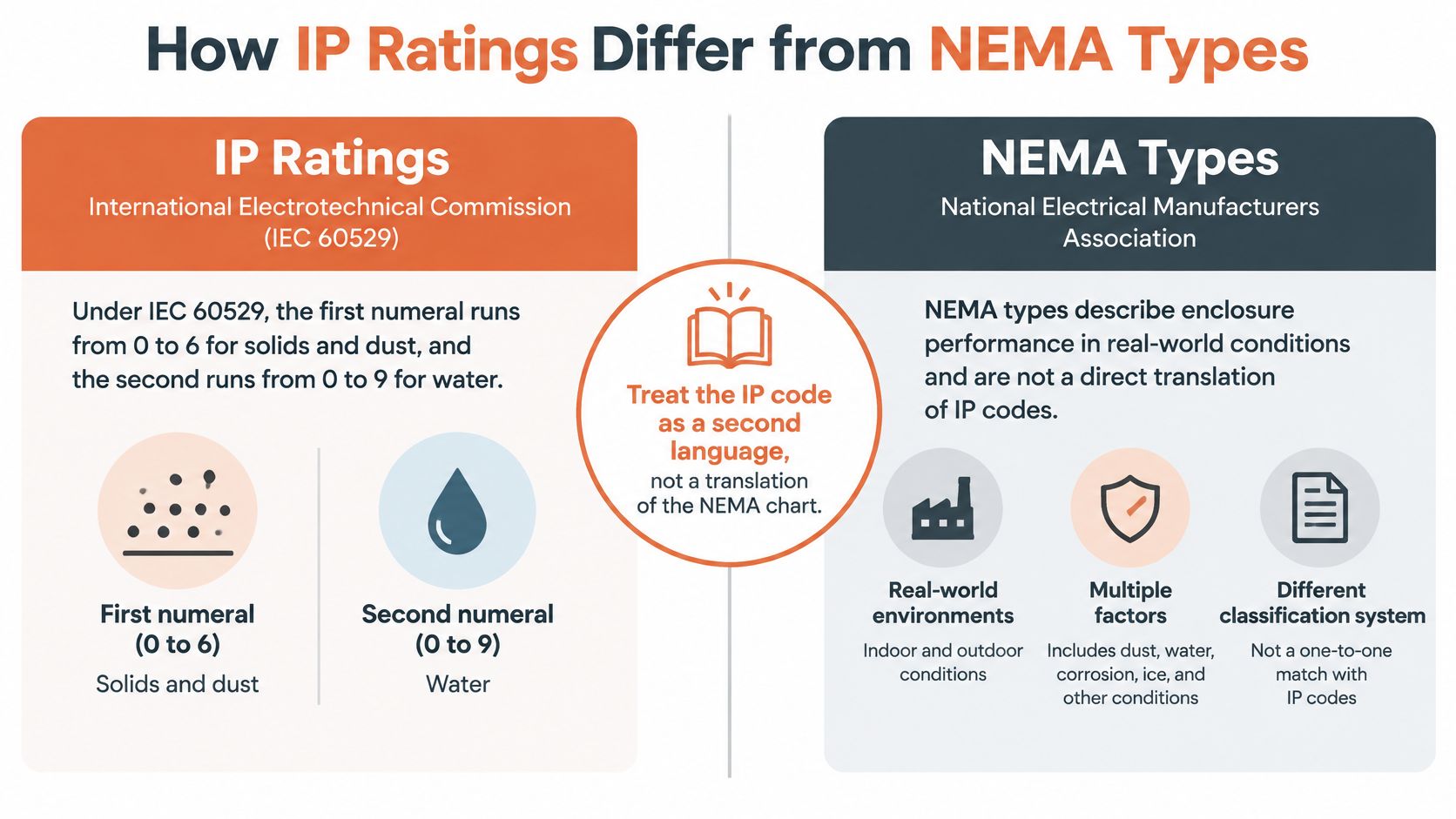
Treat an IP code as another protection language, not a direct translation of a NEMA type. It describes ingress performance through defined tests, but it doesn't answer every environmental question a North American enclosure specification may need to address.
The IEC explanation of IP ratings identifies a first numeral from 0 to 6 for solid objects and dust and a second from 0 to 9 for liquids; IEC 60529 applies to enclosures for equipment rated up to 72.5 kV. An X means the protection characteristic isn't specified by that position, so don't read it as either zero protection or a passed test.
Read each protection claim separately
IP codes often cited for outdoor equipment
| Code | Solids | Water | What it does not prove |
|---|---|---|---|
| IP54 | Dust protected | Splashing water from any direction | Not dust-tight and not a hose test |
| IP55 | Dust protected | Water jets | Not a Type 4 conversion and not corrosion performance |
| IP65 | Dust-tight | Water jets | Not high-pressure or immersion performance |
| IP66 | Dust-tight | Powerful water jets | Not immersion, ice, or corrosion performance |
| IP67 | Dust-tight | Temporary immersion under specified test conditions | Not a hose-down substitute and not corrosion performance |
| IPX9 | Not specified | High-pressure, high-temperature spray | Says nothing about dust or ordinary-rain performance as a separate test |
The digits don't create a universal ladder where every larger water digit automatically includes every lower water test. Temporary immersion and powerful jets impose different conditions on joints and seals. If equipment will experience both, obtain documentation that addresses both instead of choosing whichever code looks higher.
Likewise, high-pressure, high-temperature spray performance isn't a general endorsement for every cleaning chemical, nozzle practice, or cleaning temperature used at a plant. The enclosure's materials and the manufacturer's application limits remain separate checks.
Reject the conversion shortcut
There isn't an official one-to-one conversion that turns IP66 into Type 4X. NEMA and IEC use different test frameworks, and a water-ingress result doesn't establish corrosion resistance. Outdoor NEMA types also address external ice in ways that aren't expressed by the IP digits.
For an imported control cabinet, ask whether the project requires an IP code, a NEMA type, or documented compliance with both. Don't let a supplier substitute an approximate comparison table for the required evidence.
Inspect the features that determine whether the delivered installation supports its declared code:
- Cable entries: Confirm gland compatibility, cable diameter range, and installation method.
- Unused openings: Use appropriate closures rather than improvised plugs or sealant patches.
- Door compression: Check continuous gasket contact and latch adjustment.
- Accessories: Verify drains, breathers, and mounting orientation against the approved design.
Record the required designation in the submittal and inspect seals after penetrations are complete. The inspector needs to see the assembled condition, not just a catalog page photographed before fabrication.
Materials That Survive the Atmosphere
A rating describes performance, but it doesn't tell purchasing which metal or polymer to order. Rainfall and atmospheric chemistry damage enclosures differently, and replacing painted steel with an unspecified stainless cabinet isn't a complete corrosion strategy.
Start with the contaminant, exposure route, and cleaning practice. Salt deposited on a rooftop cabinet, caustic splashed during sanitation, and chemical vapor entering around a door require different material checks, even when all the cabinets share the same environmental rating.
Outdoor enclosure materials
| Material | Corrosion and weather | Typical failure | Where it fits |
|---|---|---|---|
| Painted carbon steel | Protection relies on an intact coating | Rust at scratches, cut edges, and salt-exposed areas | Inland industrial sites without aggressive chemical or coastal exposure |
| Aluminum | Doesn't develop red rust; galvanic couples matter | Attack near incompatible dissimilar-metal fittings | Weight-sensitive outdoor equipment |
| Fiberglass-reinforced polyester | Chemical suitability depends on resin selection | Weathering, impact damage, or corroded hardware | Corrosive areas where a nonmetallic body helps |
| Polycarbonate | Impact, chemical, and sunlight performance require a suitable grade | Chalking, embrittlement, or chemical attack of an unsuitable grade | Covers, windows, and smaller instrument housings |
Steel and stainless need different scrutiny
Painted carbon steel is a practical inland industrial choice when the atmosphere isn't aggressive and maintenance can preserve the coating. Its weak points are predictable: field-drilled holes, mounting damage, door edges, and areas where water remains against a damaged finish. Specify a compatible touch-up procedure for fabrication damage rather than accepting exposed substrate.
Type 304 stainless steel suits many washdown and mild industrial environments. Coastal chlorides or road-salt deposition push the evaluation toward Type 316 stainless steel or a suitable nonmetallic construction, but neither is a blanket chemical-resistance guarantee. Review the actual contaminant and cleaning solution with the manufacturer.
Match the surrounding installation too. A stainless cabinet connected through unsuitable fittings can leave the connection as the first maintenance problem; stainless steel conduit is a relevant option where the raceway system also needs corrosion resistance.
Nonmetallic doesn't mean maintenance-free
Fiberglass-reinforced polyester can be useful where a metal body would face persistent chemical attack. Specify the resin system and outdoor exposure suitability, then inspect the hardware package. A sound composite body doesn't prevent a mismatched hinge pin or latch from corroding.
Polycarbonate is useful for small housings and transparent covers, but impact resistance doesn't establish chemical compatibility or sunlight durability. Name the grade or require manufacturer confirmation for the service conditions. Don't accept clear plastic as a material specification.
Aluminum reduces enclosure weight, which can help with pole mounting and handling. Check compatibility at dissimilar-metal fasteners and fittings, and use the manufacturer's recommended isolation or joining approach where needed.
Material check: The first rust stain may come from a hinge, latch, or fastener rather than the enclosure body.
Write material and finish on the same specification line as the environmental rating. Include hardware, coating treatment at modifications, and any transparent parts. A corrosion-resistant designation alone doesn't identify the alloy or resin that will arrive.
Condensation and Heat Inside the Cabinet
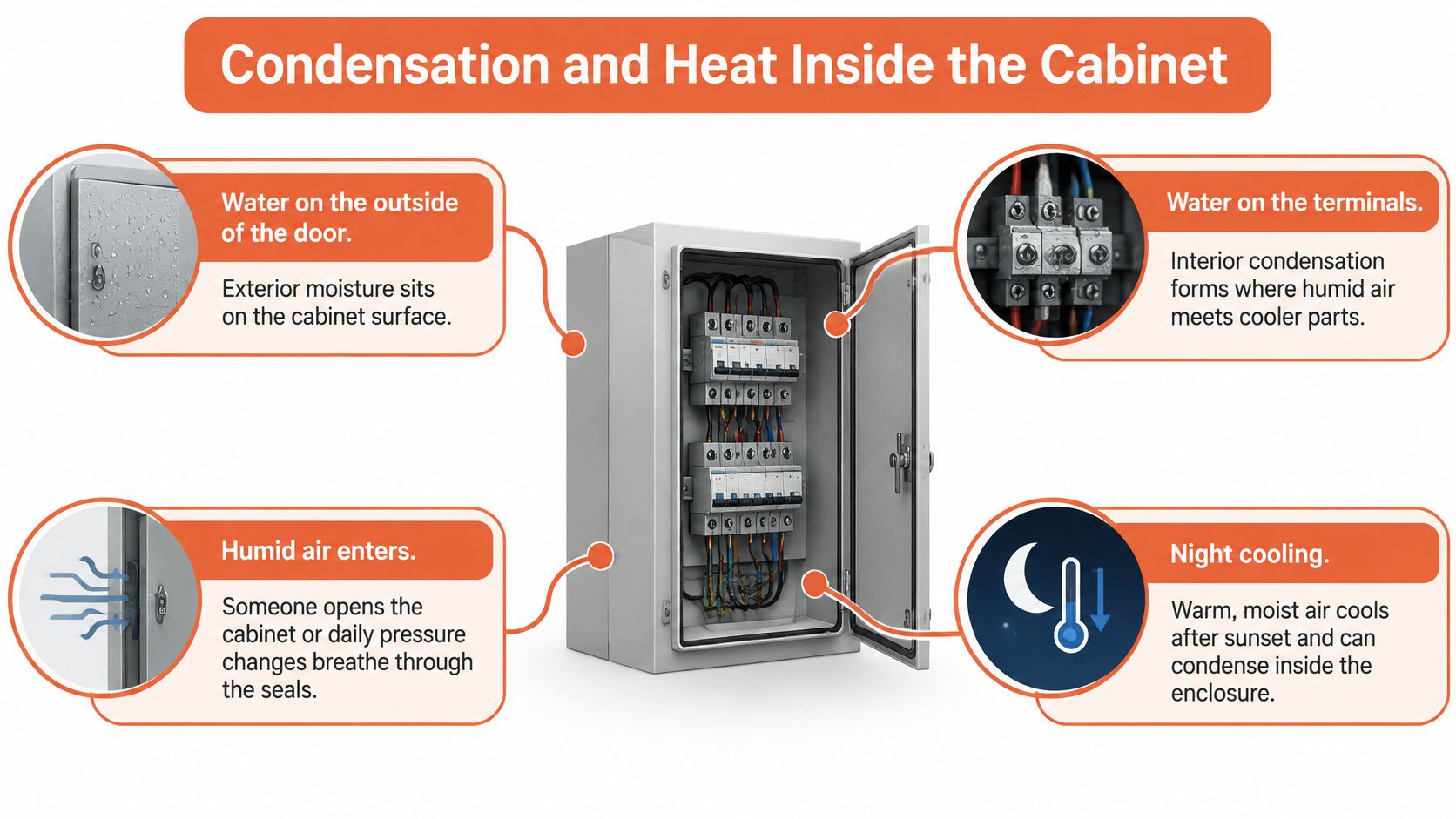
Water on the outside of a door and water on internal terminals are different problems. A cabinet can exclude external water yet contain humid air that later condenses on cooler surfaces.
Humid air enters during maintenance or through pressure-driven air exchange. When temperatures fall overnight or during a seasonal change, internal surfaces can reach the air's dew point. A fine moisture film may appear without a visible leak through the roof, seam, or conduit hub.
The Institution of Engineering and Technology's outdoor-assembly guidance identifies ventilation, internal heating, drainage, and similar measures for humid environments with wide temperature variation, and notes that maintaining the interior approximately 5°C above outside ambient can prevent condensation under relevant conditions. That's a design consideration, not a universal heater setting independent of cabinet load and site conditions.
Select the control for the moisture mechanism
Condensation and heat controls
| Condition | Control that fits | Risk if misapplied |
|---|---|---|
| Night cooling toward dew point | Controlled heater selected for the enclosure and environment | Uncontrolled heat wastes energy or overheats components |
| Pressure change draws humid air in | Listed or approved breather or drain compatible with the enclosure rating | An open hole or unsuitable drain invalidates the ingress claim |
| Door opened in humid weather, then sealed | Dry-out and gasket inspection; desiccant where access is rare | Humid air remains trapped inside |
| Heat from drives or power supplies | Rated ventilation, a sunshield, or compatible cooling | Field-added fans or filters compromise the approved construction |
| Washdown plus wide temperature swings | External-water protection plus a separate internal-moisture plan | Treating a water rating as a condensation solution |
A thermostat-controlled heater can fit utility controls, solar combiners, EV charging equipment, and industrial cabinets exposed to pronounced day-night swings. Select it using the enclosure's thermal conditions and component limits. Locate it so wiring and temperature-sensitive parts aren't exposed to inappropriate localized heat.
A breather or drain serves a different purpose. It may manage pressure or release small amounts of condensate, but only if the device and installation preserve the required protection. Drilling a hole at the low point isn't an acceptable substitute for an approved drainage arrangement.
Desiccant is reasonable for a sealed cabinet opened infrequently. It requires inspection and replacement or regeneration according to the product instructions. A saturated packet left inside for the life of the cabinet isn't a moisture-control plan.
A tighter seal isn't automatically safer
A higher ingress rating can trap humid air already inside the cabinet. Conversely, ventilation can introduce dust or corrosive contaminants if the design doesn't account for the surrounding atmosphere. Choose between sealing, controlled heating, ventilation, and cooling by evaluating both internal conditions and external hazards.
Solar exposure adds heat even when internal electrical losses are modest. A sunshield may reduce that load without creating another enclosure opening, while a drive cabinet may need engineered cooling. Don't add a fan because the internal air feels hot without checking component temperature limits and the approved assembly design.
IP and NEMA water tests don't validate every real-world thermal cycle. During commissioning, include the following checks:
- Gasket compression: Inspect corners, hinge-side contact, and areas around the latch.
- Heater control: Verify operation, sensor location, and the specified control setting.
- Drain location: Confirm the approved device sits at the intended low point and remains clear.
- Early operating inspection: Look for water trails or internal moisture after representative weather changes.
Log whether moisture appears after rain, cleaning, maintenance access, or overnight cooling. That sequence gives maintenance staff a useful diagnostic trail instead of another unexplained moisture report.
Site Examples for Mounting and Penetrations
A site survey should produce drawing notes, not just a rating recommendation. IEC 61969-3 addresses environmental and safety requirements for outdoor enclosures in locations that aren't weather-protected, reinforcing the need to consider the surrounding installation.
These scenarios show where a suitable cabinet still needs project-specific decisions.
Coastal lift station and food-plant wall
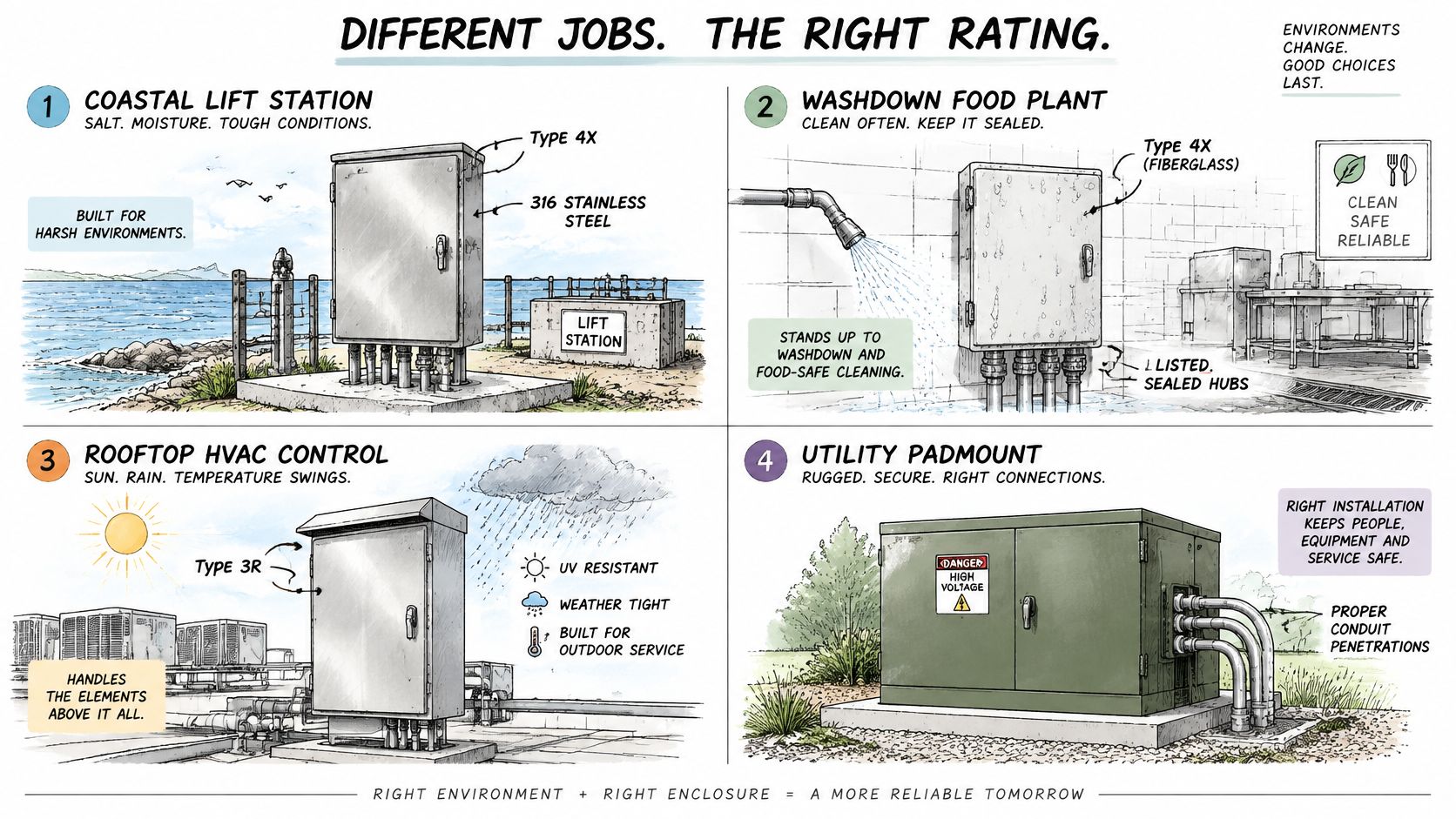
At a coastal lift station, start with corrosion-resistant construction appropriate to salt exposure, such as a suitable stainless alloy or fiberglass system. Evaluate the hubs, mounting hardware, and cable support as part of that selection. Determine elevation from applicable flood information and the project's freeboard criteria, not the position shown in a product photograph.
The drawing note needs the mounting elevation, support arrangement, and sealed-entry schedule. For flood-exposed equipment, distinguish cabinet protection from site-level measures such as watertight secondary barriers and verified penetrations. Battery-storage flood planning provides a useful model: establish the protection level and check the entire protective arrangement.
At a food plant's exterior washdown wall, account for the cleaning stream and the actual chemical used. A corrosion-resistant cabinet with an incompatible viewing window or field-added operator cutout can still be unsuitable. Require the window, operator, and sealing arrangement to be included in the accepted construction.
Add cleaning compatibility and inspection access to the drawing. Leave room for technicians to examine the door seal instead of placing pipework immediately across the opening.
Rooftop combiner and ordinary building wall
A rooftop solar combiner combines sunlight, wind-driven rain, temperature variation, and difficult access. Review the coating or polymer's outdoor suitability, mounting security, and internal moisture control. Cable routing should avoid unsupported entries and water collection around fittings.
Specify a reachable service position and a replacement path. A cabinet that requires dismantling adjacent equipment for removal creates a foreseeable outage problem, even if its ingress protection is suitable.
A building wall exposed only to falling rain may be an appropriate application for NEMA 3R pull boxes. Verify that hose cleaning, salt, and significant dust really are absent rather than assuming that all building exteriors have the same conditions.
Record entry orientation and drainage provisions on the installation detail. Preserve access to fasteners and the cover so inspection doesn't depend on removing unrelated building services.
Keep a site-risk worksheet
An ingress designation doesn't establish protection against wildfire heat, windborne debris, arbitrary flood depth, or inaccessible maintenance. Keep the remaining decisions visible in a compact worksheet:
- Hazard: Identify weather, contaminants, cleaning, and credible emergency exposure.
- Construction: Name body material, finish, hardware, and accessory compatibility.
- Elevation: State the design basis for mounting height.
- Drainage: Show approved drainage and routes that avoid water collection.
- Access: Provide working access, gasket inspection, and replacement clearance.
- Documentation: Retain drawings, approvals, inspection requirements, and replacement lead-time information.
Specify and Source the Complete Assembly
An RFQ should let a supplier quote a buildable assembly without guessing which details the installer will resolve later. The lowest cabinet price isn't a useful comparison if one quotation excludes the hubs, back panel, heater, and modifications needed for the project.
Write the specification around the delivered configuration. Separate mandatory requirements from preferences so procurement can evaluate alternatives without changing the engineering intent.
Put the essential fields in the RFQ
- Environmental designation: Required NEMA type or IP code, with the applicable project standard.
- Material and finish: Body construction, hardware, coating, and any transparent components.
- Electrical and dimensional requirements: Equipment voltage rating, usable interior space, back-panel layout, and cable-entry clearance.
- Mounting arrangement: Wall, pole, floor, or freestanding installation, including orientation and support details.
- Access and security: Hinge position, door swing, latch, lock, and authorized-access requirements.
- Installed accessories: Every hub, gland, window, operator, breather, drain, heater, and back panel.
- Required delivery: Submittal deadline, approval sequence, delivery location, and required-by date.
Ask the manufacturer to confirm in writing that the environmental rating applies to the complete proposed assembly, not merely the unmodified catalog enclosure. Request the listing or third-party test documentation available for that configuration, and resolve discrepancies before release for fabrication.
Control substitutions before they reach the field
Check compliance with the jurisdiction's adopted electrical requirements during submittal review. For government and institutional purchasing, flag Buy American Act or Trade Agreements Act requirements only when the contract imposes them, and request the corresponding documentation before ordering. Don't treat distributor location as proof of product compliance.
Lead time belongs in the approval discussion. If the preferred stainless construction isn't available when needed, fiberglass or another manufacturer's design may be an option, but it can change mounting, thermal behavior, entry methods, and maintenance practices. Obtain the engineer's written acceptance before treating it as interchangeable.
Keep a substitution register showing the proposed part, deviations, supporting documents, approval owner, and delivery commitment. That gives the contractor, panel builder, and facilities team a shared record instead of conflicting email assumptions.
For an electrical enclosure outdoor purchase, the actionable package is straightforward: an exposure description, drawing callout, accessory schedule, and required-by date. Send it to the manufacturer or a distributor with technical sourcing support so the quote addresses the specification rather than the word outdoor.
ATEK Distribution offers BOM review, hard-to-source enclosure and accessory sourcing, manufacturer coordination, and compliance-documentation support. Visit ATEK Distribution with your site exposure, drawing callout, and required-by date to discuss availability and alternatives for engineering approval.