
A 2 HDPE pipe is a nominal size, not a fixed bore. IPS PE4710 pipe at that size has an outside diameter of about 2.375 inches, and the SDR, which sets wall thickness, determines the inside diameter and pressure rating.
The popular advice is to order by nominal diameter and let the supplier sort out the rest. That's where substitutions fail. Two pipes can share the same outside diameter, fit the same trench, and still differ on pressure class, flow area, fitting compatibility, and potable water listing. If you're buying for water service, conduit, telecom duct, or a trenchless pull, the spec line decides whether the product passes. The label doesn't.
Table of Contents
- 2-Inch HDPE Pipe Dimensions and Pressure Ratings at a Glance
- Why One Nominal Size Hides Several Different Pipes
- Reading PE80, PE100 and PE4710 Resin Designations
- Water, Conduit, Telecom and Trenchless Applications for 2-Inch HDPE
- How to Join 2-Inch HDPE Pipe in the Field
- Advantages and Limits Engineers Weigh Before Choosing HDPE
- Confirm the Spec Before You Order 2-Inch HDPE Pipe
2-Inch HDPE Pipe Dimensions and Pressure Ratings at a Glance
At the same 2.375-inch outside diameter, a 2-inch IPS HDPE pipe can have different wall thicknesses, bores, and pressure ratings. The specification line, not the nominal size, determines whether a substitute fits the design. For temporary water systems, the Philadelphia Water Department temporary water specification permits PE4710 pipe at DR 9, rated 250 psi, or DR 11, rated 200 psi. Those are different pressure classes, not a single minimum for the size.
Reading the Table in Three Steps
Check the SDR or DR on the pipe marking and in the specification. Then compare its wall thickness and inside diameter with the approved product data. Finally, confirm the pressure rating and its temperature basis before approving a substitution.
2-inch IPS HDPE pipe by SDR, wall, bore and pressure
| Standard dimension ratio (SDR) | Wall thickness (in) | Inside diameter (in) | Pressure rating (psi) |
|---|---|---|---|
| SDR 7 | 0.339 calculated | 1.697 calculated | 333 |
| SDR 9 | 0.264 calculated | 1.847 calculated | 250 |
| SDR 11 | 0.216 to 0.219 | 1.937 to 1.943 | 200 |
| SDR 17 | 0.140 calculated | 2.096 calculated | 125 |
The SDR 7 and SDR 9 dimensions are calculated from a 2.375-inch outside diameter, using wall thickness = outside diameter ÷ SDR and inside diameter = outside diameter − 2 × wall thickness. The SDR 11 range follows those same calculations using its listed wall range. SDR 17 is calculated from the same OD basis. Confirm all dimensions against the manufacturer's table before ordering. Pressure ratings are commonly quoted at 73°F and must be derated for higher service temperatures.
Caveats That Change an Order
Published dimensions can vary by product and manufacturer. Use the exact submittal for the pipe being approved, particularly when fusion fittings or mechanical couplings must match the pipe's outside diameter and pressure class.
Practical rule: Confirm the SDR first. The bore value only applies to that wall thickness.
The municipal specification's DR 9 and DR 11 ratings apply to its stated requirements. Other owners may specify a different class for the same nominal size. Temperature also affects the allowable pressure, so a rating at 73°F does not automatically apply unchanged in warmer service.
A purchase request that says only “2-inch HDPE pipe” leaves the SDR unresolved. That choice changes the bore, wall, pressure capacity, surge tolerance, and fitting compatibility. Specify the required SDR and pressure class, then verify the dimensions against the approved product data.
Why One Nominal Size Hides Several Different Pipes
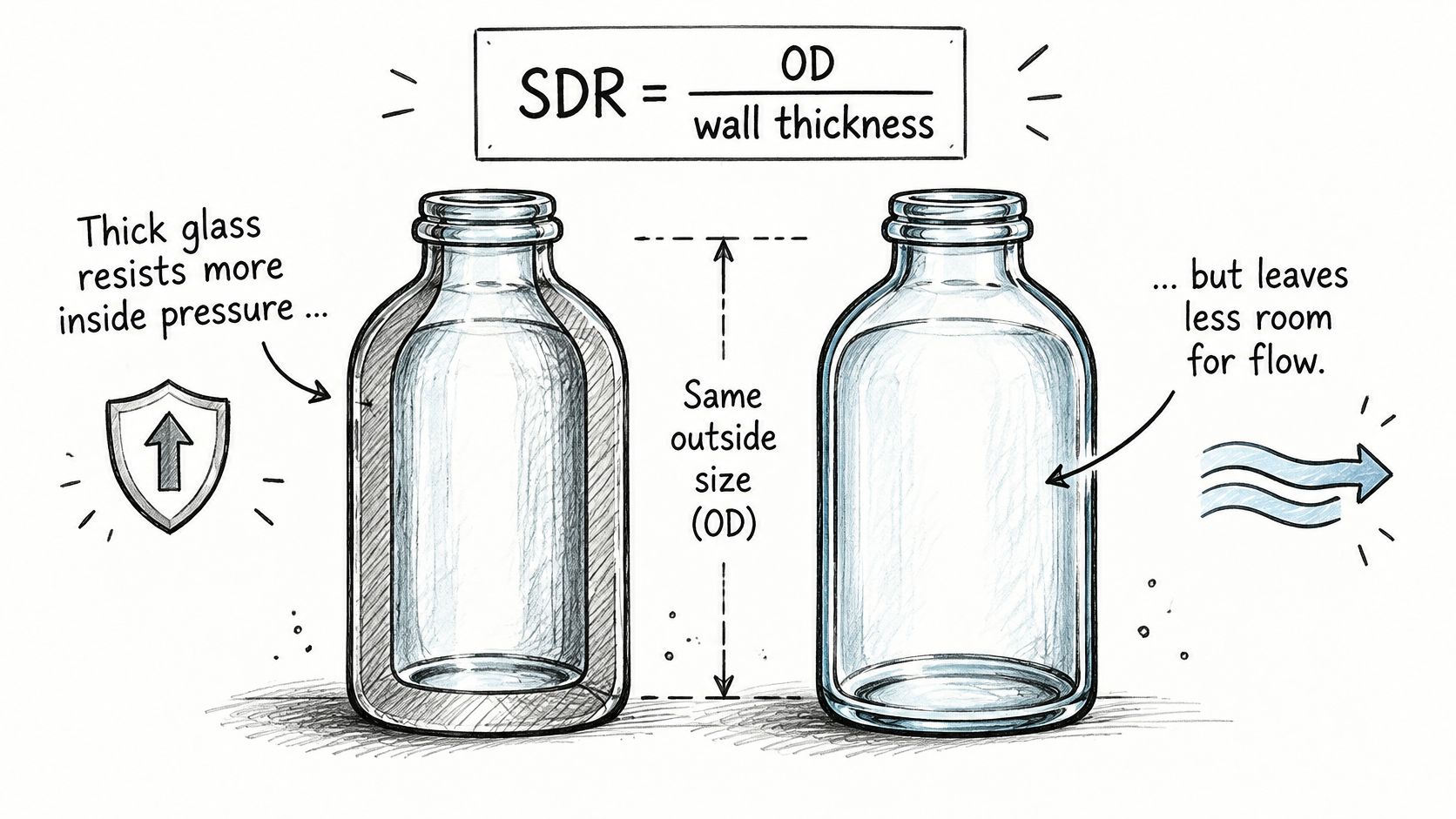
A 2-inch HDPE pipe is several products, not one. The nominal size does not establish the bore, wall thickness, or pressure capacity. SDR, the ratio of outside diameter to wall thickness, changes all three while the outside diameter stays the same. With a 2.375-inch OD, a calculated SDR 11 wall is about 0.216 inch, leaving an approximate 1.943-inch bore. At SDR 17, the calculated wall is about 0.140 inch, leaving an approximate 2.095-inch bore. These are geometric estimates; use the product submittal for manufacturer-specific dimensions and ratings.
More Bore Is Not Free
A larger bore can increase flow area, but the thinner wall also changes the pressure rating. One listed 2-inch SDR 11 PE4710 product is rated at 200 psi; its listing and linked dimensions are available from SiteOne's SDR 11 pipe product data. Do not assume that rating applies to another SDR or manufacturer. Check the specified product's rating against operating and surge pressures, with the applicable temperature basis.
The Sizing System Trap
A metric pipe described as 63 mm OD measures about 2.48 inches across, unlike 2-inch IPS pipe at 2.375 inches. The JSK 2-inch HDPE listing illustrates why the sizing system matters. Confirm IPS or metric, actual OD, SDR, and fitting compatibility before approving a substitute.
The same nominal label can mislead when comparing raceways. Check the usable opening of the 2-inch PVC conduit, not just its trade size.
Electrical conduit requires its own dimensional check. Southwire lists a construction with a 2.375-inch OD and 0.261-inch wall. Those dimensions yield an approximate 1.853-inch bore, not 1.917 inches. Use the listed construction and applicable conduit standard for fill and pulling checks, as shown in the Southwire cable specification. Pressure pipe is not an automatic conduit substitute; verify its listing against UL 651A and NFPA 70.
Reading PE80, PE100 and PE4710 Resin Designations
The resin designation reflects the minimum required strength, or MRS, that the material is classed for. It doesn't set the pressure rating by itself. The rating combines material strength, a design factor, and the SDR, so two pipes at the same SDR can carry different ratings if the resin class differs.
PE4710 is the ASTM D3350 designation for a PE100-class resin. That means PE4710 and PE100 sit in the same strength class when the material meets the designation. It doesn't mean every product described loosely as PE100 automatically satisfies a specification that calls out PE4710, a named standard, and traceability.
PE80, PE100 and PE4710 designations for a 2-inch order
| Designation | Minimum required strength (MRS) | What it means for a 2-inch order |
|---|---|---|
| PE80 | 8.0 MPa | Lower strength class; the pressure rating at a given SDR is lower than PE100, so never substitute without re-rating |
| PE100 | 10.0 MPa | Higher strength class; the rating still depends on the chosen SDR, so confirm it against the manufacturer table |
| PE4710 | 10.0 MPa class | The designation named in the 2-inch temporary water specification; confirm it on the resin certificate |
The pressure rating still depends on SDR and temperature basis. A stronger resin doesn't rescue an SDR that's too thin for the operating and surge pressures. A thicker wall doesn't fix a resin certificate that doesn't match the specified designation.
Grade Alone Does Not Finish the Design
The Plastics Pipe Institute identifies pressure rating or class, buried-pipe design, and thermal design as core considerations for polyethylene piping systems, as set out in its HDPE Handbook purchase and publication page. Those three checks explain why a buyer can't approve an alternate on resin name alone. Burial conditions and temperature can control the selection even when steady pressure looks acceptable.
Compare two order lines. "PE4710, DR 11, 200 psi, IPS, AWWA C901" can be priced, submitted, and checked. "PE100 2-inch pipe" can't. The second line leaves out sizing system, SDR, pressure class, temperature basis, governing standard, and fitting requirements.
Grade tells you the strength class of the resin. It doesn't prove compliance for the service.
Keep material grade and compliance separate in review. NSF/ANSI 61 concerns contact with potable water and doesn't prove the resin grade. Ask for the resin certificate and traceability records alongside the dimensional table, pressure class, and listing documents. If a supplier proposes PE80 where PE100 or PE4710 was specified, require a re-rating at the actual SDR and temperature before anyone treats it as an equal.
Water, Conduit, Telecom and Trenchless Applications for 2-Inch HDPE
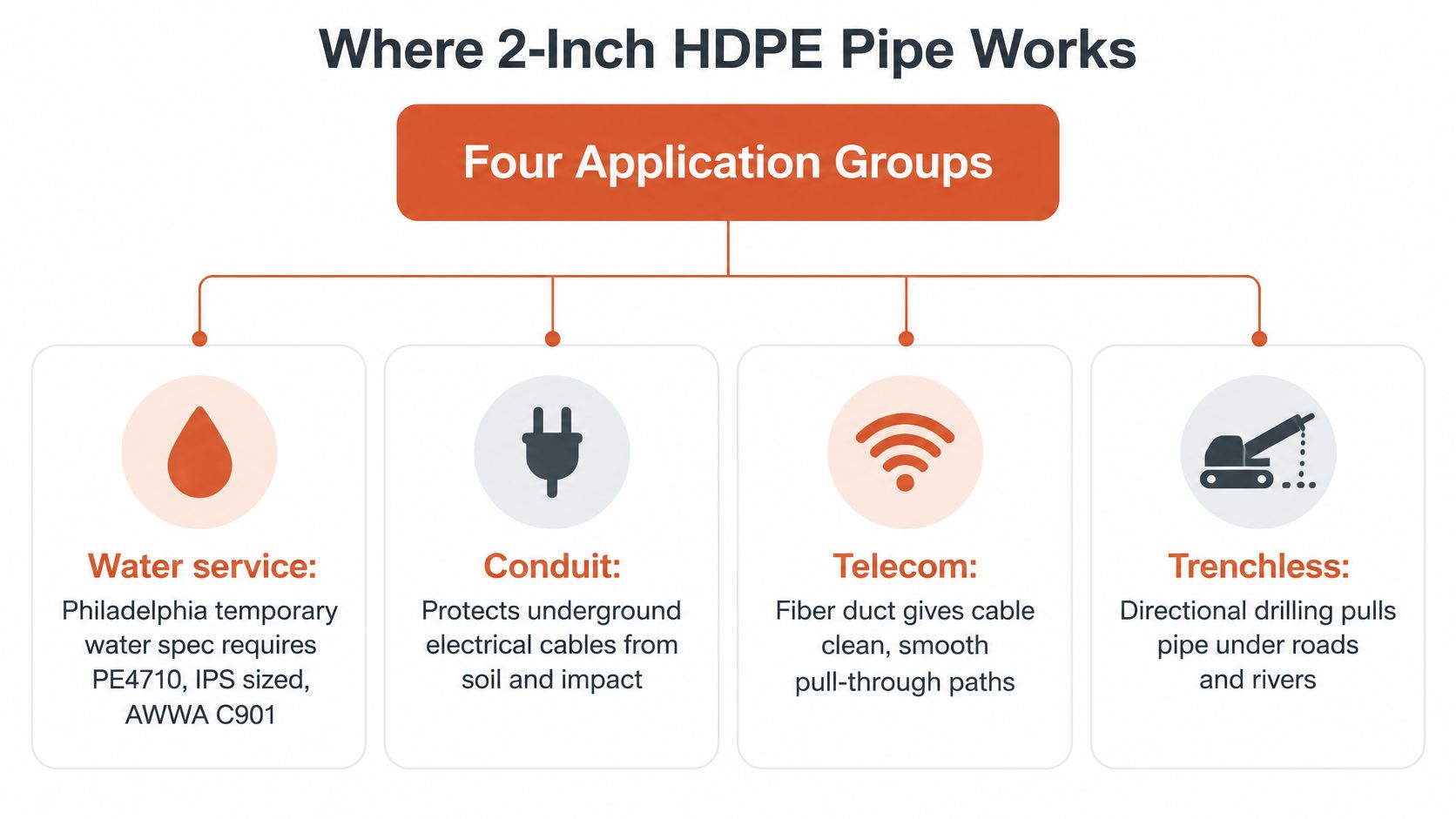
A 2-inch HDPE pipe is several products, not one. Pipes with the same nominal size can have different bores, walls, pressure ratings, and approved uses. The application sets the governing specification, so check service, sizing system, SDR, standard, and joining requirements before approving a substitute.
The diagram groups four applications that purchasing teams often see together on early bills of material.
Water Service
A Philadelphia temporary potable-water specification pairs PE4710, IPS sizing, AWWA C901, and NSF/ANSI 61 with either DR 9 at 250 psi or DR 11 at 200 psi. Fittings must be rated at least equal to the selected pipe. The SDR-to-pressure pairing matters: a DR 11 product rated at 200 psi does not meet a requirement for DR 9 at 250 psi, but it may comply where the specification allows either pairing.
Review the pipe and fittings together. A lower-rated fitting limits the pressure rating of the assembled system, even if the pipe itself meets the listed class. Submittals should identify both ratings on the same basis.
Electrical Conduit
UL 651A defines HDPE conduit as a rigid nonmetallic raceway for wires and cables under NFPA 70. Its normal ambient application is 50°C (122°F) or lower, according to the UL 651A standard listing on ANSI Webstore. The standard covers Schedule 40, Schedule 80, EPEC-A, EPEC-9, EPEC-11, and EPEC-13.5 constructions. Specify the construction, not only the nominal trade size.
For a buried feeder, the listing summary permits wiring rated up to 90°C (194°F) when the conduit is directly buried or concrete-encased outside buildings. Aboveground use requires encasement in at least 2 inches (50 mm) of concrete. Check installation method and cable temperature rating; the trade size alone establishes neither.
Conduit substitutions also require more than a bore comparison. For larger runs, the same checks apply when comparing 4-inch conduit: construction, fill, encasement, and temperature basis must suit the installation.
Telecom Duct and Trenchless Work
Telecom and communications duct requirements often come from the owner or utility. Before release, confirm the governing specification, duct size, pull-line requirements, and bend requirements. A product can match a generic dimensional description and still fail an owner's requirements for pulling or identification.
Trenchless installation adds loads that ordinary service comparisons may miss. Directional drilling and pipe bursting impose pull or burst forces on the pipe and joints during installation. The engineer of record must account for installation stress when selecting SDR, wall, and joints. A catalog match on nominal size is not a substitute for that review.
Governing references and checks by 2-inch HDPE application
| Application | Governing reference | Checks before approval |
|---|---|---|
| Potable water service | AWWA C901 and NSF/ANSI 61 | PE4710, IPS sizing, specified DR-to-pressure pairing, NSF/ANSI 61 listing, fittings rated at least equal to the pipe |
| Electrical conduit, buried or encased | UL 651A and NFPA 70 | Normal 50°C ambient rating; 90°C cable rating only for direct-buried or concrete-encased use outside buildings |
| Electrical conduit, aboveground | UL 651A and NFPA 70 | At least 2 inches of concrete encasement; confirm listed construction and temperature basis |
| Telecom and communications duct | Owner or utility specification | Confirm governing standard, duct size, pull-line, and bend requirements |
| Trenchless installation | Engineer of record and owner specification | Select SDR and wall for pull or burst loads; confirm joint method and tensile limits |
Use the project's governing document to assess each application. Different owners can approve different products for similar work, and a nominal size cannot identify the correct specification.
How to Join 2-Inch HDPE Pipe in the Field
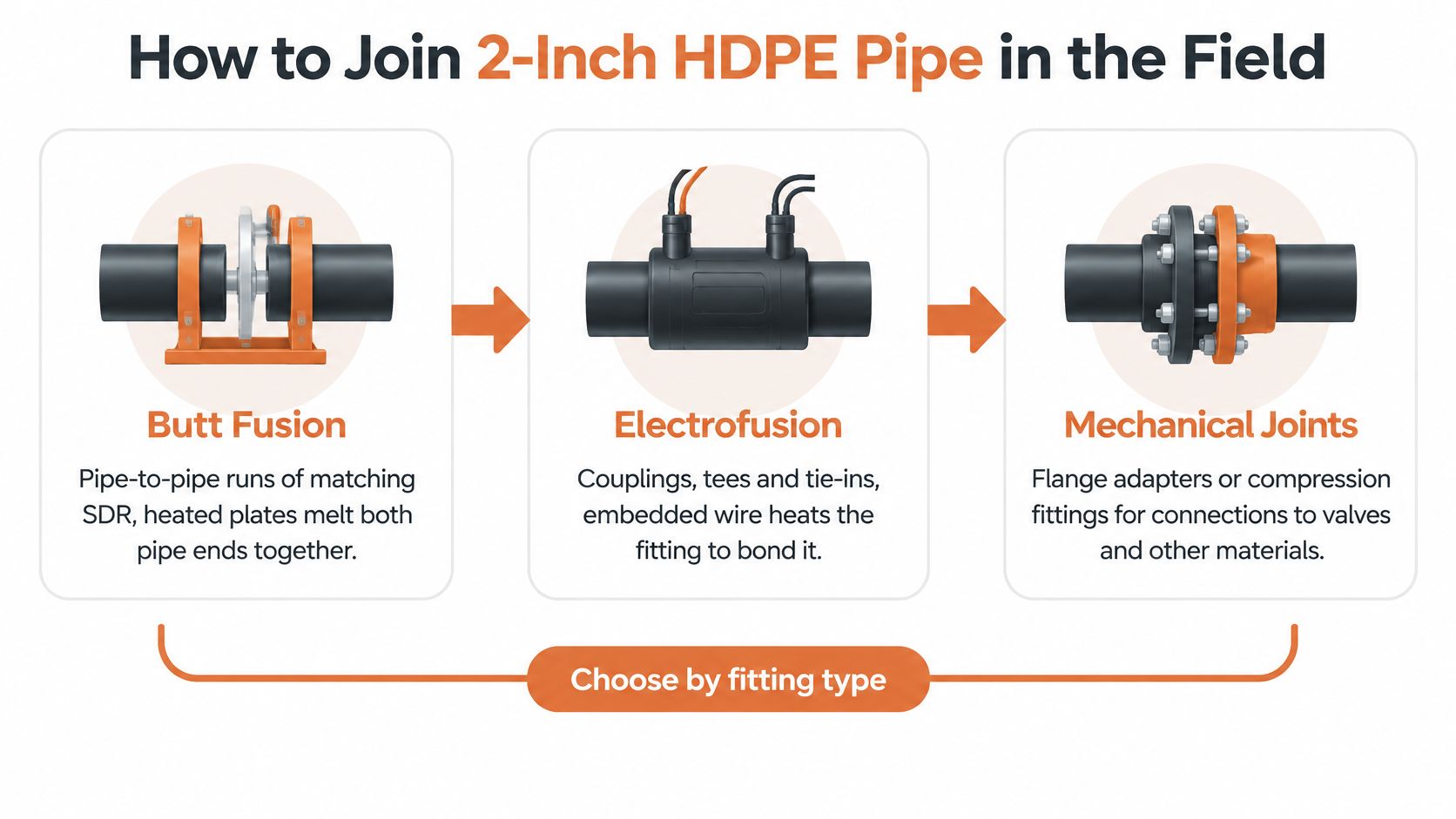
There are three joint families to sort before material arrives. Butt fusion suits pipe-to-pipe runs of matching SDR. Electrofusion suits couplings, tees, and tie-ins. Mechanical joints, such as flange adapters or compression fittings, suit valves, metallic pipe, and connections that can't be fused.
The three options are easiest to compare by fitting type.
Fusion isn't a preference you state casually. Many specifications require field assembly by butt fusion, with electrofusion where appropriate, and require the completed joint to have strength equal to or greater than the pipe. One detailed specification gives butt-fusion conditions of about 400°F, an optimum of 425°F, a maximum of 450°F unless the manufacturer directs otherwise, and 75 psi interfacial fusion pressure, as documented in the HRSD HDPE pipe and fittings specification.
Butt Fusion Procedure in the Field
- Confirm match: Verify pipe SDR, outside diameter, and fitting compatibility before heating anything.
- Confirm qualification: Verify the technician and machine are qualified for the pipe size, method, and equipment being used.
- Clean and clamp: Clean the ends, clamp them, and check alignment so the joint doesn't start misaligned.
- Face both ends: Face to a clean surface suitable for heating and fusion.
- Heat to procedure: Heat to the specified temperature for the specified time under the manufacturer procedure.
- Join and hold: Bring the ends together at the specified interfacial pressure and hold until cool.
- Inspect and log: Inspect the bead and record the joint for traceability.
- Pressure test: Test the completed work per the specification before acceptance.
That sequence is a summary for planning and submittal review. The manufacturer procedure governs the actual work, including heating, changeover, pressure, and cooling controls.
The video below helps crews visualize the handling sequence before they review the written procedure for the specific machine and fitting system on site.
Public works requirements also restrict fusion to formally trained and currently qualified technicians, with qualification tied to method, pipe size, and equipment. Request qualification records, fusion logs, machine capability information, and the test plan with the submittal. Don't accept a generic statement that the pipe is fusion compatible as proof the joint will pass.
Advantages and Limits Engineers Weigh Before Choosing HDPE
Most buyers start with hydraulics. Engineering guidance for gravity flow at the same internal diameter reports that PE pipe can provide approximately 44% greater flow capacity than concrete or clay pipe, reflecting Manning-equation behavior rather than a universal guarantee, according to the Plastics Pipe Institute hydraulic design advisory for pipe bursting.
That comparison doesn't finish a 2-inch calculation. Fittings, valves, entrance losses, elevation change, surge, and actual inside diameter may dominate, especially because SDR selection changes the bore. Use manufacturer dimensional data and a documented hydraulic method for the actual system.
Where HDPE Earns Its Place
- Smooth internal surface: Lower effective roughness reduces friction losses and supports efficient flow.
- Continuous fused bore: Butt-fused or electrofused joints preserve the internal path when they're made and inspected correctly.
- Flexibility: The material suits coiled supply, curved alignment within design limits, and trenchless installation methods.
- Corrosion resistance: Polyethylene avoids the corrosion mechanisms that drive replacement in some metallic systems.
- Long-term pressure basis: Material selection rests on validated long-term pressure performance and service-life design, not only on light weight.
Transient pressure still needs a separate check. HDPE flexibility can reduce water-hammer severity relative to rigid materials, but rapid valve closure and pump trips can still exceed the steady-state pressure rating. Comparing HDPE with options such as conduit in stainless steel makes the trade off clear. You're choosing between flexibility and corrosion behavior on one side and rigidity and different joining or protection expectations on the other.
Limits to Price Into the Decision
- Temperature derating: Pressure ratings quoted at a reference temperature must be reduced for higher service temperatures.
- Thermal movement: Expansion and contraction on long runs need design attention at terminations and connections.
- UV exposure: Outdoor exposure needs protection or a product and installation method approved for that condition.
- Conduit restrictions: Electrical use brings ambient temperature, cable rating, burial, and concrete encasement rules.
- Repair method: Repairs may need fusion equipment or matched mechanical fittings rather than a simple universal coupling.
Choose HDPE where buried, flexible, or trenchless runs benefit from fused joints and corrosion resistance more than rigidity.
Confirm the Spec Before You Order 2-Inch HDPE Pipe
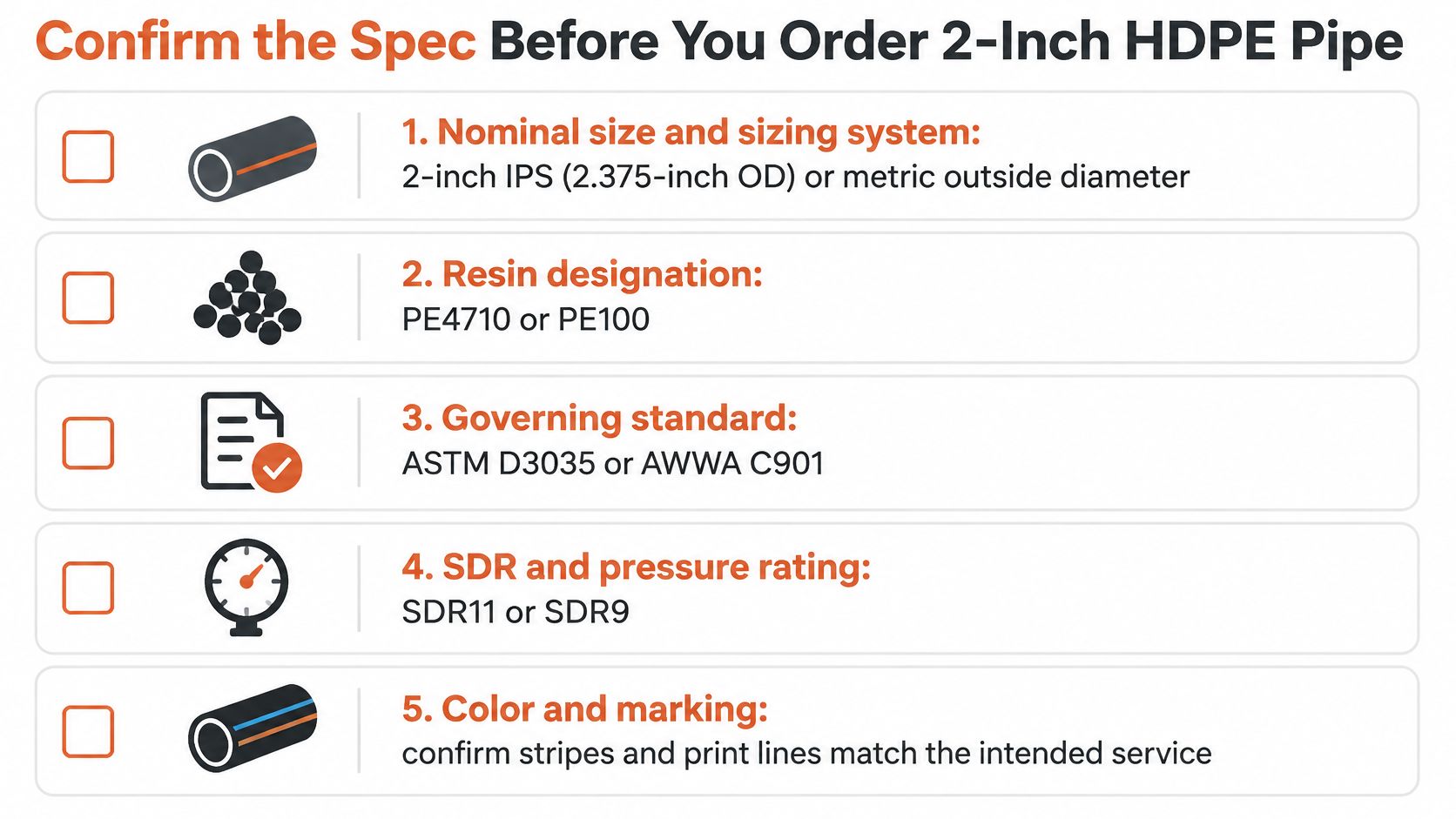
A complete RFQ prevents the most common substitution error. A product can fit physically and still fail pressure, certification, or submittal requirements. The checklist below turns a vague 2 HDPE pipe request into something an engineer can approve and a supplier can quote without guessing.
RFQ Checklist for the BOM Line
- Size and sizing system: State nominal size and whether the outside diameter basis is IPS or metric.
- Resin designation: State PE4710, PE100, or the exact grade required, with certificate requirements.
- Governing standard: Name the ASTM, AWWA, UL 651A, or owner specification that controls.
- SDR and pressure class: State SDR or DR, pressure class, and temperature basis together.
- Potable listing: State NSF/ANSI 61 status where the line contacts drinking water.
- Application conditions: For conduit, state ambient rating, cable temperature rating, burial method, and encasement.
- Fittings: Require fitting type and pressure rating matched to the pipe's actual outside diameter.
- Joining method: State butt fusion, electrofusion, or mechanical joining and the qualification required.
- Submittals: Require dimensional tables, resin certificates, listings, and traceability records.
- Alternate rules: State which changes need engineer approval before substitution.
The municipal example shows why item 4 can't be left blank. A specification listing DR 9 at 250 psi and DR 11 at 200 psi, with AWWA C901, PE4710, NSF/ANSI 61, and fittings rated at least equal to the pipe, is described in the Philadelphia temporary water systems specification from April 2025. Compare that with a line that only says "2-inch HDPE pipe." The first can be reviewed. The second invites every supplier to quote a different product.
Send the checklist with the RFQ and have the BOM line reviewed before the order is placed. Review should cover operating pressure, recurring and occasional surge, temperature, burial conditions, and water-hammer risk where they affect SDR selection. It should also confirm that an IPS product hasn't been confused with a metric or other sizing system product, and that conduit and raceway items for electrical work carry the right listing for the installation method. That review is faster before purchase than after pipe reaches the trench.
If a 2-inch HDPE line is holding up a package, send the full spec line, SDR, pressure basis, and fitting list to ATEK Distribution for BOM review, compliance documentation, and sourcing support on approved products or alternates. We'll help you check conduit, raceway, and hard-to-source electrical components against the project requirements and submit a request for quote with the details suppliers need to quote the right product the first time.