
Four-inch conduit is a nominal trade size, not a fixed dimension or a guaranteed conductor capacity. A 4-inch Schedule 40 PVC raceway has about 12.554 square inches of internal area, while 4-inch EMT has about 14.753 square inches, so the same trade-size label can mean different usable space.
That's why the popular shortcut, “Pick 4-inch conduit and check the wire count,” can steer a project wrong. The right selection depends on the raceway material and wall, conductor dimensions, pull geometry, and the requirements of the owner or serving utility. For industrial, utility, and institutional work, specifying only “4-inch conduit” leaves too much open to interpretation.
Table of Contents
- Why 4 Inch Conduit Is Not One Product
- The Four Main 4 Inch Conduit Types
- PVC EMT IMC and RMC Compared Side by Side
- How Conduit Fill Actually Works for 4 Inch
- Bends Pull Length and Pull Box Sizing
- Fittings Couplings Bodies and Supports for 4 Inch
- Underground Installation Specifics for 4 Inch
- Matching NEC Fill to Owner and Utility Standards
- Sourcing 4 Inch Conduit and Building the BOM
- Quick Reference Checklist for 4 Inch Conduit
Why 4 Inch Conduit Is Not One Product
“Four inch” describes a trade size, not a universal inside or outside diameter. The difference is more than terminology. It affects conductor fill, fittings, supports, sleeves, and whether a substituted product will pass review and fit the installation.
For example, a published NEC-based dimensional reference lists 12.554 square inches of internal area for 4-inch Schedule 40 PVC and 14.753 square inches for 4-inch EMT. That's a substantial difference in available raceway area, even though both products carry the same trade-size label. Rigid metal conduit has a different internal area again, so a generic 4-inch wire-count chart isn't a safe basis for every material. (NEC-based conduit area reference)
The basic terms matter when reading a submittal:
- Trade size is the nominal size used to identify the raceway.
- Outside diameter (OD) is the physical measurement across the exterior.
- Inside diameter (ID) determines the area available for conductors.
- Wall thickness affects the relationship between OD and ID.
- Schedule identifies a PVC wall designation, such as Schedule 40 or Schedule 80.
A 4-inch PVC-coated rigid steel example makes the gap between label and dimension plain. ABB/Ocal lists a coated OD of 4.58 inches, nominal wall thickness of 0.27 inches, and an inside diameter of about 4.05 inches; the trade size is designated 103 millimeters, while the measured coated OD is 116.30 millimeters. (ABB/Ocal 4-inch PVC-coated rigid steel conduit)
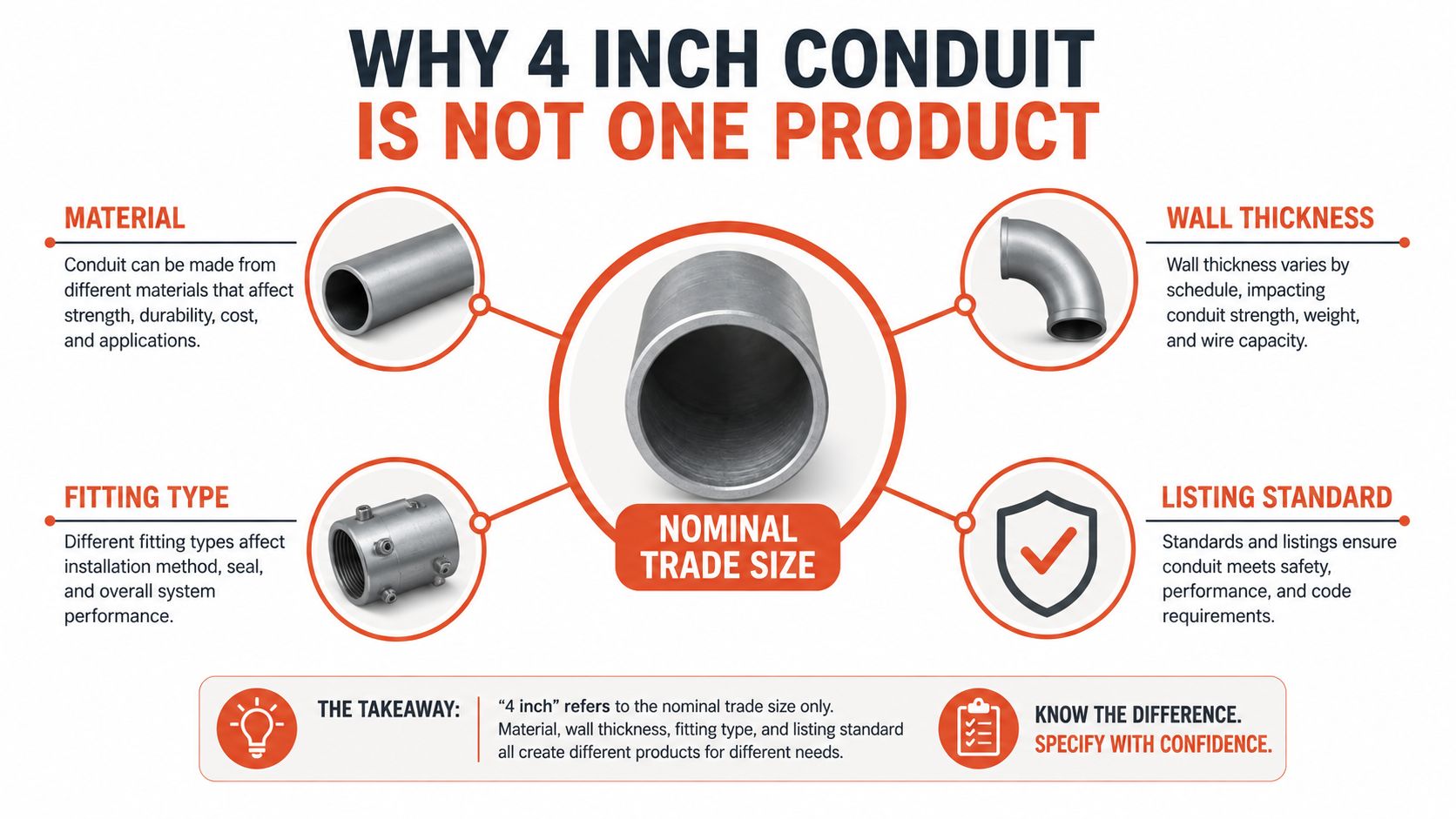
Treat the conduit type, wall or schedule, coating, certification, and length as part of the specification, not as details to be sorted out after the order. For teams managing site records and installed conditions, a reality capture documentation guide offers useful context for documenting what was installed.
The Four Main 4 Inch Conduit Types
PVC is the standard choice for many underground duct applications. It's lightweight and nonconductive, and its wall designation affects the interior area and physical characteristics. Schedule 40 and Schedule 80 aren't interchangeable descriptions: confirm the product dimensions and the project's specified standard. PVC joints use compatible solvent-weld fittings, and the installation must account for burial conditions, bends, and thermal movement where relevant. Product specifications commonly identify UL 651 and NEMA TC-2 for rigid PVC electrical conduit, with installation requirements addressed by NEC Article 352. (Schedule 40 PVC product specification)
Rigid metal conduit (RMC) provides a durable metal raceway for applications where mechanical protection is a priority. Its threaded ends connect through threaded fittings and couplings. Where corrosion is a concern, PVC-coated rigid steel is a distinct product line, not a coating detail to assume comes standard. Specify the coating and compatible fittings together.
Intermediate metal conduit (IMC) is a metal option when the design calls for a rigid raceway but the project team wants a different balance of wall construction and handling than RMC. It uses threaded connections and requires fittings selected for the conduit type. Check the applicable project specification and product documentation rather than treating IMC as a direct substitute based on trade size alone.
Electrical metallic tubing (EMT) is commonly selected for indoor installations where its product characteristics and physical protection suit the route. EMT uses compatible set-screw or compression connectors and couplings, rather than threaded joints. Its internal area differs from PVC and rigid metal products, so an EMT fill calculation can't be transferred directly to another raceway type.
Sourcing rule: Name the raceway material and construction before comparing price or availability. “Four inch” alone isn't enough for an equivalent-product review.
PVC EMT IMC and RMC Compared Side by Side
Start with the environment and installation method, then check the applicable code article and product listing for the exact product. The table is a selection aid, not a substitute for the product's marked specifications or project requirements.
| Type | NEC Article | Wall | Joining | Best For |
|---|---|---|---|---|
| PVC | Article 352 | Schedule-specific nonmetallic wall | Solvent-weld fittings | Underground duct and other permitted PVC applications |
| EMT | Article 358 | Thin-wall metal tubing | Set-screw or compression fittings | Indoor routes where EMT's protection and installation method fit |
| IMC | Article 342 | Intermediate metal conduit | Threaded fittings | Metal raceway applications needing a rigid option |
| RMC | Article 344 | Heavy-wall rigid metal conduit | Threaded fittings | Installations prioritizing mechanical protection |
The practical choice is straightforward. Use PVC where the design calls for a nonmetallic underground raceway and the project accepts its schedule and installation details. Choose RMC when the specified environment calls for rigid metal protection; use PVC-coated RMC where the coating system is required and approved. IMC can serve as the metal-raceway middle ground when its product specification fits the job. EMT is a sensible indoor choice when the installation conditions, supports, fittings, and project documents allow it.
Don't treat a material change as a simple purchasing substitution. The ID, bend behavior, joining method, and permitted use can change with the product. Review the practical distinctions in this EMT versus rigid conduit comparison before accepting a substitution.
How Conduit Fill Actually Works for 4 Inch
Conduit fill is based on the combined cross-sectional area of the conductors, not the trade-size label or a generic wire count. Under NEC Chapter 9, Table 1, the commonly applied maximum fill is 53% for one conductor, 31% for two, and 40% for three or more. A qualifying nipple no longer than 24 inches may use a 60% limit. (NEC Chapter 9 fill reference)
For a 4-inch EMT example, one published reference gives an internal diameter of 4.000 inches, a total internal area of 12.560 square inches, and an allowable area of 5.024 square inches at 40% fill for three or more conductors. The check is simple in principle:
- Identify the exact raceway type and its interior area.
- Add the actual cross-sectional areas of the conductors.
- Compare the total conductor area with the allowable fill for the conductor count.
The example's arithmetic is 12.560 × 0.40 = 5.024 square inches. That allowable area applies to the stated EMT example and fill condition. A different 4-inch raceway can have a different interior area, and the conductor areas depend on the actual insulation and dimensions. (4-inch EMT conduit-fill example)
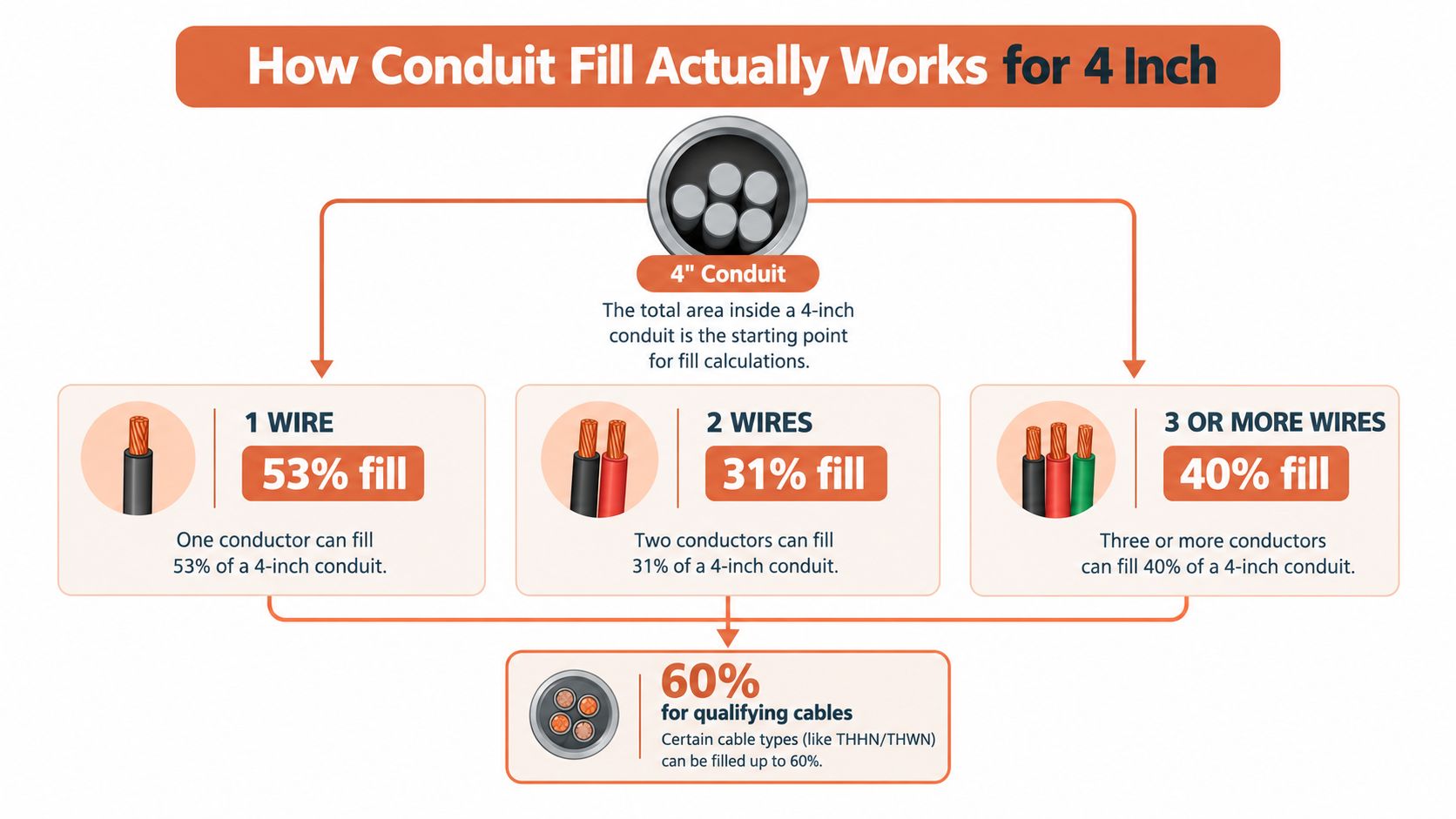
A published conductor-count chart is only a shortcut for the wire types and sizes it covers. Change the insulation, conductor dimensions, grounding conductors, cable assembly, or raceway material and the calculation needs to be checked again. A fill calculation also doesn't prove that the conductors can be pulled through the planned route.
For a visual walkthrough of the fill concept, use the video below alongside the project's actual conductor and raceway data.
Bends Pull Length and Pull Box Sizing
A 4-inch raceway can pass the fill calculation and still be a poor pull. The route's total bend, sweep radius, pull-point spacing, conductor arrangement, and pulling limits determine whether the installation is workable. For EMT, NEC Article 358.26 limits the cumulative bends between pull points to 360 degrees, equivalent to four quarter-turns. (EMT bend-limit reference)
Sweep radius deserves attention before the conduit is ordered. Utility requirements can differ by application: APS calls for at least a 36-inch sweep for three-phase 4-inch conduit, while communications systems may require a 48-inch minimum radius for 4-inch conduit. (APS underground construction guidance) The route still needs to be checked against the serving utility's current standard and the cable manufacturer's pulling limits.
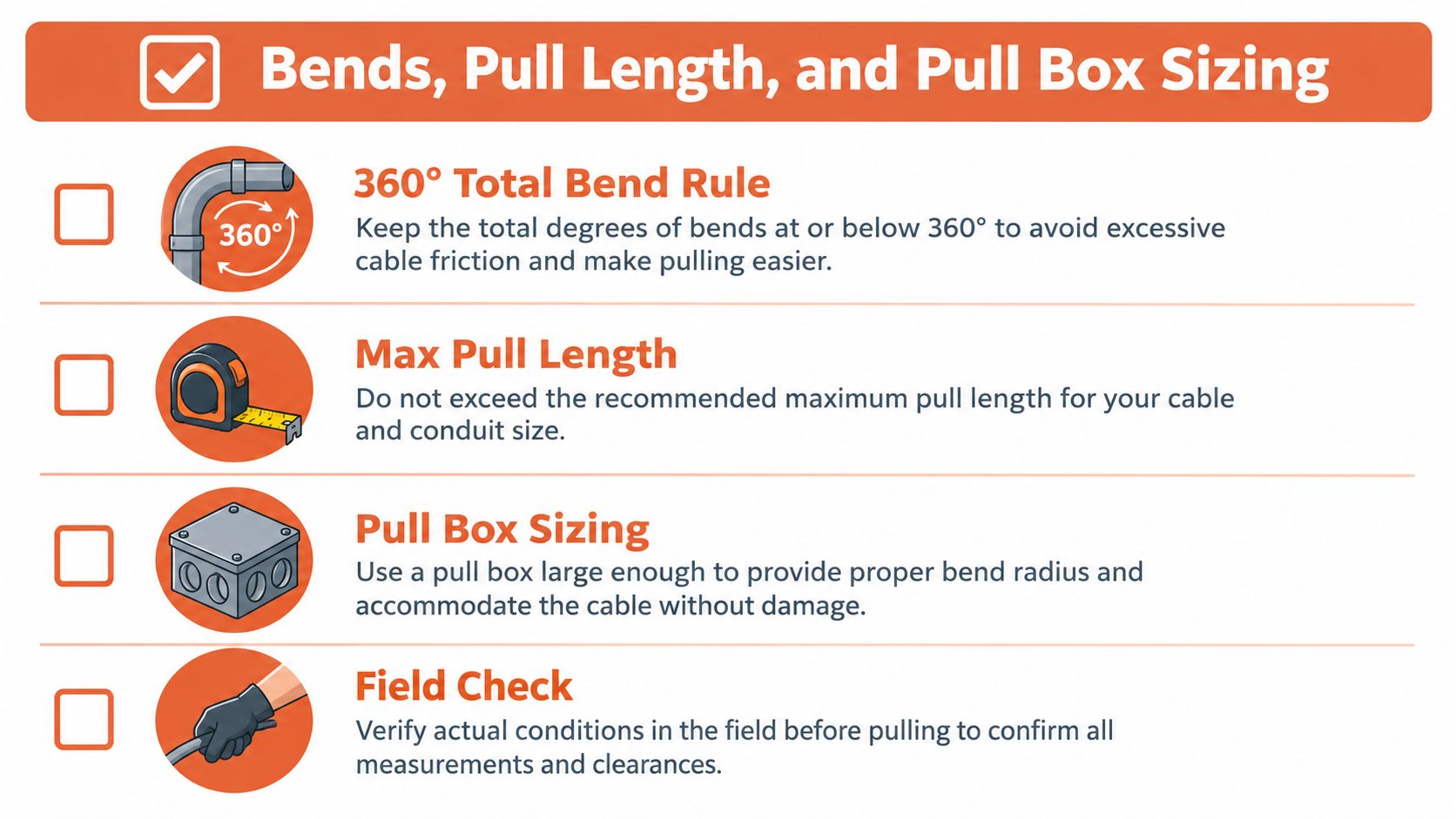
For conductors 4 AWG or larger, NEC 314.28 sets minimum pull-box dimensions for angle and straight pulls, subject to applicable provisions and any listed, marked exception. A commonly applied angle-pull factor is six times the largest raceway trade size. For a 4-inch entering raceway, that factor gives 24 inches for the relevant dimension; the complete calculation must account for all entering raceways and the pull arrangement. (Pull-box sizing guidance)
A compliant fill calculation doesn't guarantee a practical pull. If the route combines large conductors, long pulls, and multiple bends, evaluate a pull point or a larger raceway before crews are committed to the installation. A 5-inch option may reduce pulling risk more effectively than relying on added lubricant or crew effort, but it still needs engineering and owner approval.
For a route that needs a directional fitting, verify its radius and raceway compatibility against the drawings and project standard before ordering a 4-inch conduit elbow.
Fittings Couplings Bodies and Supports for 4 Inch
A clean takeoff includes more than straight lengths. At this size, the wrong fitting can create a mismatch in raceway material, connection method, or usable pull geometry. Confirm that every accessory matches the specified conduit and the installation conditions.
Build the fitting schedule around the route:
- Couplings and connectors: Match the raceway type and joining method. Threaded metal conduit needs compatible threaded fittings; EMT needs the specified EMT connectors and couplings; PVC needs compatible PVC fittings.
- Conduit bodies: Identify whether the route calls for LB, LL, LR, T, or C bodies, and confirm the product is suitable for the conductor arrangement and access needs.
- Pull and junction boxes: Size them for the actual conductors and entry directions, not just the nominal conduit size. Check the applicable pull-box rules and enclosure requirements.
- Supports: Select hardware for the conduit material, installed conditions, and project requirements. Don't assume a support detail for a smaller raceway applies unchanged to a large run.
- Expansion fittings: Include them where an exposed PVC route's temperature variation and manufacturer guidance warrant movement accommodation.
- Firestopping: Identify rated wall and floor penetrations on the drawings and coordinate the approved firestop system with the actual conduit and opening.
The missed items are usually the ones that appear late: compatible locknuts or bushings, transitions, expansion provisions, supports, pulling accessories, and the right box or body at a change in direction. Add these to the BOM before release. That's less expensive and disruptive than resolving a mismatch during installation or inspection.
Underground Installation Specifics for 4 Inch
A 4-inch trade size does not set the burial assembly. The cited Alaska DOT raceway installation guidance calls for at least 50 millimeters of lateral clearance on both sides, 450 millimeters of cover below finished grade, and 50 millimeters of bedding beneath the conduit. Treat those figures as project requirements only where that specification applies. Loading, frost, nearby utilities, or occupancy may call for greater cover.
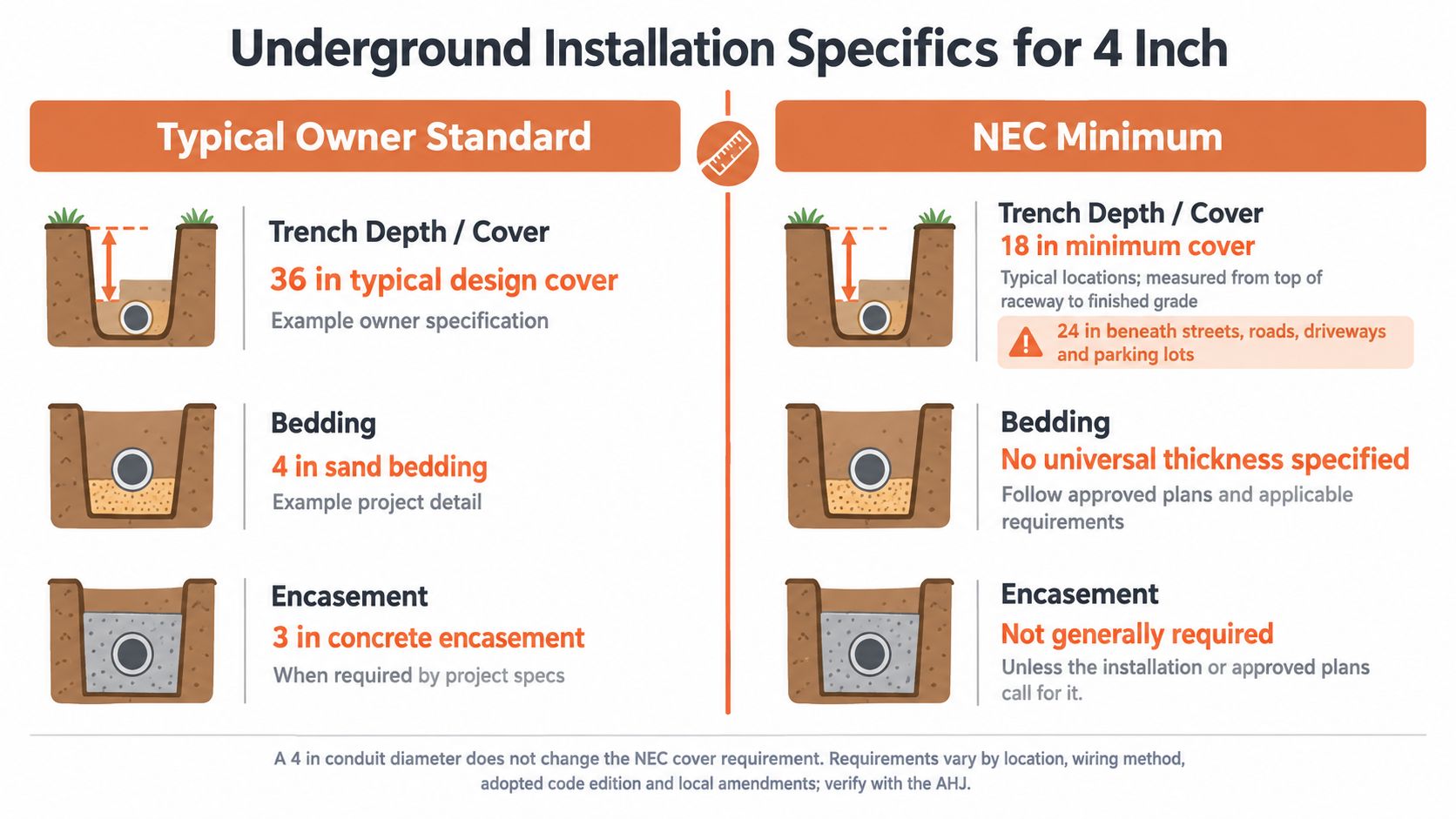
Set a clear field handoff before excavation. Hold trenching until bedding material, cover depth, encasement detail, and inspection hold point are signed on the same sketch, with conduit schedule and sweep radius noted by station. Record the serving utility's current sweep-table number and revision date in the submittal matrix before ordering elbows. Requirements vary by owner and application, so never carry a sweep detail from one project into another.
For field-cut PVC, make square cuts, deburr and ream the ends, and reject visibly deformed sections or sharp kinks. Form bends only by a manufacturer-approved method. Confirm whether the design specifies direct burial or concrete encasement before releasing material.
Exposed PVC needs support and allowance for thermal movement where required. Direct-buried and concrete-encased runs need different support approaches. Match the specified wall and application to available Schedule 40 PVC conduit options, then verify the complete assembly against the drawings and authority having jurisdiction. When a difficult pull threatens the installation, evaluate 5-inch conduit against the project requirements rather than forcing the nominal 4-inch choice.
Matching NEC Fill to Owner and Utility Standards
Passing an NEC fill check is necessary, but it doesn't settle the purchase. An owner, institution, serving utility, or authority having jurisdiction may specify the raceway schedule, material, burial assembly, sweep radius, labeling, and approval process. Those requirements can rule out a substitution even when the conductor area fits.
The project documents show why procurement needs to reconcile requirements rather than compare descriptions loosely. Northwestern's underground-duct guidance specifies 4-inch minimum conduit for primary/main feeders and telecom services. New York State underground-conduit specifications require project drawings to identify conduit sizes and schedules. APS specifies Schedule 40 NEMA TC-2 plastic conduit for certain 4-inch-and-smaller applications, while its sweep requirements depend on the system configuration. (Northwestern underground ducts and raceways guidance)
Put the requirements in a submittal matrix that the engineer, contractor, and distributor can all review:
| Submittal item | Confirm before release |
|---|---|
| Raceway | Material, trade size, schedule or wall designation |
| Product requirements | Applicable standard, certification, coating, labeling |
| Installation | Burial depth, bedding, encasement, sweep radius |
| System capacity | Conductors, calculated fill, spare ducts, pull configuration |
| Approval | Owner, utility, engineer, and AHJ acceptance |
A substitution should be reviewed against the whole matrix. A different material may change interior area; a different product may fail the owner's schedule or radius requirement. Do not approve a substitute based only on nominal size and conductor count.
Sourcing 4 Inch Conduit and Building the BOM
A usable BOM describes the product well enough for the supplier to source the right item and for the project team to verify it on delivery. Start with the raceway type and trade size, then add the schedule or wall designation, coating, applicable standard, certification, and length. For PVC, product documents may identify UL 651 and NEMA TC-2; verify the exact product. For EMT, confirm the applicable product requirements and project specification rather than carrying over a PVC standard.
Add every accessory needed to install and inspect the run: elbows, couplings, connectors, conduit bodies, boxes, supports, expansion fittings where required, firestop coordination, pull string, and pulling materials. Call out the owner's preferred manufacturers or approved-product requirements when the contract documents include them.
Shortages and long lead times can force an alternate product or route. That's when a distributor should compare the actual specification, not just locate something with a matching trade-size label. Ask for documentation showing the proposed product's material, dimensions, listing or certification, coating, and compatibility with the fittings and owner requirements. Get approval before releasing the substitution.
ATEK Distribution can assist with BOM review, sourcing hard-to-find conduit and fittings, coordinating manufacturer documentation, and evaluating approved alternatives when availability threatens a project schedule. For government and institutional work, align product submittals and procurement documentation with the contract requirements before the purchase order is released.
Quick Reference Checklist for 4 Inch Conduit
Use this checklist during takeoff, design review, submittal, and inspection. A complete answer to “Which 4-inch conduit?” should be visible in the project documents and purchase order.
- Dimensions: Confirm the actual OD and ID for the selected product, not just the trade size.
- Raceway type: Identify PVC, EMT, IMC, RMC, or PVC-coated rigid steel, including schedule or wall designation and coating.
- Product requirements: Verify the applicable NEC article, product standard, certification, and manufacturer documentation.
- Fill: Calculate using the correct internal area, conductor dimensions, and applicable fill percentage.
- Route: Check cumulative bends, sweep radius, pull points, and cable pulling limits.
- Boxes: Verify pull-box dimensions and entry arrangement against conductor size and pull direction.
- Accessories: Include compatible fittings, couplings, supports, expansion provisions, firestop coordination, and pulling accessories.
- Approval: Reconcile the design with owner, utility, engineer, and AHJ requirements before procurement.
For an industrial, utility, or government job, don't release the order until the raceway, fittings, and installation requirements agree across the drawings, submittal, and BOM. ATEK Distribution can help consolidate the package and document product alternatives for review.
Contact ATEK Distribution for help reviewing a 4-inch conduit BOM, sourcing hard-to-find raceway and fittings, or coordinating approved alternatives with project requirements. Share the conduit type, schedule, owner specification, and route details so the sourcing team can help confirm the package before release.