
Most advice on conduit stainless steel gets the first half right and the second half wrong. The tube matters, but the installation usually fails at the joints, the supports, the fittings, or the alloy choice that looked fine on paper and proved wrong in the field. If the raceway has to survive washdown, salt air, chlorides, chemicals, or repeated maintenance access, the product that counts is the complete raceway assembly, not the stick of conduit.
That matters because stainless steel is not a magic shield. It is a durable, corrosion-resistant material with clear strengths, but its performance still depends on the environment, the grade, the finish, and what it touches. For engineers, contractors, and procurement teams, the job is to spec the whole system so the conduit doesn't become the weakest link in an otherwise resilient installation.
Table of Contents
- The Hidden Vulnerabilities of Stainless Raceways
- Choosing Between 304 and 316 Stainless Alloys
- Navigating NEC Articles and UL Listing Requirements
- Preventing Galvanic Corrosion at Connections
- Industrial Applications and Lifecycle Cost Tradeoffs
- Sourcing Complete Stainless Raceway Assemblies
The Hidden Vulnerabilities of Stainless Raceways
Stainless is tough, but the system can still fail
A lot of bad installations start with a good assumption pushed too far. Stainless steel resists corrosion far better than ordinary coated steel in harsh, wet, chemical, food-processing, healthcare, utility, and infrastructure environments, but threads, cut ends, bends, and field-made transitions can still become failure points. The conduit body may last for years while the joints turn into the maintenance problem.
Practical rule: if the spec only says “stainless steel,” the job is still under-defined.
The National Electrical Code materials provisions also steer designers away from dissimilar-metal contact where practicable because galvanic action can speed attack at joints. A bare stainless tube paired with mismatched hardware can underperform a coordinated system built from compatible parts. The tube is rarely the first failure point, the interface usually is.
Treat stainless conduit as infrastructure, not commodity
For procurement, stainless conduit should be handled as an internationally sourced infrastructure product with lead time, alloy, and documentation questions, the way you would treat switchgear, not as a simple line item. The global stainless-steel melt production data for 2024 shows that the raw-material base is widely distributed rather than tied to one regional source chain, which affects availability and sourcing risk for projects that need resilient electrical raceways (global stainless-steel production overview).
The most reliable jobs I've seen start with three decisions made early, not in the field:
- Grade selection, so the alloy matches the exposure.
- Accessory matching, so fittings, boxes, and supports do not undo the corrosion resistance.
- Documentation review, so listings and installation details are aligned before material ships.
Handled up front, those three choices keep stainless steel conduit doing what it should, supporting a long-life raceway system in aggressive service. If the alloy, fittings, and paperwork do not match, the assembly behaves like a compromise.
Choosing Between 304 and 316 Stainless Alloys
Start with the environment, not the price delta
The wrong way to choose between 304 and 316 is by calling one "standard" and the other "premium." The right way is to test the site against the chemicals, moisture, temperature, and contamination risk that the raceway will see. Both alloys cover a broad range of service conditions, but 316 has molybdenum, which gives it better resistance to pitting and crevice corrosion in chloride-rich or otherwise aggressive environments (304 vs. 316 selection guidance).
That distinction matters on coastal sites, road-salt exposure, wastewater areas, and washdown zones where chloride-bearing moisture lingers at fittings and clamps. It also matters where cleaning chemicals are part of the operating routine, because the conduit is exposed to more than ambient humidity. A nameplate like “wet location” doesn't tell you enough.
A practical selection matrix
| Environmental Factor | 304 Stainless Steel | 316 Stainless Steel |
|---|---|---|
| Indoor washdown | Often suitable when chemistry is mild and cleaning is controlled | Use when cleaning agents or residue are more aggressive |
| Coastal or road-salt exposure | Less forgiving if chlorides collect at joints | Stronger choice because of better chloride resistance |
| Wastewater and process areas | May work in lighter exposure, but verify chemistry | Better fit where corrosive moisture and residue persist |
| High-temperature service | Can lose performance in certain acidic or alkaline conditions | More robust, but still requires environment review |
| Dissimilar-metal contact | Still needs careful accessory matching | Still needs careful accessory matching |
The same caution applies to other stainless products in sanitary environments, where cleanability and corrosion exposure drive material choice. A related example is browse stainless cleanroom shelving, which shows how buyers in controlled environments often evaluate finish, compatibility, and maintenance access together rather than treating stainless as a one-word answer.
What to ask before you spec either alloy
A good submittal review should force the conversation past guesswork:
- Chloride exposure, including road salt, coastal spray, and washdown residue.
- Temperature range, because heat changes corrosion behavior.
- Cleaning chemistry, especially in food, healthcare, and process plants.
- Crevice risk, which is often highest at fittings and supports.
- Galvanic exposure, especially where stainless meets aluminum, galvanized steel, or copper.
304 is often the sensible choice where the environment is controlled and the chemistry is mild. 316 earns its keep where chloride attack, persistent moisture, or aggressive cleaning makes the connection points vulnerable. The key is to specify the actual environment, not a generic label.
Navigating NEC Articles and UL Listing Requirements
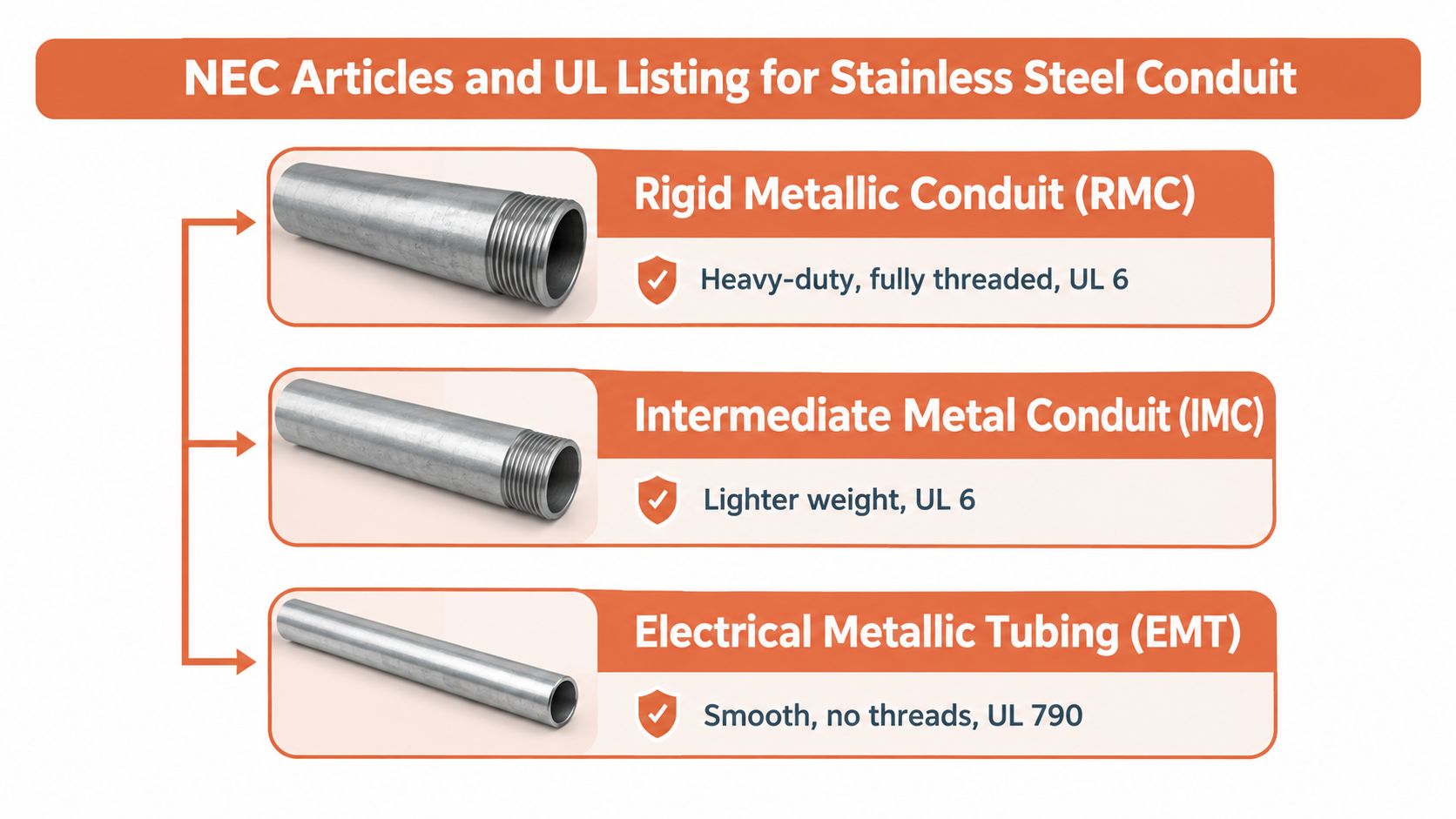
Stainless conduit does not live under one generic rule set. The spec has to follow the raceway family, because Rigid Metal Conduit is covered under UL 6A, while Electrical Metallic Tubing is covered under ANSI/UL 797A for aluminum and stainless-steel EMT used as metal raceways under NFPA 70. Those are different constructions, and a stainless finish does not make them interchangeable (UL 6A listing scope).
The NEC treats them by article as well. RMC is addressed in Article 344, IMC in Article 342, and EMT in Article 358. Installation rules, fitting requirements, support intervals, and field-use limits do not carry over from one raceway type to another (NEC corrosion and raceway requirements).
What inspectors and submittal reviewers check first
The fastest way to avoid a rejected submittal is to prove the assembly, not just the tube.
- Exact raceway type, because RMC is not EMT and EMT is not IMC.
- Trade size, since UL 6A and UL 797A cover defined size ranges.
- Compatible elbows and fittings, because the tubing listing alone is not enough. If the drawing says stainless RMC, the submittal has to prove that the elbows, couplings, and nipples match that raceway family, starting with compatible 90-degree elbows.
- Installation instructions, because the manufacturer's limits still govern the field work.
- Markings and documentation, especially on public, healthcare, industrial, and mission-critical jobs.
BOM review matters because most problems start with the accessory package. A change in availability does not justify mixing a listed raceway with unlisted fittings or a different raceway family. If the assembly is being revised, the alternate has to be checked as a complete system, not just as a stainless substitution.
Field lesson: inspection delays usually come from a mismatch between the listed raceway and the accessory package, not from the conduit body itself.
Bend layout deserves the same attention. The NEC limit of 360 degrees of bends between pull points is a design checkpoint, not a suggestion (NFPA code-development material). If a run exceeds that limit, the pull point has to be built into the raceway plan before the conduit is ordered.
Preventing Galvanic Corrosion at Connections
The raceway usually fails where metals meet
Galvanic corrosion starts when dissimilar metals touch in an electrically conductive environment, such as saltwater or persistent moisture. Stainless steel connected to aluminum, galvanized steel, or copper can become part of that circuit, and the less noble metal usually corrodes first (galvanic corrosion guidance). The conduit body may be sound. The joint, fitting, or support often is not.
That is why the raceway assembly deserves more attention than the tube alone. A stainless run with the wrong connector, a mixed support package, or unapproved hardware can lose its corrosion resistance at the exact point where water sits and current can move. In wet or chloride-heavy service, mixed accessories are where field failures start.
Build the whole assembly with that risk in mind. Keep metals close on the galvanic series where practical, isolate joints when the design allows it, and avoid substituting whatever happens to be on the shelf. A complete stainless raceway and support package usually beats a patchwork of mixed parts when the environment is aggressive.
Match the fittings, hardware, and field work to the raceway
The specification should name the stainless grade, the finish, and the accessory family together. Elbows, couplings, boxes, enclosures, straps, connectors, locknuts, hubs, and bonding hardware all need to be compatible with the raceway, not merely made of metal. For threaded field work, the NEC requires an approved electrically conductive, corrosion-resistant compound where corrosion protection is needed and the threading occurs outside the factory-listed process (UL service guidance).
Support points need the same discipline. A stainless conduit run can still fail early if it lands on incompatible straps or a mismatched enclosure, because those parts see moisture, vibration, and repeated maintenance contact. In mixed-metal environments, a sourcing review should cover the entire assembly, including the right rigid and IMC fittings from a dedicated catalog such as electrical conduit fittings.
A short field checklist keeps the assembly honest:
- Match materials at couplings and terminations.
- Isolate dissimilar metals where the design and code conditions allow it.
- Verify bonding continuity at threaded joints and transition points.
- Avoid ad hoc substitutions that break the listed system.
- Review exposed hardware because supports and straps often start the corrosion.
The goal is a raceway that stays electrically continuous and corrosion-resistant after the first washdown, the first maintenance cycle, and the first repair.
Industrial Applications and Lifecycle Cost Tradeoffs
Stainless costs more up front, and that's not the whole story
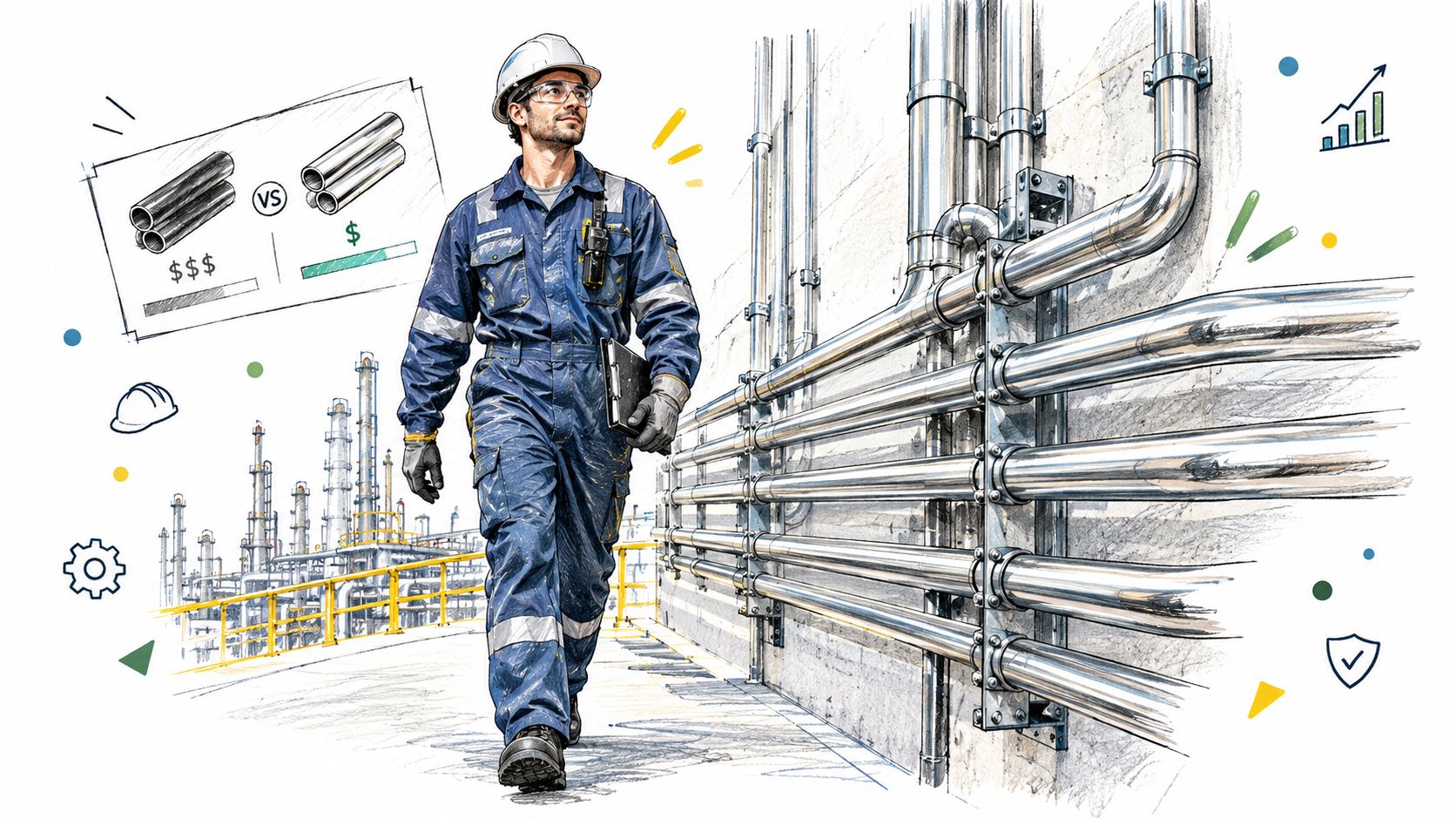
Coated steel can look cheaper on a quote. On site, the bill changes fast when a cut edge, thread, or bend loses its coating and corrosion starts. Stainless steel removes that coating dependency, which is why it holds up in coastal infrastructure, chemical service, food and beverage plants, wastewater facilities, and outdoor washdown areas.
Global melt production of roughly 62.82 million metric tons in 2024 confirms stainless as a mainstream industrial material with a broad, globally sourced supply base. China accounted for about 39.44 million metric tons, or roughly 62.8% of worldwide output (global stainless-steel production overview). For conduit buyers, that scale matters because stainless raceways are supported by a wide materials market, not a narrow specialty channel.
Where stainless usually earns its place
The strongest cases are easy to spot once first cost stops driving the conversation.
- Coastal and marine work, where chlorides attack weak points.
- Wastewater and treatment areas, where moisture and chemicals stay on the hardware.
- Food-processing and sanitation zones, where washdown is routine.
- Utility and infrastructure projects, where service life matters more than cheap replacement.
- Healthcare and clean operations, where documentation and maintainability count.
Stainless is a poor fit for every mild indoor run. A dry, low-exposure installation does not need the same alloy, accessories, or submittal burden as a salt-exposed shoreline site. Good specification means matching the raceway to the exposure, then keeping the fittings, boxes, and supports aligned with that choice.
Lifecycle cost usually comes down to one issue: if a material depends on a coating, installation damage or later maintenance can create a hidden failure mode. Bare stainless avoids that dependency, but only when the complete raceway assembly is treated as one system.
Sourcing Complete Stainless Raceway Assemblies
Procurement has to validate the whole BOM
A conduit purchase order that stops at the tube is incomplete. The actual sourcing task is the whole assembly, because elbows, couplings, locknuts, hubs, supports, and bonding hardware have to match the stainless grade and the listing family. If one item is substituted casually, the entire raceway can become a mixed-metal compromise.
That's where a systems-level sourcing partner helps. ATEK Distribution can assist with BOM review, product sourcing, alternate product evaluation, and compliance documentation when stainless conduit components are short, delayed, or regionally constrained. The practical value is not just availability, it's keeping the submittal aligned with the actual raceway you can build.
For project teams managing conduit, raceway, and cable support together, a consolidated source can reduce rework and split shipments. A useful starting point is conduit, raceway, and cable support, especially when the stainless raceway is part of a larger electrical package that also includes supports and accessories.
What to confirm before release
Before you authorize procurement, verify these points together:
- Raceway type and listing, so the material matches the standard.
- Alloy and finish, so the corrosion resistance matches the site.
- Accessory compatibility, so fittings and boxes don't undercut the system.
- Documentation package, so submittals and inspection records are ready.
- Approved alternates, so shortages don't stall the project.
That approach keeps mission-critical jobs moving when one component is unavailable. It also avoids the classic mistake of approving a substitute conduit and then discovering that the elbows, fittings, or enclosures don't share the same corrosion or listing profile.
If you're sourcing conduit stainless steel for a corrosive or mission-critical project, ATEK Distribution can help review the BOM, confirm accessory compatibility, and identify approved alternatives before material release. Visit ATEK Distribution to request sourcing support, check availability, and keep your raceway package aligned with the job spec.