
Most bad advice about NEMA 3R junction boxes starts with one lazy phrase, “outdoor waterproof box.” That shortcut causes expensive mistakes. NEMA 3R is built for falling rain, sleet, snow, and external ice formation, but it is not a blanket promise of water-tight or dust-tight performance, and Schneider Electric is explicit that it's typically used for outdoor wiring and junction-box applications, not as a substitute for harsher enclosure types in every environment Schneider Electric FAQ.
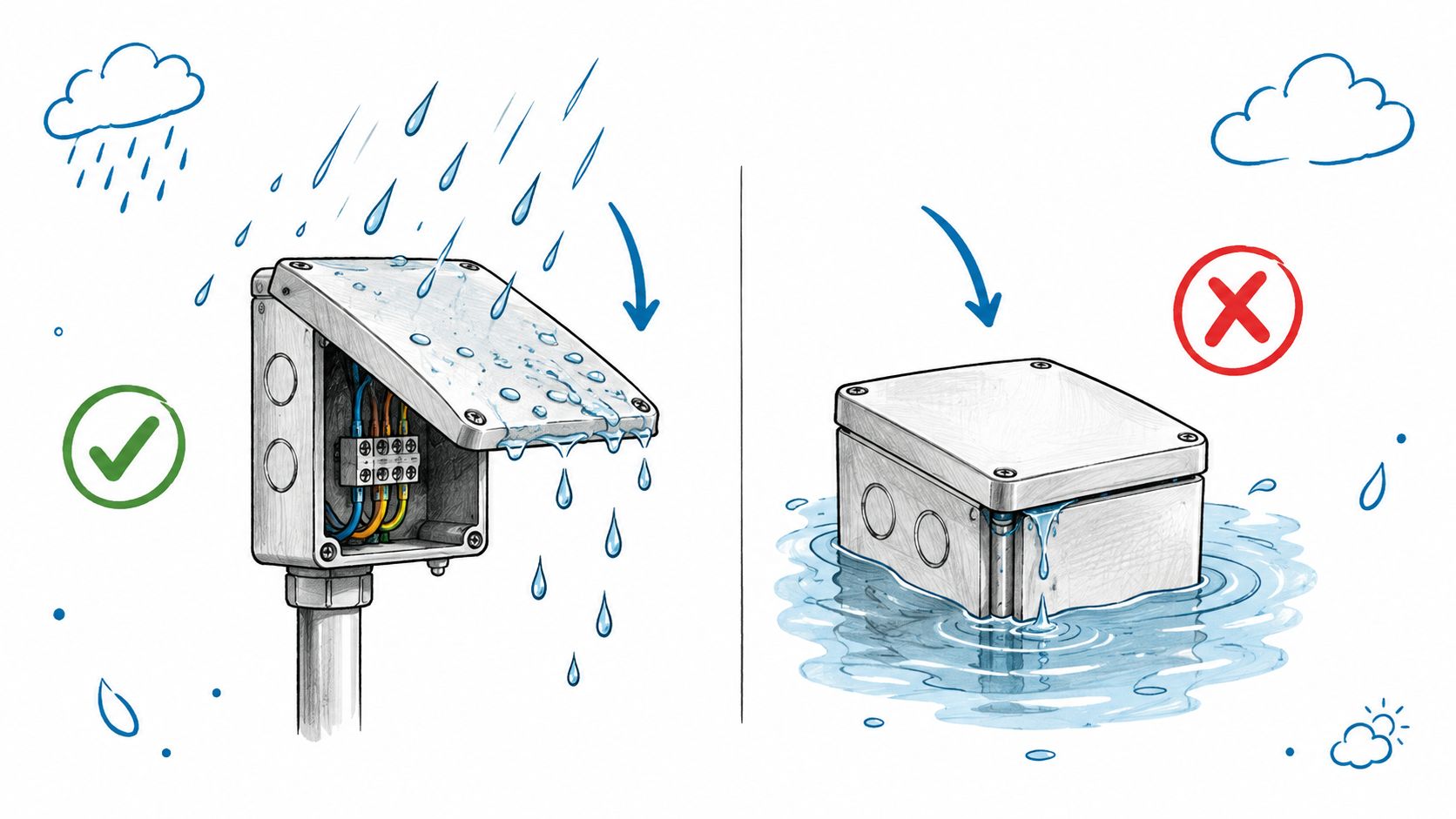
The distinction matters because procurement teams, contractors, and facility managers often see “weatherproof” and stop reading. That's how a 3R box ends up in a washdown area, a dusty process space, or a corrosive zone where NEMA 4 or 4X belongs instead. The right specification starts with the actual exposure, not the label on the submittal.
Table of Contents
- What NEMA 3R Actually Means for Outdoor Wiring
- NEMA 3R Test Standards and Performance Metrics
- Enclosure Materials and Construction Options
- How to Select the Right NEMA 3R Junction Box
- Mounting Methods and Hardware Selection
- Installation Practices and Code Compliance
- Real-World Applications and Failure Modes
- NEMA 3R vs NEMA 4 and 4X Comparison
- Inspection and Maintenance Checklist
- Procurement Guidance and ATEK Support
What NEMA 3R Actually Means for Outdoor Wiring
NEMA 3R junction boxes are designed for a narrow but very common job, protecting wiring enclosures from ordinary outdoor precipitation and external icing. They are not the same thing as sealed enclosures. Schneider Electric notes that a typical 3R design does not use a gasketed sealing surface, and it omits the windblown-dust protection associated with NEMA 3 Schneider Electric FAQ.
The practical meaning on a jobsite
That difference is easy to miss when a catalog says “weatherproof.” The rating is really an environmental-performance classification, not a synonym for waterproof. Rockwell Automation's documentation also makes the point clear, stating that Type 3R enclosures are not intended to protect against dust, internal condensation, or internal icing Rockwell documentation.
If you've ever opened a field-installed enclosure that looked fine on the outside but had moisture on terminals, you already know the problem. The enclosure may have done its job against rain, while the installation failed to manage the moisture path through conduit, openings, or drainage.
Practical rule: use NEMA 3R when the site exposure is mainly rain, sleet, snow, and external ice. Step up when the real hazard is dust, washdown, or corrosion.
Where the rating stops
A NEMA 3R junction box should not be substituted automatically for NEMA 4 or 4X in heavy dust, washdown, or corrosive environments. The box may still be perfectly appropriate for a sheltered exterior junction point, a utility pad, or a general outdoor wiring run. But if the application needs hose-directed water resistance or corrosion resistance beyond ordinary outdoor exposure, 3R is the wrong starting point.
The right habit is to check the complete assembly listing, the installation instructions, and the site conditions together. The rating tells you what the enclosure type was designed to resist. It does not tell you whether the whole installation is suitable.
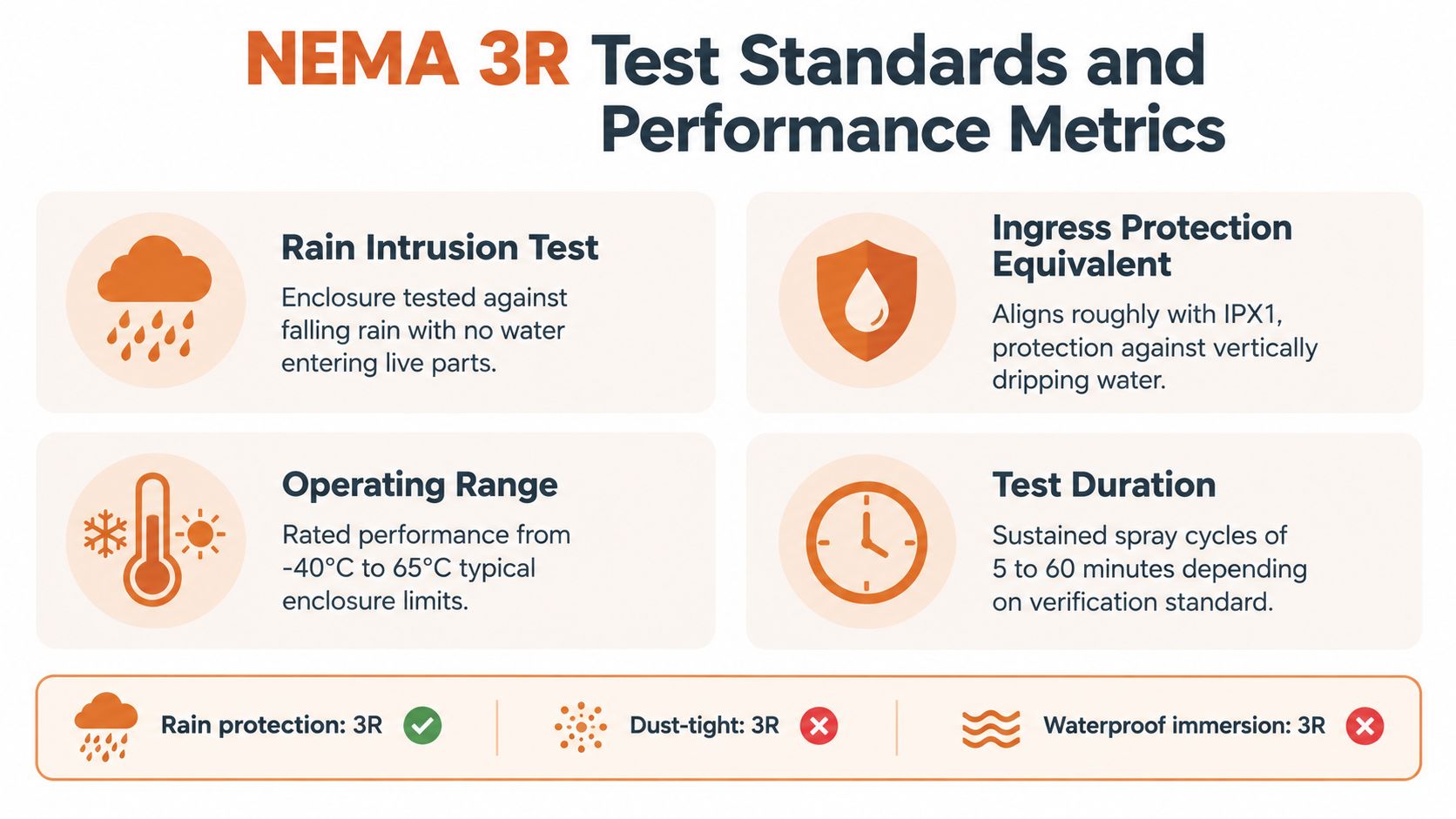
NEMA 3R Test Standards and Performance Metrics
The strength of NEMA 3R is that it isn't just a marketing term. Rockwell Automation's technical documentation identifies specific design tests for rod-entry, rain, external-icing, and corrosion performance in Type 3R enclosures Rockwell technical documentation.
What the test language tells you
The rain test sprays the enclosure's top and exposed sides at 5 psi for one hour, with water delivered at a rate sufficient to raise the level in a straight-sided pan beneath the enclosure by 18 inches Rockwell technical documentation. The external-icing test starts with one hour of water spray at 2°C, then the enclosure is cooled to about -5°C and held there for three hours Rockwell technical documentation.
Those figures are useful because they show what Type 3R is meant to survive, repeated precipitation and exterior ice formation. They do not describe a sealed system that can ignore every moisture problem. The same documentation says Type 3R enclosures are not intended to protect against dust, internal condensation, or internal icing Rockwell technical documentation.
What buyers should ask for
For procurement and submittals, ask for the test basis and the complete listing, not just the enclosure family name. A box can be sold as “outdoor-rated” while still being wrong for the site conditions. I've seen more mistakes caused by assumptions about the environment than by the enclosure hardware itself.
A good submittal review asks one question first, what is the enclosure defending against, rain, dust, corrosion, temperature cycling, or all four?
Reading the result correctly
The test values matter because they anchor the discussion in measurable performance rather than label language. If the environment includes hose-down, chemical splash, or airborne contamination, the decision has already moved beyond Type 3R. If the exposure is ordinary outdoor precipitation with a practical drainage path, 3R may fit the job well.
Enclosure Materials and Construction Options
Material choice changes how well NEMA 3R junction boxes hold up over time, even when the rating stays the same. The box type describes the environmental class. The material determines how gracefully the enclosure handles corrosion, abuse, and maintenance cycles.
Common material trade-offs
Steel is the familiar default for a lot of outdoor electrical work. It's widely used because it's economical and mechanically strong, especially where the enclosure needs to survive normal industrial handling. Coatings and finishes matter a great deal here, because the base metal alone doesn't tell the whole story.
Aluminum fits general outdoor use where lighter weight and natural corrosion resistance help. It's common when installers need a manageable enclosure that still handles exterior service conditions without pushing into a corrosive environment.
Stainless steel is the better answer near salt air, chemical exposure, or other harsher surroundings. It's the material choice I lean on when the enclosure will face ongoing corrosion pressure, especially if the project needs a longer service life and less touch-up work.
Polycarbonate and other thermoplastic options make sense where the enclosure needs to stay light and non-conductive. They're useful in selected outdoor control applications, but you still have to verify the mechanical demands of the site and the hardware the enclosure will carry.
Material comparison for procurement
| Material | Corrosion Resistance | Weight | Cost Range | Best Application |
|---|---|---|---|---|
| Steel | Moderate with coating | Heavy | Lower to moderate | General outdoor industrial use |
| Aluminum | Good | Light | Moderate | General outdoor wiring where reduced weight helps |
| Stainless steel | High | Heavy | Higher | Coastal, chemical, and harsher outdoor environments |
| Polycarbonate | Good in many non-corrosive uses | Very light | Moderate | Lightweight, non-conductive applications |
A smart BOM review looks beyond the enclosure shell. Knockout pattern, finish quality, hardware, and the way the cover sheds water all affect how the box behaves in the field. For projects where sourceability matters, ATEK Distribution can help review enclosure options alongside other outdoor components, but the material decision still has to match the site.
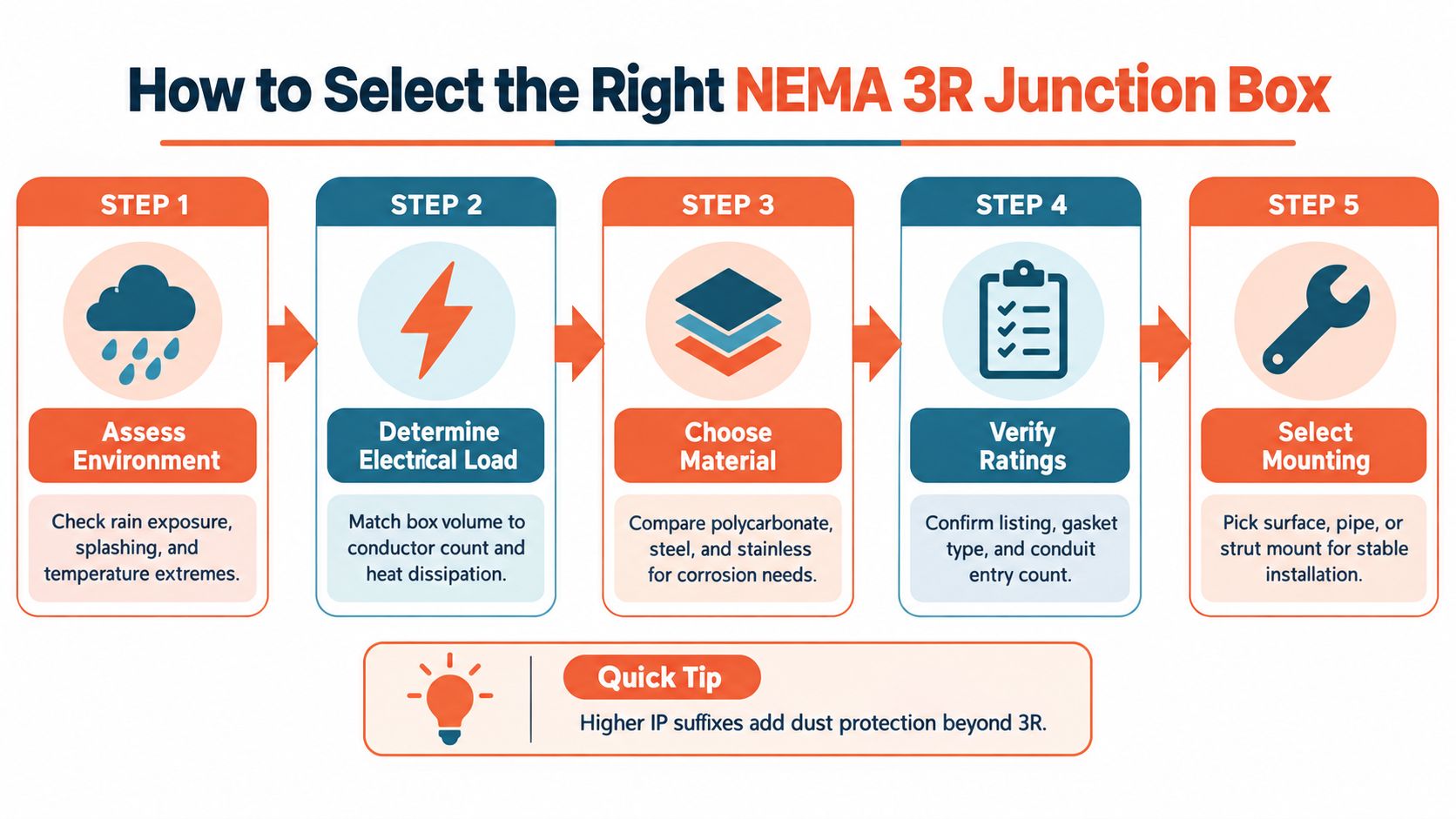
How to Select the Right NEMA 3R Junction Box
Selection starts with exposure, not catalog pages. If the site sees only ordinary rain, sleet, snow, and external icing, NEMA 3R may be enough. If the site adds washdown, heavy airborne dust, or corrosive atmosphere, the selection should move up before the box is ordered.
A field decision path that works
- Assess the environment. Look at precipitation, freezing conditions, splash risk, humidity, and whether the enclosure sits under shelter or in the open.
- Match the electrical load to the box volume. The enclosure has to handle conductor fill, bend space, terminations, and any device mounting without crowding.
- Check knockout layout. Side and bottom entries usually make more sense than top entries unless the fittings and drainage strategy are deliberate.
- Confirm the listing. Verify the complete assembly against the applicable product standard, not just a line in the catalog.
- Choose the mounting method. Surface, pole, or strut mounting all affect how the box handles vibration, service access, and water shedding.
The right enclosure often depends on what happens after the box is mounted. Downward-directed conduit entries, listed hubs, and preserved drainage paths matter because they support the rating after installation, not just at the factory.
When 3R is enough, and when it isn't
Use NEMA 3R for ordinary outdoor wiring points, especially where precipitation is the main exposure. Step to NEMA 4 or 4X when the installation needs hose-directed water protection, dust-tightness, or corrosion resistance beyond that level. That's the point where the “weatherproof” label stops being useful and the actual environment takes over.
If you want a broader enclosure-selection framework, ATEK's guide on how to choose electrical enclosures for outdoor use is worth having beside the submittal package.
Mounting Methods and Hardware Selection
Mounting is where a good enclosure spec gets saved or ruined. A NEMA 3R junction box can meet its rating on paper and still fail in practice if the hardware, orientation, or conduit entry details fight the design. That's why I treat mounting as part of the enclosure system, not an afterthought.
Three mounting approaches that show up most often
Surface mounting works well when the wall or backing structure is solid and the enclosure is small to mid-sized. Lag screws, anchors, or toggle hardware need to suit the base material, and the box should sit flat enough that covers close cleanly and drainage paths remain open.
Wall mounting on structural supports is the right move when the enclosure needs better alignment, service access, or load transfer into the building frame. It's common in commercial and industrial settings where the enclosure sits near other raceway systems and maintenance crews need clean access.
Pole or pipe mounting is common outdoors for controls, lighting, and utility work. Threaded inserts, bands, or purpose-built brackets need to be selected so the enclosure doesn't twist, rock, or stress the conduit entries over time.
Hardware and entry details that matter
Use listed hubs, strain reliefs, and seal fittings for conduit entries when the installation demands them. Maintain downward-directed entries where practical, because water doesn't care how tidy the submittal looked. Preserve factory drainage paths and don't field-modify a rain hood or drip shield just to make a conduit entry fit.
If the installer has to defeat the enclosure geometry to finish the job, the spec was wrong or the field routing needs to change.
For flexible transitions, ATEK's electrical conduit fittings resource is a useful reference when the run needs movement or vibration tolerance.
| Mounting Method Comparison | Hardware Required | Load Capacity | Typical Use Case |
|---|---|---|---|
| Surface mount | Anchors, lag screws, toggles | Light to moderate | Walls, structural backing, equipment rooms |
| Wall mount on support | Brackets, anchors, structural fasteners | Moderate to higher | Commercial and industrial exterior walls |
| Pole or pipe mount | Bands, threaded inserts, brackets | Moderate | Outdoor controls, utility, lighting, field equipment |
Installation Practices and Code Compliance
The rating on the label doesn't override the code or the instructions. Final installation still has to comply with the governing electrical code, including conductor fill, box volume, grounding and bonding, cover accessibility, support, and listed raceway fittings. If the installation doesn't satisfy those basics, the enclosure type won't rescue it.
Where field work usually goes wrong
Knockout sealing is one of the most common misses. If an opening is left unused, it needs to be handled the way the enclosure and code require, not just covered with whatever was in the truck. Incorrect cover orientation causes another set of problems, especially on boxes that depend on a rain hood or drip shield to shed water correctly.
Field modifications can be worse than bad hardware. Drilling through a drainage path, cutting away a protective lip, or forcing an unlisted fitting into place changes how the enclosure behaves under rain exposure. A box that was designed to shed water can start holding it against live parts.
Installation discipline that pays off
Use the manufacturer's instructions and the applicable code together, not one instead of the other. That sounds obvious, but the failure mode is usually a tradeoff made under schedule pressure. Installers make a compromise on the spot, and maintenance teams inherit the problem later.
For a good primer on conductor terminations and related connector habits, the Neasden Hardware push wire guide is a practical reference point, especially when comparing how quick-connect practices affect field assembly quality.
Pair that with the right strain management. ATEK's wiring strain relief resource fits well into submittal review when the conduit run, cable type, or enclosure entry needs extra protection.
Real-World Applications and Failure Modes
NEMA 3R junction boxes perform well in places where the exposure is straightforward. Exterior lighting controls, HVAC junctions, irrigation valve manifolds, and general outdoor wiring on commercial and industrial properties are all sensible uses when the box isn't being sprayed, washed down, or buried in dust. The enclosure's job is to handle weather, not every possible site hazard.
Where 3R works, and where it falls short
The box usually succeeds when the site is semi-sheltered, the conduit entries are sensible, and drainage remains open. That's why 3R shows up so often on building exteriors, utility pads, and equipment yards. It gives crews a practical enclosure without the expense and rigidity of a heavier sealed design.
Failure modes are more predictable than one might think. Internal condensation shows up when temperature cycling moves humid air through raceways, blocked drainage lets water sit where it shouldn't, and corrosion starts at fastener points or scratched finishes. UV exposure can also age seals and plastics faster than crews expect.
Environments that need more than rain protection
Coastal sites and salt-laden air are hard on anything that isn't corrosion-conscious. Tropical sites bring humidity and condensation into the picture, while northern freeze-thaw conditions can trap water in ways that don't show up during commissioning. Solar-heated installations create their own thermal cycling issues, and that can matter just as much as rainfall.
A 3R enclosure can keep rain out of the wrong places and still lose the moisture battle inside the raceway system.
That's why I treat moisture management as a system-level question. The enclosure is one piece. Conduit routing, entry style, drainage, material selection, and maintenance all decide whether the installation holds up.
NEMA 3R vs NEMA 4 and 4X Comparison
Use this comparison when the discussion shifts from “Can we use 3R?” to “Why do we need more protection?” The answer is usually simple once the actual exposure is on the table.
| Rating | Rain Protection | Dust Protection | Hose Water | Corrosion Resist | Typical Use |
|---|---|---|---|---|---|
| NEMA 3R | Yes, for rain, sleet, snow, and external ice | No | No | No | Ordinary outdoor wiring |
| NEMA 4 | Yes | Better than 3R | Yes | No | Washdown and hose-directed water exposure |
| NEMA 4X | Yes | Better than 3R | Yes | Yes | Corrosive or washdown environments |
The key point is that 3R is not a substitute for 4 or 4X when the installation faces hose-directed water, heavy dust, or corrosive conditions. NEMA 4 changes the water expectation. NEMA 4X adds the corrosion side of the problem. That's a real step up, not a marketing upsell.
If the box will live near washdown lines, wastewater equipment, food-processing zones, or salt exposure, stop trying to make 3R fit. Specify the rating the environment actually demands.
Inspection and Maintenance Checklist
A NEMA 3R junction box should be inspected like any other outdoor electrical enclosure, because time and weather eventually test every shortcut. Quarterly visual checks catch the obvious damage, and that's usually where the first warning signs show up.
Field checklist
- Cover condition: Check for cracks, warping, bent edges, or damage that keeps the cover from seating properly.
- Drainage path: Make sure weep points and drain paths are open, not blocked by dirt, sealant, or debris.
- Fasteners and hardware: Look for loosened screws, rust, or galvanic corrosion at mounting points.
- Knockout integrity: Verify that unused openings are sealed the way the enclosure listing and site practice require.
- Internal moisture: Open the box during scheduled service and look for condensation, staining, or corrosion.
- Terminations and grounding: Confirm the terminals are tight, clean, and free of heat damage or oxidation.
- Labeling and identification: Make sure the box still matches the circuit, area, and maintenance records.
Annual checks should cover grounding continuity and the general condition of terminations. In harsher environments, a more detailed review makes sense on a shorter cycle, especially where service downtime is expensive.
The point isn't to baby the enclosure. It's to catch the slow failures before they become a weather-related outage or a nuisance alarm.
Procurement Guidance and ATEK Support
Buying NEMA 3R junction boxes is easy when supply is normal and the project is simple. It gets harder when the spec needs documentation, the lead time slips, or the material that was approved in the design isn't available when the job hits procurement. That's where disciplined sourcing matters as much as the enclosure spec itself.
ATEK Distribution works as an electrical products distributor and procurement partner for contractors, engineers, facility teams, utilities, OEMs, and government buyers. In this space, that usually means BOM review, product sourcing, approved alternatives, compliance documentation, and manufacturer coordination when the original item is constrained or obsolete. For mission-critical work, those services keep jobs moving without forcing a bad substitution.
The most useful procurement questions are practical. Is the enclosure truly listed for the exposure? Is the material suitable for the environment? If the specified box is unavailable, what approved alternative preserves the rating and the installation intent?
For buyers managing multiple jobs, it helps to have one partner who can source junction boxes alongside fittings, protective devices, and related enclosure hardware. ATEK can support that workflow while keeping the enclosure choice tied to the site conditions instead of the catalog headline.
If you're sourcing NEMA 3R junction boxes for a project and need help matching the enclosure to the exposure, ATEK Distribution can review your BOM, suggest approved alternatives, and help with compliance-minded sourcing. Visit ATEK Distribution to request project support and keep the procurement moving without guessing at the enclosure rating.