
A NEMA 3R pull box isn't a watertight outdoor box, and treating it like one is a reliable way to create water-ingress, corrosion, and inspection problems. The rating is designed for ordinary rain, sleet, snow, and external ice formation. It doesn't make an enclosure suitable for hose-down cleaning, windblown dust, corrosive atmospheres, or flood exposure.
The other common mistake happens before the box reaches the jobsite. Catalog shopping often starts with conduit diameter and available stock sizes, while the actual box dimensions must account for conductor size, pull geometry, raceway arrangement, fittings, cover access, and environmental construction. A box can carry the right NEMA marking and still be the wrong part for the installation.
Table of Contents
- Defining the True Limits of NEMA 3R Protection
- Drainage Requirements and Rain Testing Standards
- Calculating Pull Box Dimensions Under NEC 314.28
- Material Selection and Corrosion Resistance
- Conduit Entries and Field Modification Risks
- Managing Internal Condensation and Moisture
- Placement Rules and Raceway Pathway Limits
- Streamlining Procurement and BOM Management
- NEMA 3R Pull Box Quick Reference Guide
Defining the True Limits of NEMA 3R Protection
The “weatherproof” label deserves more scrutiny. NEMA Type 3R is an enclosure classification under ANSI/NEMA 250, not a universal promise that water can't enter. The current standards summary identifies ANSI/NEMA 250-2020, which revised and superseded the 2018 edition, as the applicable edition for electrical equipment rated at no more than 1,000 volts. The standard treats Type 3R as an enclosure category, so a pull box, junction box, wireway, or similar enclosure can qualify when its construction and testing meet the applicable requirements. ANSI's summary of ANSI/NEMA 250-2020 provides the broader standards context.
A NEMA 3R pull box is intended for indoor or outdoor use in nonhazardous locations. It protects personnel from incidental access to hazardous parts, shields enclosed equipment from falling dirt, and limits the harmful effects of falling rain, sleet, and snow. The classification also addresses damage caused by external ice formation, which matters for exposed infrastructure in northern climates.
What Type 3R does not cover
Type 3R is narrower than NEMA Type 3. It doesn't provide the same protection against windblown dust, and it shouldn't be treated as dust-tight, watertight, or suitable for direct hose spray. A drainage-based enclosure manages ordinary outdoor exposure. It isn't designed to stop every form of water from reaching the interior.
Use the site conditions to make the selection:
- Ordinary exterior exposure: A 3R box may suit a service entrance, outdoor raceway transition, rooftop location, or sheltered industrial installation.
- Windblown dust: Consider an enclosure classification intended for that particulate exposure instead of assuming Type 3R is sufficient.
- Washdown or directed water: A higher rating is generally needed where cleaning hoses or spray can strike the enclosure.
- Flood-prone or submerged locations: Type 3R is not a submersion rating.
- Corrosive atmospheres: Evaluate the enclosure material, finish, fittings, and a more protective rating as a complete system.
Practical rule: Select NEMA 3R because the exposure is ordinary rain and snow, not because the product description uses the word “weatherproof.”
The difference between a drain-managed enclosure and a sealed heavy-duty enclosure is useful when reviewing alternatives. For additional background on enclosure construction and application trade-offs, see why choose these heavy duty boxes. For an outdoor selection workflow, the guide to choosing electrical enclosures for outdoor use is also relevant.
Drainage Requirements and Rain Testing Standards
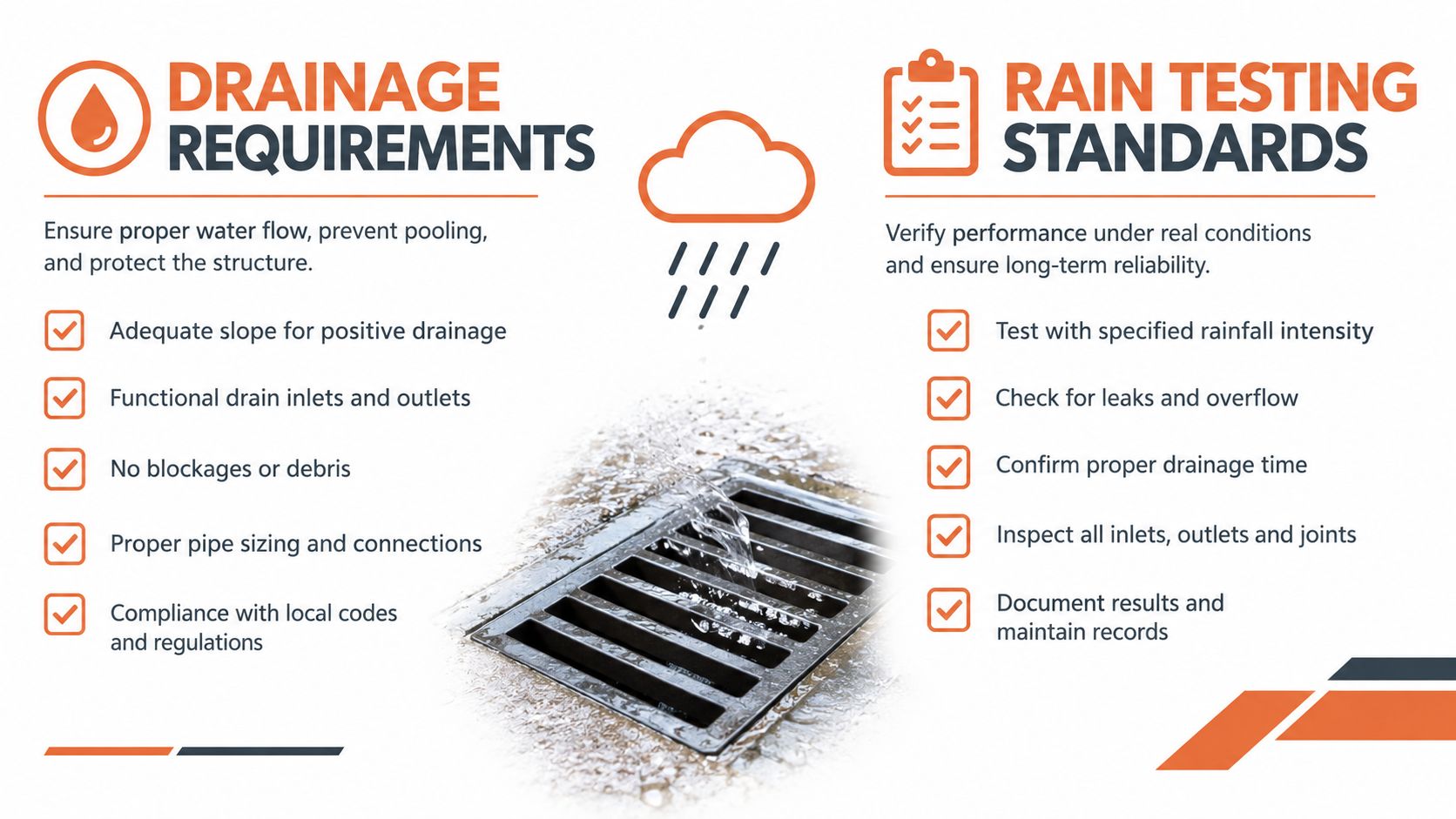
A Type 3R enclosure is expected to manage water, not necessarily exclude every drop. That design choice explains why drainage openings, cover geometry, seams, knockouts, and installation orientation all matter. A generic metal box with a rain hood isn't automatically a compliant NEMA 3R pull box.
Under the NEMA 250 provisions summarized in the available standard text, Type 3R drainage openings must be at least 3.2 millimeters, or 1/8 inch, and no more than 6.4 millimeters, or 1/4 inch, in diameter. Openings below the minimum may not provide the required drainage capacity. Openings above the maximum can affect the enclosure's intended environmental protection and permit unacceptable foreign-material entry. The available NEMA enclosure text describes the drainage provisions and associated construction requirements.
Testing matters more than appearance
Rockwell Automation's technical bulletin describes a Type 3R rain test in which the enclosure's entire top and exposed sides are sprayed with water at 5 psi for one hour. The flow is sufficient to raise water 18 inches in a straight-sided pan beneath the enclosure. The acceptance criterion is that water must not reach live parts, insulation, or mechanisms. Rockwell Automation's Type 3R technical bulletin also identifies rod-entry, external-icing, corrosion, drainage, and drip-shield considerations.
That test doesn't certify every field-modified arrangement. The listed assembly includes its cover, seams, openings, and construction details. A contractor who drills an unapproved penetration, installs an unsuitable hub, or leaves a cover misaligned may change the water path that the tested design controlled.
Schneider Electric notes that Type 3R enclosures commonly use side and bottom knockouts and aren't gasketed sealing systems. Beating rain or directed water can enter under certain conditions. Procurement should therefore verify the manufacturer's NEMA 250 Type 3R listing or certification, not rely on galvanized steel, a gasket added after purchase, or a “rainproof” phrase in a catalog title.
Calculating Pull Box Dimensions Under NEC 314.28
The NEMA rating answers an environmental question. NEC 314.28 answers the geometry question. For a NEMA 3R pull box containing conductors rated 4 AWG or larger, the box must be sized from the raceway and conductor arrangement, not selected solely by conduit diameter or catalog availability. The NEC 314.28 discussion summarizes the dimensional approach for straight pulls, angle pulls, U-pulls, splices, and multiple raceway rows.
Start with the pull configuration
For a straight pull, measure from the raceway entry to the opposite wall. The distance must be at least eight times the trade size of the largest raceway.
For an angle pull, use six times the trade size of the largest raceway, then add the sum of the trade sizes of the other raceways entering the same wall and row. A U-pull uses the same six-times-plus-sum method. Splices require the applicable pull calculation rather than an assumption that a standard pull-box dimension is sufficient.
The table below applies the required multipliers to a largest raceway with a 4-inch trade size. The numerical methods are based on the cited NEC 314.28 discussion.
| Pull Type | Calculation Method | Example, 4-inch largest raceway |
|---|---|---|
| Straight pull | 8 × largest raceway trade size | 8 × 4 inches = 32 inches |
| Angle pull | 6 × largest raceway trade size + sum of remaining raceways on the same wall and row | 6 × 4 inches + remaining raceway trade sizes |
| U-pull | 6 × largest raceway trade size + sum of remaining raceways on the same wall and row | 6 × 4 inches + remaining raceway trade sizes |
Build the schedule before buying
A dimensional pull-box schedule should identify the largest raceway, every other raceway on each applicable wall and row, the pull type, conductor size, and the calculated distance. Multiple raceway rows are evaluated individually, with the row producing the largest result controlling. Raceways carrying the same conductor must generally be separated by at least six times the largest raceway trade size, measured edge to edge.
The calculation is only the beginning. Check conductor bending space, hub depth, bonding provisions, cover removal, drain placement, and the actual fitting geometry. A box that meets a length calculation but blocks the cover with a hub or leaves no practical room for the conductors isn't a successful selection.
When raceway material and box procurement are being coordinated, keep the approved conduit system visible in the BOM. For example, an ATEK PVC conduit product category can support the material review, but the final box still has to match the engineered raceway layout and applicable code requirements.
Material Selection and Corrosion Resistance
NEMA 3R describes environmental protection. It doesn't specify one universal enclosure material. A galvanized steel pull box, painted steel box, aluminum enclosure, and fiberglass composite enclosure may all serve different projects, provided the selected product meets the required construction and certification requirements.
Galvanized steel is often practical for ordinary commercial and industrial exposure. It provides a sturdy enclosure structure and can be economical for larger pull boxes. Its weakness appears when the zinc coating is damaged, cut, abraded, or exposed to persistent salt or chemical contamination. Field-drilled holes and poorly protected edges deserve the same attention as the main panel surfaces.
Painted steel can work where the finish is appropriate for the environment and remains intact. It becomes a poor long-term choice when the coating system isn't compatible with humidity, industrial pollutants, or repeated handling. A small scratch around a mounting point can become the starting point for corrosion if maintenance teams don't address it.
Match the material to the exposure
Aluminum can reduce weight and offers useful corrosion resistance in many outdoor applications, but compatibility with nearby metals, fittings, and the atmosphere still needs review. Fiberglass composites can be useful where low weight, electrical isolation, or resistance to selected corrosive conditions is important. Neither material eliminates the need to verify the product's Type 3R construction and the suitability of its fittings.
Coastal salt air deserves specific scrutiny. Siemens identifies humid salt air as particularly corrosive to electrical products, so a standard finish that performs acceptably inland may require a different material or protection strategy near the coast. High-humidity tropical sites, industrial pollution, chemical vapors, and rooftop temperature cycling can produce similar lifecycle concerns.
The lowest purchase price isn't the same as the lowest installed cost when corrosion forces a replacement, outage, or emergency field modification.
Review the complete assembly rather than the shell alone:
- Base material: Confirm whether galvanized steel, aluminum, fiberglass, or another construction suits the site.
- Finish and cut edges: Check how the manufacturer treats exposed edges, mounting points, and factory knockouts.
- Hardware: Door fasteners, hinges, bonding points, and hubs can become the first corroded components.
- Drainage: Ensure drain paths remain functional after mounting and conduit installation.
- Maintenance access: Select a cover arrangement that allows inspection without damaging the enclosure.
Conduit Entries and Field Modification Risks
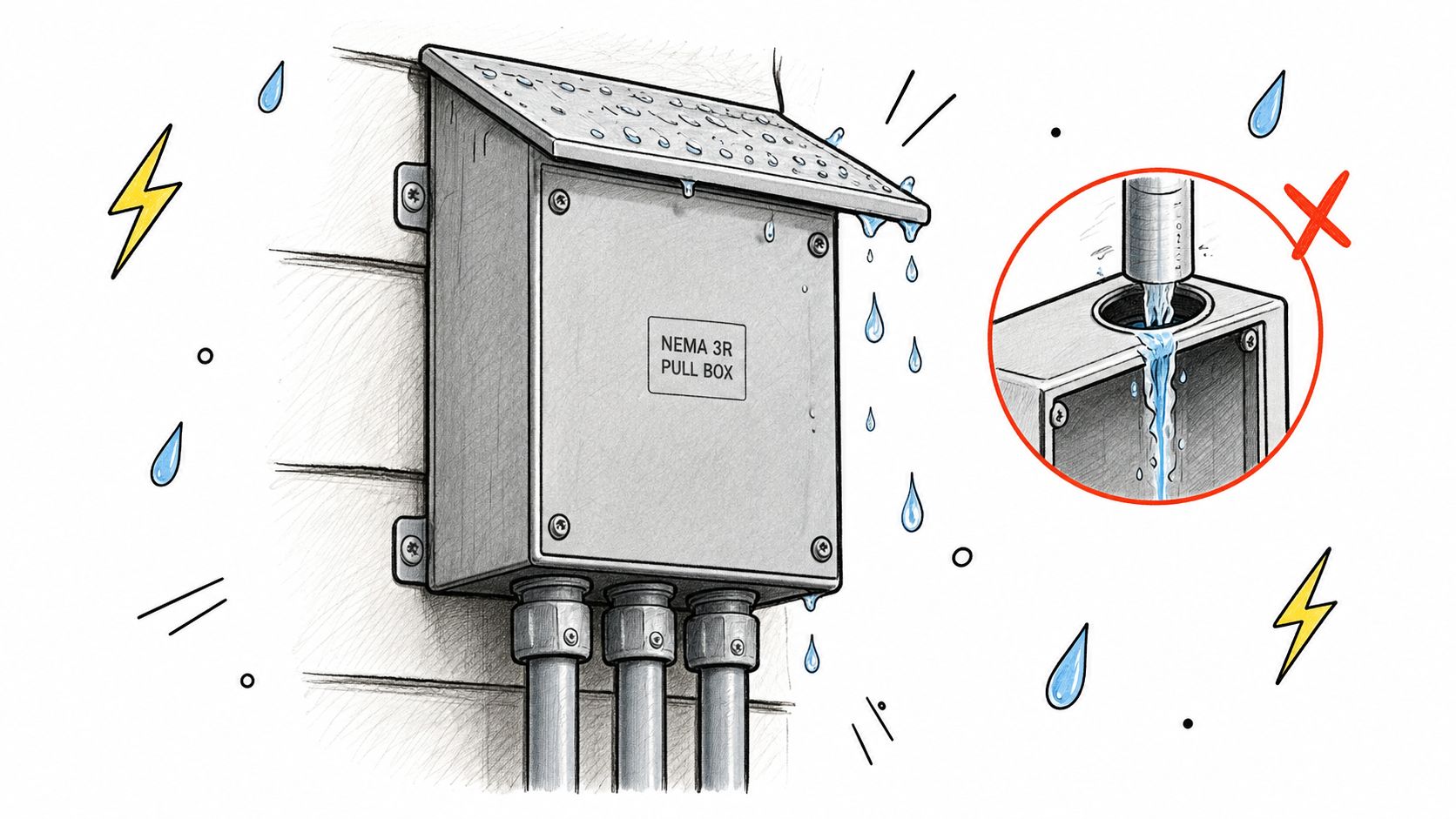
A correctly sized box can still admit water if the conduit entries create a direct path into the enclosure. Entry location is part of environmental performance. Top entries are especially vulnerable because water can run along the conduit or fitting and discharge directly inside the box. Bottom or protected side entries generally reduce that risk when the product instructions and installation conditions support them.
Siemens notes that Type 3R enclosure openings and conduit fittings must meet prescribed provisions. The practical lesson is straightforward: the hub, connector, knockout, cover, and enclosure must function together. A field-installed fitting isn't automatically acceptable just because it threads into the opening.
Modifications can change the listing
Adding an aftermarket gasket is one of the most persistent misconceptions. A gasket may reduce a visible gap, but it doesn't automatically convert a Type 3R enclosure into a higher environmental rating. The enclosure's entire construction and test performance determine its classification.
The same caution applies to drilling unlisted holes, relocating drainage openings, enlarging knockouts, replacing covers, and using fittings that weren't evaluated for the assembly. These changes can alter water flow, foreign-material entry, bonding, clearances, and the ability of the cover or drip shield to perform as tested.
Before field work begins, confirm:
- The manufacturer's permitted entry locations and knockout sizes.
- The hub or fitting type approved for the enclosure.
- Whether unused openings require listed closures.
- How the installation preserves drainage and cover alignment.
- Whether the completed assembly remains within the manufacturer's certification.
Top entry may be unavoidable in a specific layout, but it should trigger a deliberate review of the fitting and water path. A short raceway change or protected entry can be cheaper than replacing a corroded pull box after the first season.
Managing Internal Condensation and Moisture
Rain is only one moisture source inside a NEMA 3R pull box. Warm, humid air can enter through conduit pathways, fittings, and other openings, then condense as the enclosure cools. The cover, conductors, terminals, and splice hardware can all become condensation surfaces without any visible water leak.
The risk increases in coastal and tropical locations, on rooftops, near refrigerated equipment, and wherever temperatures cycle sharply. A Type 3R rating covers defined protection against falling rain and external ice formation. It does not keep the interior dry or prevent humidity exchange from producing condensation.
Control the moisture path, not just the enclosure opening
Sealing every opening may trap humid air inside. Cooling then leaves moisture with no practical path out. Uncontrolled ventilation creates the opposite problem by admitting more humid air. Choose the response based on enclosure volume, internal heat, ambient humidity, and the sensitivity of the equipment inside.
A field moisture-control plan should address these points:
- Open drainage: Keep factory drain provisions clear after mounting and conduit work.
- Protected entries: Do not create direct water paths through exposed top entries.
- Listed breather or drain devices: Use these only when they suit the enclosure and installation.
- Anti-condensation heating: For sensitive equipment in severe temperature cycles, evaluate listed heaters with thermostatic controls.
- Inspection: Check for terminal corrosion, discolored insulation, moisture marks, and blocked drains during maintenance.
Condensation protection extends to the contents of the box. Splices and underground transitions require products selected for their own exposure, not merely a weather-rated outer enclosure. An underground wire splice kit category may suit buried or moisture-exposed conductor transitions, provided the kit rating and installation method match the project.
A drain blocked by sealant, debris, paint, or an uneven mounting surface can defeat the intended moisture strategy. Treat the drain path as a working part of the enclosure, and verify it after installation and during service inspections.
Placement Rules and Raceway Pathway Limits
A NEMA 3R pull box can meet its enclosure rating and still be the wrong choice for the raceway layout. Project specifications may govern its location, accessibility, conduit length, bend accumulation, entry arrangement, and cover clearance. Those requirements often exceed the basic enclosure criteria, especially in institutional, communications, and mission-critical installations.
The University of Houston communications-pathway specification illustrates the point. It calls for NEMA 3R pull boxes in damp or wet locations, including plumbing chases and outdoor areas, while permitting NEMA 1 boxes indoors. It limits conduit runs between pull boxes to 100 feet, requires a pull box when a run includes two 90-degree sweeps or 180 degrees of total bends, and prohibits using a pull box to change the direction of a conduit run. The University of Houston pathway specification records these project-specific requirements.
Let the raceway geometry determine placement
Place the box where it supports the pull, not where the catalog dimensions happen to fit. An unplanned direction change can produce poor pulling geometry and conflict with the specification. The raceway should establish the route, while the box provides an accessible pull point.
Field conditions create additional risks. A box behind equipment, beside a structural obstruction, or in a position that prevents cover removal may pass a submittal review but fail during pulling or maintenance. Avoid locations that encourage cutting new entries on site, particularly on exposed faces. An improper conduit entry, damaged gasket, or unsealed modification can compromise the enclosure rating.
Before release, verify the specified enclosure type for the actual location, conduit distance between pull points, total bends, sweep geometry, access for inspection and future service, and box dimensions calculated under NEC 314.28 where applicable. Confirm the entry pattern, cover clearance, fittings, labeling, submittals, approved manufacturers, and any owner requirements.
The University of Houston example is not a universal rule for every project. Review the contract documents, engineered drawings, applicable NEC requirements, and manufacturer instructions together. That review prevents catalog availability from dictating a layout that cannot be installed or serviced properly.
Streamlining Procurement and BOM Management
Treat the pull box as a coordinated electrical assembly, not a commodity line item. A shortage of one size can force changes to conduit routing, cover access, fittings, conductor pulling, inspection, and the schedule. A substitute with the same NEMA designation may still fail if its dimensions, entry provisions, or construction do not suit the installation.
Make the BOM carry the installation decision
The purchase record should include the calculated box dimensions under NEC 314.28, the actual pull geometry, approved conduit-entry arrangement, material, cover configuration, drain provisions, fittings, and bonding requirements. This prevents catalog availability from overriding the design.
Field modifications deserve specific review. Drilled entries, mismatched hubs, damaged gaskets, and unsealed fasteners can compromise the Type 3R rating. Condensation provisions also need to remain compatible with the enclosure and its location. A replacement that fits the conduit may still create a moisture or corrosion problem.
Before issuing a purchase order, confirm:
- the proposed manufacturer supplies Type 3R documentation;
- hubs, connectors, closures, covers, and bonding parts are compatible;
- the selected material and finish suit the exposure;
- the box accommodates the calculated pull and conductor arrangement;
- submittals and compliance documents are available;
- the engineer, owner, or authority having jurisdiction accepts the alternate.
Record these decisions against the BOM rather than leaving them in email correspondence. That gives estimators, procurement staff, installers, and inspectors the same reference when availability changes.
Estimating tools can connect the enclosure, raceway, fittings, labor, and substitution effects in one takeoff. Teams revising electrical quantities can evaluate Exayard electrical estimating software alongside their existing estimating and specification workflow.
ATEK Distribution supports sourcing, hard-to-find component identification, alternate evaluation, material consolidation, specification review, submittals, and compliance documentation. Its SDVOSB and supplier-diversity credentials may also support documented government or institutional procurement objectives.
A distributor should reconcile the approved specification with availability, compatible accessories, documentation, and delivery requirements. The engineer retains responsibility for product selection.
NEMA 3R Pull Box Quick Reference Guide
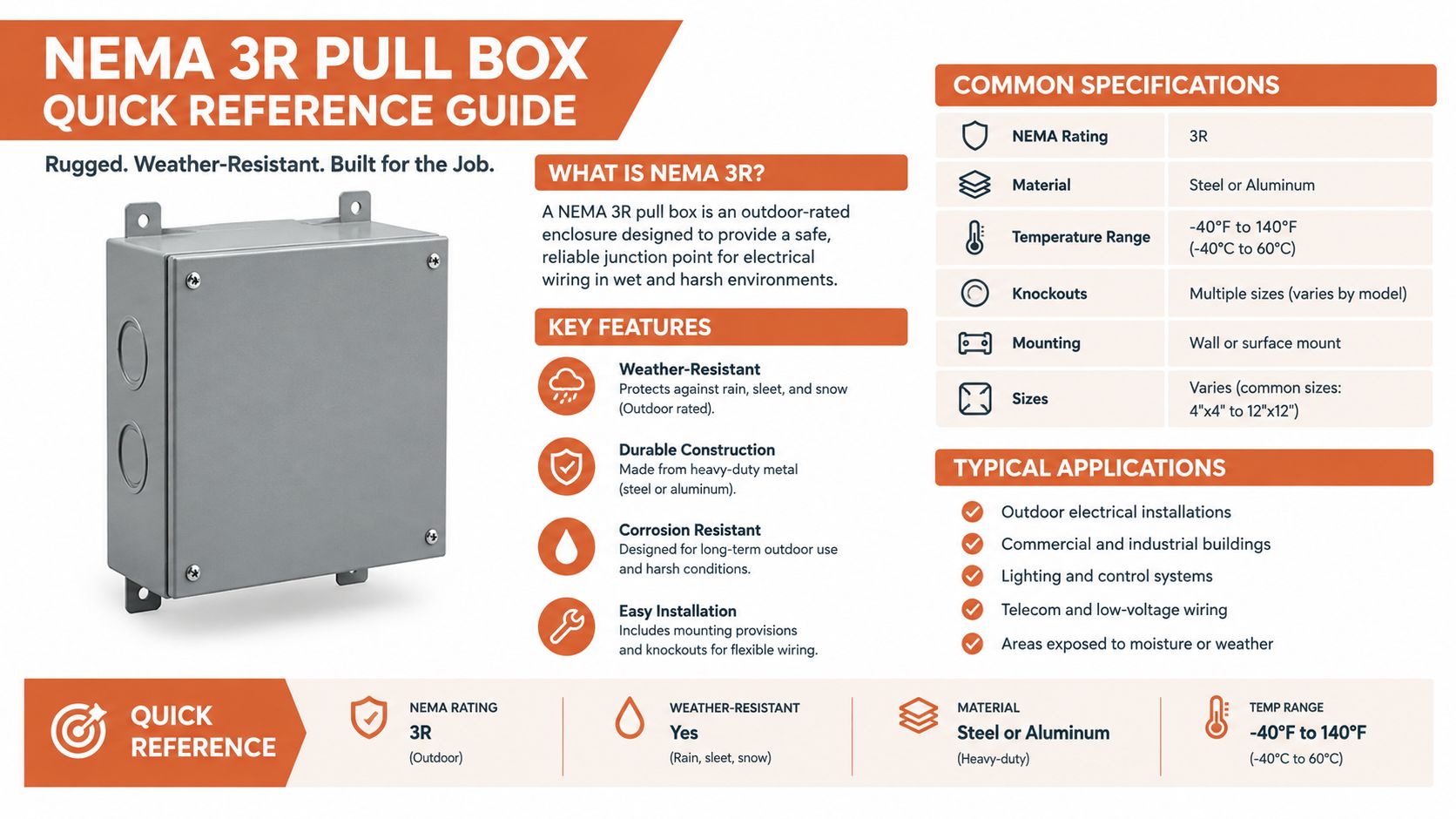
Use this guide as a final office or field check. It doesn't replace the applicable code, project specification, manufacturer instructions, or engineering review, but it can identify the questions that deserve attention before procurement.
Environmental selection
| Check | Practical interpretation |
|---|---|
| Type 3R purpose | Indoor or outdoor, nonhazardous locations with falling rain, sleet, snow, and external ice exposure |
| Falling dirt | Protection is included within the Type 3R classification |
| Windblown dust | Type 3R doesn't provide the same protection as Type 3 |
| Hose-directed water | Don't use Type 3R as a washdown solution |
| Flood or submersion | Select an enclosure evaluated for that exposure |
| Corrosive atmosphere | Review material, finish, fittings, and whether a different rating is needed |
Construction and testing
- Drain openings: Keep openings within the 1/8-inch minimum and 1/4-inch maximum boundary described in the NEMA 250 provisions summarized by the available standard text.
- Rain testing: The Rockwell Automation bulletin describes exposure at 5 psi for one hour, with water directed over the top and exposed sides.
- Assembly integrity: Treat the enclosure, cover, openings, hubs, fittings, and drainage as one tested construction.
- Field modifications: Don't assume an added gasket, drilled hole, or replacement cover preserves the original rating.
- Conduit entries: Bottom or protected side entries can reduce direct water paths compared with exposed top entries.
Sizing and installation
For conductors 4 AWG or larger, apply NEC 314.28. A straight pull uses eight times the largest raceway trade size. An angle pull or U-pull uses six times the largest raceway trade size plus the sum of the other raceways on the same wall and row. Evaluate multiple rows individually, and check separation, bending space, cover removal, hub depth, bonding, and drain clearance.
Procurement checkpoint: Don't release the box until the dimensional schedule, environmental selection, entry arrangement, accessories, and approved product documentation agree.
Material selection should reflect the site. Galvanized or painted steel may suit ordinary exposure when the finish is appropriate. Aluminum or fiberglass may be more suitable for selected weight or corrosion conditions, but the complete product still requires review. In humid salt air, industrial pollution, or persistent high humidity, lifecycle maintenance deserves more attention than the initial catalog price.
Finally, check the pathway rules. Owner specifications may govern pull-point spacing, bend accumulation, accessibility, and whether a pull box can be used for a change in conduit direction. Those requirements can determine the right location and dimensions before anyone selects a catalog number.
For a project requiring a NEMA 3R pull box, ATEK Distribution can help review the BOM, source standard or hard-to-find enclosure sizes, evaluate approved alternatives, and assemble the submittal and compliance documentation. Visit ATEK Distribution to request sourcing support for your electrical enclosure and raceway requirements.