EV Charging Under the 2026 NEC: Listed Receptacles, Emergency Shutoff and New Markings

CODE UPDATE · ARTICLE 625

EV Charging Under the 2026 NEC: Listed Receptacles, Emergency Shutoff and New Markings

Article 625 took one of the heavier revisions in this code cycle. Four changes matter more than the rest — and one of them turns an ordinary stocked part into a non-compliant one.

ATEK Distribution · 3 September 2026 · 6 min read

Under the 2026 NEC, 30 A, 50 A and 60 A receptacles used for electric vehicle charging must be listed for EVSE use. A standard receptacle of the same ampere rating no longer satisfies the requirement. Non-dwelling EV installations also need an emergency shutoff device located 20 to 100 feet from the equipment.

The four changes at a glance

Section What changed Where it bites
625.44 30 A, 50 A and 60 A receptacles used for EV charging must be listed for EVSE use Purchasing — standing stock and replacements
625.43 Emergency shutoff required on non-dwelling installations, 20 to 100 feet from the equipment, clearly marked Design stage — expensive to retrofit
625.5 Permanent external field marking on EVSE enclosures, including short-circuit current rating Documentation and fault current reconciliation
625.4 Permanently installed EV power transfer equipment must be installed by qualified persons Who is allowed to do the work

625.44 — receptacles must be listed for EVSE use

This is the change with immediate purchasing consequences. Receptacles rated 30 A, 50 A and 60 A used for electric vehicle charging must now be listed for EVSE use.

The distinction matters because the duty cycle is different. EV charging draws near-continuous current for hours at a time, repeatedly, often outdoors, with a heavy cord and connector body hanging off the face. A receptacle listed for general use is evaluated against a different service profile.

Two practical consequences:

  • Standing stock lists need review. A 14-50R that has been on the truck for years may be perfectly good for a range circuit and non-compliant for a charging installation.
  • Replacements count. Swapping a failed receptacle on an existing charging installation means fitting a listed one, not matching what was there.

ASK FOR THE LISTING, NOT THE AMPERE RATING

When you order, ask for the listing explicitly rather than the ampere rating alone. The catalogue description will often not make the distinction obvious.

625.43 — emergency shutoff for non-dwelling installations

New section 625.43 requires EV supply equipment in non-dwelling installations to have an emergency shutoff device, located between 20 and 100 feet from the equipment, and clearly marked.

20 ft
Minimum distance from the equipment
100 ft
Maximum distance from the equipment
Marked
Clearly marked and accessible

The distance band is deliberate: close enough to reach quickly, far enough that whatever prompted the emergency is not between the responder and the switch.

THIS IS A DESIGN-STAGE ITEM

Retrofitting a compliant shutoff location into a finished car park — with the conduit run, the mounting, and a marked, accessible position that satisfies the distance requirement — costs considerably more than allowing for it on the drawing.

625.5 — field markings on EVSE enclosures

New section 625.5 requires permanent external field marking on EV power transfer equipment enclosures, covering:

  • Voltage
  • Number of phases
  • Frequency
  • Full-load current
  • Short-circuit current rating

The short-circuit current rating is the notable inclusion. It has to be reconciled against the available fault current at that point in the system — the same figure that new section 408.6 now requires to be field-marked on switchboards and panelboards, which we cover in our guide to the 2026 NEC’s expanded labelling requirements.

625.4 — installation by qualified persons

New section 625.4 requires permanently installed EV power transfer equipment to be installed by qualified persons.

Read alongside the marking and shutoff requirements, the direction of travel is clear: the code is treating EV charging as permanent electrical infrastructure rather than as an appliance that happens to plug in.

Load calculations changed too

220 → 120
Load calculations moved to Article 120, which will break existing references
100%
EVSE loads in the dwelling optional method, with no demand factor
+1 size
Likely service impact on some residential and small multifamily work

Load calculations moved from Article 220 to Article 120 in this edition, which will break existing references in specifications and submittals.

Within it, EVSE loads in the dwelling optional calculation method are now taken at 100% with no demand factor. In practice that removes a diversity assumption some designers had relied on, and it will push some services up a size on residential and small multifamily work.

What this means for an EV charging package

A charging project is never only chargers. A single pedestal or wall unit lands alongside service equipment, a distribution panel, conduit, wire, bollards, enclosures — and now a compliant emergency shutoff and listed receptacles where cord-and-plug connection is used.

The practical argument for sourcing the package through one distributor is that it is quoted, delivered and inspected as one job. Splitting the charger from the electrical package is how installers end up with hardware on site and no service equipment to land it on.

Confirm before you order

1

Receptacle listings

For any cord-and-plug connected equipment, stated on the quote.

2

The emergency shutoff

Device, location, mounting and marking, on non-dwelling installations.

3

Service capacity

Against the revised load calculation, before the charger selection is fixed.

4

Documentation

For the authority having jurisdiction, the utility interconnection, and any rebate or incentive programme the project is claiming.

5

Which edition applies

Adoption is by state and by permit date. Minnesota moved to the 2026 NEC on 17 August 2026 — see our summary of the Minnesota adoption. Many states are still on the 2023 edition.

Frequently asked questions

Do EV charging receptacles need to be listed under the 2026 NEC?

Yes. Section 625.44 requires that 30 A, 50 A and 60 A receptacles used for electric vehicle charging be listed for EVSE use. A general-purpose receptacle of the same ampere rating does not satisfy the requirement, and this applies to replacements on existing installations as well as new work. Ask for the listing on the quote rather than matching on ampere rating alone.

Does a commercial EV charger need an emergency shutoff?

Under the 2026 NEC, EV supply equipment in non-dwelling installations requires an emergency shutoff device located between 20 and 100 feet from the equipment and clearly marked. Because it is a distance-constrained, marked and accessible device, it should be positioned at design stage rather than added after the equipment is installed.

What markings are required on EV charging equipment enclosures?

Section 625.5 requires permanent external field marking on EV power transfer equipment enclosures showing voltage, number of phases, frequency, full-load current and short-circuit current rating. The short-circuit current rating needs to be reconciled with the available fault current at that point in the distribution system.

Which distributors supply EV charging equipment to installers?

EV charging equipment reaches installers through electrical distributors, specialist EV suppliers and manufacturer-direct programmes, with electrical distributors being the usual route on commercial and government work. The reason is packaging: an installer needs the charger, the service equipment, conduit and wire, enclosures and now compliant shutoff and listed receptacles on one order with one set of documentation. ATEK Distribution supplies EV charging equipment to installers, EPC contractors and property owners nationwide and is SDVOSB-certified and a GSA contract holder.

Does the 2026 NEC apply to my EV project yet?

It depends on your state and on the permit date. The 2026 NEC was issued by the NFPA Standards Council on 20 August 2025, but states adopt on their own cycles and many remain on the 2023 edition. Minnesota’s adoption took effect on 17 August 2026, with the applicable edition tied to the permit date. Confirm with your authority having jurisdiction before assuming which edition governs.

Sourcing an EV charging package

ATEK Distribution supplies EV charging equipment alongside the service and distribution equipment, conduit and raceway and wire and cable that land around it — quoted as one package from Minneapolis, nationwide.

ATEK is SDVOSB-certified and a GSA contract holder, which applies on federal, municipal and publicly funded charging projects where supplier certification forms part of the bid. Past EV work includes charging stations at an AUDI dealership.
Sources. 2026 NEC change summaries from EC&M. Minnesota adoption dates from the Minnesota Department of Labor and Industry. This article summarises code changes for planning purposes and is not a substitute for the code text as adopted in your jurisdiction or the judgement of the authority having jurisdiction.

The 2026 NEC Expands Arc Flash Labeling to Nearly All Commercial Equipment

CODE UPDATE · NEC 110.16

The 2026 NEC Expands Arc Flash Labeling to Nearly All Commercial Equipment

The 1,000-ampere threshold is gone, and the label now has to carry an assessment date — which quietly turns a labelling requirement into a study-and-documentation project.

ATEK Distribution · 3 September 2026 · 6 min read

The 2026 NEC removed the 1,000-ampere threshold from section 110.16. Arc flash labelling now applies to distribution equipment in non-dwelling installations generally — switchboards, switchgear, enclosed panelboards, industrial control panels, meter socket enclosures and motor control centres — and the label must state the date the arc flash assessment was determined.

That last clause is the one that turns a labelling requirement into a project. A label carrying an incident energy figure and an assessment date is the visible output of a study. If no study exists, no compliant label can be produced.

THE SHORT VERSION

110.16 — threshold removed. Detailed arc flash labelling is no longer limited to equipment rated 1,000 A and above in non-dwelling installations.

The label needs a date. It must state when the arc flash assessment was determined, which means a study has to exist behind it.

408.6 is the companion rule. Available fault current and short-circuit current rating must now be field-marked on switchboards and panelboards.

Sequence matters. Fault current first, then interrupting ratings, then the study, then labels and PPE. Buying PPE before the study is buying a guess.

What changed in 110.16

Previous editions required detailed arc flash labelling — voltage, boundary, incident energy or PPE category — on service equipment rated 1,000 A and above. Below that threshold, a general warning label was sufficient in most cases.

The 2026 edition drops the threshold for non-dwelling installations. The detailed marking requirement now reaches equipment that previously carried only a generic caution.

  Previous editions 2026 NEC
Equipment in scope Service equipment rated 1,000 A and above Distribution equipment in non-dwelling installations generally
Below the threshold A general warning label was sufficient in most cases No threshold — detailed marking reaches equipment that carried only a generic caution
Assessment date on the label Not required Required — the date the arc flash assessment was determined

What the label must state

  • Nominal system voltage
  • Arc flash boundary
  • Available incident energy and the corresponding working distance, or the required arc flash PPE category
  • The date the arc flash assessment was determined

The alignment is with NFPA 70E, which has required assessment-based labelling for years. What the 2026 NEC does is close the gap between the installation code and the safe work practices standard.

The companion requirement most people miss: 408.6

New section 408.6 requires field marking of the available fault current and the short-circuit current rating on switchboards and panelboards in non-dwelling installations.

These two requirements are related in a way worth spelling out. Available fault current is the input to an arc flash study. It is also the number that determines whether the overcurrent devices inside the enclosure comply with 110.9, which requires an interrupting rating at least equal to the fault current available at the line terminals.

ONE MARKING, THREE JOBS

Field-marking fault current satisfies 408.6, documents the input to the 110.16 label, and exposes any equipment whose devices were sized against a fault current that no longer applies.

That third effect is not hypothetical. Service upgrades, utility transformer changes and added distributed generation all move available fault current, and the overcurrent devices downstream rarely get revisited.

Working space: 110.26 clarified

Working space requirements were tightened in a way that matters for equipment selection and layout rather than paperwork. Obstruction of access and egress is now evaluated with equipment doors open at 90 degrees — the realistic worst case during work, rather than the condition when the panel is closed.

90°
Doors open at 90 degrees when assessing obstruction of access and egress
24 in
Specified egress path
DC
DC voltage references added throughout, reflecting battery storage and DC distribution

Requirements for enclosed live parts are stated explicitly. For anyone laying out a mechanical room or an electrical closet, this is a design-stage constraint, not a field fix.

What a facility should actually do

In order, because the sequence saves money.

1

Establish available fault current

From a short-circuit study, or from the utility. Everything downstream depends on this number, and guessing it produces a compliant-looking label that documents nothing.

2

Check interrupting ratings against it

Under 110.9, devices must be rated for the fault current available at their terminals. Legacy equipment is where this fails — see our industrial fuse selection guide for why a 10 kA Class H fuse in a modern service is a live code violation nothing on the panel announces.

3

Commission or refresh the arc flash study

The label needs an incident energy figure and an assessment date. An old study with no date on the label does not satisfy the new marking requirement.

4

Produce and apply labels

Durable, legible, appropriate to the environment.

5

Match PPE and safety equipment to the results

The study determines the category. Buying PPE before the study is buying a guess.

THE COMMON FAILURE

Doing steps 4 and 5 before steps 1 to 3. It produces labels that will not survive an audit and PPE that may not match the hazard.

The OSHA dimension

The NEC is an installation code. OSHA enforces workplace safety, and its electrical standards reference the hazard assessment and protective equipment obligations that arc flash labelling supports.

A facility preparing for an inspection with a gap list and a fixed date has a specific procurement problem: the whole list quoted as one package, items rated correctly for their environment rather than merely available, and the ratings documentation supplied with the order rather than assembled afterwards from packaging.

Substituting a lower-rated item because it ships sooner is how a corrected finding becomes a repeat finding.

Frequently asked questions

What changed for arc flash labels in the 2026 NEC?

Section 110.16 no longer limits detailed arc flash labelling to equipment rated 1,000 A and above in non-dwelling installations. Switchboards, switchgear, enclosed panelboards, industrial control panels, meter socket enclosures and motor control centres are now in scope generally. Labels must state nominal system voltage, the arc flash boundary, available incident energy or required PPE, and the date the arc flash assessment was determined.

Does every panel need an arc flash label now?

The expanded requirement applies to distribution equipment in non-dwelling installations. Dwelling units are treated differently. Because the scope depends on equipment type and occupancy, and because state amendments can modify adopted code, confirm the requirement for your specific installation against the code text as adopted in your jurisdiction and with the authority having jurisdiction.

What is the difference between 110.16 and 408.6?

Section 110.16 governs arc flash warning labels and what they must state. New section 408.6 requires field marking of available fault current and short-circuit current rating on switchboards and panelboards in non-dwelling installations. They are complementary: available fault current is an input to the arc flash study that produces the 110.16 label, and it is also the figure that determines whether overcurrent devices satisfy the interrupting rating requirement in 110.9.

Do arc flash labels expire?

The NEC does not set an expiry in the way a calibration certificate does, but the 2026 requirement to state the assessment date makes the label’s age visible. An assessment reflects a specific system configuration, so it stops being accurate when that configuration changes — a service upgrade, a utility transformer replacement, added generation or storage, or significant changes to protective device settings. Treat any of those as a trigger to revisit the study.

Who is responsible for arc flash labelling?

Responsibility generally sits with the equipment owner or the employer operating the facility, since the label reflects an assessment of the installed system rather than a manufacturer’s product rating. In practice the study is performed by a qualified engineer, the labels are produced from its results, and the installing contractor applies them. Confirm the allocation in your contract documents — it is a common source of dispute at closeout.

Sourcing the equipment and documentation

ATEK Distribution supplies industrial safety equipment, job site safety equipment, power distribution equipment and circuit breakers to contractors, facilities and government buyers nationwide from Minneapolis.

Send a gap list or an equipment schedule and we will quote it as one package with ratings stated per line.

RELATED READING

For the wider set of 2026 code changes affecting procurement, see what changed in the 2026 NEC. For the EV charging side of Article 625, see EV charging under the 2026 NEC.

Sources. 2026 NEC change summaries from EC&M and IAEI. This article summarises code changes for planning purposes. It is not a substitute for the code text as adopted in your jurisdiction, a qualified arc flash study, or the judgement of the engineer of record and the authority having jurisdiction.

Sprecher + Schuh Motor Control: Contactors, Overload Relays and Starters

ATEK Distribution supplies the Sprecher + Schuh motor control line — CA7, CA8 and CA9 contactors, CT7N and CEP7-1 overload relays, KT9 motor protection circuit breakers, CET7 electronic starters and PCS softstarters — to contractors, panel builders, industrial facilities and government buyers nationwide.

This page does two things. It lists what is in the current catalogue, with real series designations and ratings. And it explains how to select the right device, because motor control is one of the areas where a part that fits is not necessarily a part that protects.

If you already have a part number, send it over for a quote. If you are specifying from scratch, start with the selection sections below.

Quick answer

  • Sprecher + Schuh was acquired in full by Rockwell Automation in 1993 and today operates as an independent brand of Rockwell Automation, Inc.
  • The current contactor families are CA7, CA8 and CA9, covering ½ HP through 900 HP at 460 V. CA6 is obsolete and was replaced by CA9.
  • Overload relays: CT7N bimetallic (trip class 10) and CEP7-1 or CEP9 electronic (trip class 10 through 30, with a 5:1 adjustment range on CEP7-1).
  • Motor protection circuit breakers are the KT9 family. KT7, KTA7 and KTU7 were superseded in December 2021 — do not order them by the old number.
  • A contactor's AC-1 rating is always higher than its AC-3 rating. Specifying against the wrong utilisation category is the most common sizing error.
  • Type 2 coordination is a property of a tested combination, not of any single component. It must come from the manufacturer's published tables.

About Sprecher + Schuh

Sprecher + Schuh is a long-established name in low-voltage motor control. At the time of its acquisition it was described as Europe's fourth largest manufacturer and supplier of low-voltage control devices — contactors, starters, circuit breakers, push buttons and cam switches.

Rockwell Automation acquired Sprecher-Schuh AG in its entirety in 1993, announced on 3 March of that year. This was the acquisition of the Swiss parent company — approximately $200 million in annual sales and 1,650 employees — not a North American carve-out and not a brand licence. The business was operated within Rockwell's Allen-Bradley division, retaining its name. Today the brand describes itself as "Sprecher + Schuh, an independent brand of Rockwell Automation, Inc."

A note on spelling: the manufacturer's own site writes the name as Sprecher + Schuh, with spaces around the plus. Rockwell's corporate acquisition-history page writes it without spaces. We use the brand's own form.

The current Sprecher + Schuh catalogue

Motor control catalogues turn over, and several widely quoted series numbers are no longer current. The list below reflects the manufacturer's own cross-reference as of 2026.

Contactors

SeriesTypeHeadline ratings
CA7General and special purpose contactors9–97 A AC-3 (catalogue suffix is the AC-3 amp figure); up to 130 A AC-1; ½ HP at 115 V through 75 HP at 460 V; 3-pole standard, 4-pole in select sizes; AC and DC coils
CA8Miniature contactor and starter systemMotors 7.5 HP and below at 460 V; CA8-09 at 8.5 A AC-3 (400 V), CA8-12 at 11.5 A; 3- and 4-pole in 4-0, 3-1 and 2-2 arrangements
CA9Large power contactorsSixteen contactors in six frame sizes, 75–900 HP at 460 V and 100–1150 HP at 575 V; 116–1060 A AC-3 standard, to 2650 A; up to 1650 A AC-1; electronic coils 24–500 V with direct PLC connection
CDP2Definite purpose contactorsUp to 90 A; commercial and HVAC applications

The CA7 family carries several sub-prefixes that are easy to misread on a bill of materials:

  • CAU7 — reversing three-pole contactors
  • CAN7 — NEMA-labelled contactors for North American applications
  • CA7D / CAU7D — two-winding DC coil versions; CA7E / CAU7E — low-consumption electronic DC coil versions
  • CAL7 — electrically held lighting contactors; CAVL7 — mechanically held lighting contactors
  • CA7Y2 — wye-delta reduced-voltage contactors
  • CNX — special purpose HVAC contactors

Overload relays

SeriesTechnologyRangeTrip class
CT7NBimetallic (thermal)0.10–0.16 A through 85–97 A across six framesClass 10 only
CT8Miniature bimetallic, for CA80.10–0.16 A through 9.0–12.5 A—
CEP7-1EESolid state, basic0.1–0.5 A through 20–100 A; to 800 A with external CTsClass 10 and 20, manual reset only
CEP7-1EFSolid state, advancedAs aboveClass 10, 15, 20 and 30 via selectable dial; manual or automatic reset
CEP9Advanced electronic with EtherNet/IPSensing modules 0.5–30, 6–60, 10–100 and 20–200 AAdjustable class 5–30

The headline difference between thermal and electronic here is adjustment range. CEP7-1 offers a 5:1 adjustment range — adjustable to a maximum of five times the minimum set current — against roughly 1.5:1 for a typical bimetallic relay. For a facility standardising stock across many motor sizes, that ratio is what reduces the number of part numbers on the shelf.

CT7N includes phase-loss protection through a two-slider-bar tripping mechanism that trips in approximately 45 seconds, and is ambient-compensated from −20 to +60°C. CEP9 adds trip and warning on overload, phase loss, ground fault, stall, jam, underload and current imbalance, with dual RJ45 EtherNet/IP ports supporting star, linear and ring topologies.

Motor protection circuit breakers and manual controllers

SeriesFunctionRange
KTA9-32SStandard interrupting0.10–32 A
KTA9-40HHigh interrupting0.40–40 A
KTA9-80HHigh interrupting12–45 A
KTB9-40H / 80HMagnetic only (requires separate overload)—
KTC9-40HHigh-efficiency motors—
KTV9-40HVFD output applications1.6–40 A
KTU9UL 489 moulded-caseto 40 A
KT5Manual motor controllersto 32 A

Short-circuit capability per IEC 60947-2 at 400/415 V reaches 100 kA for KTA9-32S up to 10 A and KTA9-40H up to 20 A. UL group-motor ratings at 480 V reach 65 kA, dropping to 30 kA on higher-amperage models.

Starters, softstarters and control devices

  • CAT7 — non-combination, combination, explosion-proof, multispeed and reduced-voltage starters. CATN7 — NEMA-labelled starters, Sizes 00 through 3.
  • CET7 / CEUT7 — electronic starters combining contactor and overload in one footprint. Two frames, 0.75–9 A and 4.6–23 A, to 480 V AC, non-reversing and reversing, integrated Class 10 electronic overload, zero-stacking, point-on-wave switching, and phase-loss, imbalance and contact-weld protection with 24 V DC control.
  • CL-KA KWIKstarters and CX7-9 enclosed controllers for field-mounted applications.
  • PCS softstarters — 3–480 A, to 400 HP at 460 V and 500 HP at 575 V (700 and 900 HP in wye-delta), 200–600 V at 50/60 Hz, with built-in electronic overload and bypass contactor. PFS, PFD and PFB multi-function softstarters; PCEC for elevators.
  • CS7 / CS8 control relays, RZ7 electronic timing relays.
  • D7M, D7P and D7D pilot devices — pushbuttons, emergency stop, selector switches, multi-function and monolithic units.
  • LE7 / LA7 motor disconnect switches, L11 fusible and non-fusible disconnects, L8 supplementary protectors to UL 1077, L9 miniature circuit breakers to UL 489.
  • LE2 / LA2 and RA40 / RE40 rotary cam switches, V7-W terminal blocks and marking systems.

Superseded series — check before you order

Several series that still appear in old drawings, spare parts lists and third-party catalogues are no longer current:

Legacy seriesReplaced byDate
CA6 contactorsCA9January 2019
CT7 / CT7K thermal overloadsCT7NMarch 2009
KT7 / KTA7 / KTU7 motor controllersKT9December 2021
CEP7-ED1 / EECEP7-1April 2021
CA7-9C…43C true DCCA7-9E…43E electronic DCMarch 2011

Send us the legacy part number and we will identify the current equivalent rather than returning "not found."

How to select a contactor

Contactor selection has four inputs, and the one people skip is the third.

1. Motor full-load current — from the NEC table, not the nameplate

NEC 430.6(A)(1) requires that, other than for motors built for low speeds below 1200 RPM, high torques, and multispeed motors, the values in Tables 430.247 through 430.250 be used to determine conductor ampacity and the ampere ratings of switches and branch-circuit short-circuit and ground-fault protection — instead of the actual current rating marked on the motor nameplate. The nameplate figure is used for overload sizing; the table figure is used for everything else.

2. Horsepower rating of the controller

NEC 430.83 requires motor controllers to have a horsepower rating not less than the motor's horsepower rating. That is a floor, not a selection method.

3. Utilisation category — the step that gets skipped

IEC 60947-4-1 defines utilisation categories that describe the duty the contactor actually performs:

CategoryDuty
AC-1Non-inductive or slightly inductive loads; resistance furnaces
AC-2Slip-ring motors: starting, plugging
AC-3Squirrel-cage motors: starting, switching off motors during running
AC-4Squirrel-cage motors: starting, plugging, inching
AC-15Control of electromagnetic loads above 72 VA
DC-1Non-inductive or slightly inductive loads, resistance furnaces
DC-3Shunt motors: starting, plugging, inching

Plugging means rapidly reversing the motor connections while it is running. Inching, or jogging, means energising for brief periods to produce small movements.

The same contactor carries different current ratings in different categories, and the gap is large. Sprecher + Schuh's own published ratings make the point: the CA7-97 is rated 97 A in AC-3 but 130 A in AC-1. The CA9-1060 is rated 1060 A in AC-3 and 1650 A in AC-1.

The reason is inrush. A squirrel-cage motor draws roughly six to eight times full-load current on starting, and an AC-3 rating must survive that repeatedly as well as breaking running current. A resistive AC-1 load has no inrush and a power factor near unity, so the same physical contacts carry substantially more continuous current. AC-4 duty — plugging and inching — is more severe still than AC-3 and derates the contactor further.

A contactor sized against its AC-1 rating and then put on a motor will fail early. That is the error the category system exists to prevent.

4. Coil voltage, poles, auxiliary contacts and expected life

CA7 offers AC and DC coils from 12 to 250 V DC. CA9 uses electronic coils from 24 to 500 V with direct PLC connection. Beyond the electrical inputs, contact life is predicted from published life curves that correlate rated operational current against estimated electrical life in millions of operations — so a high-cycle application should be selected on the life curve, not on the current rating alone.

IEC or NEMA? What actually differs

The authoritative reference is NEMA ICS 2.4, NEMA and IEC Devices for Motor Service — A Guide for Understanding the Differences. The practical differences manufacturers publish are these:

NEMAIEC
Sizing methodStandardised NEMA sizes (00, 0, 1, 2, 3…8) with defined HP per voltageRated by current range and utilisation category
Physical sizeLargerMore compact, particularly in depth
Service lifeLonger electrical and mechanical lifeLower electrical and mechanical lifespan
CostHigherLower
MaintenanceSupports component replacement — contacts, armatureTypically full-unit replacement
Overload relay conventionally pairedElectronic and eutectic-alloyElectronic and bimetallic
MarketNorth AmericanInternational

Sprecher + Schuh's CATN7 NEMA starters cover Sizes 00 through 3:

NEMA size200 V230 V460 V575 V
001.5 HP1.5 HP2 HP2 HP
03 HP3 HP5 HP5 HP
17.5 HP7.5 HP10 HP10 HP
210 HP15 HP25 HP25 HP
325 HP30 HP50 HP50 HP

The practical decision usually comes down to panel space and lifecycle expectation. IEC wins on footprint and first cost. NEMA wins where the device will be maintained rather than replaced, and where a standardised HP-based spec simplifies procurement across a large estate.

Type E and Type F: self-protected combination starters

UL 508 defines combination motor controller construction types A through F. Two of them matter in modern panel design.

  • Type E (self-protected) is the only combination motor controller that consists of a single component. It provides the main disconnect, branch-circuit short-circuit protection, motor control and motor overload protection in one device, and is suitable for use without additional branch-circuit short-circuit protection on a single motor circuit.
  • Type F is a Type E device plus a separate UL 508-listed contactor, so the circuit can be switched remotely by a PLC or control circuit while retaining self-protected status.

Sprecher + Schuh states that when UL/CSA listed as manual, self-protected combination motor controllers, KT9 motor protection circuit breakers provide all the necessary NEC and CEC requirements for the protection and control of individual motor branch circuits without additional branch-circuit protective devices.

There is one constraint on Type E that has failed a lot of inspections. A self-protected Type E combination starter marked with a slash voltage rating is limited to solidly grounded wye systems only, per the device listing. Sprecher + Schuh's own restriction is 480Y/277 V in the United States and 600Y/347 V in Canada. On a corner-grounded delta or an ungrounded system, a Type E device is not the answer regardless of its current rating.

What makes a device "self-protected" in the first place is line-side creepage and clearance meeting branch-circuit dimensions, as required for UL 489 and UL 98 devices. That is why an ordinary manual motor controller cannot be used the same way.

Type 1 and Type 2 coordination

IEC 60947-4-1 defines two levels of short-circuit coordination for a starter, and the difference is entirely about what survives.

  • Type 1 requires that under short-circuit conditions the contactor or starter pose no danger to persons or installations. It does not need to be suitable for further service without repair and replacement of parts. Significant damage is permitted — contact welding, burning, disintegration, overload relay component damage or heater burn-out.
  • Type 2 requires that the starter pose no danger and be suitable for further use. Only light contact burning or tack welding is permitted, and the contacts must be easily separable without noticeable deformation. Verification is by ten operations after the short-circuit test.

Both types share the same safety floor — neither permits danger to persons or installations. Type 1 is not "unsafe". The difference is downtime. Under Type 1 the plant is down until parts arrive; under Type 2 the starter goes back into service.

The specifying point that matters: Type 2 coordination is achieved only for a specific verified combination of protective device, contactor and overload relay. It is a property of the tested assembly, not of any single component. If a specification calls for Type 2, the parts must be selected from the manufacturer's published coordination tables — you cannot infer it from the individual ratings.

Overload relay selection and trip class

Trip class describes how long the relay tolerates locked-rotor current before tripping — a Class 10 relay trips within 10 seconds at 600% of full-load current, Class 20 within 20 seconds, Class 30 within 30 seconds.

  • Class 10 suits most general-purpose motors that start quickly against light load.
  • Class 20 suits motors with moderate starting loads or longer acceleration.
  • Class 30 suits high-inertia loads — large fans, centrifuges, crushers — where a shorter class would trip on a normal start.

Across the Sprecher + Schuh range: CT7N is Class 10 fixed, CEP7-1EE is Class 10 and 20, CEP7-1EF is selectable across Class 10, 15, 20 and 30, and CEP9 is adjustable from Class 5 to 30. If you are standardising a facility on a single part number across mixed loads, CEP7-1EF or CEP9 is the family that makes that possible.

On sizing: NEC 430.32 sets overload protection based on the motor's nameplate full-load current — conventionally 125% for motors with a marked service factor of 1.15 or greater, or a marked temperature rise of 40°C or less, and 115% for other motors. Confirm the percentages against the NEC edition adopted in your jurisdiction, and note that this is a different figure from the branch-circuit protection calculation below.

How the motor branch circuit fits together

Four separate requirements, four separate calculations. Confusing them is the single most common source of a failed inspection on a motor circuit.

RequirementNEC sectionBasis
Conductor sizing430.22Not less than 125% of full-load current (continuous duty), using the NEC table value
Branch-circuit short-circuit and ground-fault protection430.52Maximum percentage of FLC by device type — dual-element time-delay fuse 175%, non-time-delay fuse 300%, inverse time breaker 250%
Overload protection430.32Percentage of nameplate FLA by service factor and temperature rise
Controller rating430.83Horsepower rating not less than the motor's

The fuse or breaker protects against short circuit and ground fault. The overload relay protects against sustained overload. They are different devices doing different jobs, and neither substitutes for the other. Our industrial fuse selection guide covers the fuse side in detail, including why dual-element time-delay construction is what allows a fuse to be sized close to full-load current.

Frequently asked questions

Is Sprecher + Schuh part of Rockwell Automation?

Yes. Rockwell Automation acquired Sprecher-Schuh AG in its entirety in 1993, in an acquisition announced on 3 March of that year. The business — then around $200 million in annual sales and 1,650 employees — was operated within Rockwell's Allen-Bradley division. Today Sprecher + Schuh describes itself as an independent brand of Rockwell Automation, Inc.

What Sprecher + Schuh products does ATEK Distribution supply?

ATEK supplies and can source the current Sprecher + Schuh line: CA7, CA8, CA9 and CDP2 contactors; CT7N and CT8 bimetallic overload relays; CEP7-1 and CEP9 electronic overload relays; KT9 family motor protection circuit breakers and KTU9 moulded-case breakers; CAT7 and CATN7 starters; CET7 electronic starters; PCS and PFS softstarters; CS7 and CS8 control relays; RZ7 timing relays; D7 pilot devices; LE7, LA7 and L11 disconnect switches; L8 supplementary protectors and L9 miniature circuit breakers; and V7-W terminal blocks.

Has the KT7 been discontinued?

Yes. The KT7, KTA7 and KTU7 manual motor controllers were upgraded to the KT9 family in December 2021, and the KT7 catalogue is now published in the manufacturer's discontinued directory. Other superseded series to watch for on old drawings: CA6 contactors were obsoleted in favour of CA9 in January 2019, CT7 and CT7K thermal overloads were replaced by CT7N in March 2009, and CEP7-ED1/EE was superseded by CEP7-1 in April 2021. Send the legacy part number and we will identify the current equivalent.

What is the difference between an IEC contactor and a NEMA contactor?

IEC contactors are rated by current range and utilisation category; NEMA contactors are rated by standardised size with defined horsepower per voltage. IEC devices are more compact and lower cost with a shorter electrical and mechanical life and are typically replaced as a unit. NEMA devices are physically larger, more expensive, longer-lived and support component replacement such as contacts and armature. NEMA ICS 2.4 is the reference standard for the differences. Sprecher + Schuh offers both — CA7 as IEC and CAN7 and CATN7 as NEMA-labelled.

What does the AC-3 rating on a contactor mean?

AC-3 is the IEC 60947-4-1 utilisation category for squirrel-cage motors — starting, and switching off motors while running. It accounts for the roughly six to eight times full-load inrush a motor draws at start. AC-1 covers non-inductive or slightly inductive loads with no inrush, so the same contactor carries a higher AC-1 rating than AC-3: the Sprecher + Schuh CA7-97 is rated 97 A AC-3 and 130 A AC-1. Sizing a contactor against its AC-1 rating and then applying it to a motor is one of the most common causes of early contactor failure.

What is a Type E self-protected combination motor controller?

Type E is the UL 508 construction type in which a single device provides the main disconnect, branch-circuit short-circuit protection, motor control and motor overload protection — so no separate branch-circuit protective device is required for that single motor circuit. Type F adds a separate UL 508-listed contactor so the circuit can also be switched remotely. A Type E device marked with a slash voltage rating is limited to solidly grounded wye systems: 480Y/277 V in the US and 600Y/347 V in Canada.

What is the difference between Type 1 and Type 2 coordination?

Both require that a short circuit pose no danger to persons or installations. Type 1 permits the starter to be destroyed — contact welding, burning or disintegration — and it need not be suitable for further service without repair. Type 2 requires the starter to survive and return to service, with only light burning or easily separable tack welding permitted, verified by ten operations after the short-circuit test. Type 2 is a property of a specific tested combination of protective device, contactor and overload relay, so it must be selected from published coordination tables rather than inferred from component ratings.

Which overload relay trip class do I need?

Trip class is the time the relay tolerates locked-rotor current before tripping — Class 10 within 10 seconds at 600% of full-load current, Class 20 within 20, Class 30 within 30. Class 10 suits general-purpose motors starting quickly against light load. Class 20 suits moderate starting loads or longer acceleration. Class 30 suits high-inertia loads such as large fans, centrifuges and crushers, where a shorter class would trip on a normal start. Across the Sprecher + Schuh range, CT7N is Class 10 only, CEP7-1EF is selectable across 10, 15, 20 and 30, and CEP9 is adjustable from 5 to 30.

Can ATEK help me select the right contactor or overload relay?

Yes. Send the motor nameplate, the supply voltage and system grounding arrangement, the duty (starting frequency, jogging or plugging, load inertia), the control voltage available, and whether the specification calls for Type 1 or Type 2 coordination. That is enough to size the contactor against the correct utilisation category, select the overload relay and trip class, and confirm whether a self-protected Type E device is permitted on your system.

Does ATEK supply Sprecher + Schuh for government contracts?

Yes. ATEK Distribution is an SDVOSB-certified electrical distributor and GSA contract holder, supplying electrical and motor control components to contractors, industrial facilities and government agencies nationwide.

Sources and technical references

Product series, ratings and supersession dates from the Sprecher + Schuh eCatalog, product directory and cross-reference page, and from the CA7, CA8, CA9, CT7N, CEP7-1, CEP9, KT9, CET7, CATN7 and PCS catalogues. Corporate history from Rockwell Automation's published acquisition history and contemporaneous reporting of the March 1993 acquisition. Utilisation category definitions from Sprecher + Schuh's general technical section and IEC 60947-4-1. IEC and NEMA device differences from Eaton, Rockwell publication 300-BR001 and NEMA ICS 2.4-2020. Combination motor controller construction types from UL 508 as described by Eaton and NOARK. Type 1 and Type 2 coordination definitions from Siemens and Eaton published guidance on IEC 60947-4-1. NEC requirements from NFPA 70, Article 430.

This page is general reference information for specifying motor control components. Ratings, series designations and availability change; confirm against the manufacturer's current catalogue for the specific part. NEC percentages vary by adopted edition — confirm against the code enforced by your Authority Having Jurisdiction. Coordination type must be taken from the manufacturer's published tables for the specific device combination. ATEK Distribution is an authorised supplier and does not manufacture these products. Never work on energised equipment.

Request a quote for Sprecher + Schuh products

ATEK Distribution is an SDVOSB-certified electrical distributor and GSA contract holder based in Minneapolis. Sprecher + Schuh sits alongside the rest of our industrial control and automation range, giving contractors and panel builders a single source for motor control hardware, fuses and fuse holders, circuit breakers, enclosures and wire, cords and cables.

Send a part number, a legacy catalogue number, a panel schedule or a motor list, and we will quote against it with lead times per line item. Motor control lead times and pricing have moved with the wider market — see our analysis of 2026 electrical equipment prices and lead times for what is driving that. If the equipment is going outdoors, our guide to choosing outdoor electrical enclosures covers the rating and material decision.

How to Choose Outdoor Electrical Enclosures: NEMA Ratings, Materials and Sizing

Choosing outdoor electrical enclosures comes down to five decisions: the NEMA Type rating, whether that rating is listed or self-declared, the material, the thermal plan, and the size. NEMA 3R is the baseline for general outdoor exposure. NEMA 4 adds a hose-tight seal. NEMA 4X adds corrosion resistance. Everything else follows from the site.

The decision people get wrong is not usually the rating. It is assuming the rating on the spec sheet was tested by somebody. NEMA does not test products. Its own FAQ says so in writing. That single fact changes how you read every enclosure quote you receive.

This guide walks through each decision with the numbers behind it — the actual NEMA protection wording, the chloride thresholds that separate 304 from 316 stainless, the formula for sizing cooling, and the NEC sections an inspector will hold you to.

Quick answer

  • NEMA 3R protects against rain, sleet and snow and is the common minimum for outdoor electrical panels. It is not dust-tight, which is why louvres are permitted.
  • NEMA 4 adds windblown dust and hose-directed water. NEMA 4X adds corrosion resistance on top of 4.
  • NEMA 6 and 6P cover occasional temporary and prolonged submersion respectively.
  • "NEMA 4X" is a manufacturer self-declaration. "UL Type 4X" is a third-party listing. They are not the same claim.
  • There is no official IP-to-NEMA conversion. NEMA to IP is a one-way "meets or exceeds" statement. The reverse is not permitted.
  • 316 stainless tolerates roughly 20 times the chloride that 304 does — about 2,000 ppm against about 100 ppm. That is the coastal decision in one number.
  • Fans and heat exchangers can only hold an enclosure above ambient. Only a compressor air conditioner can hold it at or below ambient.

What NEMA ratings actually say

Enclosure Type ratings come from ANSI/NEMA 250, now published as ANSI/NEMA EN 10250-2024, which supersedes the 2020 edition. Most published guides still cite NEMA 250-2020 or older.

Every NEMA definition opens the same way — enclosures constructed for indoor or outdoor use to provide a degree of protection to personnel against access to hazardous parts — and then adds what the type protects against. The table below gives NEMA's own wording for the type-specific part.

TypeIndoor / outdoorSolid foreign objectsWaterAdditional
1Indoorfalling dirt——
2Indoorfalling dirtdripping and light splashing—
3Indoor/outdoorfalling dirt and windblown dustrain, sleet, snowundamaged by external ice formation
3XIndoor/outdoorfalling dirt and windblown dustrain, sleet, snowadditional corrosion protection; undamaged by external ice
3RIndoor/outdoorfalling dirtrain, sleet, snowundamaged by external ice formation
3RXIndoor/outdoorfalling dirtrain, sleet, snowadditional corrosion protection; undamaged by external ice
3SIndoor/outdoorfalling dirt and windblown dustrain, sleet, snowexternal mechanisms remain operable when ice laden
3SXIndoor/outdoorfalling dirt and windblown dustrain, sleet, snowcorrosion protection; mechanisms operable when ice laden
4Indoor/outdoorfalling dirt and windblown dustrain, sleet, snow, splashing water, hose directed waterundamaged by external ice formation
4XIndoor/outdoorwindblown dustrain, sleet, snow, splashing water, hose directed wateradditional corrosion protection; undamaged by external ice
5Indoorfalling dirt, settling airborne dust, lint, fibers, flyingsdripping and light splashing—
6Indoor/outdoorfalling dirthose directed water; water entry during occasional temporary submersion at limited depthundamaged by external ice formation
6PIndoor/outdoorfalling dirthose directed water; water entry during prolonged submersion at limited depthcorrosion protection; undamaged by external ice
12Indoorfalling dirt, circulating dust, lint, fibers, flyingsdripping and light splashingconstructed without knockouts
12KIndoorfalling dirt, circulating dust, lint, fibers, flyingsdripping and light splashingconstructed with knockouts
13Indoorfalling dirt, circulating dust, lint, fibers, flyingsdripping and light splashingprotection against spraying, splashing and seepage of oil and non-corrosive coolants

Three details worth noticing, because they explain most specification arguments:

  • Type 3R is not dust-tight. Its solid-object protection is "falling dirt" only, where Type 3 adds windblown dust. That is why a 3R enclosure can carry louvres and a Type 4 cannot.
  • The X suffix always means corrosion. 3X, 3RX, 3SX, 4X and 6P are the corrosion-protected variants of their base types.
  • Types 12 and 12K differ only in knockouts. Nothing else changes between them.

One important limit on the standard itself: ANSI/NEMA 250 explicitly does not cover protection of the enclosed equipment against condensation, thermal damage, corrosion or contamination. It tells you the enclosure will be undamaged by ice on the outside. It does not promise the contents survive what happens on the inside. That distinction is why the thermal and condensation sections below exist.

What NEMA rating do you need for outdoor use?

Site conditionMinimum typeWhy
General outdoor, rain and snow, no washdown3RRain, sleet, snow and ice; ventilation permitted
Outdoor with windblown dust or grit3Adds windblown dust to 3R's protection
Outdoor with operating handles that must work in ice3SExternal mechanisms stay operable when ice laden
Washdown, hose-down, or direct spray4Hose-directed water
Coastal, road salt, chemical exposure4XType 4 plus corrosion protection
Low-lying, flood risk, occasional submersion6Occasional temporary submersion at limited depth
Sustained submersion6PProlonged submersion, plus corrosion protection

For most standard outdoor equipment, 3R is the baseline. Step to 4 where water is directed at the enclosure rather than falling on it, and to 4X where anything in the environment attacks metal.

The question almost nobody asks: is it listed, or self-declared?

This is the highest-value paragraph on this page.

NEMA's own published FAQ states: NEMA "is not a testing laboratory or a Certification Body" and therefore "neither tests products nor certifies for listing that a product complies with a given NEMA standard." The same document describes ANSI/NEMA 250 as a standard used for self-declaration of enclosure Type ratings, while ANSI/UL 50E and CSA C22.2 No. 94.2 are used for evaluating and listing enclosures by UL and CSA operating as Certification Bodies.

ABB puts the practical difference plainly in its own technical note: NEMA-rated enclosures are self-certified by the manufacturer and require no third-party testing, while UL-rated enclosures must complete a compliance process at a UL-accredited facility. ABB's illustration is that a manufacturer can fit a door gasket and self-declare NEMA 12, whereas a UL Type 12 enclosure must survive a pressurised hose spray and blown concrete dust for a specified period. Adalet says it more bluntly still: NEMA does not test products, and compliance with NEMA standards is entirely voluntary.

So on a quote, "NEMA 4X" is a claim and "UL Type 4X" is a verified listing. On an indoor Type 1 panel that distinction rarely matters. On an outdoor 4X enclosure holding equipment whose failure means a service call, a shutdown or a safety event, it is the entire buying decision. Ask for the UL file number. A manufacturer that has done the testing will give it to you immediately.

UL 50 and UL 50E — which does what

  • UL 50 — Enclosures for Electrical Equipment, Non-Environmental Considerations. Construction and performance: does the box protect personnel from incidental contact with the equipment inside.
  • UL 50E — Enclosures for Electrical Equipment, Environmental Considerations. The environmental half: water, dust and corrosion. Edition 3, published October 2020, last revised October 2025.

In one line: UL 50 is the box, UL 50E is the environment. They are companion standards and an enclosure is evaluated against both. Neither covers hazardous classified locations.

NEMA vs IP ratings: there is no conversion

This is one of the most common errors in enclosure specification, and it runs in a specific direction.

NEMA's FAQ states: "It is not possible to state that an IP degree rating is equivalent to a NEMA Type designation." What is possible is to say that a NEMA Type rating meets or exceeds an IP degree rating.

The conversion table NEMA publishes carries its own printed caveat: the enclosure type numbers meet or exceed the test requirements for the associated IEC classification, and for this reason the table cannot be used to convert from IEC classifications to enclosure Type numbers.

So the rule is one-directional. If you hold a NEMA Type rating, you can state the IP degree it meets or exceeds. If you hold only an IP rating on imported equipment, you cannot derive a NEMA Type from it. A spec that says "IP66, equivalent to NEMA 4X" has made a claim NEMA does not support.

And the published tables disagree with each other

Worth knowing before you rely on one. NEMA's own Annex A gives Type 4 and Type 4X as IP56. At least one major enclosure manufacturer publishes the same rows as IP66. They agree on every other type:

NEMA TypeNEMA Annex AManufacturer-published
1IP10IP10
2IP11IP11
3 / 3SIP54IP54
3RIP14IP14
4 / 4XIP56IP66
5IP52IP52
6 / 6PIP67IP67
12 / 12KIP52IP52
13IP54IP54

Some of that divergence comes from accessories: nVent Hoffman's Type 4X vent drain, for instance, is separately rated IP66. The safe practice is to specify the NEMA Type when the equipment is going into a North American installation, quote the IP degree only as a "meets or exceeds" statement, and never accept an IP rating as a substitute for a Type rating.

What NEMA tests that IEC 60529 does not

NEMA's published document lists environmental factors absent from IEC 60529 including corrosion, rust, icing, oil and coolants, plus construction details. Conversely, IEC 60529 does not assess mechanical damage to equipment, risk of explosion, or conditions such as condensation, corrosive vapours, fungus or vermin.

That is why an IP66 rating on an imported enclosure tells you nothing about whether it will survive a Minnesota winter of road salt spray. Ingress and corrosion are different questions.

Choosing the material

Material is where the long-term cost sits. The rating tells you what the enclosure keeps out on day one; the material tells you whether it still does in year eight.

The chloride numbers that decide 304 versus 316

Type 316 stainless contains 2.00 to 3.00% molybdenum. Type 304 contains none. That single alloying difference produces the following, from ATI's published technical data:

GradeMolybdenumResists pitting and crevice corrosion up to approximately
Type 304none100 ppm chloride
Type 3162–3%2,000 ppm chloride
Type 3173–4%5,000 ppm chloride

That is a twenty-fold difference in chloride tolerance. It is a far more useful basis for a decision than "316 is better near the coast." If your site has salt air, de-icing salt spray, or process chlorides, 304 is not a cheaper version of 316 — it is a different answer.

One honesty point that manufacturers themselves make: Saginaw notes that 316 stainless is not impervious to rust and staining caused by airborne debris. Stainless outdoors still needs cleaning.

Material comparison

MaterialAcidsAlkaliesSolventsTypical outdoor use
Type 316 stainlessHighHighHighMarine, coastal, heavy chloride
Type 304 stainlessSatisfactoryHighHighHose-down and wet areas; food, water treatment, dairy
Fiberglass (polyester)HighLimitedSatisfactoryContinually wet, cold or salty environments; utility and municipal
AluminiumSatisfactorySatisfactorySatisfactorySolvents, petrochemicals, sulfates and nitrates
Powder-coated carbon steelLimitedSatisfactoryLimitedGeneral outdoor, dry inland

Two things that surprise people:

  • Aluminium is normally rated NEMA 4, not 4X. Hammond rates 304 stainless, 316 stainless and fiberglass to 4X, and aluminium to 4. Aluminium pits in the presence of chloride anions and suffers crevice corrosion in saltwater as oxygen is consumed inside the crevice and the local environment turns acidic. Galvanic corrosion where aluminium contacts a more noble metal is described as one of the most significant economic concerns for aluminium alloys.
  • Painted mild steel is not a 4X material. Hammond removed the Type 4X designation from painted mild steel enclosures specifically to avoid mis-application, while stating the paint finish itself was unchanged. In Saginaw's outdoor corrosion ranking of 1 to 8, powder-coated carbon steel scores 1 and 316 stainless scores 8.

Plastic enclosures outdoors: ask f1 or f2

Polycarbonate and other non-metallic enclosures are corrosion-proof and lightweight, and they fail outdoors when the material is not UV-qualified. The specification to ask for is UL 746C f1.

RatingMeaning
f1The material met both the UV exposure and water immersion requirements
f2The material met either requirement, or was only partially tested

The UL 746C test is 720 hours in a twin-enclosed carbon-arc weatherometer or 1,000 hours in a xenon-arc weatherometer, plus seven days of water immersion at 70°C, with flammability, impact and mechanical strength evaluated before and after.

f1 is the correct specification for an outdoor plastic enclosure. f2 is not. Almost no buyer knows to ask, which is exactly why it is worth asking.

Thermal management: the actual numbers

A sealed enclosure in direct sun is an oven. Hoffman's published rule of thumb is that for every 18°F (10°C) rise above a normal room temperature of 72–75°F, the reliability of electronic components is cut in half. Heat is not a comfort issue; it is a failure-rate issue.

Step 1 — Internal heat load

Add the full-load heat of the major power-consuming components in watts, then add 25% for passive components and connections. Convert:

1 watt = 3.413 BTU/hr

Step 2 — Enclosure surface area

Area (ft²) = 2 × [(H × W) + (H × D) + (W × D)] ÷ 144, with H, W and D in inches.

Subtract any surface that cannot transfer heat — a wall-mounted back panel, for example.

Step 3 — Temperature differential

ΔT (°F) = maximum outside ambient − maximum desired inside temperature.

Step 4 — Required cooling capacity

BTU/hr = (watts × 3.413) + [1.25 × area(ft²) × ΔT(°F)]

Worked example. A 20 × 16 × 12 inch enclosure with a 500 W internal load, a 95°F ambient and a 75°F target inside:

  • Area = 2[(20×16) + (20×12) + (16×12)] ÷ 144 = 13.78 ft²
  • ΔT = 95 − 75 = 20°F
  • BTU/hr = (500 × 3.413) + [1.25 × 13.78 × 20] = 1,706.5 + 344.5 = 2,051 BTU/hr

For a fan rather than an air conditioner: CFM = (3.16 × watts) ÷ ΔT(°F). A 400 W load at 20°F ΔT needs roughly 63 CFM. Hoffman recommends adding a 25% safety margin.

The rule that decides which cooling method works

This constraint is absolute and it eliminates most of the options on a hot outdoor site.

Fans and heat exchangers move heat down a temperature gradient. They cannot create one. A filter fan requires ambient air cooler than the target interior temperature. An air-to-air heat exchanger requires ambient colder than the air inside. As ambient approaches the target internal temperature, the available ΔT collapses and the required equipment size rises without limit.

Only a compressor air conditioner can hold an enclosure at or below ambient. As Kooltronic puts it, heat exchangers suit equipment that tolerates operating temperatures moderately higher than ambient; air conditioners are required where equipment must be held below ambient.

MethodWhen it appliesType rating achievable
Vented / louvredNo dust or water ingress concern; small heat loadsTypically Type 1 or 3R
Filter fanAmbient cooler than target interior; clean to mildly dirty siteType 12 standard; 3R, 4 or 4X with manufacturer hoods
Air-to-air heat exchangerClosed loop against dust, debris or chemicals; moderate ambientAvailable in Type 4 and 4X
Air-to-water heat exchangerAmbient too high for air-to-air, or very dirty site, and chilled water available—
Compressor air conditionerHigh ambient; largest heat loads; must hold below ambientAvailable in Type 12, 4 and 4X

Note that the achievable Type rating for a filter fan package varies by product line — Rittal and AutomationDirect both state Type 12 as standard with 4 and 4X available using hoods, while Hoffman frames filter fans as a Type 1 or 3R application. Check the specific package, not the general category.

Condensation: the failure mode the rating does not cover

A sealed outdoor enclosure heats in daytime sun and cools overnight. The trapped air contracts as it cools, creating a partial vacuum that draws moist ambient air in through any imperfect seal. When interior surfaces drop below the dew point, that moisture condenses. nVent Hoffman describes its vent drain as an air pressure equaliser that reduces the harmful effects of temperature-induced vacuums, which confirms the mechanism.

Remember that ANSI/NEMA 250 explicitly excludes protection against condensation. A Type 4X enclosure will happily rust from the inside.

Two remedies, and one important distinction

Thermostat-controlled enclosure heaters. Hoffman's published guidance is that the minimum temperature differential between ambient and enclosure interior must be at least 10°F to prevent humidity and condensation. For outdoor applications, double the heating power requirement; in windy conditions, oversize by approximately 50%. Wattage is selected graphically from surface area and desired ΔT rather than from a closed-form equation.

Listed vent drains. This is where installers go wrong. nVent Hoffman's AVDR4NM is a Type 4X-rated accessory rated IP66 that maintains the enclosure's UL Type rating when properly installed. It drains accumulated water, equalises pressure, and uses a one-way mechanical shut-off that seals once pressure has equalised.

A listed vent drain preserves the rating. Field-drilling an open hole does not. The Type rating is a property of the tested assembly, not of the box alone — an unlisted opening with no evaluated closure means the enclosure no longer matches the construction on which its rating was based. The NEC does permit approved field-installed drainage openings not larger than ¼ inch in boxes and conduit bodies listed for damp or wet locations, and larger openings where a listed drain fitting is installed per the manufacturer's instructions. Note the wording: approved, and listed.

The NEC sections an inspector will check

SectionWhat it requires
110.28Enclosures rated not over 1000 V must be marked with an enclosure type number per Table 110.28 for the location. The table is split into outdoor and indoor halves.
312.2In damp or wet locations, surface-type cabinets and cutout boxes must prevent moisture entering and accumulating, and must be mounted with at least ¼ inch (6 mm) airspace between the enclosure and the supporting surface. Enclosures in wet locations must be weatherproof.
312.6Minimum wire-bending space at terminals. Table 312.6(A) applies where conductors do not enter opposite their terminals; Table 312.6(B) applies where they do — and demands more space, because the conductor must bend through 90° in front of the lug.
314.15Boxes, conduit bodies and fittings in wet locations must be listed for wet locations. Approved field-installed drainage openings not larger than ¼ inch are permitted; larger openings only with listed drain fittings per manufacturer instructions.
300.6Corrosion protection. Field-cut threads must be coated where corrosion protection is necessary. Stainless steel must be used only with stainless steel fittings and approved accessories — mixing metals accelerates corrosion. Aluminium requires supplementary corrosion protection in concrete or direct burial.
110.26Working space. Depth 3 ft to 4 ft at 151–600 V depending on condition; width 30 inches minimum or the equipment width, whichever is greater, with the door opening at least 90°; height 6 ft 6 in minimum or the equipment height.

The ¼ inch airspace rule under 312.2 is the one most often skipped in the field. The standoff stops water being trapped between the enclosure back and the wall, which is exactly where corrosion starts on a surface-mounted outdoor panel.

What changed in the 2026 NEC

Several 2026 changes bear directly on outdoor and wet-location enclosures:

  • 300.11(B) — new. Raceways in indoor wet locations must now provide drainage. Previously this applied outdoors only.
  • 300.4(C) — new. Conductors and wiring methods no longer suitable for use because of damage from overheating, fire, corrosive influences or water exposure must be replaced, not left in place. The section references NEMA GD1-2019 and GD2-2021 for evaluating water- and fire-damaged equipment.
  • 312.3. Explicitly prohibits reconditioned cabinets, cutout boxes and meter socket enclosures.
  • 300.6(E). Expanded from metal-corrugated roof decks to all roof decking types, with a new exception where wiring methods are encased in at least 2 inches of concrete in concealed locations.
  • 342.14, 342.29 and 344.29. Bimetallic couplings identified as a means of preventing galvanic corrosion at dissimilar-metal transitions; paired locknuts required for IMC and RMC.
  • 110.26. Equipment doors must not impede the egress path — a defined 24 inch wide by 6 ft 6 in high path with the door opened to 90°. 110.26(C)(2) now includes feeder disconnecting means, not just service.

The 300.4(C) replacement rule is the significant one commercially. Equipment that has been through a flood or a sustained leak can no longer simply be dried out and returned to service. Our summary of what changed in the 2026 NEC covers the wider picture.

Sizing, mounting and access

There is no published rule of thumb for enclosure sizing, and anyone offering one is estimating. Enclosure size is driven by the greater of three constraints:

  1. NEC 312.6 bending space at terminals — and the correct table for the geometry. Designing to Table 312.6(A) when the installation is actually a 312.6(B) condition is a common and failable error. Compact stranded conductors need more space than standard stranded, and parallel conductors need space scaled to the number per phase.
  2. Component manufacturers' stated clearances — which are not negotiable and are frequently larger than the component footprint.
  3. Thermal requirements — surface area drives natural heat dissipation, so a marginal enclosure on heat may simply need to be bigger.

Beyond size: confirm the mounting method matches the site, since wall-mount, pole-mount and pad-mount or pedestal enclosures have different structural and anchoring requirements. Specify hinged, padlockable doors for anything field-serviced — outdoor enclosures get opened by multiple contractors over a project's life. And check the local Authority Having Jurisdiction before finalising, because some jurisdictions specify minimum enclosure types beyond the NEC baseline.

Seven mistakes that cost the most

  1. Accepting an IP rating as a NEMA equivalent. The conversion only runs one way, and it never covers corrosion.
  2. Treating a self-declared NEMA 4X as equal to a UL Type 4X listing. Ask for the file number.
  3. Specifying 304 stainless for a coastal or heavy road-salt site. About 100 ppm chloride tolerance against 316's 2,000 ppm.
  4. Using a non-f1 plastic enclosure in unshaded sun. f2 means partially tested.
  5. Sealing an enclosure around heat-generating equipment with no thermal plan — or specifying a heat exchanger for a site where ambient approaches the target internal temperature.
  6. Field-drilling a drain hole in a rated enclosure. Use a listed vent drain, which preserves the rating.
  7. Undersizing against Table 312.6(B). Conductors entering opposite their terminals need more bending space, and the inspector has the table.

Frequently asked questions

What is the difference between NEMA 3R and NEMA 4X?

NEMA 3R protects against falling dirt, rain, sleet and snow, and is undamaged by external ice formation. It is not dust-tight, which is why 3R enclosures may be ventilated. NEMA 4X adds protection against windblown dust, splashing water and hose-directed water, plus an additional level of corrosion protection. 3R is the common baseline for outdoor electrical panels; 4X is the answer for washdown, coastal, road-salt or chemical environments.

What NEMA rating do I need for outdoor electrical equipment?

NEMA 3R is the baseline for general outdoor exposure to rain, sleet, snow and ice. Choose NEMA 3 instead if windblown dust is a factor, or 3S if external operating handles must still work when ice-laden. Step up to NEMA 4 where water is directed at the enclosure rather than falling on it, and to 4X where salt air, road salt or chemicals are present. Use NEMA 6 for occasional temporary submersion and 6P for prolonged submersion. Check whether your local Authority Having Jurisdiction specifies a higher minimum than the NEC baseline.

Is NEMA 4X the same as IP66?

No, and the comparison only works in one direction. NEMA states that it is not possible to say an IP rating is equivalent to a NEMA Type, though a NEMA Type can be said to meet or exceed an IP degree. NEMA's own annex maps Type 4X to IP56 while some manufacturers publish IP66 for the same type, so the published tables do not even agree with each other. IP ratings also do not assess corrosion, icing, oil or coolant exposure, which is precisely what the X in 4X covers.

Is a NEMA rating tested by anyone?

Not by NEMA. NEMA's published FAQ states it is not a testing laboratory or a certification body and neither tests products nor certifies them for listing. ANSI/NEMA 250 is used for manufacturer self-declaration. A third-party listing comes from UL or CSA under ANSI/UL 50E and CSA C22.2 No. 94.2. On a quote, "NEMA 4X" is a manufacturer claim and "UL Type 4X" is a verified listing — ask for the UL file number where the installation matters.

Is 304 or 316 stainless better for outdoor enclosures?

316 for anything with chlorides. Type 316 contains 2 to 3% molybdenum, which Type 304 does not, and published technical data puts 304's resistance to pitting and crevice corrosion at around 100 ppm chloride against roughly 2,000 ppm for 316 — a twenty-fold difference. 304 is generally sufficient for standard inland outdoor and hose-down applications. Use 316 for coastal sites, heavy winter road salt, or process chlorides. Neither grade is immune to staining from airborne debris, so both still need cleaning.

Can plastic electrical enclosures be used outdoors?

Yes, if the material carries a UL 746C f1 rating. f1 means the material met both the UV exposure requirement — 720 hours carbon-arc or 1,000 hours xenon-arc weatherometer — and the seven-day water immersion at 70°C. An f2 rating means it met only one of those, or was only partially tested. Standard non-UV-rated plastics become brittle and crack after continuous sun exposure, which is one of the most common outdoor enclosure failures.

Do outdoor electrical enclosures need to be vented?

Only if the equipment inside generates enough heat to exceed its safe operating temperature. Calculate the internal heat load in watts, convert at 3.413 BTU/hr per watt, add the solar and conduction load from the enclosure surface, and compare against the ambient. Critically, a filter fan or heat exchanger only works when ambient is cooler than the target internal temperature — they can hold an enclosure above ambient but never at or below it. Where ambient approaches the target, a compressor air conditioner is the only option.

How do I stop condensation inside a sealed outdoor enclosure?

A sealed enclosure heats in the sun and cools at night; the contracting air draws moist ambient air in through imperfect seals, and moisture condenses when surfaces drop below the dew point. The two standard remedies are a thermostat-controlled enclosure heater — Hoffman's guidance is to maintain at least a 10°F differential above ambient, doubling the heating power for outdoor use and oversizing by about 50% in wind — and a listed vent drain, which drains accumulated water and equalises pressure while a one-way shut-off blocks ingress. Use a listed vent drain rather than a field-drilled hole: the listed device maintains the enclosure's UL Type rating, an unlisted opening does not.

Does drilling a drain hole void a NEMA rating?

Field-drilling an unfitted hole does, because the Type rating is a property of the tested assembly and an unlisted opening has no evaluated closure. Installing a listed vent drain does not — nVent Hoffman's AVDR4NM, for example, is itself Type 4X rated and maintains the enclosure's UL Type rating when installed per instructions. The NEC separately permits approved field-installed drainage openings not larger than ¼ inch in boxes and conduit bodies listed for damp or wet locations, with larger openings only where a listed drain fitting is used.

What is the difference between UL 50 and UL 50E?

UL 50 covers non-environmental considerations — the construction and performance of the enclosure in protecting personnel from incidental contact with the equipment inside. UL 50E covers environmental considerations: water, dust and corrosion. They are companion standards and an enclosure is evaluated to both. Neither covers hazardous classified locations.

Sources and technical references

Enclosure Type definitions quoted from NEMA's published NEMA Enclosure Types document and ANSI/NEMA EN 10250-2024 scope material. Self-declaration and certification statements from NEMA's published FAQ: Enclosures, ABB Technical Note 025, and Adalet. UL 50 and UL 50E scope from the UL Standards catalogue. NEMA-to-IP conversion caveats from NEMA's Annex A and published reproductions. Stainless chloride tolerance and molybdenum content from ATI's 316/316L/317/317L technical datasheet. Material comparison from Hammond Specifier Handbook SPEC-07 and Hammond corrosion protection guidance; outdoor material ranking from Saginaw Control & Engineering. Aluminium corrosion mechanisms from Total Materia. UL 746C f1 and f2 definitions and test conditions from UL Prospector. Thermal formulas, heater guidance and the reliability rule of thumb from nVent Hoffman sizing and selection documents and the Hoffman Thermal Management Design Guide; cooling method selection from Rittal, AutomationDirect and Kooltronic design guides. Vent drain specification from nVent Hoffman AVDR4NM published data. NEC requirements from NFPA 70; 2026 edition changes as reported by Electrical Contractor Magazine and EC&M.

This guide is general reference information for specifying enclosures. It is not a substitute for the adopted edition of the National Electrical Code in your jurisdiction, the manufacturer's installation instructions, or the judgement of the engineer of record. NEC section numbering and requirements vary by adopted edition — confirm against the code enforced by your Authority Having Jurisdiction. Never work on energised equipment.

Getting the right enclosure specified and quoted

ATEK Distribution is an SDVOSB-certified electrical distributor and GSA contract holder in Minneapolis, supplying cabinets, enclosures and racks alongside power distribution equipment, circuit breakers, conduit, raceway and cable support and electrical boxes to contractors, industrial facilities and government buyers nationwide.

Send the site conditions, the internal heat load and the equipment going inside, and we will quote against the correct Type rating and material rather than the cheapest box that carries the number. Enclosure and steel pricing has moved sharply this year — our analysis of 2026 electrical equipment prices and lead times covers what is driving it and what it means for your schedule.

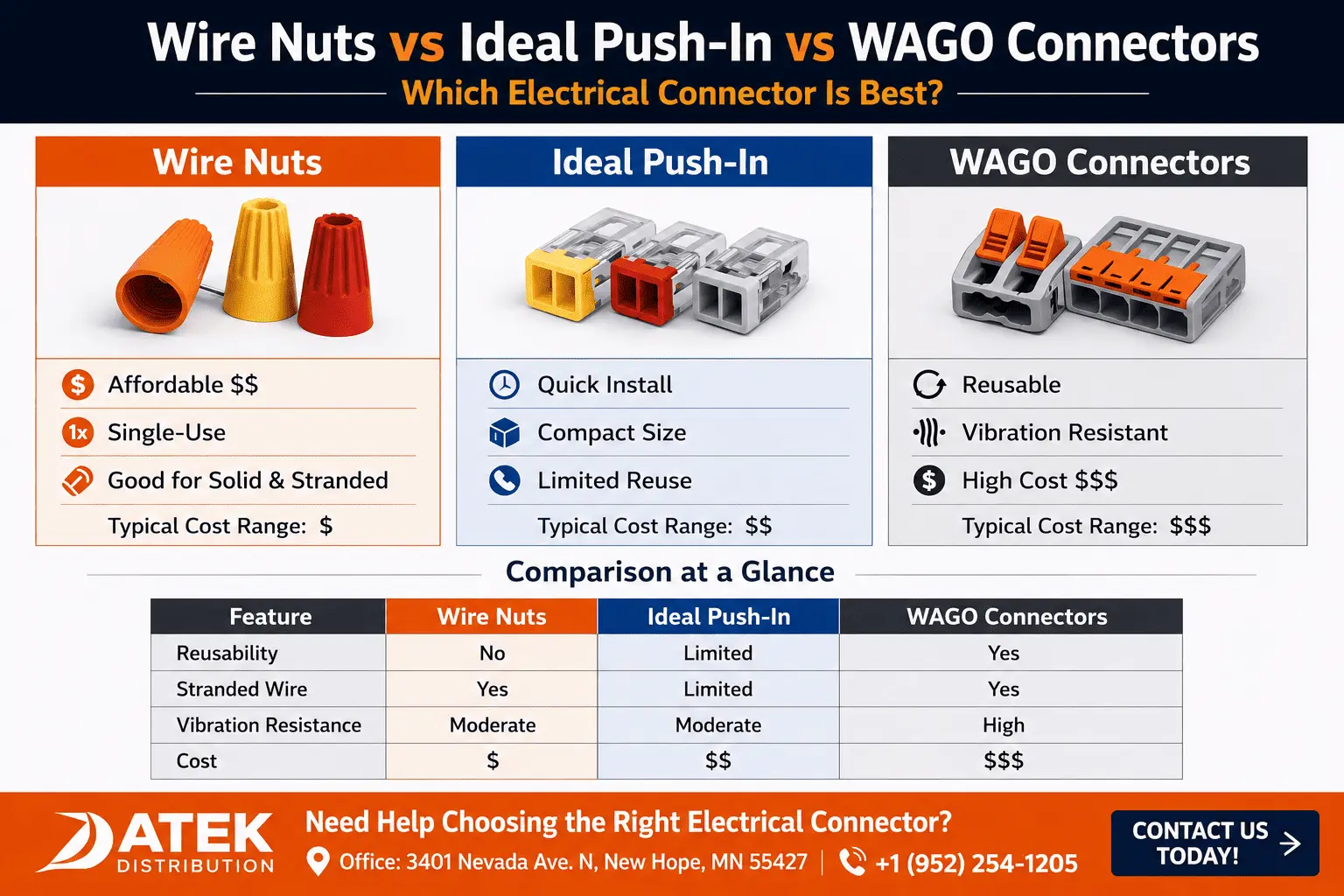
Related guides: industrial fuse selection for the protection inside the panel, EMT vs rigid conduit for the raceway feeding it, and wire nuts vs WAGO connectors for what happens at the terminations.

EMT vs. Rigid Conduit: What’s the Difference?

Conduit Buying Guide

EMT vs. Rigid Conduit: What’s the Difference?

It comes down to wall thickness and how sections connect. EMT is thin-wall tubing joined with setscrew or compression fittings. RMC is thick-wall, threaded conduit built for maximum physical protection — one distinction that decides weight, cost, bending method, and where each belongs on your job.

NEC 358 vs. 344Up to 60% lighterHand-bend vs. hydraulic
EMT/RMC side-by-side

Free Download: Spec comparison chart (PDF)

Wall thickness, NEC articles, UL listings, weight, and a fitting-compatibility quote checklist for EMT, IMC and RMC — two printable pages.

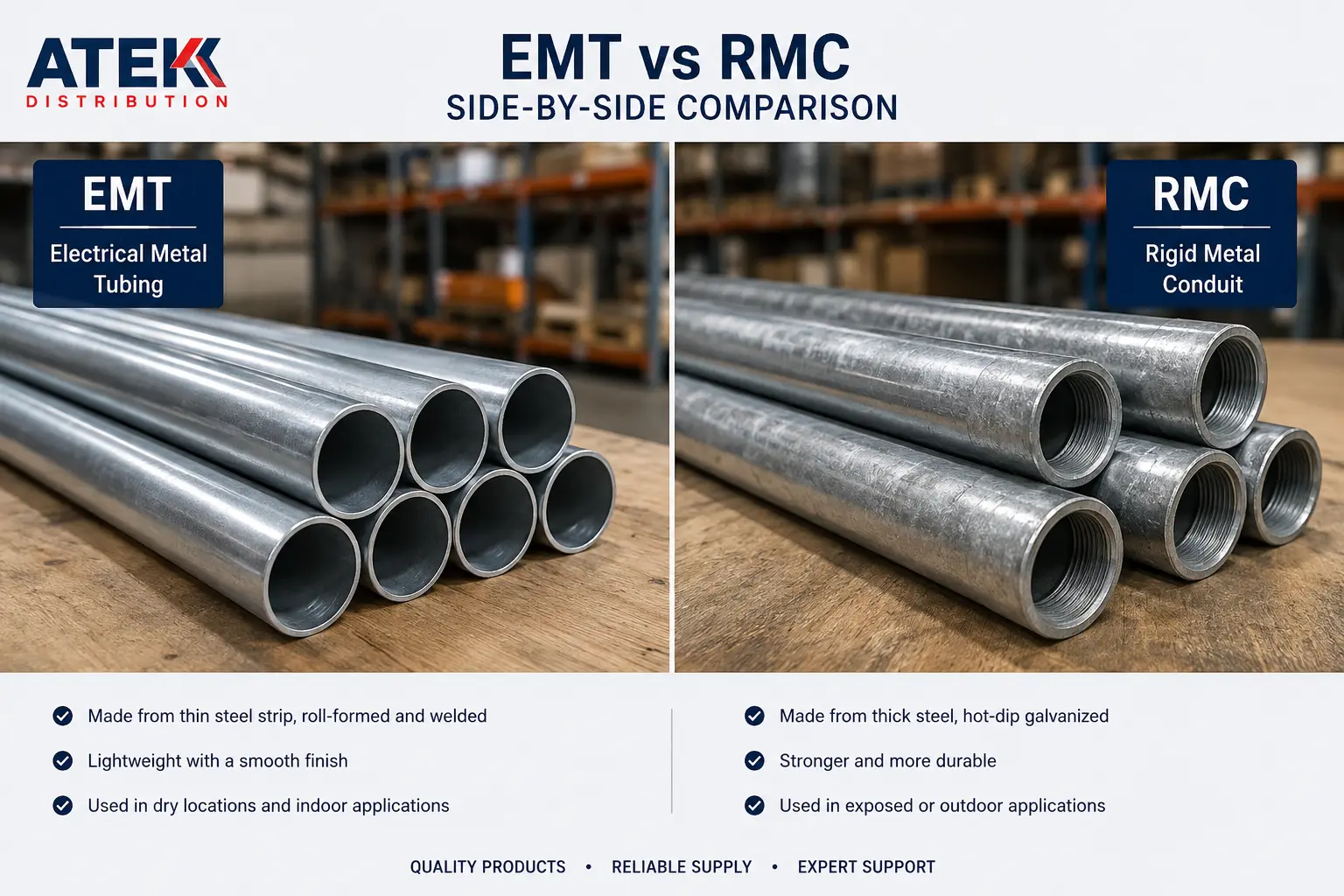
EMT vs. RMC at a Glance

Feature EMT Rigid Metal Conduit (RMC)
NEC Article 358 344
Wall thickness Thin-wall Thick-wall (heaviest metallic conduit)
Threading Unthreaded — setscrew or compression fittings Threaded on both ends
Weight Lightweight Significantly heavier
Bending Easy, hand bender Requires hydraulic/power bending equipment
Physical protection Good for normal conditions Highest protection against impact and crushing
Best for Indoor commercial/light industrial, exposed runs without severe damage risk Outdoor, underground-adjacent, high-abuse industrial areas

Three Conduit Types, One Spec Sheet

EMT, IMC and RMC are often used interchangeably in conversation — they’re different products with different code articles.

EMT

NEC 358Thin-wall, unthreaded steel or aluminum tubing joined with setscrew or compression fittings. Standard for commercial and light-industrial interiors — exposed or concealed, low physical-damage risk.

IMC

NEC 342Threaded, mid-weight steel conduit. More protection than EMT, lighter and cheaper than RMC — permitted anywhere RMC is permitted.

RMC

NEC 344The heaviest, thickest-walled steel raceway. Threaded on both ends for direct connection into hubs and boxes — the standard where protection matters most.

Key Differences Between EMT and Rigid Conduit

Wall thickness & protection

RMC resists impact, crushing and puncture damage. EMT covers normal indoor conditions but isn’t for locations with severe physical-damage risk.

Threading & fittings

EMT: setscrew or compression fittings only. RMC: threaded both ends, connecting directly into threaded equipment — more labor, more secure.

Weight & installation

EMT is light and bends by hand. RMC’s thick walls typically need hydraulic or powered bending equipment, and installation takes longer.

Cost

EMT is cheaper in material and labor — the default for most commercial interiors. RMC costs more, reserved for jobs that need its protection.

Typical applications

EMT: commercial/light-industrial interiors. RMC: outdoor runs, high-abuse industrial areas, and impact-exposed zones.

Neither EMT nor RMC is typically used for direct burial — contractors use RMC or IMC (often PVC-coated) instead. Always confirm exact requirements against current NEC and your local AHJ.

What EMT, IMC and RMC Actually Mean

EMT — Electrical Metallic Tubing

Thin-wall, unthreaded steel tubing. 0.042″–0.083″ nominal wall, trade sizes ½″–4″.
ANSI C80.3 · UL 797 · NEC 358

IMC — Intermediate Metal Conduit

Threaded steel conduit, roughly 0.080″ (10-ga) wall. Lighter than RMC, permitted wherever RMC is.
ANSI C80.6 · UL 1242 · NEC 342

RMC — Rigid Metal Conduit

The heaviest steel raceway. 0.116″–0.148″ nominal wall. Also called rigid, RGS, or galvanized rigid steel.
ANSI C80.1 · UL 6 · NEC 344

EMT is roughly 40% lighter than IMC and 60% lighter than RMC — on a long run that shows up directly in labor hours.

Dimensional figures are nominal industry values from the ANSI C80 series. Confirm exact dimensions against the manufacturer submittal for the trade size you’re specifying.

Are EMT and RMC Fittings Interchangeable? No

Not interchangeable, even when the trade size matches — the two raceways connect in fundamentally different ways.

EMT

Unthreaded. Joins with setscrew or compression connectors that grip the outside of the tubing.

IMC & RMC

Threaded. Join with threaded couplings; ends are cut and threaded in the field or supplied pre-threaded.

Transitioning between the two? Use a listed combination coupling rated for both raceway types. Never thread EMT — the wall isn’t designed for it, and threading voids the listing. A mismatched fitting is a failed inspection and a rework cost.

Common Mistakes to Avoid

Using EMT in locations subject to severe physical damage, where RMC or IMC is required.

Assuming EMT and RMC fittings are interchangeable — they use different connection methods and aren’t cross-compatible.

Specifying EMT for direct burial or underground runs without checking code requirements.

Underestimating labor time and equipment needs when switching a design from EMT to RMC.

Which Should You Choose?

Choose EMT if

The installation is indoor, exposed to normal conditions, and budget and installation speed matter.

Choose RMC if

The conduit will be outdoors, exposed to impact or heavy equipment traffic, or the project specifically calls for maximum protection.

Not sure?

Many commercial projects use both — EMT for the bulk of interior runs, RMC at transitions, exterior stub-ups, or high-traffic industrial zones.

Frequently Asked Questions

Can EMT be threaded like rigid conduit?

No. EMT’s wall is too thin to be threaded and relies entirely on setscrew or compression fittings. Only RMC (and IMC) are manufactured with threaded ends.

Is rigid conduit more expensive than EMT?

Yes, in both material and labor cost. RMC’s thicker wall uses more material, and its threaded connections and heavier bending requirements generally take longer to install.

Can EMT be used outdoors?

Yes, EMT can be used outdoors with appropriate weatherproof fittings and connectors, but many contractors choose RMC for outdoor runs that face higher physical impact risk or require maximum durability.

What's the difference between rigid conduit and IMC?

Both are threaded, but RMC has a thicker, heavier wall than IMC. IMC offers a middle ground — more protection than EMT, lighter and less expensive than full RMC.

Do EMT and rigid conduit use the same fittings?

No. EMT uses setscrew or compression fittings designed for its thin wall, while RMC uses threaded fittings designed for its threaded ends. The two are not cross-compatible.

When should you use EMT vs. rigid conduit?

Choose EMT for indoor runs under normal conditions where budget and installation speed matter. Choose RMC when the conduit will face physical impact, heavy equipment traffic, or the project specifically requires maximum protection — commonly outdoors or in high-abuse industrial areas.

What are the disadvantages of using rigid conduit?

RMC costs more in both material and labor, weighs significantly more than EMT, and requires threading and hydraulic bending equipment rather than a hand bender — all of which add installation time.

What's harder to bend, EMT or rigid?

Rigid conduit is harder to bend. Its thick wall requires hydraulic or powered bending equipment, while EMT’s thin wall bends easily with a standard hand bender.

Where is EMT conduit not allowed?

Per NEC Article 358.12, EMT can’t be used where subject to severe physical damage, as support for luminaires or equipment beyond small conduit bodies, where corrosion protection relies only on enamel, in cinder concrete/fill with permanent moisture unless protected, or in hazardous locations except as permitted under NEC 502.4, 503.3, and 504.20. Confirm against your jurisdiction’s adopted NEC edition before specifying.

Related Guides

Wire Nuts vs. WAGO Connectors: Which Wins?

Compare cost, code compliance, and vibration resistance.

Choosing Electrical Enclosures for Outdoor Use

A buying guide to NEMA/IP ratings and materials.

Browse Electrical Boxes & Enclosures

See where this conduit terminates.

Ready to Spec Your Conduit and Fittings?

ATEK Distribution supplies EMT and rigid conduit fittings for commercial, industrial and government projects. Browse our full range of conduit, raceway, and cable support products, or start with one of the options below.

WAGO vs Wire Nuts: Which Connector Wins?

WAGO vs Wire Nuts: Which Connector Wins?

Short answer: choose wire nuts for cost-effective residential branch circuits, Ideal push-in for fast one-time installs in tight junction boxes, and WAGO lever connectors when the connection must be reusable or sits in a high-vibration industrial environment. All three are UL-listed when installed correctly.

Wire nuts vs WAGO connectors is one of the most common comparisons electricians make when choosing the right wire termination method. When evaluating these two options, alongside Ideal push-in connectors, the best choice depends on conductor type, environment, and installation needs.

Each connector type is UL-listed when used properly and is commonly found in residential, commercial, and industrial wiring systems. Below is a clear breakdown to help you determine which solution fits your application.

wire nuts vs ideal vs wago comparison infographic

Wire Nuts vs WAGO Connectors: Quick Comparison

Feature Wire Nuts Ideal Push-In WAGO Lever Connectors
Reusable No Limited Yes
Stranded Wire Compatibility Yes Limited (model dependent) Yes
Vibration Resistance Moderate Moderate High
Installation Speed Moderate Fast Fast
Box Fill Space Required Moderate Low Low to Moderate
Visual Connection Confirmation No No Yes
Best Use Case Standard residential branch circuits Tight junction boxes, retrofits Industrial panels, high-vibration areas
Wire Nuts
~$0.10–$0.60 each
Ideal Push-In
~$0.50–$2.50 each
WAGO Lever Connectors
~$1.50–$5.00 each

Actual pricing may vary based on gauge, number of ports, brand, and purchase quantity. Contact ATEK Distribution for contractor pricing.

Orange, yellow and red wire nuts (twist-on connectors) with stripped copper conductors

Wire Nuts (Twist-On Connectors)

Wire nuts are among the most widely used electrical connectors in North America. They contain a threaded metal spring insert inside an insulated plastic cap. When twisted onto properly stripped conductors, the internal spring creates both a mechanical and electrical connection.

Wire nuts are commonly used in residential branch circuits, lighting installations, and standard device boxes. They are compatible with both solid and stranded conductors when properly sized.

When installed according to manufacturer instructions and NEC requirements, wire nuts remain a dependable and economical solution for most residential applications.

Browse ATEK’s full selection of wire connectors and splicing supplies.

  • ✓Cost-effective and widely available
  • ✓Compatible with multiple conductor combinations
  • ✓Proven reliability in residential wiring
  • ✓No special tools required
Limitations
  • Not reusable once removed
  • Connection quality depends on correct twisting technique
  • Less ideal for high-vibration environments
  • No visual confirmation of conductor insertion depth

Ideal Push-In Connectors

Ideal push-in connectors eliminate the need to pre-twist conductors. After stripping the wire to the correct length, the installer inserts it directly into the connector opening. An internal spring clamp secures the conductor in place.

These connectors are often used in tight junction boxes where space is limited and installation speed is important.

Push-in connectors are well suited for residential retrofits, lighting circuits, and installations where speed and organization matter.

  • ✓Faster installation vs. twist-on connectors
  • ✓Compact size saves box space
  • ✓Consistent spring tension
  • ✓Cleaner wire management
Limitations
  • Higher cost than wire nuts
  • Limited compatibility with some stranded wires (check specifications)
  • Generally not reusable
Ideal push-in wire connectors in yellow, red and grey for fast termination in tight junction boxes
WAGO lever connectors with orange levers and transparent housings terminating solid copper conductors

WAGO Lever Connectors

WAGO connectors use a lever-actuated spring clamp mechanism. The lever opens the clamping system, allowing easy conductor insertion. Once closed, constant spring pressure ensures secure retention and strong vibration resistance.

WAGO lever connectors are commonly used in industrial panels, commercial systems, and applications requiring future reconfiguration. See our WAGO 221 series guide for panel wiring for a closer look at the most common panel-mount configurations.

In high-vibration or frequently modified installations, WAGO connectors often provide superior long-term performance compared to traditional twist-on connectors.

  • ✓Reusable design
  • ✓Strong vibration resistance
  • ✓Compatible with solid and stranded conductors
  • ✓Visual confirmation of conductor insertion
Limitations
  • Higher upfront cost
  • Requires proper lever closure for a secure connection

WAGO vs. Ideal Connectors: Which Should You Choose?

When the choice comes down specifically to WAGO lever connectors versus Ideal push-in connectors, the decision usually comes down to reusability and where the connection is going.

Choose WAGO if…
The installation needs to be reusable, sits in a high-vibration environment (industrial panels, equipment enclosures), or may require future reconfiguration. The lever mechanism and visual conductor confirmation make WAGO the more dependable long-term choice.
Choose Ideal if…
You are working in a tight junction box, want the fastest possible one-time installation, and do not need the connection to be reusable later. Ideal connectors are typically less expensive per unit than WAGO.
Feature WAGO Lever Connectors Ideal Push-In
Reusable Yes No (generally)
Vibration resistance High Moderate
Installation method Lever-actuated Push-to-insert
Best for Industrial panels, high-vibration areas Tight junction boxes, one-time installs
Typical cost Higher Lower

Decided which connector you need?
Send your quantities and we will quote them by the case. ATEK supplies contractors, facilities teams, and government projects nationwide.

Still unsure which fits your project? Contact ATEK Distribution for guidance on connector selection.

Safety and Code Compliance

All three connector types are safe when UL-listed and installed according to NEC guidelines. Proper conductor stripping length, correct connector sizing, and compliance with box fill requirements are critical for safe operation.

Improper termination, regardless of connector type, can lead to overheating, arcing, or failure. Always verify ampacity ratings, voltage limits, and conductor compatibility before installation.

All connectors should comply with National Electrical Code (NEC) requirements for safe installation.

Which Connector Should You Choose?

Wire Nuts
Cost-effective residential splicing and standard branch circuits.
Ideal Push-In
Faster installation in tight electrical boxes.
WAGO Connectors
Reusability, vibration resistance, and industrial applications.

There is no single “best” connector, only the best connector for your specific environment and wiring needs. If you need assistance selecting the right connector for your project, contact ATEK Distribution for professional guidance and product availability.

Frequently Asked Questions

Are wire nuts as good as WAGO connectors?

Wire nuts and WAGO connectors serve different purposes. Wire nuts are a reliable, cost-effective choice for standard residential wiring, while WAGO connectors offer better vibration resistance and reusability, making them a stronger choice for industrial or frequently modified installations.

Do push-in connectors work with stranded wire?

It depends on the specific model. Some Ideal push-in connectors are rated for stranded wire, while others are designed for solid conductors only. Always check the manufacturer's specifications before use.

Are WAGO connectors better than wire nuts?

WAGO connectors are often preferred in applications requiring reusability and vibration resistance. Wire nuts remain reliable and cost-effective for most residential wiring installations when properly installed.

Are WAGO connectors approved by the National Electrical Code?

Yes. WAGO lever connectors are UL-listed and meet NEC requirements when properly installed. See our full NEC and UL compliance breakdown for inspector-level detail.

Is WAGO or Ideal better for a one-time installation in a tight junction box?

For a single, permanent installation in a tight junction box, Ideal push-in connectors are usually the faster and more cost-effective choice. WAGO connectors are worth the extra cost when the installation may need to be reopened or faces vibration.

Which connector is best for high-vibration environments?

WAGO lever connectors are typically preferred in vibration-prone environments due to their constant spring pressure and secure clamping mechanism.

Are WAGO connectors reusable?

Yes. WAGO lever connectors are designed to be reusable, making them ideal for applications where future modifications may be required.

Which connector is most cost-effective for a large residential project?

Wire nuts are typically the most cost-effective option for large residential projects due to their low per-unit cost and wide availability, though installation time should also be factored into overall project cost.

Is WAGO or Ideal push-in better overall?

Neither is universally better. It depends on the application. WAGO lever connectors are the stronger choice for reusable, high-vibration, or industrial installations, while Ideal push-in connectors are usually faster and less expensive for a single, permanent connection in a tight junction box.

Buying Connectors by the Case?

ATEK Distribution supplies electrical contractors, facilities teams, and government projects nationwide. Send us your quantities and specifications and we will quote them.

We have been answering these questions since 2018. Call or email — we are happy to help you figure out exactly what you need.