Conduit Buying Guide

EMT vs. Rigid Conduit: What’s the Difference?

It comes down to wall thickness and how sections connect. EMT is thin-wall tubing joined with setscrew or compression fittings. RMC is thick-wall, threaded conduit built for maximum physical protection — one distinction that decides weight, cost, bending method, and where each belongs on your job.
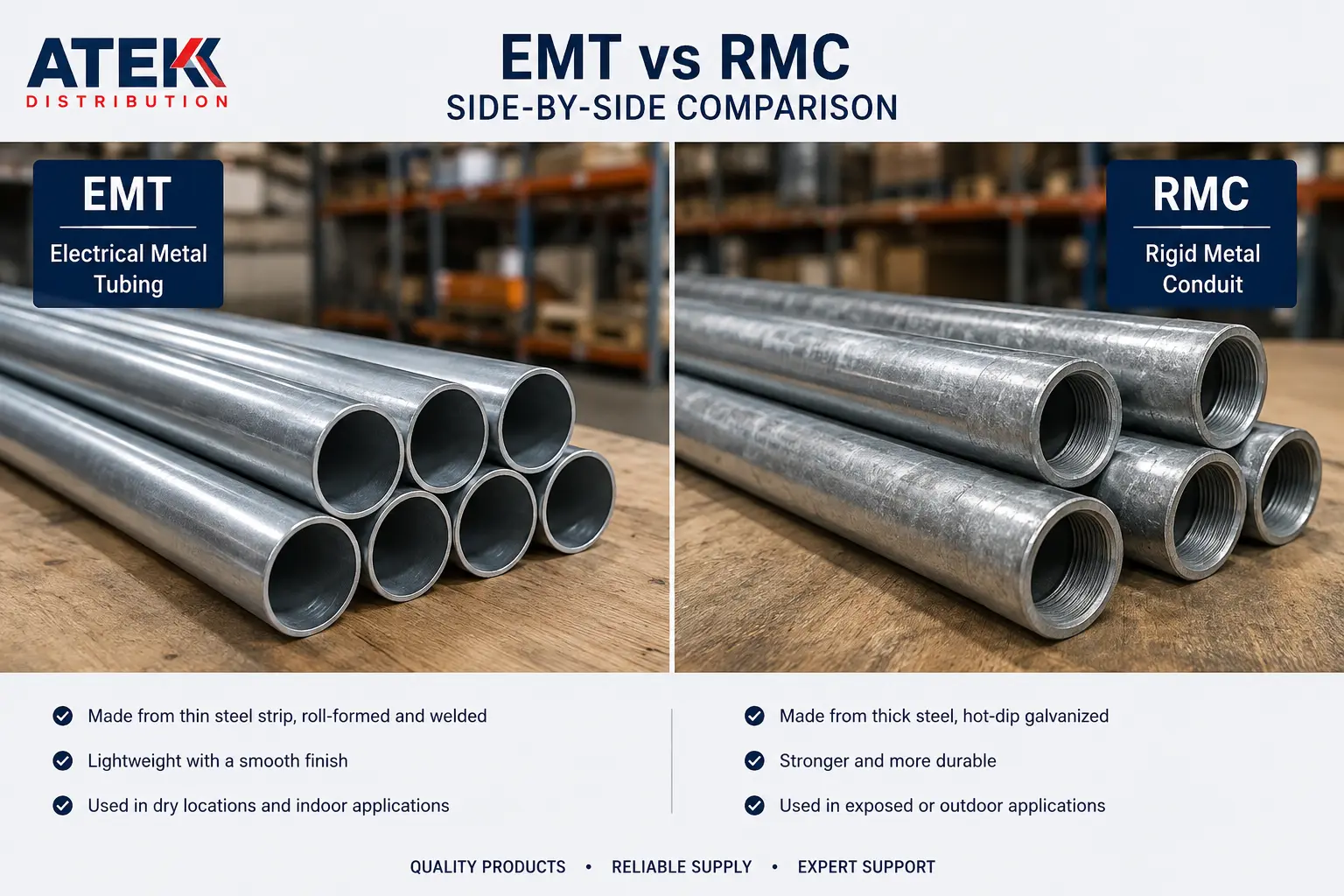
NEC 358 vs. 344Up to 60% lighterHand-bend vs. hydraulic
EMT/RMC side-by-side

Free Download: Spec comparison chart (PDF)

Wall thickness, NEC articles, UL listings, weight, and a fitting-compatibility quote checklist for EMT, IMC and RMC — two printable pages.

EMT vs. RMC at a Glance

Feature EMT Rigid Metal Conduit (RMC)
NEC Article 358 344
Wall thickness Thin-wall Thick-wall (heaviest metallic conduit)
Threading Unthreaded — setscrew or compression fittings Threaded on both ends
Weight Lightweight Significantly heavier
Bending Easy, hand bender Requires hydraulic/power bending equipment
Physical protection Good for normal conditions Highest protection against impact and crushing
Best for Indoor commercial/light industrial, exposed runs without severe damage risk Outdoor, underground-adjacent, high-abuse industrial areas

Three Conduit Types, One Spec Sheet

EMT, IMC and RMC are often used interchangeably in conversation — they’re different products with different code articles.

EMT

NEC 358Thin-wall, unthreaded steel or aluminum tubing joined with setscrew or compression fittings. Standard for commercial and light-industrial interiors — exposed or concealed, low physical-damage risk.

IMC

NEC 342Threaded, mid-weight steel conduit. More protection than EMT, lighter and cheaper than RMC — permitted anywhere RMC is permitted.

RMC

NEC 344The heaviest, thickest-walled steel raceway. Threaded on both ends for direct connection into hubs and boxes — the standard where protection matters most.

Key Differences Between EMT and Rigid Conduit

Wall thickness & protection

RMC resists impact, crushing and puncture damage. EMT covers normal indoor conditions but isn’t for locations with severe physical-damage risk.

Threading & fittings

EMT: setscrew or compression fittings only. RMC: threaded both ends, connecting directly into threaded equipment — more labor, more secure.

Weight & installation

EMT is light and bends by hand. RMC’s thick walls typically need hydraulic or powered bending equipment, and installation takes longer.

Cost

EMT is cheaper in material and labor — the default for most commercial interiors. RMC costs more, reserved for jobs that need its protection.

Typical applications

EMT: commercial/light-industrial interiors. RMC: outdoor runs, high-abuse industrial areas, and impact-exposed zones.

Neither EMT nor RMC is typically used for direct burial — contractors use RMC or IMC (often PVC-coated) instead. Always confirm exact requirements against current NEC and your local AHJ.

What EMT, IMC and RMC Actually Mean

EMT — Electrical Metallic Tubing

Thin-wall, unthreaded steel tubing. 0.042″–0.083″ nominal wall, trade sizes ½″–4″.
ANSI C80.3 · UL 797 · NEC 358

IMC — Intermediate Metal Conduit

Threaded steel conduit, roughly 0.080″ (10-ga) wall. Lighter than RMC, permitted wherever RMC is.
ANSI C80.6 · UL 1242 · NEC 342

RMC — Rigid Metal Conduit

The heaviest steel raceway. 0.116″–0.148″ nominal wall. Also called rigid, RGS, or galvanized rigid steel.
ANSI C80.1 · UL 6 · NEC 344

EMT is roughly 40% lighter than IMC and 60% lighter than RMC — on a long run that shows up directly in labor hours.

Dimensional figures are nominal industry values from the ANSI C80 series. Confirm exact dimensions against the manufacturer submittal for the trade size you’re specifying.

Are EMT and RMC Fittings Interchangeable? No

Not interchangeable, even when the trade size matches — the two raceways connect in fundamentally different ways.

EMT

Unthreaded. Joins with setscrew or compression connectors that grip the outside of the tubing.

IMC & RMC

Threaded. Join with threaded couplings; ends are cut and threaded in the field or supplied pre-threaded.

Transitioning between the two? Use a listed combination coupling rated for both raceway types. Never thread EMT — the wall isn’t designed for it, and threading voids the listing. A mismatched fitting is a failed inspection and a rework cost.

Common Mistakes to Avoid

Using EMT in locations subject to severe physical damage, where RMC or IMC is required.
Assuming EMT and RMC fittings are interchangeable — they use different connection methods and aren’t cross-compatible.
Specifying EMT for direct burial or underground runs without checking code requirements.
Underestimating labor time and equipment needs when switching a design from EMT to RMC.

Which Should You Choose?

Choose EMT if

The installation is indoor, exposed to normal conditions, and budget and installation speed matter.

Choose RMC if

The conduit will be outdoors, exposed to impact or heavy equipment traffic, or the project specifically calls for maximum protection.

Not sure?

Many commercial projects use both — EMT for the bulk of interior runs, RMC at transitions, exterior stub-ups, or high-traffic industrial zones.

Frequently Asked Questions

Can EMT be threaded like rigid conduit?
No. EMT’s wall is too thin to be threaded and relies entirely on setscrew or compression fittings. Only RMC (and IMC) are manufactured with threaded ends.
Is rigid conduit more expensive than EMT?
Yes, in both material and labor cost. RMC’s thicker wall uses more material, and its threaded connections and heavier bending requirements generally take longer to install.
Can EMT be used outdoors?
Yes, EMT can be used outdoors with appropriate weatherproof fittings and connectors, but many contractors choose RMC for outdoor runs that face higher physical impact risk or require maximum durability.
What's the difference between rigid conduit and IMC?
Both are threaded, but RMC has a thicker, heavier wall than IMC. IMC offers a middle ground — more protection than EMT, lighter and less expensive than full RMC.
Do EMT and rigid conduit use the same fittings?
No. EMT uses setscrew or compression fittings designed for its thin wall, while RMC uses threaded fittings designed for its threaded ends. The two are not cross-compatible.
When should you use EMT vs. rigid conduit?
Choose EMT for indoor runs under normal conditions where budget and installation speed matter. Choose RMC when the conduit will face physical impact, heavy equipment traffic, or the project specifically requires maximum protection — commonly outdoors or in high-abuse industrial areas.
What are the disadvantages of using rigid conduit?
RMC costs more in both material and labor, weighs significantly more than EMT, and requires threading and hydraulic bending equipment rather than a hand bender — all of which add installation time.
What's harder to bend, EMT or rigid?
Rigid conduit is harder to bend. Its thick wall requires hydraulic or powered bending equipment, while EMT’s thin wall bends easily with a standard hand bender.
Where is EMT conduit not allowed?
Per NEC Article 358.12, EMT can’t be used where subject to severe physical damage, as support for luminaires or equipment beyond small conduit bodies, where corrosion protection relies only on enamel, in cinder concrete/fill with permanent moisture unless protected, or in hazardous locations except as permitted under NEC 502.4, 503.3, and 504.20. Confirm against your jurisdiction’s adopted NEC edition before specifying.

Related Guides

Wire Nuts vs. WAGO Connectors: Which Wins?

Compare cost, code compliance, and vibration resistance.

Choosing Electrical Enclosures for Outdoor Use

A buying guide to NEMA/IP ratings and materials.

Browse Electrical Boxes & Enclosures

See where this conduit terminates.

Ready to Spec Your Conduit and Fittings?

ATEK Distribution supplies EMT and rigid conduit fittings for commercial, industrial and government projects. Browse our full range of conduit, raceway, and cable support products, or start with one of the options below.