
You're standing in a dispensing room with a submittal in your hand. The proposed fixture matches the lumen output, voltage, mounting pattern, and color temperature. It looks sealed and rugged. None of that tells you whether it belongs overhead.
That's where hazardous location lights specifications usually fail. Buyers compare lighting performance first and check the certification marking last, if at all. Reverse that order. Start with the classified area, read the complete label, and only then compare light output.
Table of Contents
- What Makes an Ordinary Light Hazardous in the First Place
- Reading Class, Division and Zone Classifications
- Explosion-Proof and Intrinsically Safe Fixtures Compared
- Temperature Codes and Gas Groups on the Label
- Standards and Certifications Across NEC, UL, ATEX and IECEx
- Specification Data, Substitutions and Ordering Sequence
What Makes an Ordinary Light Hazardous in the First Place
A standard ceiling fixture can operate safely in an office corridor and create an ignition risk in a solvent dispensing room. The fixture is unchanged; the surrounding atmosphere is not.
Combustion needs fuel, oxygen, and an ignition source. In a classified area, fuel may be flammable gas, vapor, or combustible dust mixed with air. Oxygen is already present, so the fixture must not supply the ignition source. A hot surface or electrical spark can provide one.
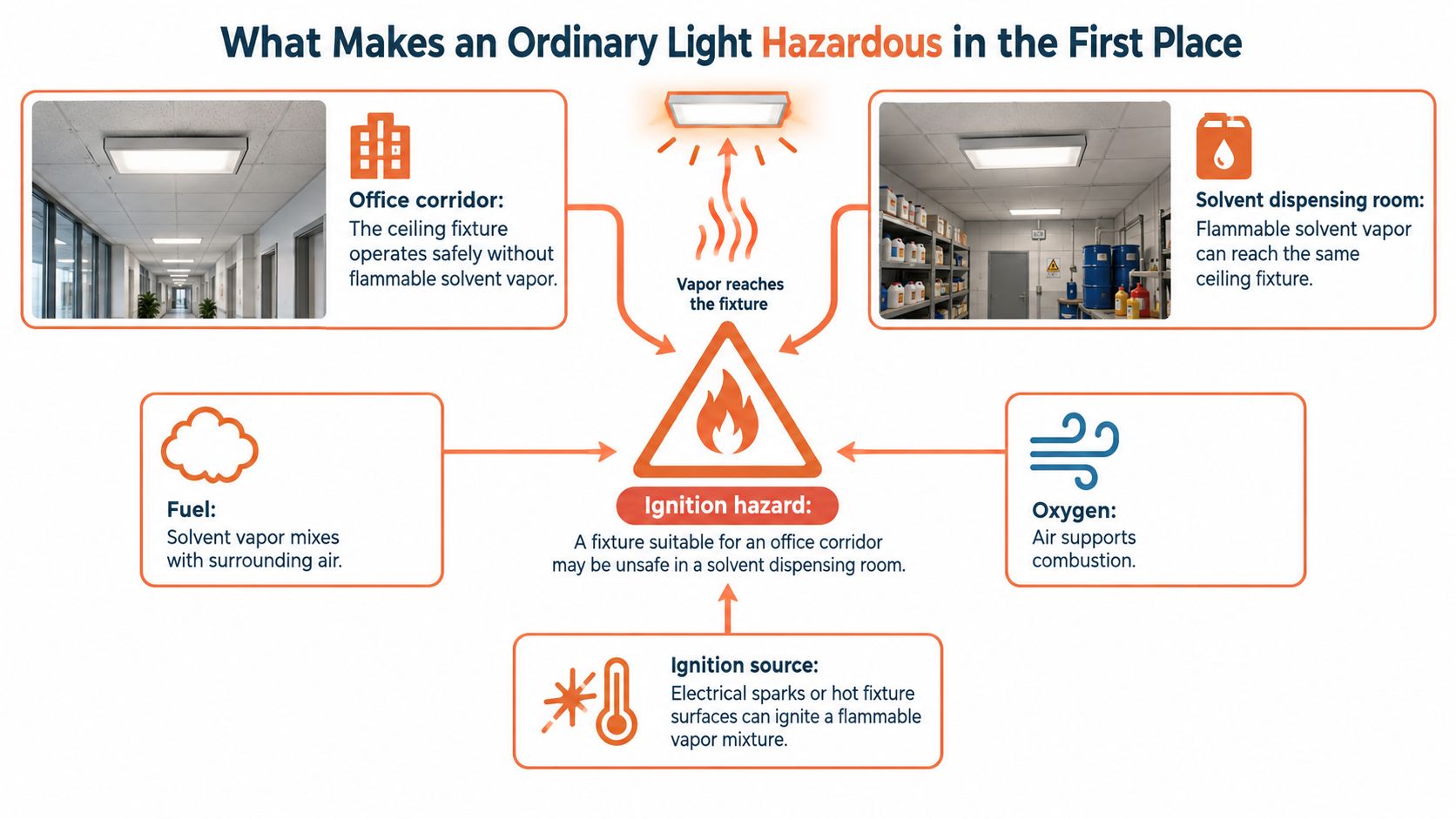
Three Ways a Fixture Can Ignite the Room
- Hot surfaces: Lamp envelopes, drivers, and heatsinks can become hot. Dust collecting on a housing can raise its surface temperature.
- Arcing: Switches, terminals, and connectors can spark during operation or if a fault occurs.
- Breakage: A cracked lens or missing guard can expose hot or sparking parts to the surrounding mixture.
A hazardous location is an area where flammable gas, vapor, or combustible dust may be present in an ignitable concentration. A hazardous-location luminaire is evaluated against ignition-protection requirements for its intended area. A rugged housing or high light output alone does not establish that suitability.
Before comparing lumen output, voltage, or mounting options, check the fixture's classification and certification markings. Read the complete label and confirm that its ratings match the area's documentation. A lumen-matched substitute can still be unsuitable if its marking does not match; a Division 2 fixture, for example, must not be placed in a Division 1 area. Check the label's temperature rating against the specified ambient conditions, too, since a marking read at the wrong ambient temperature can lead to the wrong selection.
Use industrial lighting options for a classified space only after confirming that the fixture's markings fit the intended location. Compare performance specifications after that check, not before.
Reading Class, Division and Zone Classifications
Classification answers two questions. What material creates the hazard? How likely is an ignitable concentration?
Class identifies the material. Class I covers flammable gases and vapors. Class II covers combustible dust. Class III covers easily ignitable fibers and flyings. Division identifies likelihood. Division 1 means ignitable concentrations can exist during normal operation. Division 2 means they're not expected during normal operation and would come from a leak, rupture, or equipment failure. The OSHA six-designation framework covering Class I, II, and III in Divisions 1 and 2 is the North American starting point, and a fixture suitable for one designation isn't automatically suitable for another.
Zones are the IEC-based alternative. Zones 0, 1, and 2 apply to gas. Zones 20, 21, and 22 apply to dust. Don't treat Zones as a one-to-one swap for Divisions. They use related logic, but the marking on the fixture has to match the system used on your drawings.
Classify the Room, Not the Whole Building
OSHA requires each room, section, or area to be evaluated individually rather than assigning one classification across an entire facility. A solvent dispensing booth shows why. The interior may be Class I, Division 1 while the area beyond a ventilated boundary is Division 2. One building, two different fixture requirements.
Field check: If you don't have a classification drawing for the current layout, you don't have enough information to release a purchase order.
| Designation | Hazard material | Likelihood of ignitable concentration | Typical example area |
|---|---|---|---|
| Class I, Division 1 | Flammable gases and vapors | Present during normal operation, repair, or frequent failure | Interior of a solvent dispensing or spray booth |
| Class I, Division 2 | Gases or vapors in closed systems | Only after leak, rupture, or abnormal operation | Area around a sealed solvent pump |
| Class II, Division 1 | Combustible dust | Normally in suspension or capable of ignition in normal operation | Interior of a grain elevator or flour mill |
| Class II, Division 2 | Combustible dust | Not normally in suspension, accumulations may be present | Area outside a dust collector enclosure |
| Class III, Division 1 | Easily ignitable fibers or flyings | Fibers handled or manufactured in the area | Textile or woodworking fiber processing area |
| Class III, Division 2 | Easily ignitable fibers or flyings | Fibers stored or handled, not manufactured | Fiber storage room |
| Zone 0 (gas) | Flammable gas or vapor | Present continuously or for long periods | Inside a vessel or tank |
| Zone 1 (gas) | Flammable gas or vapor | Likely during normal operation | Area around a vent or filling point |
| Zone 2 (gas) | Flammable gas or vapor | Not likely, and short-term if it occurs | Area around a pump flange |
| Zone 20 (dust) | Combustible dust | Present continuously or for long periods | Inside a silo or hopper |
| Zone 21 (dust) | Combustible dust | Likely during normal operation | Area near a dust loading point |
| Zone 22 (dust) | Combustible dust | Not likely, and short-term if it occurs | Area near a dust collector filter housing |
The common field failure is a Division 2 fixture installed in a Division 1 area. It usually isn't a deliberate shortcut. A process gets added, a booth gets moved, and the boundary changes while the installed fixture doesn't. Check the classification drawing against the fixture label before the material arrives, not during inspection.
Explosion-Proof and Intrinsically Safe Fixtures Compared
Two analogies clear up most of the confusion. An explosion-proof fixture is a heavy steel box. If ignition happens inside, the enclosure contains it and cools escaping gases through engineered joints so they don't ignite the atmosphere outside. An intrinsically safe circuit is closer to a low-energy battery toy. It limits electrical energy so a spark or hot surface can't ignite the surrounding mixture in the first place.
One contains ignition. The other prevents it by starving it of energy.
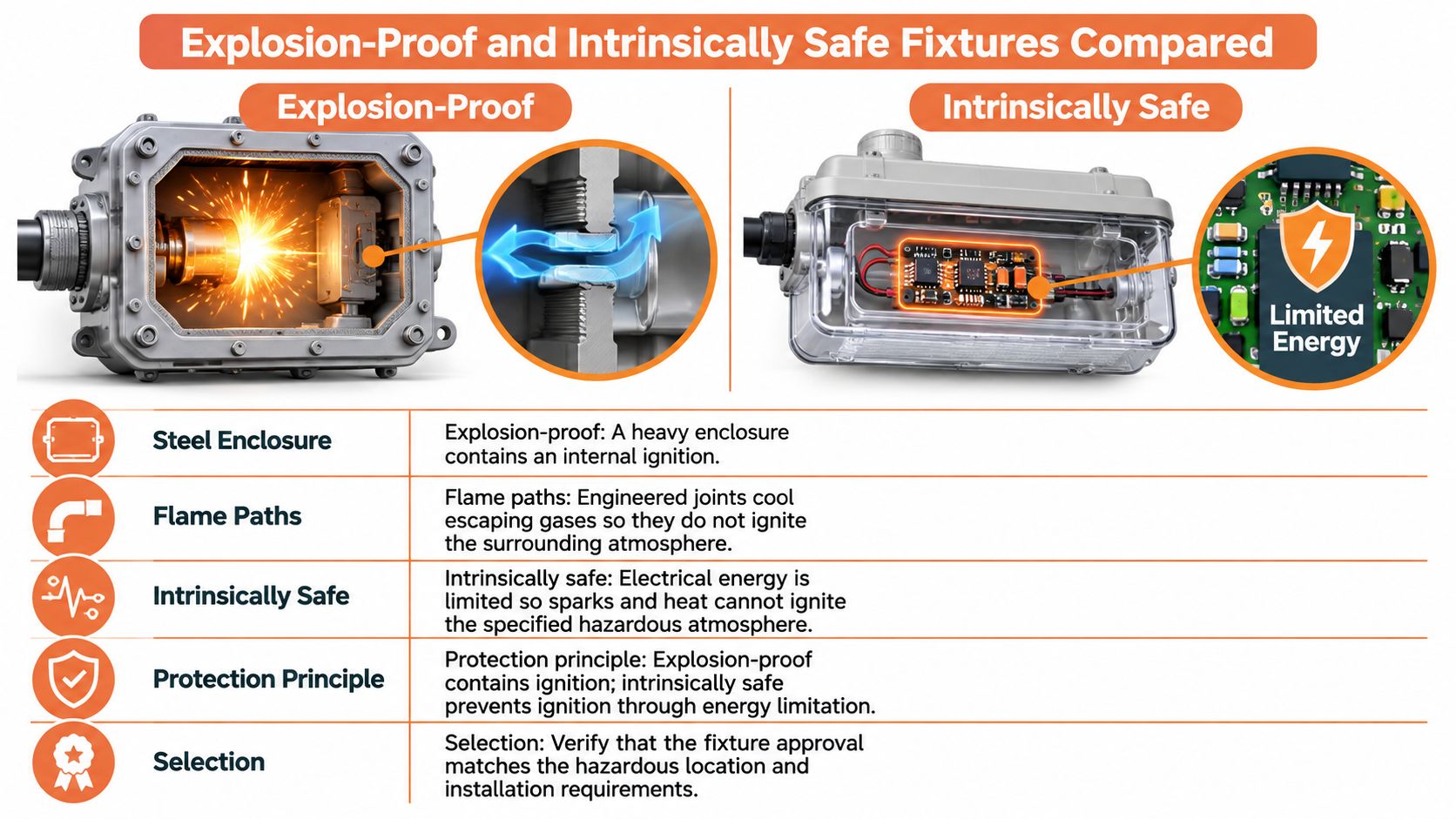
Explosion-proof is the common North American term. Flameproof, marked Ex d, is the IEC equivalent. Intrinsically safe systems depend on approved barriers, associated apparatus, and a control drawing. That dependency makes them common in instrumentation and low-power circuits, not in high-output general lighting where the luminaire needs substantial power.
The short video below is useful for seeing how enclosure construction and protection concepts differ in practice before you compare catalog claims.
| Method | How it prevents ignition | Typical use | Watch-out |
|---|---|---|---|
| Explosion-proof (flameproof, Ex d) | Enclosure withstands internal explosion and cools gases through controlled joints | Fixed luminaires in Class I, Division 1 or Zone 1 | Joints, threads, and seals must stay intact |
| Intrinsically safe (Ex i) | Limits energy so sparks and heat cannot ignite the atmosphere | Low-power circuits and instrumentation | Needs control drawing, barriers, and associated apparatus |
| Increased safety (Ex e) | Construction measures reduce arcs, sparks, and hot spots | Terminal enclosures and certain Zone 1 or 2 luminaires | Depends on certified construction, not field work |
| Purged or pressurized (Ex p) | Protective gas pressure keeps hazardous atmosphere out | Large enclosures and specialized housings | Requires purge controller, alarms, and interlocks |
| Nonincendive | Equipment cannot ignite atmosphere under normal conditions | Class I, Division 2 where listing allows | Valid only with listed equipment and wiring method |
The Practical Verdict and the Dust Problem
For fixed luminaires in Class I, Division 1 or Zone 1, explosion-proof construction is the usual choice. In Division 2, nonincendive designs may work where the listed equipment and installation method allow it. Either way, field modification is the enemy. Damaged joints, missing threads, substituted seals, or a drilled enclosure can void the protection the listing depends on.
Dust changes the logic. In Class II and Zone 20 to 22 areas, protection depends on keeping combustible dust out and controlling surface temperature under dust layers. IEC markings use dust-protection codes such as Ex t, not flameproof codes. A gas-rated explosion-proof fixture does not establish Class II suitability. Put the cleaning schedule in the specification, because accumulated dust is part of the thermal problem.
Temperature Codes and Gas Groups on the Label
A T-code sets the highest surface temperature a fixture may reach under its rated conditions. The numbering runs opposite to what many buyers expect: T1 permits the hottest surface, while T6 permits the coolest. That rating is only useful when compared with the ignition temperature of the gas, vapor, or dust at the site.
IECEx temperature class values run from T1 at 450°C down to T6 at 85°C. The table gives the maximum surface temperature for each class. Select a class whose maximum is below the ignition temperature of the hazardous material.
| Temperature class | Maximum surface temperature | Condition for use |
|---|---|---|
| T1 | 450°C | Gas ignition temperature above 450°C |
| T2 | 300°C | Gas ignition temperature above 300°C |
| T3 | 200°C | Gas ignition temperature above 200°C |
| T4 | 135°C | Gas ignition temperature above 135°C |
| T5 | 100°C | Gas ignition temperature above 100°C |
| T6 | 85°C | Gas ignition temperature above 85°C |
For example, a site classified Zone 1, gas group IIA, T4 requires equipment suitable for Zone 1 and IIA, with a T4 or cooler temperature class. If the gas in the hazard inventory has an ignition temperature of 180°C, a T4 fixture rated for a maximum surface temperature of 135°C stays below that value. A T3 fixture, which can reach 200°C, does not. The mistake to avoid is treating 135°C as the point at which a surface becomes dangerous. It is the T4 maximum; the gas's ignition temperature determines whether that limit is suitable.
Gas groups provide another part of the match. IEC uses IIA, IIB, and IIC for gases. U.S. Class I practice uses Groups A through D. Check the fixture's marking against the specific gas or vapor in the site hazard inventory. A gas-group label is not a general approval for every gas.
Why a Correct Label Can Still Run Hot
The marked temperature class applies under specified ambient conditions. Check the fixture's certification and marking for its rated ambient range, then compare that range with the highest credible temperature at the installation. OSHA 29 CFR 1910.307 equipment marking requirements addresses equipment marking, but it does not establish a universal 40°C ambient basis.
A fixture can exceed the expected surface temperature if actual conditions differ from its rating. High ambient heat, dust on the lens or housing, thermal derating, mounting orientation, and nearby heat sources can all affect operation. Read the full marking against site conditions, not just the temperature recorded during a comfortable indoor visit. A cooler-rated LED may help limit surface temperature, but it does not replace the required Class, Division, or Zone certification.
Standards and Certifications Across NEC, UL, ATEX and IECEx
Start with the U.S. framework. NFPA 70, the National Electrical Code, covers division-based Class I, II, and III locations in Articles 500 through 504. Article 505 covers the zone-based Class I system. U.S. marine electrical rules point to those same NFPA 70 Articles 500 to 504 and Article 505 for hazardous-location equipment, which shows how central the NEC structure is to equipment suitability.
The edition in force isn't your choice. The adopting jurisdiction and the authority having jurisdiction set the edition and local amendments. Confirm both on each project before you lock a specification.
Equipment for Class I locations must be tested and listed by an independent laboratory against recognized standards. A manufacturer's unverified claim isn't enough. For luminaires, UL 844 is the long-established North American standard for electric luminaires in hazardous classified locations. UL 1598 for luminaires and UL 8750 for LED equipment are broader standards. They matter, but neither one by itself establishes hazardous-location suitability.
A fixture can be a well-built LED luminaire and still have no hazardous-location listing. Those are separate questions.
| Standard or mark | Region or scope | What it covers | What to check |
|---|---|---|---|
| NFPA 70 Articles 500 to 504 | United States, as adopted locally | Class I, II, and III division-based locations | Edition adopted by the authority having jurisdiction |
| NFPA 70 Article 505 | United States, as adopted locally | Zone-based Class I locations | Zone marking matches the area |
| UL 844 | North America | Electric luminaires for hazardous classified locations | Listing and classification marking on fixture |
| UL 1598 | North America | Broader luminaire construction | Doesn't alone confirm hazardous suitability |
| UL 8750 | North America | LED equipment safety | Doesn't replace hazardous-location listing |
| ATEX | European Union | Equipment for explosive atmospheres | Category and Ex marking matched to zone |
| IECEx | International scheme | Ex equipment certificates and conditions | Certificate, conditions, and temperature class |
| CCC Ex | China | Explosion-protection certification | Mark for installations in China |
| ECAS Ex | Eurasian region | Regional explosion-protection certification | Certificate and marking for installation country |
International work adds separate pathways. A product may need ATEX, IECEx, CCC Ex, or ECAS Ex approval depending on the country and installation regime. Don't assume a North American listing travels.
The certification mark has to match the site's classification, temperature code, and electrical rating together. That discipline applies to the whole installed system, including raceway decisions you'll coordinate with items such as conduit sizing and routing for the wiring method. LED efficacy and enclosure construction are useful data. They don't establish suitability on their own.
Specification Data, Substitutions and Ordering Sequence
A grain handling building needs 150 fixtures replaced. A proposed alternate matches lumen output, voltage, color temperature, and mounting pattern. On a lighting schedule, it looks equivalent. Then someone reads the label and finds no Class II marking. That fixture isn't an alternate. It's a different product for a different hazard.
That's the substitution trap. Matching photometrics and mechanical fit doesn't establish hazardous-location equivalency. Under OSHA practice, equipment must be intrinsically safe, approved for the location, or demonstrably safe for the specific combustible hazard. The definition of the classes themselves, set out in OSHA 1910.399 hazardous location class definitions, makes the point plainly. A luminaire for combustible dust isn't automatically suitable for flammable vapor service, and the reverse is also true.
For Class I specifically, Division 1 covers locations where ignitable concentrations can exist during normal operation, during frequent repair or maintenance, or where equipment failure could release hazardous concentrations and create an ignition source at the same time. Division 2 covers materials normally confined in closed systems that could escape only through accidental rupture or abnormal operation, as described in the NFPA 497 Class I Division 1 and Division 2 area descriptions. That distinction is exactly why a Division 2 rating can't be stretched into a Division 1 space.
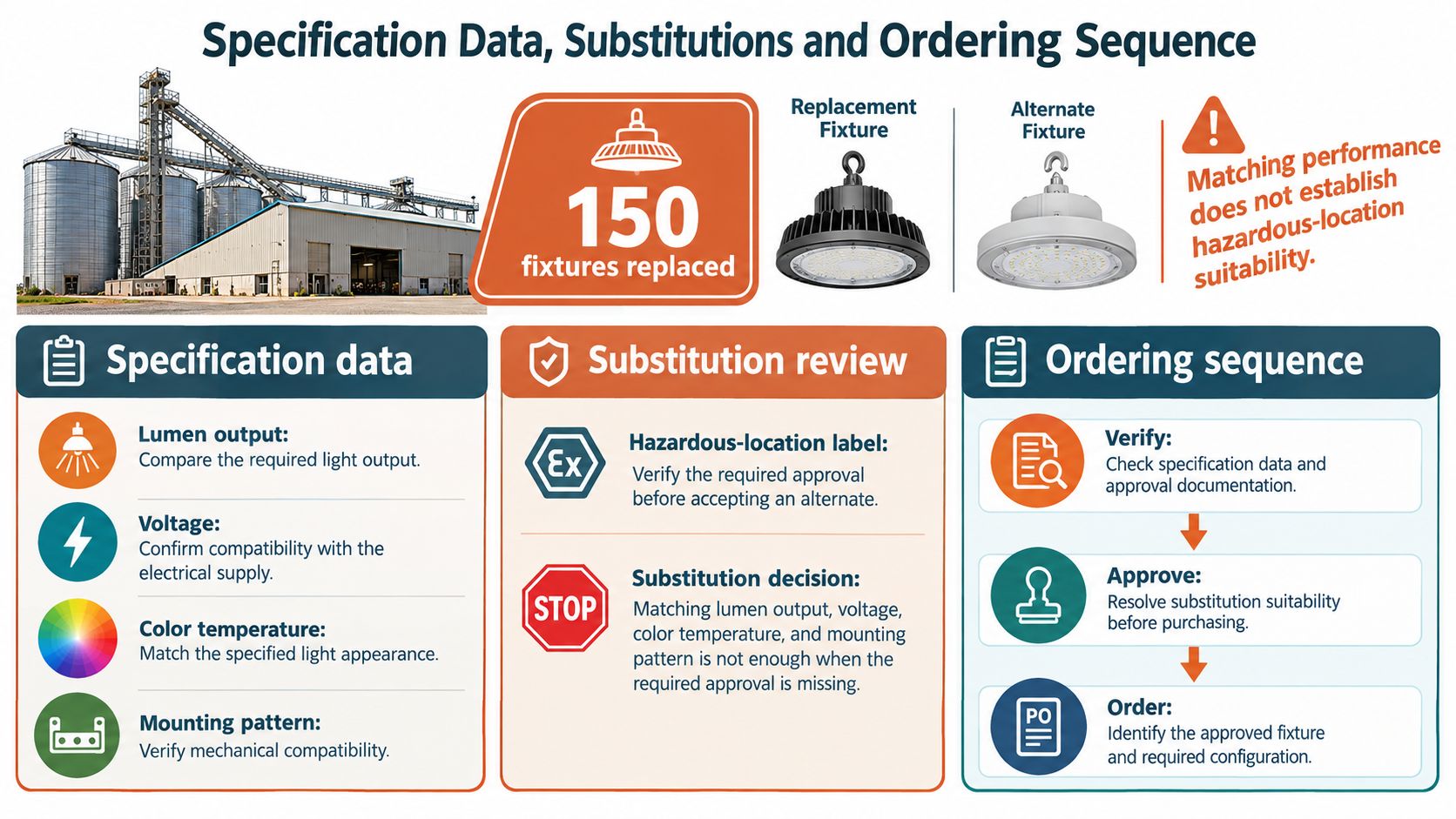
Data Every Specification and Submittal Must Contain
Don't release a fixture for pricing until these items are written down for each area.
- Class and Division or Zone: State it for every area, not once for the building.
- Gas or dust group: Match it to the actual materials in the hazard inventory.
- Temperature code: Verify it against ignition temperatures, with margin for real conditions.
- Ambient range: Include the highest credible temperature, not the design-day average.
- Enclosure, mounting, and wiring method: Include sealing fittings and entry details.
- Certification agency and complete marking: Require the full label text, not a summary line.
- Control drawing: Required where intrinsically safe or associated apparatus applies.
- Installation instructions and impact protection: Cover lenses, guards, and mounting hardware.
- Service path: Confirm how lamps, drivers, gaskets, and seals get replaced without breaking the listing.
Requiring the manufacturer's certification label, control-drawing requirements where applicable, installation instructions, and evidence that the protection method covers the identified hazard protects you during alternate-product sourcing. If a submittal gives you lumens and wattage but not the complete marking, send it back. It's incomplete.
Installation Points That Belong in the Purchase Decision
A listed product can still become a noncompliant installation. Specify sealing fittings where the wiring method requires them, and drain or breather fittings where condensation is possible. Prohibit field modification of listed enclosures in the project documents, and make sure the installing contractor knows which entries, glands, and adapters are part of the listed assembly.
In Class II areas, schedule dust removal as maintenance, not housekeeping. Dust layers change thermal behavior and can become fuel. Log seal and gasket condition during those same visits. If a lens guard is damaged or a threaded joint won't engage fully, treat it as a protection failure and replace it with the same listed configuration.
The Buying Sequence That Catches Errors Early
Follow this order and most substitution problems surface before money is committed.
- Collect the hazard inventory: Get materials and process conditions for each area from the owner or process engineer.
- Classify each area: Work with the engineer and the authority having jurisdiction using the current layout.
- Write the specification: Include the nine data items above for every classified area.
- Verify candidate markings: Check each fixture's complete marking against its certificate or listing, model by model.
- Request documents before award: Get submittals, instructions, and control drawings while you can still change course.
- Evaluate alternates narrowly: Approve one only when marking, listing, and documentation match the classified requirement.
- Plan replacements: Stock the same listed model and log seal, gasket, and dust-cleaning maintenance.
For government and institutional projects, collect compliance documents before award rather than after first delivery. Once fixtures are on site, a missing certification file becomes a schedule problem as well as a compliance problem.
Pre-order rule: If the label doesn't name your Class, Division or Zone, group, and temperature rating, the fixture isn't approved for your area no matter how closely the catalog performance matches.
Retrofit work deserves the same discipline as new construction. A project framed as an LED lighting retrofit for energy and maintenance savings still has to clear the classification, group, and temperature checks first. Savings from a fixture you have to remove after inspection aren't savings. Send the classified area schedule with your bill of material, require complete markings from every bidder, and resolve alternates on paper while the fix is still cheap.
If you're sourcing hazardous location lights and the submittals don't line up with your classification drawing, send the area schedule and bill of material to ATEK Distribution for BOM review, approved alternate evaluation, manufacturer coordination, and compliance documentation support. ATEK helps engineers, contractors, and procurement teams source listed fixtures and related distribution equipment without losing schedule to a bad substitution.