Types of Fuses: Complete Guide to Types, Ratings & Sizes

TECHNICAL GUIDE

Types of Fuses: A Complete Guide to Fuse Types, Ratings, Sizes and Selection

There is no official list of fuse types. Fuses are classified by physical form, by application, and by speed at once — which is why sources disagree on the number. A practical guide to the main families, what actually drives selection, and the ratings that matter.
ATEK Distribution · 10 September 2026 · 18 min read
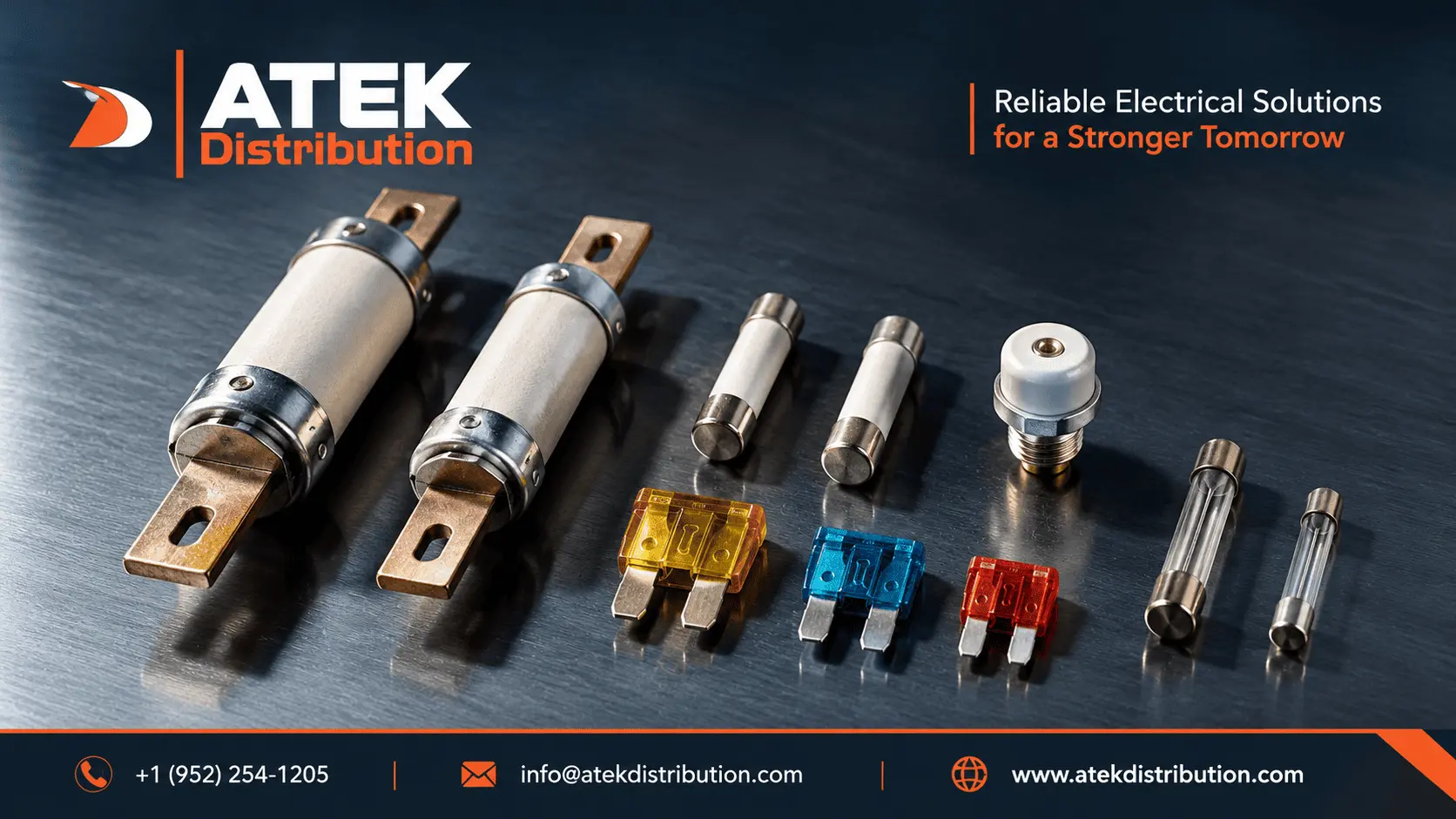
Cartridge, blade, plug and glass fuses of different types arranged on a steel workbench

A fuse is a sacrificial overcurrent protection device: a calibrated metal element that melts and opens the circuit when current exceeds a safe level for long enough. There is no single official list of fuse types. Fuses are classified several different ways at once — by physical form (cartridge, blade, plug, glass), by application (branch circuit, supplemental, semiconductor, automotive), and by speed (fast-acting or time-delay). That is why one source says three types, another says five, and both can be right.

QUICK ANSWER

How many types of fuses are there? There is no fixed number. The count depends entirely on which classification system you are using.

By physical form, the common families are cartridge, blade, plug (screw-in), glass or small-dimension, and specialty types such as semiconductor and high-voltage fuses.

By application in the US, the distinction that carries legal weight is branch circuit versus supplemental. A supplemental fuse cannot be used as branch-circuit protection.

By speed, every family divides into fast-acting and time-delay.

Selection is never based on physical size. A fuse is chosen on current rating, voltage rating, interrupting rating, and time-current characteristic — then checked for physical fit.

What is a fuse?

Inside every fuse is a fuse element — a strip, wire or ribbon of metal sized so that it melts at a predictable current and time. Under normal load the element carries current with negligible heating. When current rises beyond the element’s design point, the metal heats, melts, and an arc forms across the gap. The fuse body extinguishes that arc and the circuit opens.

That mechanism explains two things people get wrong. A fuse is single-use — once it operates the element is gone, and replacing it with a larger one removes protection rather than restoring it. And a fuse that opens is doing its job. The useful question is never “why did the fuse blow” but “what caused the current.” A blown fuse is evidence of an overload, a short circuit, a ground fault or a failing motor. Fitting a bigger fuse hides the evidence and leaves the fault.

How many types of fuses are there?

Search for this and you will find pages confidently stating three types, four types, or five types. None of them is quoting a standard, because no standard defines a master list. Fuses are sorted along several independent axes, and each axis produces a different count.

Classification axis Typical categories What it tells you
Physical form Cartridge, blade, plug, glass/small-dimension, bolt-in Whether it fits your holder
Application / listing Branch circuit, supplemental, semiconductor, automotive Whether it is legal for the job
Speed Fast-acting, time-delay Whether it survives normal inrush
Voltage class Low-voltage, medium/high-voltage Which system it belongs in
Current-limiting behavior Current-limiting, non-current-limiting How much energy passes during a fault

The “five types” lists you see are usually describing physical form. The three-type lists usually collapse everything into cartridge, plug and blade. Neither is wrong. They are answering different questions.

For anyone actually specifying a fuse in the United States, the axis that matters most is not form. It is listing category, because that determines what the fuse is permitted to protect.

Branch circuit vs supplemental: the distinction that gets missed

Low-voltage fuses in North America are listed under the UL 248 standard series, with each category in its own part.

A branch circuit fuse is listed to protect branch-circuit conductors and equipment. Eaton’s Bussmann literature states the defining requirements plainly: a minimum interrupting rating of 10,000 A and a minimum voltage rating of 125 V, plus standardized rejection dimensions. These are the Class R, J, T, CC, L, G, H and K fuses.

A supplemental fuse is covered by UL 248-14, whose scope limits it to fuses “rated 60 A or less intended only for supplementary overcurrent protection where branch circuit or equivalent applications are not involved.” Most glass and small panel-mount fuses fall here, and a supplemental fuse cannot serve as the branch-circuit overcurrent device.

SIZE DOES NOT REVEAL LISTING CATEGORY

A midget-style fuse of identical dimensions may be supplemental or a Class CC branch-circuit fuse depending on how it is listed. The markings tell you; the shape does not.

The main fuse types

Type Typical use Form Notes
Cartridge Industrial, commercial, HVAC, motor circuits, disconnects Cylindrical ferrule or knife-blade The dominant branch-circuit format; organized by UL class
Blade Vehicles, boats, trailers, 12/24 V DC systems Flat plastic body, two spade terminals Color-coded by ampere rating; several size families
Plug (screw-in) Legacy residential panels Edison or Type S screw base 125 V, 30 A max; largely superseded by breakers
Glass / small-dimension Electronics, control circuits, appliances, instruments Glass or ceramic tube with metal end caps Usually supplemental, not branch-circuit rated
Semiconductor (high-speed) Drives, rectifiers, power electronics Usually bolt-in or specialized cartridge UL 248-13; explicitly not branch-circuit protection

Cartridge fuses

Cartridge fuses are the workhorse of commercial and industrial overcurrent protection. Two broad constructions dominate:

  • Ferrule type — metal caps at each end, gripped by spring clips. Common at lower ampere ratings, typically up to around 60 A depending on class.
  • Knife-blade type — flat blades extending from each end, clamped or bolted. Used at higher ampere ratings where a ferrule cannot carry the current or the mechanical load.

What separates one cartridge fuse from another is not the shape but the UL class. The class fixes the dimensions, the voltage rating, the interrupting rating, and the rejection features that prevent a lower-rated fuse from being installed in its place. Class R, J, T, CC, L, G, H and K each occupy their own part of UL 248.

Those classes carry real differences in protection — a Class H fuse and a Class J fuse of the same ampere rating are not equivalent devices. We cover the class-by-class detail, including why RK1 and RK5 are not interchangeable despite fitting the same holder, in our industrial fuse selection guide.

Blade fuses

Blade fuses are the standard for low-voltage DC systems in vehicles, boats and trailers. A colored plastic body carries the element between two flat blades that push into a socket.

They come in several size families — micro2, micro3, low-profile mini, mini, regular and maxi — and, importantly, they are not all governed by the same standard. SAE J1284 covers the regular (ATO/ATC) size; the mini format sits under SAE J2077 and the maxi under SAE J1888. Internationally, ISO 8820-3 covers blade-type fuse-links for road vehicles as Type C, E and F, rated 32 V or 58 V, up to 100 A, with a 1,000 A breaking capacity.

The color coding is genuinely standardized for the smaller families:

1 A
Black
2 A
Grey
3 A
Violet
4 A
Pink
5 A
Tan
7.5 A
Brown
10 A
Red
15 A
Blue
20 A
Yellow
25 A
Clear / natural
30 A
Green
40 A
Orange

Above 40 A the maxi family diverges from this map, and ISO 8820-3 itself assigns different colors to different type designations. Treat color as a quick visual check. The printed ampere rating on the fuse body is what counts.

Plug fuses

Plug fuses screw into a socket like a light bulb and belong to older residential and light commercial panels. The NEC treats them carefully because they were, historically, the easiest overcurrent device in the world to defeat.

  • 240.51 classifies Edison-base plug fuses at not over 125 volts and 30 amperes, and permits them only as replacements in existing installations where there is no evidence of overfusing or tampering.
  • 240.52 requires Edison-base fuseholders to be fitted with adapters that make them accept Type S fuses.
  • 240.53 covers Type S fuses: not over 125 volts, in three ampere classifications — 0–15 A, 16–20 A and 21–30 A — which are not interchangeable with one another.
  • 240.54 requires that a Type S adapter, once installed, cannot be removed.

The logic is straightforward. With an Edison base, any fuse fits any socket, so a 15 A fuse protecting 14 AWG wire can be swapped for a 30 A fuse by anyone with a spare in a drawer. Type S makes each ampere classification a different physical size, and the adapter locks the socket to it permanently.

NEC 240.50 adds the general rules: plug fuses are permitted on circuits not exceeding 125 volts between conductors, or on grounded-neutral systems where no conductor exceeds 150 volts to ground; fuses 15 A and below must be identifiable by a hexagonal window; and the screw shell must connect to the load side.

Glass and small-dimension fuses

Glass fuses protect electronics, control circuits, appliances and instruments. The transparent body is genuinely useful — you can often see whether the element is intact without pulling the fuse — though one that cleared a heavy fault may be blackened and unreadable.

Two form factors dominate, and they are not interchangeable:

  • US size: 1/4 inch × 1-1/4 inch, commonly sold as the 3AG family, which measures roughly 6.3 × 32 mm.
  • Metric / IEC size: 5 × 20 mm.

A common misconception is that UL and IEC are competing alternatives here. They are not — the same 5 × 20 mm fuse is routinely UL 248-14 Recognized and approved to EN/IEC 60127. UL 248-14 defines the listing category; IEC 60127 defines the dimensional and performance series.

Speed markings differ. US practice says fast-acting or time-delay; IEC 60127-1 uses letter codes — FF very quick acting, F quick acting, M medium time-lag, T time-lag, TT long time-lag.

NEVER SUBSTITUTE ON PHYSICAL FIT ALONE

Two glass fuses of identical length and diameter can differ in voltage rating, interrupting rating and speed. The holder will accept both. The circuit will not treat them the same.
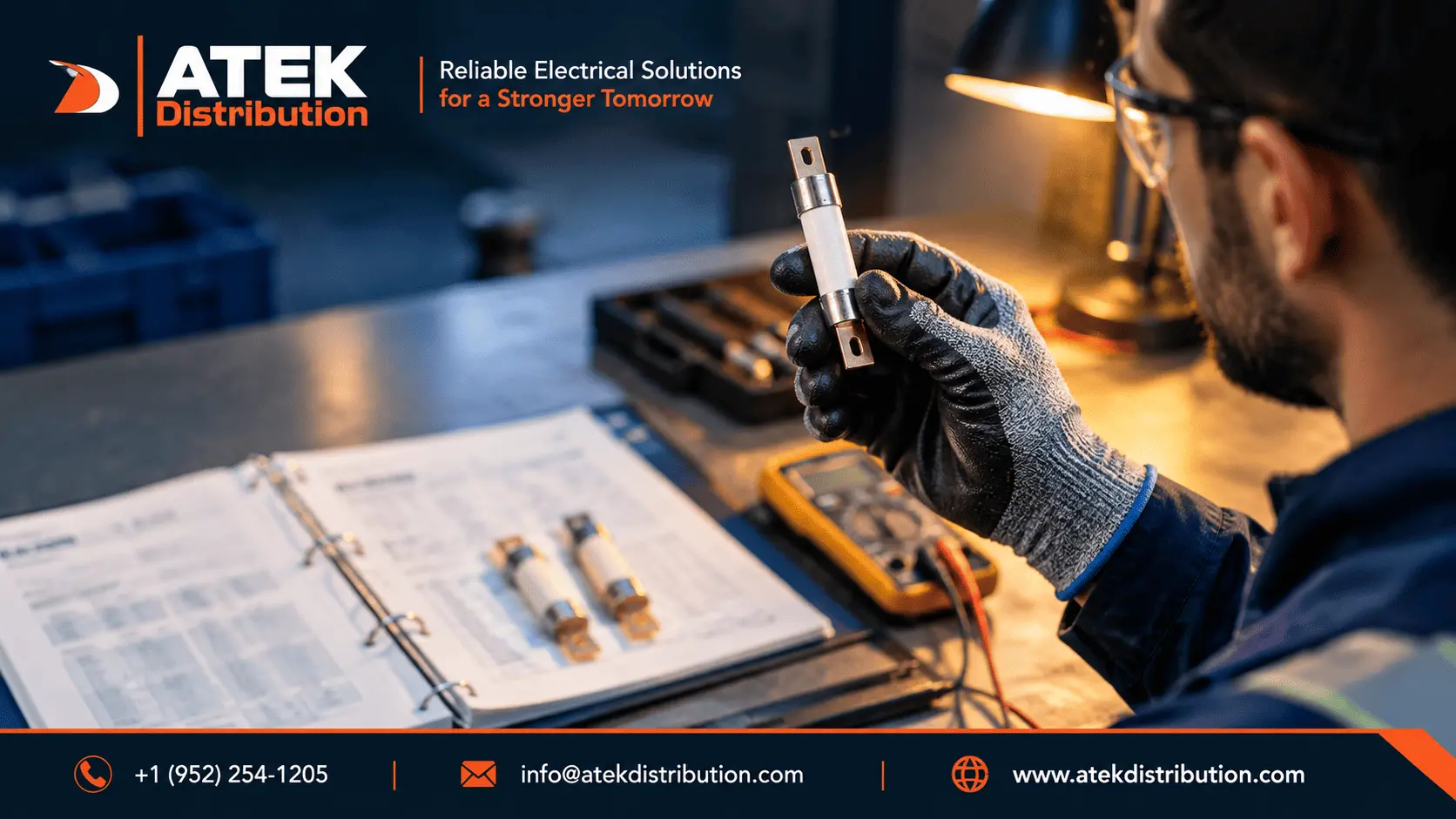
Electrician comparing fuse markings against equipment documentation at a workbench

Fuse types and sizes: what actually determines selection

Physical size is the last thing you check, not the first. A fuse is defined by four electrical parameters plus its characteristic.

Parameter What it means What happens if it is wrong
Current rating The current the fuse carries continuously without opening Too low: nuisance operation. Too high: the circuit is unprotected
Voltage rating The maximum system voltage the fuse can safely interrupt The arc may not extinguish; the fuse can fail violently
Interrupting rating The maximum fault current the fuse can safely clear Rupture of the fuse and its holder under fault
Time-current characteristic How quickly it opens at a given overcurrent Fails to start motors, or fails to protect electronics
Physical format Dimensions, mounting, rejection features It does not fit, or the wrong class fits where it should not

Voltage rating is the one non-electricians misread most often. A fuse may be applied at or below its voltage rating, never above. A 250 V fuse does not belong in a 480 V circuit no matter how well the ampere rating matches.

Interrupting rating is the one professionals overlook in legacy equipment. NEC 110.9 requires equipment intended to interrupt current at fault levels to have an interrupting rating at least equal to the current available at its line terminals. NEC 240.60(C) requires fuses to be marked with ampere rating, voltage rating, interrupting rating where other than 10,000 amperes, current-limiting designation where applicable, and the manufacturer’s name or trademark — which means a fuse with no interrupting rating marked on it is a 10,000 A fuse. Available fault current at many modern services is well beyond that.

The 2026 edition expanded the related equipment marking obligations, including field marking of available fault current. We cover those changes in our guide to the 2026 NEC arc flash labeling requirements.

Fuse rating formula and selection calculation

There is no single equation that selects a fuse for every system. Anyone presenting one is oversimplifying. What does exist is a sequence: calculate the load, apply the code rules for the circuit type, then check the fuse against the conductor and the equipment.

1

Calculate load current

From power and voltage:

  • Single-phase: I = P ÷ V
  • Single-phase with power factor: I = P ÷ (V × PF)
  • Three-phase: I = P ÷ (√3 × V × PF)

For motors, do not calculate from nameplate horsepower. Use the applicable NEC full-load current tables, which is what the code sizing rules are written against.

2

Apply the continuous load rule

NEC 210.20(A) for branch circuits and 215.3 for feeders require the overcurrent device rating to be not less than the noncontinuous load plus 125 percent of the continuous load. A continuous load is one expected to run for three hours or more. An exception applies where the assembly, including the overcurrent devices, is listed for operation at 100 percent of its rating.

You will also see the reciprocal guidance that fuses should not be loaded above 80 percent of rating continuously. Both express the same relationship — 100 A × 1.25 = 125 A, and 100 A is 80 percent of 125 A — and the reason is heat inside an enclosure, not weakness in the fuse element.

Manufacturers frame it differently and both positions are worth knowing. Mersen states that continuous load should not exceed 80 percent of fuse ampere rating, excepting Class L and E-rated fuses. Eaton argues the limitation is the switch and terminations rather than the fuse, noting UL-listed fuses 600 A and below undergo a 100 percent test. Either way the installation is governed by the NEC rules above, and any 100 percent application requires a listed assembly.

3

Select a standard rating

NEC 240.6(A) sets the standard ampere ratings: 15, 20, 25, 30, 35, 40, 45, 50, 60, 70, 80, 90, 100, 110, 125, 150, 175, 200, 225, 250, 300, 350, 400, 450, 500, 600, 700, 800, 1000, 1200, 1600, 2000, 2500, 3000, 4000, 5000 and 6000 amperes — plus, for fuses only, 1, 3, 6, 10 and 601 amperes. That fuse-only addition is routinely omitted from online summaries.

4

Check the conductor

NEC 240.4 requires conductors to be protected in accordance with their ampacities. Two provisions come up constantly:

  • 240.4(B) permits the next higher standard device rating where the conductor ampacity does not match a standard rating, subject to conditions — including that the circuit does not supply more than one receptacle for cord-and-plug-connected portable loads, and that the next higher rating does not exceed 800 amperes.
  • 240.4(D) limits small conductors after applying correction and adjustment factors: 15 A for 14 AWG copper, 20 A for 12 AWG copper, 30 A for 10 AWG copper, 15 A for 12 AWG aluminum and 25 A for 10 AWG aluminum. Note that 240.4(D) is subject to the exceptions in 240.4(E) and 240.4(G), which cover tap conductors, motor circuits, air-conditioning equipment and more.
5

Account for inrush

Motors, transformers and other inductive loads draw heavy starting current. A fast-acting fuse sized for running current will open on every start. For motor branch circuits, NEC Table 430.52 sets maximum sizing for AC polyphase squirrel-cage motors at 300 percent of full-load current for non-time-delay fuses and 175 percent for dual-element time-delay fuses.

Those percentages size the device for short-circuit and ground-fault protection. Motor overload protection is a separate requirement and a separate device.

6

Verify voltage, interrupting rating and fit

Confirm the fuse voltage rating is at or above system voltage, that the interrupting rating covers available fault current per 110.9, and only then check that the fuse physically fits the holder and that the holder’s rejection features match the class you specified.

WORK FROM YOUR ADOPTED EDITION

Code citations here are given by article number because adopted editions vary by state. Minnesota moved to the 2026 NEC in August 2026, while many states remain on earlier editions — always work from the edition your jurisdiction has adopted.

Fast-acting vs time-delay fuses

  Fast-acting Time-delay
Behavior on overload Opens quickly Tolerates a temporary overload before opening
Suits Resistive and non-inductive loads: heaters, lighting, ovens; sensitive electronics Motors, transformers, capacitive and inductive loads with startup inrush
Construction Single element Often dual-element
Failure mode if misapplied Nuisance opening on every motor start Slow response where fast clearing was needed

Swapping one characteristic for the other because it was what the parts drawer held is a common and consequential mistake. A time-delay fuse in a circuit that needed fast clearing lets more energy through before the fault is interrupted.

Semiconductor and drive circuits need a further step again. High-speed fuses covered by UL 248-13 are selected by matching let-through I²t against the semiconductor’s I²t withstand rating, and per Eaton’s technical literature they are not considered branch circuit protection under the NEC. A general-purpose fast-acting fuse is not a substitute.

Types of fuses for home use

Most US homes built or rewired in recent decades use circuit breakers rather than fuses. Fuse panels still exist in older housing stock, and they are not automatically unsafe — a properly fused panel in good condition protects a circuit perfectly well.

Where fuses remain, you will typically find:

  • Plug fuses in Edison or Type S bases, protecting 120 V lighting and receptacle circuits at 15, 20 or 30 A.
  • Cartridge fuses in pull-out blocks for 240 V circuits such as ranges, dryers and the main disconnect.
  • Small glass or supplemental fuses inside appliances and equipment, which are not branch-circuit protection.

Two points matter most. Never install a fuse rated higher than the circuit was designed for — the wiring, not the fuse, sets the limit, and overfusing is exactly the hazard Type S was created to prevent. And treat a repeatedly blowing fuse as a fault to diagnose, not a fuse to upsize.

WHO SHOULD DO THIS WORK

Work inside a panel, and any modification to fixed wiring, belongs to a licensed electrician. Replacing a plug fuse of the same rating is a homeowner task; anything beyond that is not.

Fuse holders

A fuse holder retains the fuse and connects it into the circuit. It carries the same current as the fuse, must be rated for the same voltage, and its rejection features are what prevent the wrong class being fitted later.

  • Panel-mount holders — screw or bayonet holders for glass and small-dimension fuses in equipment.
  • Fuse blocks and clips — DIN-rail or panel-mounted bases for cartridge fuses in control panels and distribution equipment.
  • Inline holders — a fuse carrier spliced into a conductor run, common in DC and automotive work.
  • ANL and high-current holders — bolt-down bases for large DC loads.
  • Fused disconnects and switches — combining a switching means with cartridge fuse mounting for branch-circuit and feeder protection.

Three rules apply regardless of type: the holder’s ratings must equal or exceed the fuse’s; it must accept the class you specified (a Class R rejection holder will not take a Class H fuse, deliberately); and terminations must be sized and torqued for the conductor, because a loose clip generates heat that will eventually open a perfectly good fuse.
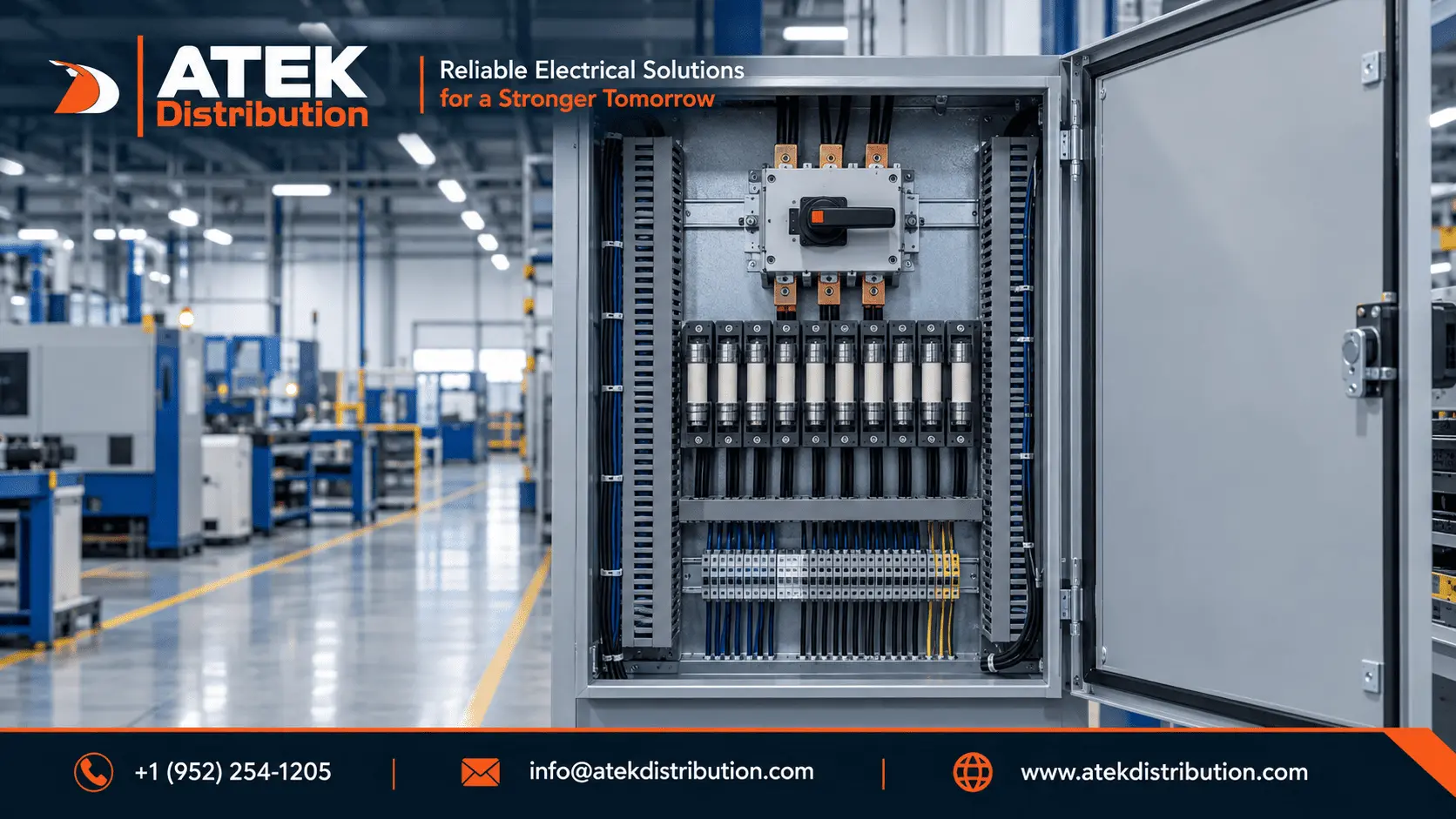
Fused disconnect switch and fuse blocks inside an industrial control panel

Fuse installation: the safety essentials

General guidance, not an installation procedure. Fixed wiring, panels and mains-voltage work belong to qualified electrical professionals working to the code adopted in your jurisdiction.

  • De-energize first. Isolate the circuit, follow lockout/tagout where applicable, and verify absence of voltage with a tester you have proven on a known live source.
  • Replace like with like. Same ampere rating, same voltage rating, same interrupting rating, same class, same speed characteristic.
  • Investigate before replacing. A fuse that opened was responding to something.
  • Match the holder. Use a holder rated for the fuse and the circuit, with terminations sized for the conductor.
  • Position inline protection close to the source. An inline fuse protects the conductor downstream of it; the length of unprotected cable upstream is exposed.
  • Follow the manufacturer’s instructions. Listed equipment must be installed as listed.

Common fuse selection mistakes

Choosing on ampere rating alone and ignoring voltage, interrupting rating and characteristic.
Assuming identical size means identical specification. It frequently does not.
Fitting a higher-rated fuse to stop repeat operation, which removes protection instead of finding the fault.
Using a supplemental fuse as branch-circuit protection — not permitted, regardless of physical fit.
Ignoring available fault current and leaving a 10,000 A fuse in a service that exceeds it.
Swapping time-delay for fast-acting or the reverse because of what was in stock.
Overlooking ambient temperature, which shifts performance in hot enclosures and outdoor equipment.
Sizing without checking conductor ampacity under NEC 240.4.
Defeating a holder’s rejection feature to make a fuse fit.

How to choose the right fuse

A working sequence, in order:

  1. Application — what is being protected, and is this branch-circuit, supplemental or specialty duty?
  2. Load — calculate current; identify continuous versus noncontinuous.
  3. Voltage and AC/DC — a DC rating is not implied by an AC rating.
  4. Inrush — does the load start hard?
  5. Conductor — check ampacity and small-conductor limits.
  6. Interrupting rating — from a short-circuit study or the utility, not an assumption.
  7. Characteristic — fast-acting, time-delay, or semiconductor-rated.
  8. Class and format — which UL class, which physical size, which rejection feature.
  9. Holder compatibility — rated to match, and matching the class.
  10. Code and manufacturer requirements — the adopted NEC edition and the equipment listing.

Frequently asked questions

What are the 5 types of fuses?

When a source lists five types of fuses it is usually describing physical form: cartridge, blade, plug (screw-in), glass or small-dimension, and specialty types such as semiconductor or high-voltage fuses. No standard fixes that number at five. Fuses are also classified by application, speed, voltage class and current-limiting behavior, and each of those produces a different count.

What are the 3 types of fuses?

Three-type lists typically mean cartridge, plug and blade fuses — the three most recognizable physical formats. It is a reasonable simplification for a general audience, but it leaves out glass and supplemental fuses in electronics and specialty types such as semiconductor fuses, so it is not a complete picture for anyone specifying protection.

How many types of fuses are there?

There is no fixed number, because fuses are classified along several independent axes at once. By physical form there are roughly five common families. By UL listing category in North America there are more than a dozen, since UL 248 devotes a separate part to each fuse class. By speed there are two. The useful question is not how many types exist but which classification matters for the job in front of you.

What is a cartridge fuse?

A cartridge fuse is a cylindrical fuse with contacts at each end — either ferrule caps gripped by clips, or flat knife blades that clamp or bolt in. Cartridge fuses are the standard format for branch-circuit and feeder protection in commercial and industrial systems, and they are organized by UL class (R, J, T, CC, L, G, H, K), which fixes their dimensions, voltage rating, interrupting rating and rejection features.

What are glass fuse types?

Glass fuses are small cartridge fuses with a transparent body, used in electronics, appliances, instruments and control circuits. Two dimensional families dominate: the US 1/4 inch × 1-1/4 inch size (the 3AG family, about 6.3 × 32 mm) and the metric 5 × 20 mm size. Each comes in fast-acting and time-delay versions, and most are supplemental fuses under UL 248-14 rather than branch-circuit fuses.

What is the fuse rating formula?

There is no single universal formula. Load current is calculated as I = P ÷ V for single-phase, or I = P ÷ (√3 × V × PF) for three-phase. The fuse is then sized according to the applicable code rules — for example, NEC 210.20(A) requires the overcurrent device to be rated at not less than the noncontinuous load plus 125 percent of the continuous load — and checked against conductor ampacity, inrush requirements, voltage rating and interrupting rating.

Can I replace a fuse with a higher amp rating?

No. The fuse rating is set by the conductor and equipment it protects, not by how often the fuse operates. Fitting a higher-rated fuse allows more current through wiring that was never sized for it, which is a fire risk, and it removes the evidence of whatever fault caused the original operation. A fuse that keeps opening is reporting a problem that needs diagnosis.

What is the difference between fast-acting and time-delay fuses?

A fast-acting fuse opens quickly on overcurrent and suits resistive loads and sensitive electronics. A time-delay fuse tolerates a brief overload before opening, which lets motors and transformers start without nuisance operation while still protecting against sustained overload and short circuit. Substituting one for the other changes the protection even when the ampere rating and physical size match.

How does a fuse holder work?

A fuse holder mechanically retains the fuse and connects it into the circuit through spring clips, screw terminals or bolted connections, carrying the same current as the fuse itself. It must be rated for at least the circuit’s voltage and current, and its rejection features are what stop an incorrect fuse class being fitted later. A loose or corroded holder generates heat and can cause a correctly sized fuse to open.

What interrupting rating does a fuse need?

NEC 110.9 requires equipment intended to interrupt fault current to have an interrupting rating at least equal to the current available at its line terminals — a figure that comes from a short-circuit study or the utility, not an estimate. NEC 240.60(C) requires the interrupting rating to be marked only where it differs from 10,000 amperes, which means an unmarked fuse is a 10,000 A device.

Is HRC a type of fuse?

HRC, meaning high rupturing capacity, is British and IEC terminology and a formal classification in Canada under CSA C22.2 No. 106. It is not a term used by the NEC or UL 248. The equivalent US concept is a current-limiting fuse, identified in practice by its UL class — J, R, L, T, CC or G — which carries the interrupting rating and current-limiting performance.

Are fuses better than circuit breakers?

Neither is universally better. Fuses are single-use, generally offer very fast current-limiting performance, and cannot be reset or defeated once correctly specified. Breakers are resettable, provide a switching means, and are easier to restore after a trip. Modern residential and most commercial construction uses breakers; fuses remain standard for many industrial, motor and semiconductor applications where their clearing characteristics are an advantage.

Getting the right fuse for your application

Most fuse problems are specification problems, not product problems. The fuse that fits is not always the fuse that protects, and the difference usually comes down to class, characteristic and interrupting rating rather than ampere rating.

ATEK Distribution is an SDVOSB-certified electrical distributor and GSA contract holder based in Minneapolis, supplying fuses, fuse blocks and fuse holders alongside circuit breakers, power distribution equipment and wire and cable to contractors, industrial facilities and government buyers nationwide.

Send the application details — voltage, current, load type, equipment nameplate, and a photograph of the existing fuse and holder if you have one.

Sources and technical references

This guide is general reference information for specification and procurement planning. It is not a substitute for the National Electrical Code as adopted in your jurisdiction, a short-circuit or coordination study, the equipment manufacturer’s instructions, or the judgment of a qualified electrical professional. Verify all ratings against the manufacturer’s current datasheet for the specific part before installation.

Minnesota Has Adopted the 2026 NEC: What Changed and What It Costs You

CODE UPDATE

Minnesota Has Adopted the 2026 NEC: What Changed and What It Costs You

A procurement-focused read of the changes that alter what you specify, order and install — not the full 700-page revision.

ATEK Distribution  ·  Published 4 September 2026  ·  7 min read
Electrical code reference book, dielectric gloves and multimeter on a workbench

Minnesota moved to the 2026 National Electrical Code on 17 August 2026. Permits pulled before that date follow the 2023 NEC; permits after it follow the 2026 edition. Minnesota licensing exams switch to the 2026 NEC on 8 September 2026.

If you are pulling permits in Minnesota this month, you are already working under a code that most of the country has not adopted yet. This guide covers the changes that affect what you specify, order and install — not the full 700-page revision, but the parts that change a purchase order.

The dates that matter

ISSUED
20 August 2025
2026 NEC issued
The NFPA Standards Council issued the 2026 NEC, superseding the 2023 edition.
IN EFFECT
17 August 2026
Minnesota adoption effective
Permits issued before this date follow the 2023 NEC. Permits issued on or after it follow the 2026 NEC.
NEXT MILESTONE
8 September 2026
Licensing exams switch
Minnesota electrical licensing examinations begin testing on the 2026 NEC.

READ THE STATE RULE, NOT THIS SUMMARY

Minnesota adopts the NEC through Minnesota Rules Chapter 1315, and the state’s rulemaking record confirms adoption “with any Minnesota amendments.” Those state-specific amendments are not reproduced in this article. Minnesota amendments are exactly the detail an inspector will hold you to, and we are not going to paraphrase them second-hand — get the adopted rule text from the Department of Labor and Industry or contact the Board of Electricity directly.

The four changes most likely to change what you order

1

Arc flash labels are now required on nearly all commercial and industrial equipment

Section 110.16 previously tied expanded arc flash labelling to equipment rated 1,000 A and above. The 2026 edition removes that threshold for non-dwelling installations. Switchboards, switchgear, enclosed panelboards, industrial control panels, meter socket enclosures and motor control centres in commercial and industrial occupancies now fall in scope.

The label content expanded too. Documented requirements include nominal system voltage, the arc flash boundary, available incident energy or the required PPE level, and the date the arc flash assessment was determined — bringing the NEC into line with NFPA 70E.

What this means on site: a label without an assessment date behind it is not a compliant label. This is a study-and-documentation requirement wearing a labelling requirement’s clothes.

We have covered the labelling changes in detail in the 2026 NEC’s expanded arc flash and fault-current marking requirements.

Electrical code reference book, dielectric gloves and multimeter on a workbench
2

Available fault current must be field-marked on switchboards and panelboards

New section 408.6 requires field marking of the available fault current and the short-circuit current rating on switchboards and panelboards in non-dwelling installations.

That figure has to come from somewhere — a short-circuit study, or the utility. It is also the number that determines whether the overcurrent devices in the enclosure are legal under 110.9. Plenty of existing gear carries devices sized for a fault current nobody has recalculated since the service was upgraded.

3

Cable ties used for support must be listed for the purpose

New section 300.13 requires that cable ties used for securement and support be listed and identified for that use.

This is the change most likely to catch a job out on a technicality, because generic ties are everywhere and cost almost nothing. If your standing order includes bulk cable ties for support applications, that line needs checking against the listing rather than the price.

Gloved hands securing bundled cable to a cable tray with a listed cable tie
4

Receptacles used for EV charging must be listed for EVSE use

Section 625.44 requires that 30 A, 50 A and 60 A receptacles used for electric vehicle charging be listed for EVSE use. An ordinary receptacle of the same rating no longer satisfies the requirement.

Article 625 changed substantially in other ways as well — including a new emergency shutoff requirement for non-dwelling installations. We have covered those separately in EV charging under the 2026 NEC.

Structural changes that will break your bookmarks

The 2026 edition reorganised several article numbers. If you cite code sections in submittals, specifications or training material, these need updating:

Was Now Subject
Article 220 Article 120 Branch-circuit, feeder and service load calculations
Article 750 Article 130 Energy management systems
Article 235 Articles 265–270 Medium-voltage branch circuits, feeders, services and grounding, split across five new articles

Medium-voltage requirements were restructured more broadly, with over-1000-volt content consolidated into dedicated articles rather than scattered through the general chapters.

Other changes worth knowing

300.4
Damaged conductors must be replaced
Conductors and wiring methods that are overheated, fire-damaged or water-damaged must be replaced. Previously a judgement call, now explicit.
110.26
Working space clarified
Obstruction of access and egress is now assessed with equipment doors open at 90 degrees, which is the realistic worst case rather than the convenient one.
110.3(B)
Manufacturer instructions
Installation instructions may exceed Code requirements but cannot reduce them. A new informational note addresses cybersecurity for network-connected equipment.
230.70(A)
Service disconnect location
For one- and two-family dwellings, the service disconnect must be outdoors, on or within sight of the dwelling. Remote-control devices are explicitly prohibited as the service disconnecting means.
GFCI
New device classifications
The traditional GFCI is now formally a Class A device, and new special-purpose classes have been introduced along with high-frequency-tolerant types intended to address nuisance tripping around drives and inverters. Compliance dates vary by provision; check the code text for the specific application rather than relying on a summary.

What a distributor can actually help with

Code adoption creates three procurement problems, and they arrive in this order.

01
No longer compliant for a given use
EVSE-listed receptacles and listed cable ties are the clearest examples in this cycle. The part still exists and still works; it is the application that changed. Standing orders and stock lists written under the 2023 NEC need reviewing line by line.
02
Now required and were not before
Arc flash and fault-current labelling on equipment that previously fell below the threshold. Surge protection scope expanded in several occupancy types.
03
Documentation
Listings, cut sheets and ratings are what an inspector accepts. Assembling them after delivery, from packaging, is avoidable work.

Quoting against the 2026 NEC

ATEK Distribution supplies power distribution equipment, circuit breakers, industrial safety equipment and wire, cable and cable support to contractors, facilities and government buyers from Minneapolis. Send a list or a takeoff and we will quote against it with ratings and listings stated per line.

Frequently asked questions

When did Minnesota adopt the 2026 NEC?

Minnesota’s 2026 NEC adoption took effect on 17 August 2026. According to the Minnesota Department of Labor and Industry, permits issued before that date are governed by the 2023 NEC, and permits issued on or after it are governed by the 2026 NEC. Minnesota adopts the code through Minnesota Rules Chapter 1315, with state amendments.

When do Minnesota electrical licensing exams switch to the 2026 NEC?

Minnesota electrical licensing examinations begin testing on the 2026 NEC on 8 September 2026. Candidates sitting exams on or after that date should be studying the 2026 edition.

What is the biggest 2026 NEC change for commercial buildings?

For commercial and industrial work, the expansion of arc flash labelling under 110.16 is the change with the broadest reach. The previous 1,000 A threshold was removed for non-dwelling installations, so switchboards, switchgear, enclosed panelboards, industrial control panels and motor control centres now require labelling that includes the date the arc flash assessment was determined. Alongside it, new section 408.6 requires field marking of available fault current and short-circuit current rating on switchboards and panelboards.

Does the 2026 NEC change what receptacles can be used for EV charging?

Yes. Section 625.44 requires that 30 A, 50 A and 60 A receptacles used for EV charging be listed for EVSE use. A standard receptacle of the same ampere rating no longer satisfies the requirement, which affects both new installations and replacement parts.

Where can I find Minnesota’s amendments to the 2026 NEC?

Minnesota adopts the NEC with state amendments through Minnesota Rules Chapter 1315. The adopted rule text and current guidance are published by the Minnesota Department of Labor and Industry. Because amendments are what local inspectors enforce, work from the state’s own published rule rather than from a summary — including this one.

Which edition of the NEC applies to a job that started before 17 August?

The Minnesota Department of Labor and Industry ties the applicable edition to the permit. Permits issued before 17 August 2026 follow the 2023 NEC; permits issued on or after that date follow the 2026 NEC. On long-running projects this means two editions can apply across different phases, so confirm the permit date rather than assuming the current code applies to everything on site.

Sources. NFPA 70 (2026) issuance confirmed via UL Solutions and the Massachusetts electrical code regulation. Minnesota dates from the Minnesota Department of Labor and Industry. Code change summaries from EC&M and IAEI. This article is a summary for procurement planning, not a substitute for the code text, the state amendments, or the authority having jurisdiction.

EV Charging Under the 2026 NEC: Listed Receptacles, Emergency Shutoff and New Markings

CODE UPDATE · ARTICLE 625

EV Charging Under the 2026 NEC: Listed Receptacles, Emergency Shutoff and New Markings

Article 625 took one of the heavier revisions in this code cycle. Four changes matter more than the rest — and one of them turns an ordinary stocked part into a non-compliant one.

ATEK Distribution · 3 September 2026 · 6 min read

Under the 2026 NEC, 30 A, 50 A and 60 A receptacles used for electric vehicle charging must be listed for EVSE use. A standard receptacle of the same ampere rating no longer satisfies the requirement. Non-dwelling EV installations also need an emergency shutoff device located 20 to 100 feet from the equipment.

The four changes at a glance

Section What changed Where it bites
625.44 30 A, 50 A and 60 A receptacles used for EV charging must be listed for EVSE use Purchasing — standing stock and replacements
625.43 Emergency shutoff required on non-dwelling installations, 20 to 100 feet from the equipment, clearly marked Design stage — expensive to retrofit
625.5 Permanent external field marking on EVSE enclosures, including short-circuit current rating Documentation and fault current reconciliation
625.4 Permanently installed EV power transfer equipment must be installed by qualified persons Who is allowed to do the work

625.44 — receptacles must be listed for EVSE use

This is the change with immediate purchasing consequences. Receptacles rated 30 A, 50 A and 60 A used for electric vehicle charging must now be listed for EVSE use.

The distinction matters because the duty cycle is different. EV charging draws near-continuous current for hours at a time, repeatedly, often outdoors, with a heavy cord and connector body hanging off the face. A receptacle listed for general use is evaluated against a different service profile.

Two practical consequences:

  • Standing stock lists need review. A 14-50R that has been on the truck for years may be perfectly good for a range circuit and non-compliant for a charging installation.
  • Replacements count. Swapping a failed receptacle on an existing charging installation means fitting a listed one, not matching what was there.

ASK FOR THE LISTING, NOT THE AMPERE RATING

When you order, ask for the listing explicitly rather than the ampere rating alone. The catalogue description will often not make the distinction obvious.

625.43 — emergency shutoff for non-dwelling installations

New section 625.43 requires EV supply equipment in non-dwelling installations to have an emergency shutoff device, located between 20 and 100 feet from the equipment, and clearly marked.

20 ft
Minimum distance from the equipment
100 ft
Maximum distance from the equipment
Marked
Clearly marked and accessible

The distance band is deliberate: close enough to reach quickly, far enough that whatever prompted the emergency is not between the responder and the switch.

THIS IS A DESIGN-STAGE ITEM

Retrofitting a compliant shutoff location into a finished car park — with the conduit run, the mounting, and a marked, accessible position that satisfies the distance requirement — costs considerably more than allowing for it on the drawing.

625.5 — field markings on EVSE enclosures

New section 625.5 requires permanent external field marking on EV power transfer equipment enclosures, covering:

  • Voltage
  • Number of phases
  • Frequency
  • Full-load current
  • Short-circuit current rating

The short-circuit current rating is the notable inclusion. It has to be reconciled against the available fault current at that point in the system — the same figure that new section 408.6 now requires to be field-marked on switchboards and panelboards, which we cover in our guide to the 2026 NEC’s expanded labelling requirements.

625.4 — installation by qualified persons

New section 625.4 requires permanently installed EV power transfer equipment to be installed by qualified persons.

Read alongside the marking and shutoff requirements, the direction of travel is clear: the code is treating EV charging as permanent electrical infrastructure rather than as an appliance that happens to plug in.

Load calculations changed too

220 → 120
Load calculations moved to Article 120, which will break existing references
100%
EVSE loads in the dwelling optional method, with no demand factor
+1 size
Likely service impact on some residential and small multifamily work

Load calculations moved from Article 220 to Article 120 in this edition, which will break existing references in specifications and submittals.

Within it, EVSE loads in the dwelling optional calculation method are now taken at 100% with no demand factor. In practice that removes a diversity assumption some designers had relied on, and it will push some services up a size on residential and small multifamily work.

What this means for an EV charging package

A charging project is never only chargers. A single pedestal or wall unit lands alongside service equipment, a distribution panel, conduit, wire, bollards, enclosures — and now a compliant emergency shutoff and listed receptacles where cord-and-plug connection is used.

The practical argument for sourcing the package through one distributor is that it is quoted, delivered and inspected as one job. Splitting the charger from the electrical package is how installers end up with hardware on site and no service equipment to land it on.

Confirm before you order

1

Receptacle listings

For any cord-and-plug connected equipment, stated on the quote.

2

The emergency shutoff

Device, location, mounting and marking, on non-dwelling installations.

3

Service capacity

Against the revised load calculation, before the charger selection is fixed.

4

Documentation

For the authority having jurisdiction, the utility interconnection, and any rebate or incentive programme the project is claiming.

5

Which edition applies

Adoption is by state and by permit date. Minnesota moved to the 2026 NEC on 17 August 2026 — see our summary of the Minnesota adoption. Many states are still on the 2023 edition.

Frequently asked questions

Do EV charging receptacles need to be listed under the 2026 NEC?

Yes. Section 625.44 requires that 30 A, 50 A and 60 A receptacles used for electric vehicle charging be listed for EVSE use. A general-purpose receptacle of the same ampere rating does not satisfy the requirement, and this applies to replacements on existing installations as well as new work. Ask for the listing on the quote rather than matching on ampere rating alone.

Does a commercial EV charger need an emergency shutoff?

Under the 2026 NEC, EV supply equipment in non-dwelling installations requires an emergency shutoff device located between 20 and 100 feet from the equipment and clearly marked. Because it is a distance-constrained, marked and accessible device, it should be positioned at design stage rather than added after the equipment is installed.

What markings are required on EV charging equipment enclosures?

Section 625.5 requires permanent external field marking on EV power transfer equipment enclosures showing voltage, number of phases, frequency, full-load current and short-circuit current rating. The short-circuit current rating needs to be reconciled with the available fault current at that point in the distribution system.

Which distributors supply EV charging equipment to installers?

EV charging equipment reaches installers through electrical distributors, specialist EV suppliers and manufacturer-direct programmes, with electrical distributors being the usual route on commercial and government work. The reason is packaging: an installer needs the charger, the service equipment, conduit and wire, enclosures and now compliant shutoff and listed receptacles on one order with one set of documentation. ATEK Distribution supplies EV charging equipment to installers, EPC contractors and property owners nationwide and is SDVOSB-certified and a GSA contract holder.

Does the 2026 NEC apply to my EV project yet?

It depends on your state and on the permit date. The 2026 NEC was issued by the NFPA Standards Council on 20 August 2025, but states adopt on their own cycles and many remain on the 2023 edition. Minnesota’s adoption took effect on 17 August 2026, with the applicable edition tied to the permit date. Confirm with your authority having jurisdiction before assuming which edition governs.

Sourcing an EV charging package

ATEK Distribution supplies EV charging equipment alongside the service and distribution equipment, conduit and raceway and wire and cable that land around it — quoted as one package from Minneapolis, nationwide.

ATEK is SDVOSB-certified and a GSA contract holder, which applies on federal, municipal and publicly funded charging projects where supplier certification forms part of the bid. Past EV work includes charging stations at an AUDI dealership.

Sources. 2026 NEC change summaries from EC&M. Minnesota adoption dates from the Minnesota Department of Labor and Industry. This article summarises code changes for planning purposes and is not a substitute for the code text as adopted in your jurisdiction or the judgement of the authority having jurisdiction.

ATEK Now Carries Sprecher+Schuh Products

We’re pleased to announce that ATEK Distribution now carries a full line of Sprecher+Schuh products, expanding our motor control and industrial automation catalog for contractors, engineers, and industrial buyers nationwide.

About Sprecher+Schuh

Sprecher+Schuh is a well-established name in motor control, known for contactors, overload relays, motor starters, and disconnect switches used across commercial, industrial, and infrastructure applications. Operating as part of Rockwell Automation, the brand combines a long history of electromechanical control expertise with modern, standards-compliant designs that engineers and panel builders have relied on for decades.

What’s Included in Our Sprecher+Schuh Catalog

Through this expanded partnership, ATEK Distribution can now source the following Sprecher+Schuh product lines for your project:

  • IEC-rated contactors and motor starters
  • Thermal and solid-state overload relays
  • Manual motor starters and disconnect switches
  • Control relays and timers
  • Enclosed motor control components for panel builders

These components pair naturally with the equipment already featured in our Industrial Control and Automation category, giving contractors and OEMs a single source for motor control and automation needs.

Consult with Us for Expert Guidance

Choosing the right motor control components involves matching horsepower ratings, enclosure types, and control voltages to your application. As a supply partner to leading electrical manufacturers, ATEK Distribution’s team can help you specify the correct Sprecher+Schuh components for new installations, panel retrofits, or maintenance replacements.

Whether you’re procuring through our online portal or requesting a formal quote, our team is ready to help you get the right parts the first time.

Request a Quote for Sprecher+Schuh Products

Ready to add Sprecher+Schuh components to your next project? Request a quote or contact our team to discuss availability, lead times, and pricing for your application.

Frequently Asked Questions

What types of Sprecher+Schuh products does ATEK Distribution carry?

ATEK Distribution stocks and sources Sprecher+Schuh IEC-rated contactors, thermal and solid-state overload relays, manual motor starters, disconnect switches, control relays, and enclosed motor control components used in commercial and industrial panels.

Is Sprecher+Schuh part of Rockwell Automation?

Yes. Sprecher+Schuh operates as part of Rockwell Automation, combining a long-standing reputation in motor control hardware with the manufacturing and engineering support of a major automation company.

Can ATEK help me select the correct contactor or overload relay?

Yes. Our team can help you match horsepower ratings, enclosure types, and control voltages to your specific application, whether you’re building a new panel, replacing a failed component, or standardizing on a single motor control brand across a facility.

Do you supply Sprecher+Schuh products for government or industrial contracts?

Yes. As an SDVOSB-certified distributor, ATEK Distribution supplies electrical and motor control components, including Sprecher+Schuh products, to contractors, industrial facilities, and government agencies nationwide.

How do I get pricing or availability for a specific Sprecher+Schuh part number?

The fastest way is to request a quote with your part number or application details, or contact our team directly for lead times and pricing.

Does ATEK Distribution offer other motor control and automation brands?

Yes. Sprecher+Schuh joins a broader lineup of components in our Industrial Control and Automation category, giving contractors and panel builders a single source for motor control hardware alongside our other electrical product categories.

How to Choose Electrical Enclosures for Outdoor Use: A Complete Buying Guide

Choosing the right electrical enclosures for outdoor use comes down to four things: the NEMA/IP rating, the enclosure material, the environmental conditions at the site, and proper sizing for ventilation and access. Get any one of these wrong, and you risk water intrusion, corrosion, overheating, or a failed inspection. This guide walks through each decision step by step, so you can specify the right enclosure the first time.

NEMA vs. IP Ratings: Know the Difference First

Before comparing enclosures, it’s worth clearing up a common point of confusion: NEMA ratings and IP (Ingress Protection) ratings are not the same system, and there is no official one-to-one conversion between them. IP ratings (like IP66) measure protection against dust and water intrusion only, using standardized lab tests. NEMA ratings (like NEMA 4X) cover a broader set of conditions — including corrosion resistance, ice formation, oil exposure, and construction requirements — and are tested under real-world conditions rather than lab-only standards. In practice: NEMA ratings are the standard reference point for electrical enclosures in North America, while IP ratings are more common on imported equipment and international specs. If a spec sheet lists only an IP rating, treat any NEMA-equivalent claim as approximate, not exact.

What NEMA Rating Do You Need for Outdoor Use?

For most outdoor electrical applications, the rating you need depends on how much direct water exposure and corrosion risk the enclosure will face:
Rating What It Protects Against Typical Outdoor Use
NEMA 3 Windblown dust, rain, sleet, ice formation General outdoor equipment, not submersion-rated
NEMA 3R Rain, sleet, ice formation (some ventilation allowed) Most common minimum rating for outdoor electrical panels
NEMA 4 Splashing water, hose-directed water, ice formation Washdown areas, outdoor equipment needing a watertight seal
NEMA 4X Same as NEMA 4, plus corrosion resistance Coastal areas, chemical exposure, salt air
NEMA 6 Temporary submersion Occasional flooding risk
NEMA 6P Prolonged submersion Enclosures that may sit underwater for extended periods
For most standard outdoor equipment enclosures, NEMA 3R is the baseline. If the enclosure will face direct hose-down, coastal salt air, or chemical exposure, step up to NEMA 4 or 4X.

Choosing the Right Enclosure Material

Painted or Powder-Coated Steel

Steel enclosures are strong and cost-effective, but the coating is doing all the corrosion-resistance work. In dry, inland climates this is often sufficient; in humid or coastal areas, coating failure over time can lead to rust.

Stainless Steel (303, 304, or 316)

Stainless steel resists corrosion without relying on a coating. 304 is the standard grade for most outdoor commercial and industrial use. 316 stainless adds molybdenum for significantly better resistance to chloride and salt exposure — the right choice for coastal installations or areas that use road salt heavily in winter.

Fiberglass / Polyester

Fiberglass enclosures are naturally corrosion-proof, non-conductive, and hold up well in chemical or wastewater environments. They’re a common choice for utility and municipal outdoor equipment.

Polycarbonate & UV-Rated Plastic

Lightweight and corrosion-proof, but not all plastics are equal outdoors. Look specifically for UV-stabilized polycarbonate — standard plastics can become brittle and crack after prolonged sun exposure, which is one of the most common outdoor enclosure failures we see reported.

5 Environmental Factors That Affect Enclosure Selection

  • Rain and standing water — determines whether NEMA 3R (rain-tight) or NEMA 4/4X (watertight) is required.
  • UV exposure — direct sun degrades non-UV-rated plastics over time; look for UV-stabilized materials for south-facing or unshaded installations.
  • Temperature swings and condensation — large day-to-night temperature changes can cause condensation inside sealed enclosures, which is a common cause of internal corrosion and equipment failure.
  • Corrosion sources — salt air, road salt spray, and industrial chemical exposure all call for stainless steel (316) or fiberglass over standard steel.
  • Dust and pests — windblown dust (NEMA 3) and insect/rodent intrusion are easy to overlook but can affect both performance and safety over time.

Ventilation vs. Sealed Enclosures: Which Do You Need?

This is one of the most common trade-offs in outdoor enclosure selection. Equipment that generates heat (drives, transformers, dense panelboards) needs airflow to avoid overheating, but any opening is a potential entry point for water and dust. The usual solutions are vented enclosures with rain-tight louvers or filtered vents (maintaining a NEMA 3R-equivalent seal while allowing airflow), or fully sealed enclosures paired with a thermostat-controlled fan or air conditioner unit for heat-generating equipment. As a rule: if you’re unsure whether your equipment needs active cooling, check the manufacturer’s maximum operating temperature and worst-case ambient conditions at the install site before finalizing enclosure selection.

Sizing, Mounting & Access Considerations

  • Leave adequate internal clearance for wire bend radius and future circuit additions — undersized enclosures are a frequent cause of code violations and rework.
  • Confirm mounting method matches the site: wall-mount, pole-mount, or pad-mount/pedestal enclosures each have different structural and anchoring requirements.
  • Prioritize hinged, padlockable doors for field-serviced equipment — outdoor enclosures are frequently accessed by multiple contractors over a project’s lifetime.
  • Check local code and AHJ (Authority Having Jurisdiction) requirements before finalizing — some jurisdictions specify minimum NEMA ratings for certain outdoor equipment classes beyond NEC baseline requirements.

Common Mistakes to Avoid

  • Assuming an IP rating and a NEMA rating are interchangeable without checking the actual test standard.
  • Using standard (non-UV-rated) plastic enclosures in direct, unshaded sun exposure.
  • Choosing 304 stainless steel for a coastal or heavy-road-salt installation instead of 316.
  • Sealing an enclosure completely around heat-generating equipment without a cooling or ventilation plan.
  • Undersizing the enclosure, leaving no room for future circuits or proper wire bend radius.

Quick Decision Checklist

  1. What’s the worst-case water exposure — rain only, hose-down, or submersion risk?
  2. Is there salt air, road salt, or chemical exposure at the site?
  3. Will the enclosure sit in direct, unshaded sunlight?
  4. Does the equipment inside generate heat that requires ventilation or active cooling?
  5. Does the local AHJ specify a minimum NEMA rating beyond NEC baseline?

Frequently Asked Questions

What's the difference between NEMA 3R and NEMA 4X?
NEMA 3R protects against rain, sleet, and ice formation and allows some ventilation, making it the common minimum for outdoor electrical panels. NEMA 4X adds a fully watertight seal against hose-directed water plus corrosion resistance, making it the better choice for coastal areas, washdown environments, or chemical exposure.
Can plastic electrical enclosures be used outdoors?
Yes, but only if the plastic is specifically UV-stabilized or UV-rated. Standard, non-UV-rated plastics can become brittle and crack after continuous sun exposure, leading to premature failure.
Do outdoor electrical enclosures need to be vented?
Only if the equipment inside generates heat that exceeds its safe operating temperature without airflow. Vented enclosures use rain-tight louvers or filtered vents to allow cooling while maintaining a NEMA 3R-equivalent seal; equipment that doesn’t generate significant heat can typically use a fully sealed enclosure.
What NEMA rating do I need for direct sun and rain exposure?
NEMA 3R is the standard baseline for general outdoor exposure to rain, sleet, and ice. If the site also has salt air, chemical exposure, or requires a fully watertight seal, step up to NEMA 4X.
Is 304 or 316 stainless steel better for outdoor enclosures?
316 stainless steel offers significantly better resistance to chloride and salt exposure than 304, making it the better choice for coastal installations or areas with heavy winter road-salt use. 304 is generally sufficient for standard inland outdoor applications.

Need Help Choosing the Right Enclosure?

ATEK Distribution stocks electrical enclosures for industrial use, including NEMA 3R, 4, and 4X options in steel, stainless steel, and fiberglass construction. Our team can help you match the right rating, material, and size to your project’s environmental conditions and code requirements — contact us with your specs, or browse our Cabinets, Enclosures & Racks page to get started.

Related Guides

Ready to order? Request a Quote from ATEK Distribution.

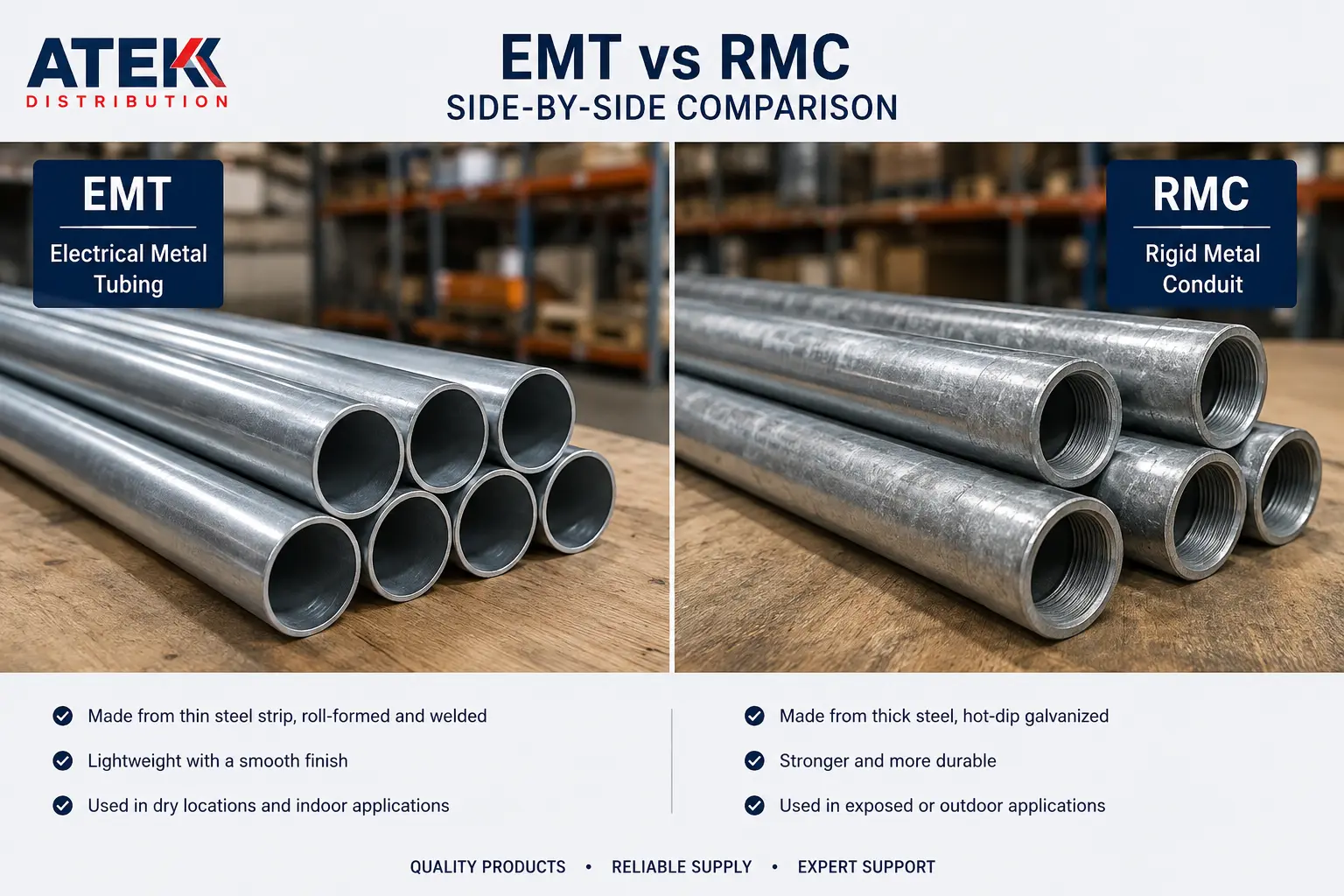
EMT vs. Rigid Conduit: What’s the Difference?

Conduit Buying Guide

EMT vs. Rigid Conduit: What’s the Difference?

It comes down to wall thickness and how sections connect. EMT is thin-wall tubing joined with setscrew or compression fittings. RMC is thick-wall, threaded conduit built for maximum physical protection — one distinction that decides weight, cost, bending method, and where each belongs on your job.

NEC 358 vs. 344Up to 60% lighterHand-bend vs. hydraulic
EMT/RMC side-by-side

Free Download: Spec comparison chart (PDF)

Wall thickness, NEC articles, UL listings, weight, and a fitting-compatibility quote checklist for EMT, IMC and RMC — two printable pages.

EMT vs. RMC at a Glance

Feature EMT Rigid Metal Conduit (RMC)
NEC Article 358 344
Wall thickness Thin-wall Thick-wall (heaviest metallic conduit)
Threading Unthreaded — setscrew or compression fittings Threaded on both ends
Weight Lightweight Significantly heavier
Bending Easy, hand bender Requires hydraulic/power bending equipment
Physical protection Good for normal conditions Highest protection against impact and crushing
Best for Indoor commercial/light industrial, exposed runs without severe damage risk Outdoor, underground-adjacent, high-abuse industrial areas

Three Conduit Types, One Spec Sheet

EMT, IMC and RMC are often used interchangeably in conversation — they’re different products with different code articles.

EMT

NEC 358Thin-wall, unthreaded steel or aluminum tubing joined with setscrew or compression fittings. Standard for commercial and light-industrial interiors — exposed or concealed, low physical-damage risk.

IMC

NEC 342Threaded, mid-weight steel conduit. More protection than EMT, lighter and cheaper than RMC — permitted anywhere RMC is permitted.

RMC

NEC 344The heaviest, thickest-walled steel raceway. Threaded on both ends for direct connection into hubs and boxes — the standard where protection matters most.

Key Differences Between EMT and Rigid Conduit

Wall thickness & protection

RMC resists impact, crushing and puncture damage. EMT covers normal indoor conditions but isn’t for locations with severe physical-damage risk.

Threading & fittings

EMT: setscrew or compression fittings only. RMC: threaded both ends, connecting directly into threaded equipment — more labor, more secure.

Weight & installation

EMT is light and bends by hand. RMC’s thick walls typically need hydraulic or powered bending equipment, and installation takes longer.

Cost

EMT is cheaper in material and labor — the default for most commercial interiors. RMC costs more, reserved for jobs that need its protection.

Typical applications

EMT: commercial/light-industrial interiors. RMC: outdoor runs, high-abuse industrial areas, and impact-exposed zones.

Neither EMT nor RMC is typically used for direct burial — contractors use RMC or IMC (often PVC-coated) instead. Always confirm exact requirements against current NEC and your local AHJ.

What EMT, IMC and RMC Actually Mean

EMT — Electrical Metallic Tubing

Thin-wall, unthreaded steel tubing. 0.042″–0.083″ nominal wall, trade sizes ½″–4″.
ANSI C80.3 · UL 797 · NEC 358

IMC — Intermediate Metal Conduit

Threaded steel conduit, roughly 0.080″ (10-ga) wall. Lighter than RMC, permitted wherever RMC is.
ANSI C80.6 · UL 1242 · NEC 342

RMC — Rigid Metal Conduit

The heaviest steel raceway. 0.116″–0.148″ nominal wall. Also called rigid, RGS, or galvanized rigid steel.
ANSI C80.1 · UL 6 · NEC 344

EMT is roughly 40% lighter than IMC and 60% lighter than RMC — on a long run that shows up directly in labor hours.

Dimensional figures are nominal industry values from the ANSI C80 series. Confirm exact dimensions against the manufacturer submittal for the trade size you’re specifying.

Are EMT and RMC Fittings Interchangeable? No

Not interchangeable, even when the trade size matches — the two raceways connect in fundamentally different ways.

EMT

Unthreaded. Joins with setscrew or compression connectors that grip the outside of the tubing.

IMC & RMC

Threaded. Join with threaded couplings; ends are cut and threaded in the field or supplied pre-threaded.

Transitioning between the two? Use a listed combination coupling rated for both raceway types. Never thread EMT — the wall isn’t designed for it, and threading voids the listing. A mismatched fitting is a failed inspection and a rework cost.

Common Mistakes to Avoid

Using EMT in locations subject to severe physical damage, where RMC or IMC is required.

Assuming EMT and RMC fittings are interchangeable — they use different connection methods and aren’t cross-compatible.

Specifying EMT for direct burial or underground runs without checking code requirements.

Underestimating labor time and equipment needs when switching a design from EMT to RMC.

Which Should You Choose?

Choose EMT if

The installation is indoor, exposed to normal conditions, and budget and installation speed matter.

Choose RMC if

The conduit will be outdoors, exposed to impact or heavy equipment traffic, or the project specifically calls for maximum protection.

Not sure?

Many commercial projects use both — EMT for the bulk of interior runs, RMC at transitions, exterior stub-ups, or high-traffic industrial zones.

Frequently Asked Questions

Can EMT be threaded like rigid conduit?

No. EMT’s wall is too thin to be threaded and relies entirely on setscrew or compression fittings. Only RMC (and IMC) are manufactured with threaded ends.

Is rigid conduit more expensive than EMT?

Yes, in both material and labor cost. RMC’s thicker wall uses more material, and its threaded connections and heavier bending requirements generally take longer to install.

Can EMT be used outdoors?

Yes, EMT can be used outdoors with appropriate weatherproof fittings and connectors, but many contractors choose RMC for outdoor runs that face higher physical impact risk or require maximum durability.

What's the difference between rigid conduit and IMC?

Both are threaded, but RMC has a thicker, heavier wall than IMC. IMC offers a middle ground — more protection than EMT, lighter and less expensive than full RMC.

Do EMT and rigid conduit use the same fittings?

No. EMT uses setscrew or compression fittings designed for its thin wall, while RMC uses threaded fittings designed for its threaded ends. The two are not cross-compatible.

When should you use EMT vs. rigid conduit?

Choose EMT for indoor runs under normal conditions where budget and installation speed matter. Choose RMC when the conduit will face physical impact, heavy equipment traffic, or the project specifically requires maximum protection — commonly outdoors or in high-abuse industrial areas.

What are the disadvantages of using rigid conduit?

RMC costs more in both material and labor, weighs significantly more than EMT, and requires threading and hydraulic bending equipment rather than a hand bender — all of which add installation time.

What's harder to bend, EMT or rigid?

Rigid conduit is harder to bend. Its thick wall requires hydraulic or powered bending equipment, while EMT’s thin wall bends easily with a standard hand bender.

Where is EMT conduit not allowed?

Per NEC Article 358.12, EMT can’t be used where subject to severe physical damage, as support for luminaires or equipment beyond small conduit bodies, where corrosion protection relies only on enamel, in cinder concrete/fill with permanent moisture unless protected, or in hazardous locations except as permitted under NEC 502.4, 503.3, and 504.20. Confirm against your jurisdiction’s adopted NEC edition before specifying.

Related Guides

Wire Nuts vs. WAGO Connectors: Which Wins?

Compare cost, code compliance, and vibration resistance.

Choosing Electrical Enclosures for Outdoor Use

A buying guide to NEMA/IP ratings and materials.

Browse Electrical Boxes & Enclosures

See where this conduit terminates.

Ready to Spec Your Conduit and Fittings?

ATEK Distribution supplies EMT and rigid conduit fittings for commercial, industrial and government projects. Browse our full range of conduit, raceway, and cable support products, or start with one of the options below.