
You're on a job where the wiring looked fine at rough-in, but the call-back says otherwise. The cord's been tugged, the jacket is scuffed at the knockout, and now the inspector wants to know why the termination is taking the load instead of the fitting. That's the value of wiring strain relief, it keeps pull, bend, vibration, and impact from reaching the conductors and terminal screws.
Table of Contents
- Why Wiring Strain Relief Matters on the Job
- Strain Relief Types and Where Each One Belongs
- Codes and Standards That Drive the Selection
- Matching Threads, Materials, and Clamp Range to the Cable
- Installing Wiring Strain Relief the Right Way
- Common Mistakes and Dynamic-Use Pitfalls
- Procurement Checklist and Common Questions
Why Wiring Strain Relief Matters on the Job
A bad field shortcut usually doesn't fail right away. I've seen a 480V motor disconnect where the SOOW cord was looped through the knockout and held with a zip tie on the panel side, then left alone until the first inspection after the equipment had already been in service for months. By then the bend had worked the jacket hard, the copper had darkened, and the enclosure was no longer something an inspector was going to sign off on.
What strain relief actually protects
Wiring strain relief is mechanical protection, not cosmetic support. It keeps the load from being transmitted into the joint, terminal screw, or lug, which is exactly why OSHA 1910.305(g)(2)(iii) and 1926.405(g)(2)(iv) require flexible cords and cables to be connected so strain relief prevents pull from reaching the terminations, and why NFPA 70 Article 400.14 says tension can't be transmitted to joints or terminals. In Europe, DIN EN 62444 replaced DIN EN 50262 in 2014, which matters because it formalized the updated cable gland and strain-relief expectations that inspectors now look for Leviton wire management overview.
Practical rule: if the cable can move the terminal, the strain relief isn't doing its job.
The field failures are usually the same four. The cable pulls out under service load, the jacket gets cut where it enters the enclosure, the edge of the knockout abrades insulation, or repeated motion breaks the conductor at the lug. The right fitting is there to absorb those forces before they become downtime, a red tag, or a repair that turns into a second truck roll.
Strain Relief Types and Where Each One Belongs
The part matters, but the application matters more. A cord grip that works on a portable saw can be a poor fit on a robot arm, and a molded boot that belongs on an OEM cord set will not help a field retrofit unless the assembly was designed around it. The quickest way to narrow the choice is to start with the service: portable cord, fixed machine wiring, control cabinet work, or a factory-built cord set.
The main families you'll see
| Type | Best Fit | Typical Cable OD | Weak Spot |
|---|---|---|---|
| Nylon or brass cord grip | SOOW, portable cord, general field wiring | Moderate, depends on body size | Flat festoon cable and severe motion |
| Metal cable gland | Machine builders, IEC-style panels | Broad, with metric and PG sizing | Ultra-flexible silicone that needs gentler retention |
| Snap-in or click-out grommet | Indoor control cabinets with low pull load | Smaller jacket ranges | Vibration and repeated movement |
| Molded PVC or Santoprene boot | Factory cord sets, wet-location appliances, medical equipment | Fixed by assembly design | Poor field retrofit options |
| Overmolded strain relief | Plugs, connectors, molded assemblies | Built into the connector system | Can't be added after the fact |
Cord grips, especially nylon and brass versions, are the workhorse for portable cord and general-purpose equipment. Cable glands fit machine builders and IEC-style enclosures better because the thread system, sealing ring, and compression body are meant to work together. The thread choice matters too, because NPT, PG, and metric bodies do not interchange cleanly in the field.
For enclosure transitions and conduit-adjacent work, buyers often keep a reference like flexible conduit fittings open while they size the entry point. That helps avoid the common mistake of selecting a good cable fitting and a poor enclosure interface.
Grommets are fine when the load is low and the cabinet stays still, but they are not the right answer when vibration is part of the duty cycle. Molded boots and overmolds are more specialized. They work best when they are part of the original design, and they are weak field fixes when someone tries to copy the result with a loose replacement part.
Field selection comes down to the load path. If the cable has to survive repeated flexing, look for a fitting that grips the jacket without crushing it, allows the bend radius the cable can tolerate, and matches the enclosure opening without forcing the cord into a sharp edge. If the job is static, a simpler retention method may be enough. If the job moves, choose for movement first and appearance second.
Codes and Standards That Drive the Selection
A fitting can look right and still fail inspection. On site, the questions are usually simple: is it listed, is it sized for the cable, and does it keep pull force out of the termination? That is why UL 514B, DIN EN 62444, and IPC/WHMA-A-620 matter together, along with the installation rules that govern how the cord enters the equipment.
What each document changes in the buying decision
OSHA 1910.305(g)(2)(iii) and 1926.405(g)(2)(iv) require flexible cords and cables to be connected so strain relief keeps pull from reaching joints or terminal screws, and NFPA 70 Article 400.14 says the same thing in field terms. The purchase decision follows from that: use a listed fitting that controls force at the entry point, instead of a field-fabricated bushing that only fills the opening Leviton wire management overview.
UL 514B is the U.S. fitting standard that matters at the point of installation. The 13.5 kg pull test described in field guidance is the practical verification method. The cable must stay put, and the jacket should show no slipping or obvious damage EDN cable strain relief selection. If the clamp bites the conductors or depends on friction alone, it is the wrong choice.
DIN EN 62444 matters on European machinery and metric installations because it sets the expectations for glands and retention. IPC/WHMA-A-620 sits behind the fitting and defines workmanship for the wire harness or cable assembly itself, so a good cord grip cannot make up for a poor termination.
A strong fitting protects a good termination. A weak fitting can ruin one.
Matching Threads, Materials, and Clamp Range to the Cable
A lot of bad selections happen before anyone looks at the cable. The fitter starts with the wrong knockout, then forces the wrong thread into it, then discovers the cable doesn't fit the clamp range anyway. Good procurement flips that order, first match the enclosure, then the thread system, then the material, and only then the clamp range.
Start with the thread system, not the catalog photo
NPT still dominates many U.S. enclosures, PG survives in legacy European hardware, and metric is the cleanest fit for IEC-style gear and a lot of imported panels. If the thread doesn't match the knockout, you've already created an adapter problem you didn't budget for. The practical rule is simple, match the enclosure hole pattern first, because a pretty gland body won't make a wrong thread work.
Then choose the body material for the environment
Nylon is fine in dry indoor cabinets, nickel-plated brass is a common step up for outdoor or washdown work, stainless 316 belongs in corrosive or food-grade environments, and PVDF is used where chemical exposure is the bigger threat. The material choice affects durability, sealing behavior, and service life, so the low-cost option isn't always the low-risk option. For cable sourcing and related fit-up decisions, buyers often review wire cords and cables alongside the fitting to keep the whole assembly consistent.
Clamp range has to follow cable OD
This is the part people miss. A 1/2" NPT cord grip with a 6 to 12 mm clamp range won't hold a 14 mm SOOW jacket, even if the thread looks right on paper. Put the cable outside diameter in the middle of the range when you can, because that usually gives the best seal and retention without crushing the jacket.
| Cable / Enclosure | Thread | Material | Clamp Range |
|---|---|---|---|
| SOOW cord in a U.S. panel | NPT | Nylon or brass | Sized to the measured jacket OD |
| IEC machine lead in a metric enclosure | Metric | Nickel-plated brass or stainless 316 | OD centered in the listed clamp span |
| Legacy European panel | PG | Brass or nickel-plated brass | Match jacket OD, not nominal cord size |
| Chemical washdown run | Metric | PVDF or stainless 316 | Narrowest span that still centers the cable |
Installing Wiring Strain Relief the Right Way
A good installation starts before the fitting is tightened. I have seen sound hardware fail because the installer stripped too much jacket, routed the cable after termination, or treated the clamp like a hole plug. The fitting only does its job when the cable sits on intact jacket and the body carries the retention load.
Confirm the knockout matches the thread, then have the locknut or sealing ring ready. Strip only enough jacket to reach the termination point, feed the cable through the body before landing the conductors, and seat the body against the enclosure wall before you snug the locknut. If the enclosure needs matching hardware, keep it on hand from the start through electrical boxes and accessories.
Torque deserves the same attention. Nylon bodies usually call for less tightening force than brass, and guessing can deform the jacket enough to weaken the grip. Once the body is set, the fitting should hold the cable without depending on terminal-side friction.
Verify the installation, don't assume it passed
Field verification starts with the pull test. As noted earlier, the common UL-style check uses a 13.5 kg load held for 1 minute, then looks for cable slip or jacket damage. The point is simple, the fitting must grip the jacket, not the conductors.
The bend geometry matters too. Keep enough radius for the cable type and duty cycle, since static runs and moving runs do not fail the same way. If the application flexes, add a service loop and clamp the trunk, not individual conductors. For sizing context on cord grips and enclosure fit-up, the same trade-offs are covered in EDN cable strain relief selection, but the installation itself still comes down to clean seating, correct torque, and a jacket that stays intact.
Document the install with a visible torque mark if your inspection process uses one. That gives the crew a fast way to confirm the fitting was tightened and checked, instead of just installed and forgotten.
Common Mistakes and Dynamic-Use Pitfalls
The most common mistakes are usually the ones people defend as “good enough.” A zip tie through the knockout looks tidy for about five minutes, then it starts failing the way the standards said it would, because it doesn't meet the code intent for strain relief and it won't pass a proper pull check. Mismatched threads create a different kind of failure, they may hold long enough to fool a quick inspection, then loosen under vibration or crack when the enclosure moves.
Where standard cord grips stop being the right answer
Ordinary dome-cap glands are fine for static cable. They're not the right choice for robotic tooling, repeated-axis motion, or any application where the cable moves with the machine over and over again. In those cases, the cable needs a flex-rated retention design or a gland built for repeated motion, because ordinary compression on a jacket that keeps bending will fatigue the jacket and the conductors inside.
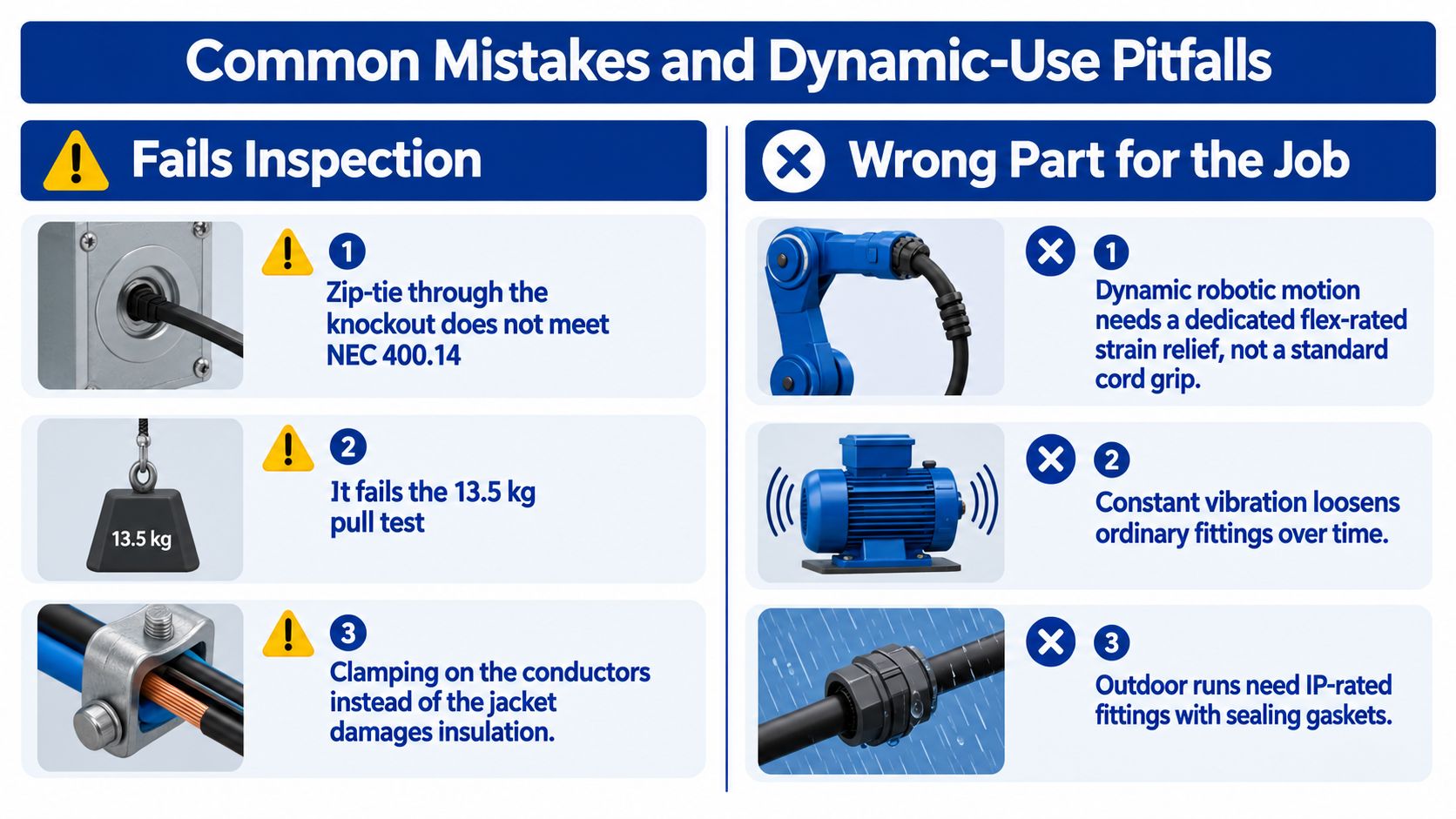
If the cable already carries its own strain member, like some type W or stage-style assemblies, don't clamp that member the same way you would a simple jacketed cord. The strain member needs its own relief point inside the enclosure, otherwise the gland ends up taking a load it wasn't meant to carry. UV, oil, and heat also punish nylon faster than a lot of crews expect, so outdoor and process environments usually deserve a tougher material selection.
Practical rule: if the machine moves, the strain relief has to be selected for motion, not just for retention.
Procurement Checklist and Common Questions
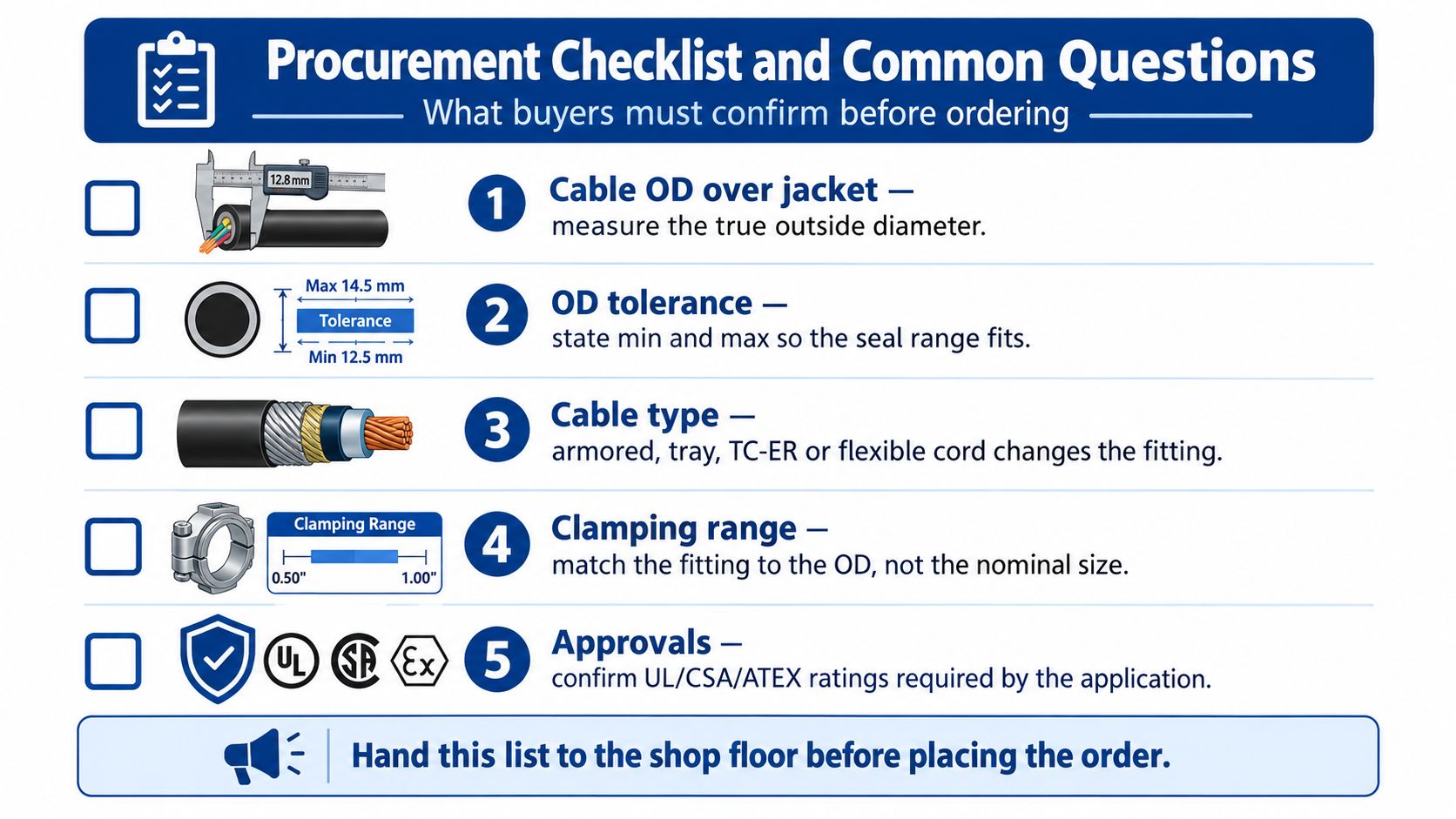
A bad order usually starts with a vague spec. Give purchasing the cable OD measured over the jacket, the thread standard, the enclosure hole size, the material, the indoor or outdoor rating, and whether the run is static or moving. That is the information that keeps the seal, clamp, and enclosure aligned with the job instead of forcing a field workaround.
What buyers should confirm before ordering
- Cable OD over jacket: Measure the actual outside diameter, not the catalog name.
- OD tolerance: State the minimum and maximum so the clamp range is usable.
- Cable type: Armored, tray, TC-ER, and flexible cord all point to different fittings.
- Connector thread and hole size: Confirm NPT, PG, or metric before the order goes out.
- Approvals and environment: Check the enclosure rating, temperature range, and any UL, CSA, or ATEX requirements.
Common questions from the tech line
When is PG acceptable versus metric versus NPT? PG still belongs on some legacy and imported equipment, and that includes older Siemens-style panels where the hole pattern was built around PG hardware. Metric fits IEC-style panels cleanly, while NPT remains common on North American enclosures. If the thread is wrong, the job usually pays for it with an adapter, extra labor, and another leak point.
Can a standard cord grip hold a moving machine? It can hold the cable in place, but repeated flexing changes the story. Dynamic applications need a fitting rated for motion and a cable built for that duty, because a static grip tightened harder is not the same thing as a motion-rated solution.
What does the inspector want to see? The fitting should be listed for the use, the cable should be retained on the jacket, and the pull check should show no slip or conductor damage. The pull benchmark discussed earlier in the article is the practical reference people use to verify that the clamp is gripping the jacket correctly EDN cable strain relief selection.
If you need strain relief hardware, matching cable support, enclosure accessories, or help sorting through thread systems and compliance requirements, ATEK Distribution can help with sourcing and technical selection. Visit ATEK Distribution to review options and get the right parts lined up before the crew starts pulling cable.