
PVC-jacketed MC cable is a specific listed assembly under UL 1569 that combines metallic armor with an outer PVC sheath for wet or corrosive locations, governed by NEC Article 330. Depending on the insulation and construction, UL 1569 ratings extend to 600 volts for thermoplastic insulation and 600 or 2,000 volts for thermoset insulation, with conductor limits generally specified at 75°C or 90°C. Southwire's product documentation illustrates why the complete listing matters.
A contractor may receive a specification that says only “PVC jacketed MC cable.” The cable arrives, the jacket looks substantial, and the team assumes the substitution is complete. Later, the submittal review exposes a missing wet-location marking, an incompatible fitting, or a conductor insulation designation that doesn't match the installation.
That mistake is avoidable. A PVC jacket changes the cable's environmental role, but it doesn't erase the need to verify the armor, conductors, grounding method, terminations, temperature limits, and permitted installation method.
Table of Contents
- Understanding PVC Jacketed MC Cable and Its Role
- Construction Layers and Core Components
- NEC Code Requirements and UL 1569 Standards
- Comparing Cable Options for Industrial Use
- Ampacity, Termination, and Installation Risks
- Procurement and Sourcing Support at ATEK
Understanding PVC Jacketed MC Cable and Its Role
A cable can look ready for an outdoor run and still fail the submittal review. The phrase “PVC jacketed MC cable” describes a factory-listed cable assembly, not ordinary wire with plastic added afterward. Typical constructions combine copper or 8000-series aluminum conductors, THHN/THWN or XHHW-2 insulation, interlocked aluminum or galvanized-steel armor, and an exterior PVC jacket. UL 1569 covers round and flat armored cables with thermoplastic or thermoset insulation. Southwire's Type MC documentation shows why the complete construction and rating must be reviewed.
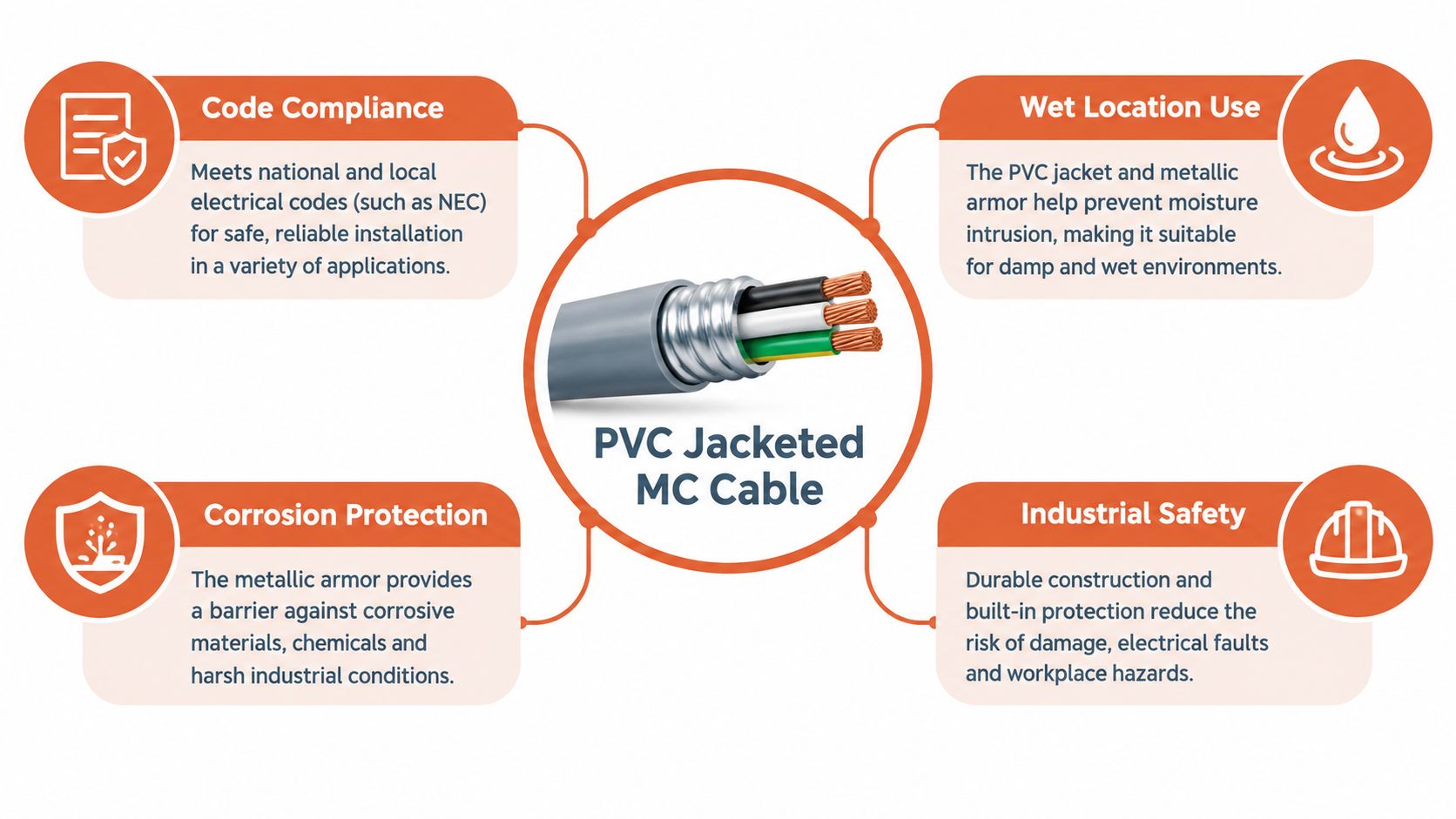
The jacket matters when a circuit leaves a clean, dry interior. Unjacketed MC may suit a dry exposed installation, while condensation, outdoor exposure, corrosive atmospheres, direct burial, or concrete encasement call for markings that specifically permit those conditions. PVC can improve resistance to moisture, sunlight, abrasion, and handling damage. It does not, by itself, establish every environmental rating.
What the jacket changes
The armor still supplies mechanical protection and, in a listed construction, may participate in the equipment-grounding path. The PVC layer shields that armor from moisture and corrosive contact. It also adds installation friction: a larger outside diameter can affect bending space, fittings, support, and termination preparation.
A jacketed cable is not automatically interchangeable with another jacketed cable. Check markings for wet locations, sunlight resistance, direct burial, concrete encasement, oil exposure, fire performance, and hazardous locations. Confirm the fitting is listed for the cable's actual outer diameter and assembly.
For sourcing comparisons, ATEK's wire and cable category is a practical starting point. Final approval should rely on the complete manufacturer datasheet and listing. The useful question is whether this exact assembly is listed for this exact installation.
Construction Layers and Core Components
A PVC-jacketed MC cable has several functional layers, and each one answers a different installation problem.
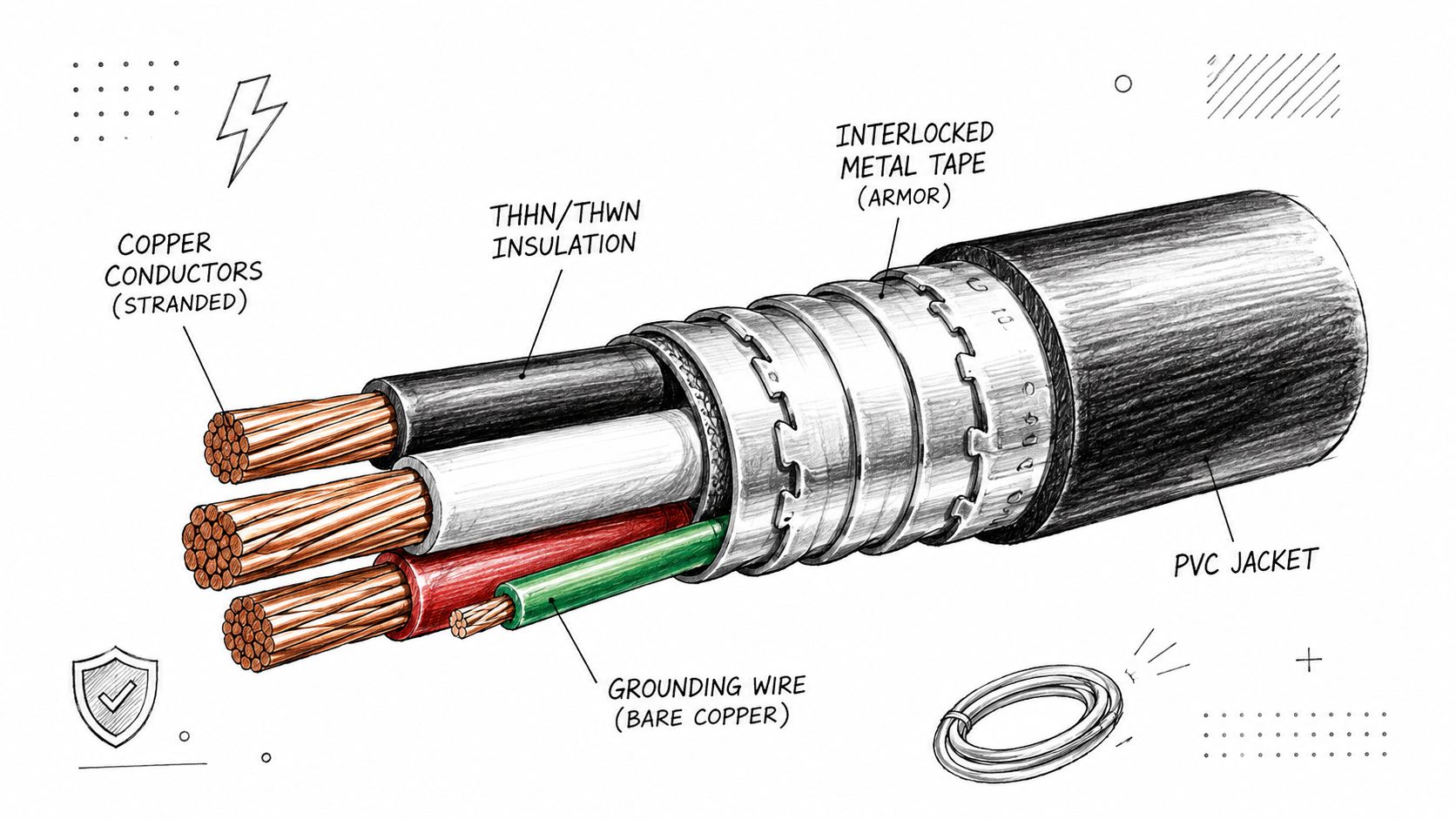
Start at the center. The conductors carry the circuit load and are insulated with materials such as THHN/THWN or XHHW-2. The insulation designation affects dry- and wet-location suitability, temperature rating, and the ampacity calculation. Two cables with similar outside diameters can therefore have different permitted uses because their conductor insulation systems differ.
Around the insulated conductors sits the metallic covering. UL 1569 covers metal-clad cables with insulated conductors ranging from 18 AWG through 2000 kcmil, enclosed by interlocked metal strip armor or a smooth or corrugated metal tube, as summarized by UL 1569 construction information. The PVC jacket is an additional outer covering. It doesn't replace the armor or turn the product into nonmetallic cable.
Why each layer matters
Interlocked aluminum or galvanized-steel armor protects the conductors from ordinary handling and provides the cable's metal-clad structure. It may also provide an equipment-grounding path when the cable construction and fittings are specifically listed for that purpose. The nonconductive PVC jacket itself doesn't create grounding continuity.
The outer jacket protects the assembly from environmental contact, but it also changes the installation experience. The larger outside diameter can increase pulling friction and affect the space available at boxes, cabinets, and fittings. Cold conditions, tight bends, damaged jacket sections, and poorly prepared terminations deserve attention during installation.
A useful inspection sequence is:
- Read the cable marking. Confirm the Type MC identification, conductor insulation, voltage rating, temperature rating, and environmental markings.
- Check the armor. Verify whether it is aluminum or galvanized steel and determine how the equipment-grounding path is formed.
- Match the fittings. Use connectors listed for the cable construction and grounding application. A connector selected for ordinary MC may not be suitable for every jacketed assembly.
- Review the outer diameter. Confirm that the bend space, entry hardware, and enclosure capacity work with the actual cable.
- Inspect the jacket after pulling. Cuts, crushing, and abrasion can undermine the environmental protection that justified the product choice.
The following installation overview is useful when crews need a visual reference for the cable's layered construction and handling:
NEC Code Requirements and UL 1569 Standards
Type MC requirements moved from NEC Article 334 in the 1999 edition to Article 330 in the 2002 edition. That change placed Type MC under its own article and clarified construction and installation provisions. Article 330 recognizes smooth metallic sheath, corrugated metallic sheath, and interlocking metal-tape armor as principal metallic-covering forms. Electrical Contractor's review of MC requirements documents this code history and the related environmental distinctions.
The practical consequence is simple. “Metal-clad” describes a family of constructions, not one universal environmental rating. Unjacketed MC could be installed in an other space used for environmental air under NEC Section 300.22(C), while wet-location installations required the metallic covering to be impervious to moisture or the insulated conductors to be listed for wet locations. A nonmetallic-jacketed MC assembly could be used in wet locations when the complete assembly was appropriately listed.
Read the listing with the installation method
Wet location, direct burial, and concrete encasement are not automatic consequences of seeing PVC on the outside. The cable must be identified for the specific method, and the installation still has to satisfy the applicable NEC edition, fittings requirements, support rules, physical protection provisions, and authority-having-jurisdiction interpretation.
UL 1569 sets the product framework. Under its fifth edition, published in 2018, covered ratings extend to 600 volts for thermoplastic insulation and to 600 or 2,000 volts for thermoset insulation, with conductor temperature limits generally at 75°C or 90°C depending on the design. Those figures identify possible listed ratings, not permission to apply one rating to every cable.
That distinction matters on temporary facilities as well as permanent plants. Teams coordinating a trailer-mounted office or field facility may benefit from reviewing mobile office trailer electrical requirements alongside the cable manufacturer's instructions and the governing electrical code. The installation environment, service arrangement, grounding, and local approval process still control the final decision.
For projects subject to a changing code basis, the applicable edition should be established before procurement. A Minnesota project, for example, may require teams to check Minnesota 2026 NEC changes as part of design review, inspection planning, and submittal coordination. Product compliance doesn't replace jurisdictional compliance.
Comparing Cable Options for Industrial Use
The decision is not merely between cheap cable and expensive cable. It is between different combinations of environmental protection, mechanical behavior, serviceability, installation labor, and listing coverage.
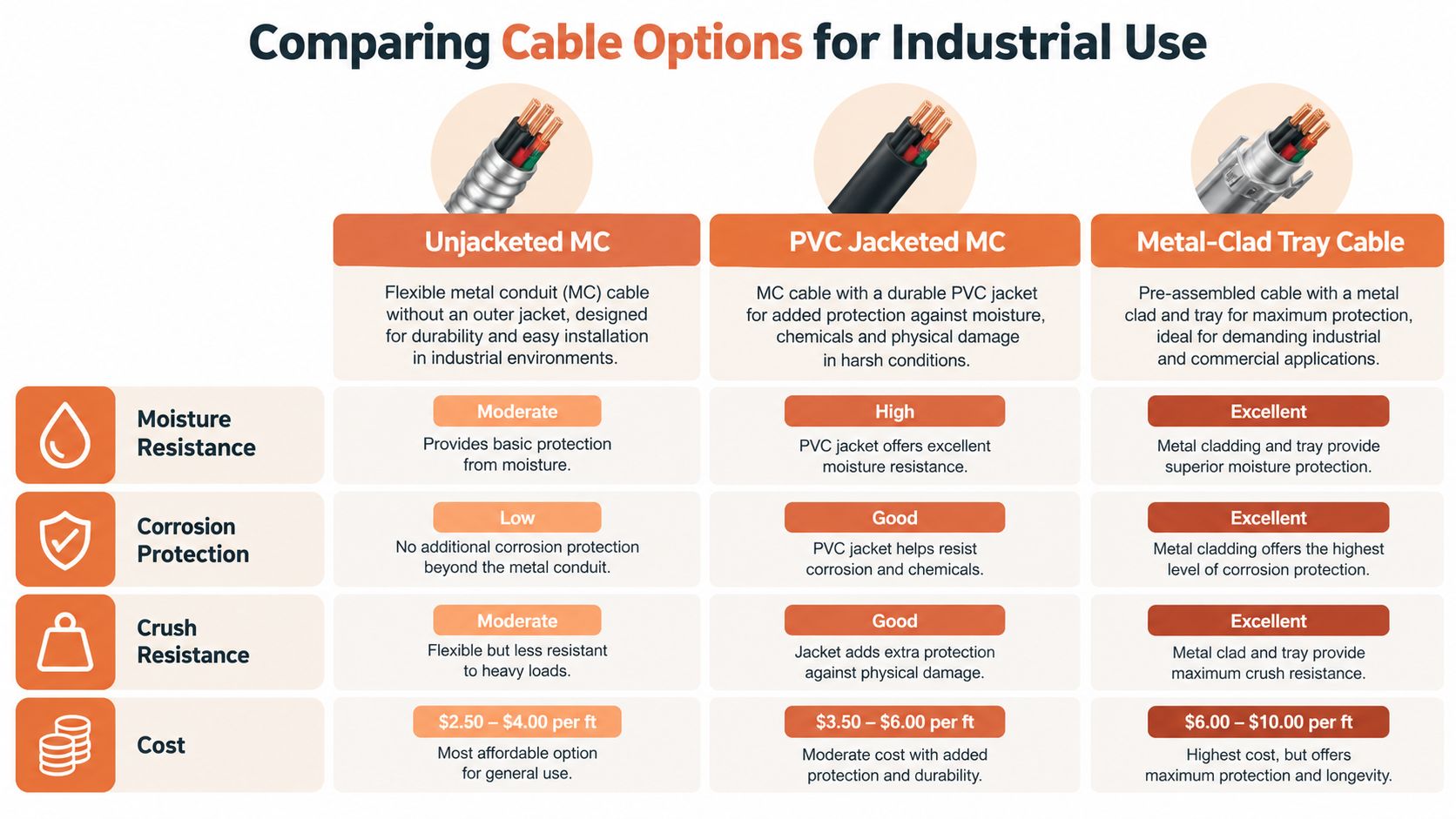
Unjacketed Type MC can make sense in a dry indoor area where the cable isn't exposed to corrosive agents or persistent moisture. PVC-jacketed MC becomes more compelling when the route encounters condensation, sunlight, oil, corrosive exposure, direct burial, or concrete encasement, provided the exact product is listed for that use. Tray cable may be the better choice where the project already has a designed cable tray system and the cable's listing aligns with the tray, termination, and environmental requirements.
A practical selection view
| Installation concern | Unjacketed MC | PVC-jacketed MC | Metal-clad tray cable |
|---|---|---|---|
| Dry indoor exposure | Often suitable when listed and protected from damage | May be more protection than needed | Depends on tray and cable listing |
| Moisture or condensation | Requires careful conductor and armor evaluation | Strong candidate when specifically listed | Depends on wet-location listing |
| Corrosive exposure | Limited by armor and environment | Jacket can add protection, but chemical compatibility remains essential | Requires cable jacket and tray system review |
| Direct burial or concrete | Not assumed suitable | Only when specifically listed | Depends on product and installation method |
| Future modifications | More difficult than conduit | Similar handling limits, with added jacket friction | Tray may simplify access if routing is already available |
| Material and labor trade-off | Lower material complexity in suitable dry areas | Added material and termination considerations | Requires supporting tray infrastructure |
Some available PVC-jacketed MC constructions combine galvanized interlocked armor with a 50-mil PVC jacket, sunlight resistance, direct-burial or concrete-encasement listing, oil resistance, and operating limits of 90°C dry, 75°C wet, and -40°C minimum temperature, as shown in Atkore's product information. Those features belong to the identified product, not to every cable described as PVC jacketed.
Selection rule: Choose the least complex wiring method that still satisfies the actual environmental, mechanical, grounding, and serviceability requirements. Overspecification wastes budget. Underspecification creates failures that are harder to correct after installation.
Conduit remains attractive where physical damage is likely, future conductor changes are expected, or the project requires a rigid protective pathway. A related option such as one-inch flexible metal conduit may help with equipment connections, but its suitability depends on the complete raceway design and applicable fittings. PVC-jacketed MC is not a universal replacement for conduit, tray cable, or plain MC.
Ampacity, Termination, and Installation Risks
The most common technical mistake is treating a 90°C conductor rating as the final operating permission. PVC-jacketed MC products commonly use THHN/THWN or XHHW-2 conductors rated 90°C in dry locations, and XHHW-2 may carry a 90°C wet rating. The final ampacity still depends on adjustment, correction, terminal temperature, overcurrent protection, and the installation conditions described in Southwire's ampacity information.
Use the 90°C value as an engineering input when the applicable rules permit it, not as a blanket authorization. More than three current-carrying conductors, ambient-temperature correction, terminal limitations under NEC 110.14(C), and overcurrent-protection limits under 240.4 can all constrain the result.
Verify the calculation and the connection
A sound review follows the circuit from conductor to termination:
- Conductor insulation: Confirm whether the cable contains THHN/THWN or XHHW-2 and whether the wet rating matches the location.
- Ampacity basis: Apply the relevant NEC table, adjustment factors, correction factors, and small-conductor limitations.
- Terminations: Check the temperature rating and wire range of lugs, breakers, disconnects, terminal blocks, and other equipment.
- Fittings: Use connectors listed for the specific MC construction and grounding function. The jacket may require a different entry arrangement or stripping procedure.
- Grounding path: Confirm whether the assembly contains an internal equipment-grounding conductor, uses listed armor for grounding, or requires another bonding arrangement.
Pulling is another place where the jacket creates trade-offs. The outer covering can increase friction and outside diameter, especially in long or crowded routes. Pulling tension, bend space, cold-weather handling, and entry alignment should be considered before the cable reaches the jobsite. A jacket that arrives intact can still be damaged by a sharp edge, excessive force, or a bend tighter than the manufacturer permits.
Termination workmanship deserves its own inspection. Remove the jacket and armor only as instructed, preserve conductor insulation, install compatible fittings, and verify that seals and bonding components are fully engaged. A watertight-looking entry isn't necessarily a listed wet-location termination.
The same discipline applies to low-voltage and security pathways. For teams coordinating power with CCTV and alarm installation Melbourne, cable routing, enclosure entry, environmental exposure, and separation should be coordinated rather than handled as isolated trades. The product category may differ, but poor pathway planning creates the same type of access and inspection problems.
Procurement and Sourcing Support at ATEK
A technically correct cable can still become a procurement problem if the requested description omits the information needed to identify the assembly. “PVC jacketed MC cable” should be treated as a starting phrase, not a complete purchase order line.
A useful submittal package should identify:
- Conductor details: Copper or 8000-series aluminum, conductor size, strand construction where relevant, and insulation designation.
- Cable rating: Voltage, conductor temperature, wet or dry suitability, and any limits that affect the design.
- Armor construction: Aluminum or galvanized steel, interlocked or other permitted form, and the grounding method.
- Environmental listing: Sunlight, corrosion, oil, direct burial, concrete encasement, firestop, or hazardous-location suitability when required.
- Installation hardware: Compatible connectors, bonding components, seals, glands, supports, and firestop systems.
- Documentation: UL 1569 listing information, manufacturer datasheet, installation instructions, and any jurisdiction-specific submittal requirements.
The procurement team should compare the proposed cable against the approved basis of design, not just against conductor size and voltage. During shortages, an alternate may look equivalent while differing in jacket thickness, wet-location status, armor material, temperature limits, grounding construction, or permitted installation method.
ATEK Distribution can support BOM review, manufacturer coordination, hard-to-source component searches, alternate evaluation, product submittals, compliance documentation, and project staging. That role is useful when an engineer needs a technically defensible substitution or when a contractor must keep a mission-critical installation moving without losing control of the approved materials.
The best sourcing process also checks the accessories. A cable and fitting combination should be reviewed as an installation system, especially where the jacket affects entry dimensions, stripping, seals, firestop, or bonding. A complete material review prevents the familiar outcome where the cable is available but the listed connectors are not.
For PVC-jacketed MC cable, ATEK Distribution offers product sourcing, BOM support, approved-alternate evaluation, and documentation review for the cable and associated electrical components. Visit ATEK Distribution with your cable schedule, environmental requirements, and submittal criteria so the sourcing team can help verify the complete assembly before it reaches the jobsite.