
M21-750-499 is a Brady 0.75-inch by 16-foot black-on-white B-499 nylon-cloth label cartridge built for BMP21, BMP21-PLUS, BMP21-LAB, ID PAL, and LABPAL printers. It's a continuous identification consumable for wire, cable, panels, terminal blocks, and equipment, not an electrical power or circuit-protection component.
A contractor usually encounters this part when a panel build, retrofit, or service call needs durable identification and the printer is already sitting on the truck or in the shop. The purchasing question isn't only whether the label looks right. You need to confirm that the cartridge fits the printer, suits the substrate and environment, and can be replaced without creating a documentation or compliance problem.
Table of Contents
- What the M21-750-499 Cartridge Is and Where It Fits
- Key Specifications and Dimensions
- Printer Compatibility and the BMP21 Family
- Typical Applications in Electrical and Industrial Work
- Environmental Ratings and On-the-Job Performance
- Cross-Referencing Equivalent Replacements
- Comparing Nylon Cloth to Vinyl and Polyester Labels
- Compliance, Submittals, and Documentation
- Quick-Reference Summary for Buyers
- Frequently Asked Questions About the M21-750-499
What the M21-750-499 Cartridge Is and Where It Fits
M21-750-499 is a Brady BMP21-series continuous nylon-cloth label cartridge for electrical and industrial identification. The stock is 0.75 inches wide and 16 feet long, approximately 19.05 millimeters by 4.88 meters, according to the M21-750-499 product listing from Home Depot.
The part belongs in the consumables portion of a labeling system. It doesn't switch power, protect a circuit, interrupt fault current, or serve as a wiring device. Its job is to produce printed identification that helps an installer, technician, or operator connect a physical conductor or component with the drawing, schedule, terminal designation, or maintenance record.
Continuous stock, not pre-cut markers
The cartridge feeds a continuous strip, so the operator prints the required legend and cuts the label at the needed point. That format works well when conductor lengths, terminal arrangements, and field conditions vary. A panel builder can print a sequence of wire numbers, cut each marker to suit, and continue without changing between pre-sized marker groups.
The nylon cloth is also more useful on curved surfaces than a rigid plastic strip. It can conform around conductors and cable jackets, which is why the cartridge is commonly specified for wire and cable marking, terminal blocks, control panels, communications cables, voice/data systems, and general equipment identification.
Practical rule: Confirm the printer family before comparing label materials. A correct application match is useless if the cartridge won't seat in the handheld printer already assigned to the job.
This part is most appropriate when the project needs a narrow, high-contrast black-on-white legend and the labeling workflow already uses Brady BMP21-family equipment. Generic office label stock may appear similar, but it usually doesn't address the same combination of printer interface, flexible material, adhesive behavior, and industrial documentation requirements.
Key Specifications and Dimensions
A BOM check should start with the cartridge's physical specification, then test whether that specification suits the application. The published data lists a 0.75-inch-wide by 16-foot-long roll, approximately 19.05 millimeters by 4.88 meters, with a matte finish, permanent acrylic adhesive, and approximately 0.0065-inch material thickness. These details appear in the Newark specification for the black-on-white label tape.
| Attribute | Value |
|---|---|
| Product | Brady M21-750-499 |
| Material | B-499 polyamide-coated nylon cloth |
| Label width | 0.75 in, approximately 19.05 mm |
| Roll length | 16 ft, approximately 4.88 m |
| Approximate linear stock | 192 linear inches |
| Print format | Black on white |
| Finish | Matte |
| Adhesive | Permanent acrylic |
| Approximate thickness | 0.0065 in |
| Format | Continuous cartridge |
The 0.75-inch width generally accommodates wire numbers, device designations, panel references, and communications-cable identifiers. It also remains narrow enough for many conductor and cable applications. Check the actual legend before ordering. Long equipment names, larger conductors, or multi-line identification may call for a wider format or another label family.
Why the roll length matters
The continuous roll lets the operator print and cut markers as installation progresses. That avoids ordering separate pre-cut groups for every conductor size or terminal position and helps panel shops handle changing layouts.
The listed 16-foot roll length equals approximately 192 linear inches of labeling material. Use that figure as a planning value during BOM review, then allow for cut spacing, discarded starts, and misprints rather than treating every inch as usable finished marker stock.
The matte black-on-white format supports clear inspection and maintenance marking. Its high contrast is easy to check under work lights, while the matte surface avoids the reflective appearance associated with some glossy label materials.
For purchasing, verify the complete specification: material, adhesive, finish, width, roll length, and printer interface. A substitute that matches the width may still fail the application or the assigned printer. Specification matching is the first cross-reference check when stock is short.
Printer Compatibility and the BMP21 Family
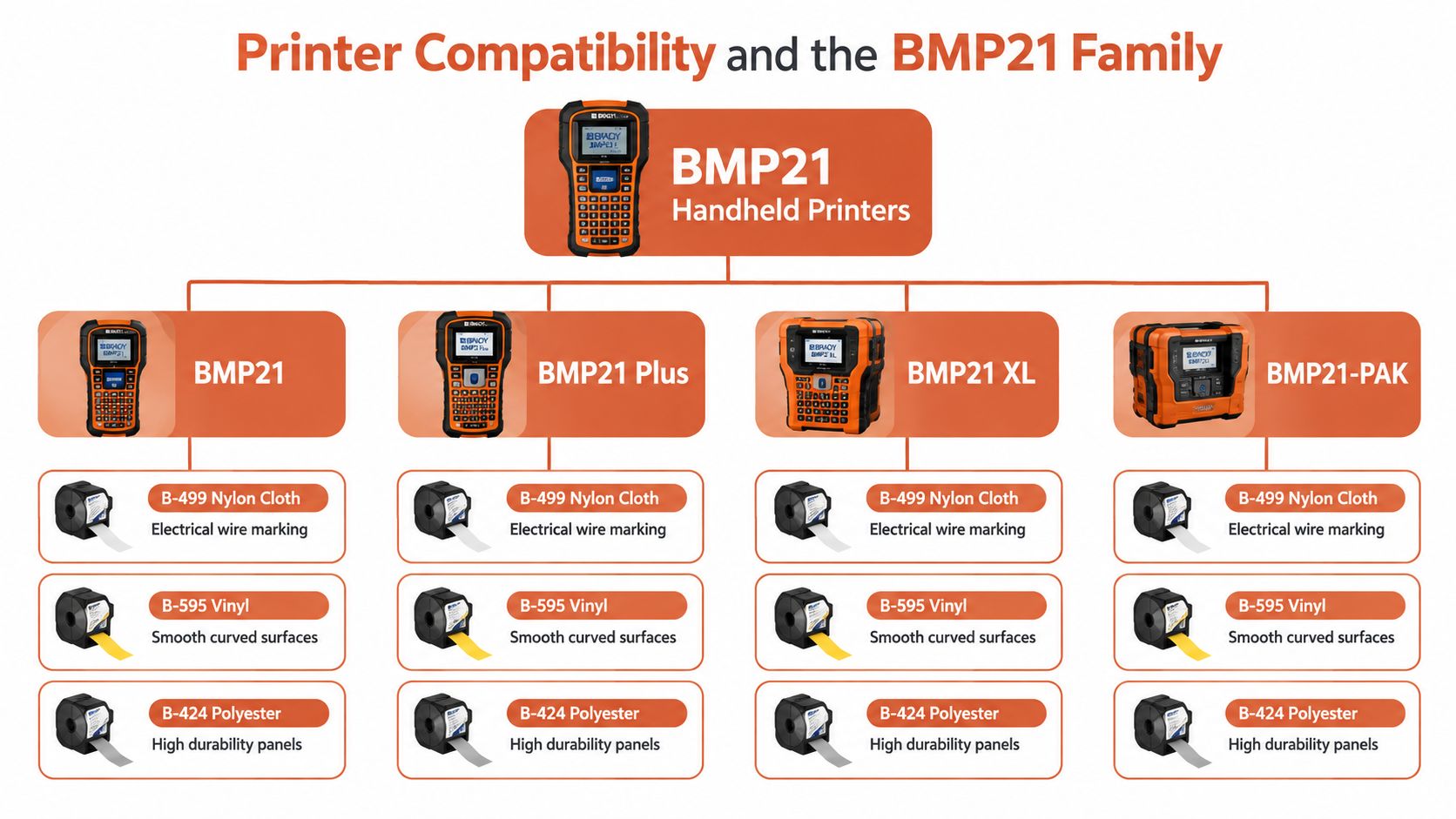
The M21-750-499 is designed for Brady BMP21, BMP21 Plus, BMP21-LAB, ID PAL, and LABPAL handheld printers. The manufacturer datasheet identifies those models as the published compatible printer family.
Match the handheld printer first
A field electrician using a BMP21 or BMP21 Plus typically needs fast wire, cable, and panel identification during installation or service. A panel shop may use the same family for terminal blocks, control-panel components, and retrofit documentation. The BMP21-LAB and LABPAL models serve labeling workflows where the material and printer combination must support laboratory or facility identification.
The important distinction is that printer compatibility and application suitability are separate checks. The label may be ideal for a curved cable jacket, but it still won't work if the printer uses another cartridge footprint. Conversely, a cartridge that physically fits may not provide the material or adhesive behavior required by the project.
Before approving an order, identify the exact printer model on the truck, in the panel shop, or in the maintenance crib. Don't assume that a Brady portable printer from another product line accepts this cartridge. The published compatibility is specific to the BMP21 cartridge family, not every Brady handheld or desktop printer.
For broader asset-identification workflows, Evright Industrial asset tag labeling solutions provide useful context on how printer and material selection changes with the identification task. Teams reviewing the printer, label stock, and field tools together can also use ATEK's tools and testing products as part of a wider equipment procurement review.
Typical Applications in Electrical and Industrial Work
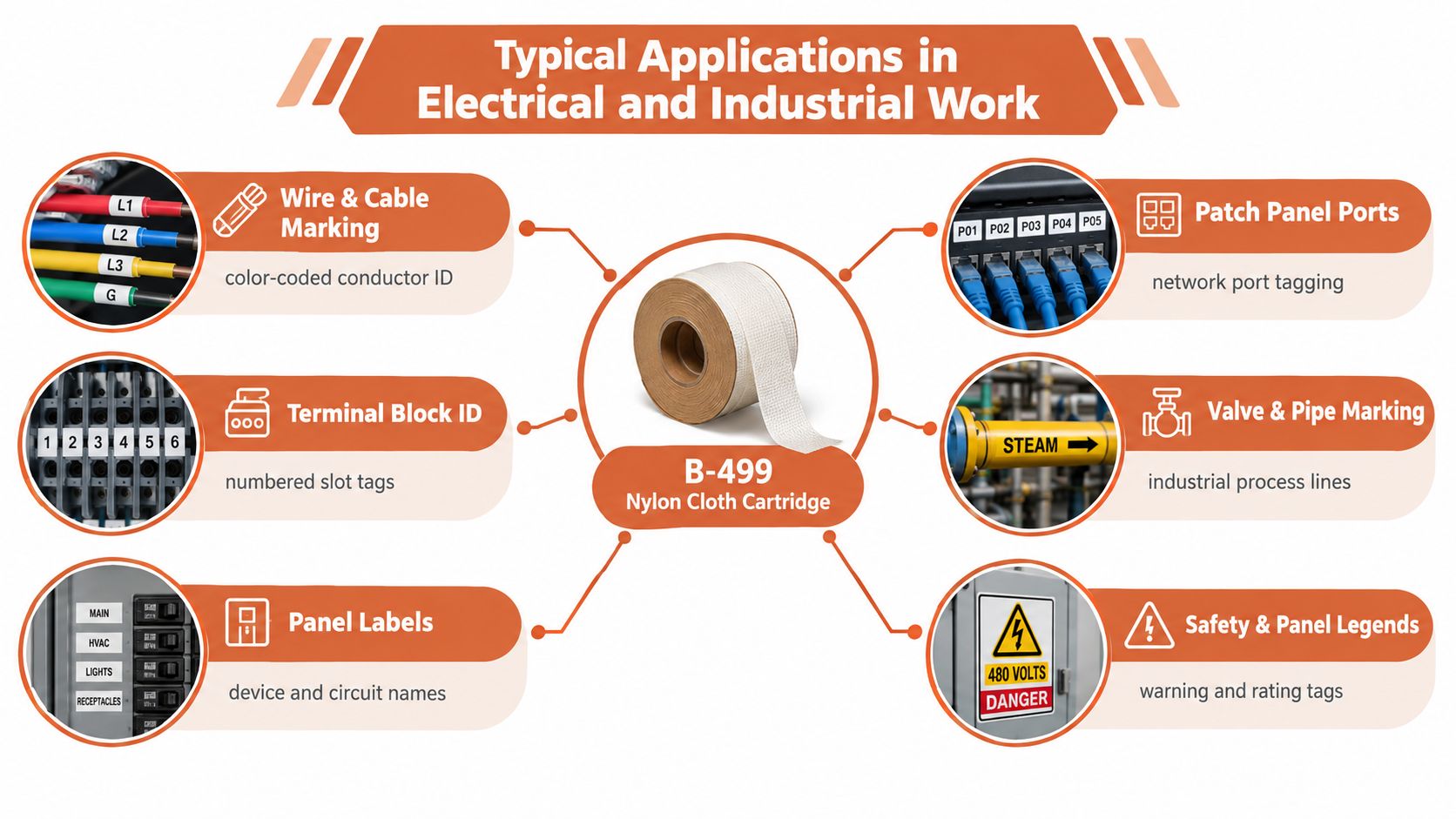
A field technician replacing a cable in a crowded panel needs an identifier that can sit close to the installation without becoming a rigid obstruction. B-499 nylon cloth is pliable, allowing it to conform around curved cable jackets and irregular surfaces. The Newark application description lists wire and cable marking, communications and voice/data identification, panel identification, laboratory identification, and general equipment labeling.
Where the material works well
- Wire and cable marking: Wrap or flag a printed identifier around a conductor or cable jacket where a rigid marker would be difficult to position.
- Terminal-block identification: Print terminal references during panel assembly, commissioning, and retrofit work.
- Control-panel labeling: Mark devices, circuit references, and equipment designations with a compact black-on-white legend.
- Voice and data systems: Identify communications cables, patch-panel connections, and related infrastructure.
- Laboratory and facility identification: Use the cartridge for handheld, continuous labeling workflows that match the documentation requirement.
- General equipment marking: Label suitable equipment surfaces after reviewing the substrate and service conditions.
A service technician may print only the identifiers required for one repair, while a panel builder may produce a repeatable sequence for terminal blocks and device references. Continuous stock supports both workflows and reduces the need to carry several pre-cut marker formats.
Application suitability still requires a site check. Confirm the surface, available clearance, label orientation, and expected handling before approving the cartridge for a specific job. Printer fit is a separate procurement check, so verify the cartridge family against the actual BMP21 printer before ordering substitutes.
For cable routing, identification, and installation planning, these cable management resources help teams assess the label alongside the supports, pathways, and accessories installed around it.
The following video provides additional visual context for handheld industrial labeling workflows.
Environmental Ratings and On-the-Job Performance
B-499 polyamide-coated nylon cloth is described as resistant to abrasion, chemicals, humidity, ultraviolet exposure, and weathering. Distributor data lists an operating temperature range of -40°F to 194°F, approximately -40°C to 90°C, as shown in the Elliott Electric product specification.
That profile makes the cartridge relevant to indoor panels, facility equipment, utility installations, and outdoor enclosures where ordinary paper labels can deteriorate. The material's low profile and pliability are also useful where the identification needs to sit close to a cable or conform around a curved jacket.
Read the rating as a boundary, not a blanket approval
A temperature range doesn't approve every installation. The engineering review should compare the stated product capability with the actual service temperature, exposure duration, substrate, cleaning chemicals, and printing conditions. A label installed on a clean indoor panel face has a different risk profile from one exposed to ultraviolet light, washdown, solvents, or repeated handling.
Substrate matters, too. Product data describes adhesion to surfaces including stainless steel, textured ABS, polypropylene, smooth surfaces, and powder-coated surfaces. That doesn't remove the need for surface preparation. Dust, oil, condensation, release agents, and rough contamination can reduce practical adhesion even when the substrate itself is listed as suitable.
Field observation: The label material and the installation surface have to be treated as one system. A strong adhesive can't compensate for a dirty, wet, or chemically incompatible surface.
For a governed project, retain the current manufacturer documentation and compare it with the equipment environment. If the application involves unusual solvents, sustained exposure beyond the listed conditions, or a high-consequence identification requirement, request technical confirmation instead of relying only on a distributor summary.
Cross-Referencing Equivalent Replacements
When M21-750-499 is out of stock, width and color are the usual starting points. They are not enough for approval. A replacement must match the application, printer interface, and material behavior, not just the finished label's appearance.
Use this checklist to screen alternatives:
| Attribute | Required Value | Verification Source |
|---|---|---|
| Width | 0.75 in, approximately 19.05 mm | Current manufacturer datasheet |
| Length | 16 ft, approximately 4.88 m | Current manufacturer datasheet |
| Print color | Black on white | Product label and technical data |
| Material family | B-499 polyamide-coated nylon cloth | Manufacturer material specification |
| Adhesive behavior | Permanent acrylic adhesive | Technical datasheet |
| Printer family | BMP21, BMP21 Plus, BMP21-LAB, ID PAL, or LABPAL | Printer and cartridge compatibility data |
A practical substitution sequence
- Identify the printer. Record the exact handheld model. A same-width cartridge may not fit or feed correctly if the printer is outside the BMP21 family.
- Confirm the label envelope. Compare width and continuous length with the BOM, print layout, and clearance around the conductor or component.
- Match the material. B-499 nylon cloth is not equivalent to vinyl or polyester merely because each can produce black-on-white labels.
- Review adhesive behavior. Confirm the adhesive type and check suitability for the project substrates.
- Check the application. Cable jackets, terminal blocks, and enclosure surfaces place different demands on the label.
- Verify approvals. Obtain current manufacturer-controlled documentation for any UL, CSA, RoHS, or other project-required compliance claim.
The manufacturer datasheet helps identify the part and intended printer family, but it should not replace a controlled substitution review. If a distributor calls an alternative “equivalent,” request a line-by-line comparison covering material, adhesive, dimensions, printer compatibility, and approvals. Newark listing for M21-750-499 can support part identification, while the approval decision should rest on current controlled documentation.
Procurement checkpoint: Do not approve a substitute from a photograph. Require the datasheet, confirm the printer model, and record why the material suits the installation.
A generic vinyl cartridge may suit a flat, clean surface if the project owner approves it. It does not automatically replace B-499 nylon cloth for cable wrapping, terminal-block work, or a specification that names the material. When stock is short, test the proposed cartridge in the actual printer and verify print placement before releasing it to production or field crews.
Comparing Nylon Cloth to Vinyl and Polyester Labels
B-499 nylon cloth is usually selected for conformability and electrical identification flexibility. Vinyl can be a sensible choice for smooth surfaces, while polyester may be preferred when durability and resistance to heat or chemicals dominate the decision. The correct substitute depends on the installation, not the label's color.
A vinyl label may work well on a flat panel face, enclosure door, or smooth equipment surface. It can be the wrong choice for flagging around a cable if its handling characteristics don't provide the same conformability or adhesion behavior as the specified nylon cloth.
Polyester is often considered for harsher industrial conditions where a more rigid film and stronger resistance profile are needed. That can make it a better engineering choice for demanding panels or solvent-exposed areas, but it may be less forgiving around small-radius cables and irregular surfaces.
The trade-off in plain terms
- B-499 nylon cloth: Pliable, low profile, matte, and suited to curved conductors, cable jackets, terminal blocks, and general electrical identification.
- Vinyl: Flexible and useful for many smooth-surface applications, but not automatically equivalent for cable wrapping or a governed material specification.
- Polyester: More rigid and often selected for high-durability environments, with the trade-off of reduced conformability in some cable-marking situations.
The best comparison starts with the substrate and exposure, then checks the printer. If the job involves a BMP21-family printer and curved cable identification, B-499 remains the direct baseline. If the job involves a flat panel and a different environmental requirement, an approved vinyl or polyester alternative may be more appropriate.
Compliance, Submittals, and Documentation
Product listings identify several compliance signals for M21-750-499, including UL recognition, RoHS compliance, and halogen-free performance under DIN VDE 0472 Part 815. One listing also cites CSA C22.2 No. 0.15-95. Those claims should be verified against current manufacturer-controlled certificates and datasheets before they appear in a formal submittal.
Treat the documentation as part of the purchase:
- Confirm the exact part number: Make sure the certificate or datasheet applies to M21-750-499 and its B-499 material.
- Check the project requirement: Determine whether the specification needs recognition, compliance, material declarations, or a specific approval.
- Retain controlled records: Keep the current manufacturer datasheet, distributor specification, and approved-submittal record with the project file.
- Document substitutions: Record the technical comparison and approval when the original cartridge is unavailable.
A distributor bullet point can help locate a product, but it isn't the same as project approval. Engineers and procurement teams should verify the applicable recognition details and confirm whether the completed labeling installation meets the governing equipment, wiring, or facility requirement. For related identification considerations, review the ATEK article on 2026 NEC arc-flash labeling requirements, then apply the requirements that govern the specific installation.
Quick-Reference Summary for Buyers
Keep this reference beside the quote request or BOM review.
| Item | M21-750-499 reference |
|---|---|
| Format | Continuous black-on-white nylon cloth |
| Width and length | 0.75 in by 16 ft |
| Material | B-499 polyamide-coated nylon cloth |
| Adhesive | Permanent acrylic |
| Printer family | BMP21, BMP21 Plus, BMP21-LAB, ID PAL, LABPAL |
| Primary uses | Wires, cables, terminal blocks, panels, voice/data, equipment |
| Environmental description | Abrasion, chemical, humidity, UV, and weather resistance |
Before placing the order, verify the exact printer, label width and length, B-499 material, adhesive behavior, application surface, environmental exposure, and required compliance documents. If the cartridge is short, compare replacements line by line instead of accepting a same-width tape as automatically equivalent.
Frequently Asked Questions About the M21-750-499
Can one cartridge serve multiple jobs?
Yes. Its continuous format lets operators print and cut labels as needed across wire, cable, panel, and terminal-block work.
How do I approve a non-Brady alternative?
Match the printer family, dimensions, material, adhesive, application, and required approvals. Obtain current technical documentation before approval.
How much should I reorder?
Base the quantity on the project label schedule, expected rework, and service stock policy. Don't estimate from cartridge appearance alone.
What if the BMP21 family is being phased out?
Confirm the installed printer fleet and evaluate the replacement printer and cartridge system together. A new printer may require a different cartridge family.
For availability checks, approved alternatives, or a procurement request that combines this cartridge with other electrical materials, contact a qualified industrial distributor before the stockout affects field work.
ATEK Distribution can help source M21-750-499, review the related BOM, and document technically appropriate alternatives when availability is limited. Visit ATEK Distribution to request sourcing support, product availability, or project-specific procurement assistance.