
The most common advice on Buy American Act compliance is the least useful one: check for a “Made in USA” label and move on. That shortcut might satisfy a casual buyer, but it won’t hold up when a contracting officer asks for component origin, delivery-period applicability, or proof that the product category was tested under the right rule.
For electrical contractors, that gap matters on every package that includes switchgear, transformers, controls, wire, lighting, enclosures, or fabricated assemblies. Compliance turns on the product-level evidence chain, not the marketing label, and the only safe way through it is to tie each line item to the clause, the bill of materials, and the supporting records.
Table of Contents
- Why a Made in USA Label Is Not Enough
- Calculating Domestic Content Thresholds
- Navigating Fragmented Funding Rules
- Building a Product-Level Evidence Chain
- Sourcing Strategies for Electrical Infrastructure
- Managing Nonavailability and Waivers
- Partnering for Compliant Procurement
Why a Made in USA Label Is Not Enough
A domestic label tells you where a product was assembled, not whether it clears the federal domestic-content test. Under Buy American Act compliance rules, that distinction is the difference between a submittal that passes review and one that gets kicked back for missing documentation.
Assembly and component cost are different tests
For most federally acquired supplies and construction materials, the governing test is based on domestic component cost, not just final assembly. The current rule structure uses more than 60% domestic components historically, 65% for items delivered during calendar years 2024 through 2028, and 75% for items delivered beginning in 2029. That staged change matters because a product that was acceptable on an earlier project may need new sourcing or better records for a later delivery date. Buy American Act domestic-content requirements
Practical rule: if the submittal package stops at the manufacturer’s country-of-assembly statement, the file is incomplete.
Electrical gear is where this gets messy fast. A switchboard or control panel can look domestic from the outside while still carrying components from multiple countries, and components of unknown origin are treated as foreign under the standard construction-material clause. That makes traceability a procurement issue, not just an engineering issue.
Why documentation has to follow the product
A single manufacturer letter rarely solves the whole problem. For complex electrical equipment, the buyer needs a record that connects the product, the component makeup, the delivery window, and the applicable contract clause. That’s also why guidance on navigating global compliance certification is useful here, because the compliance burden sits in the evidence trail, not the label.
If you’re reviewing a BOM for a federal project, treat every item as a question: what exact rule applies, what date does delivery occur, and what proof exists for the origin of the parts inside the product? That’s the level of detail auditors expect, and it’s the level that keeps submittals from stalling.
Calculating Domestic Content Thresholds
The test begins after the label check. For federal electrical work, the calculation changes with product type, and the first question is whether you are dealing with a general manufactured supply or a construction material with significant iron or steel content.
What belongs in the calculation
For electrical assemblies, the bill of materials matters more than the marketing sheet. Component cost can include transportation, duties, and allocable overhead under the federal framework, while final-product manufacturing cost does not. That shifts the result depending on how the supplier built the record and what it can support.
A panelboard can look straightforward until you break it into the parts that count. If the BOM shows domestic enclosure fabrication, but the breaker kits, buswork, harnesses, and control devices came from multiple sources, the percentage can move quickly once freight, duties, and other allowable component costs are included. A file that ignores those costs may understate the domestic share, while a file that pads the wrong items can fail the audit just as easily.
A compliant BOM is more than a parts list, it is a cost story tied to each component.
That is why procurement teams should review the product-level evidence chain, not just a manufacturer letter. The goal is to tie each line item to origin support, cost support, and the exact product delivered under the contract. On a federal submittal, that is the difference between a clean review and a stalled package.
Iron and steel need a separate check
Products consisting wholly or predominantly of iron or steel are tested under a different rule. Under the cited construction provision, foreign iron and steel must stay below 5% of the cost of all components used in that construction material. Construction material iron and steel rule
That is a narrower test than the domestic-component calculation used for other covered supplies and materials. The practical risk is mixing the two. A team can do the general percentage correctly and still miss the iron and steel rule if the assembly is treated like ordinary equipment instead of a covered construction material.
For contractors reviewing electrical gear, the safest approach is simple. Match the product to the clause, total the component costs with the right treatment for freight and duties, and keep origin records for every part that will be questioned in an audit. When a supplier cannot prove a component’s origin, treat it as a foreign component and correct the BOM before the submittal goes out.
Navigating Fragmented Funding Rules
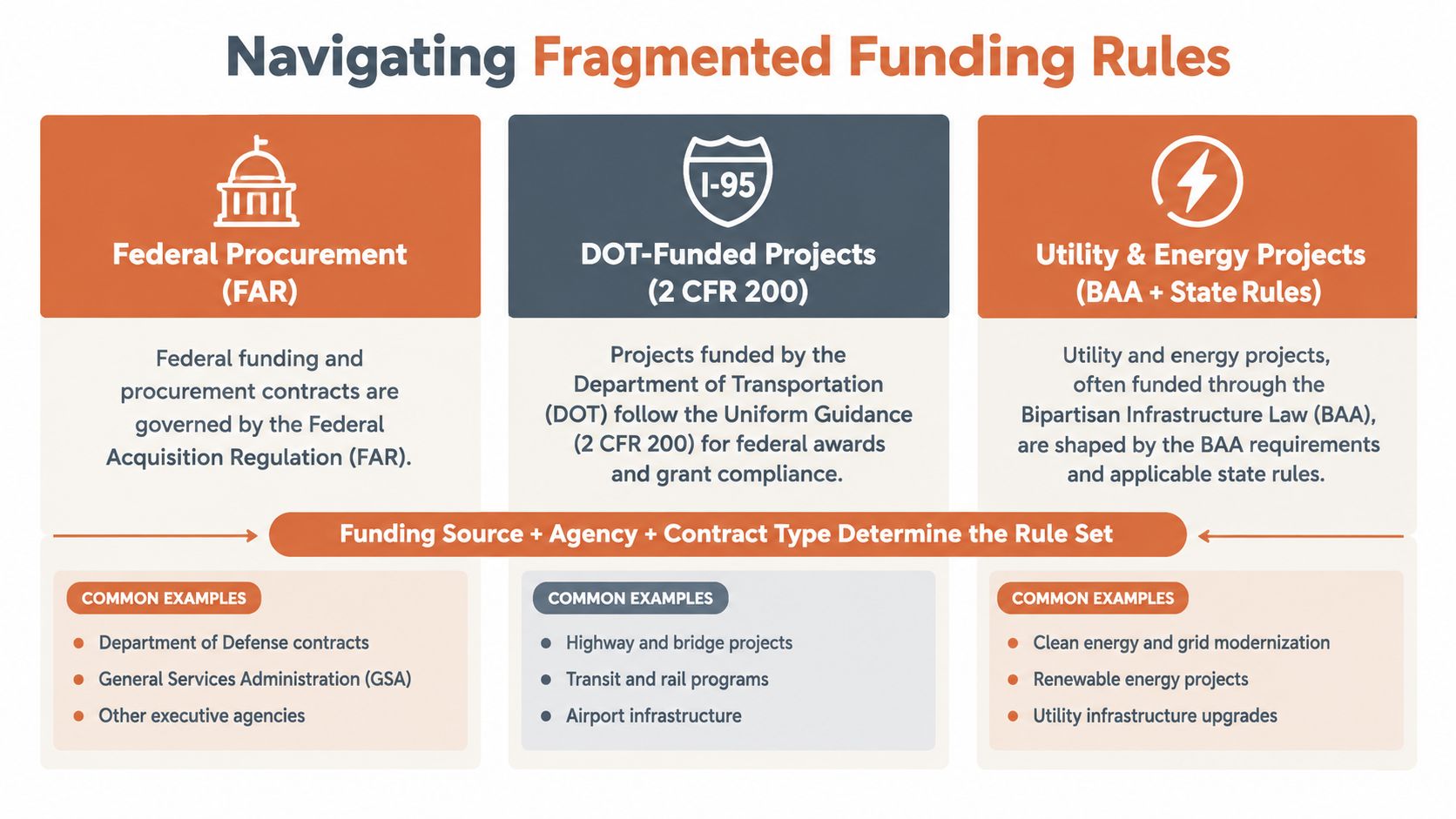
Buy American Act compliance is not one universal checklist. The rule set changes with the funding source, the agency, and the contract clause, which is why the wrong assumption can be more expensive than the wrong part number.
Three common frameworks buyers confuse
For direct federal procurement, the Federal Acquisition Regulation drives the domestic-preference test. For defense buys, the Defense Federal Acquisition Regulation Supplement adds its own treatment, including the way qualifying-country components can be counted with U.S. components for the ordinary domestic-content calculation and the separate rule for iron or steel content. DFARS component and iron/steel rules
For federally assisted infrastructure projects, the question changes again. The funding award, agency implementation, and waiver path can override whatever the supplier assumed from prior jobs, so older submittals can’t just be reused without checking the exact clause set. A useful external reference on related procurement compliance issues is American Additive Manufacturing on Section 889, especially for teams that already manage restricted-source review as part of their sourcing discipline.
The practical takeaway is simple: a domestic product can still fail if it’s matched to the wrong project rule. That’s why procurement teams should trace the award, the agency, the contract type, and any waiver language before they approve substitutions or release a PO.
Why project type changes the answer
A utility upgrade, a highway package, and a federal direct buy may all involve the same electrical product, but each can carry a different compliance path. That’s why a project file needs to show not just what was bought, but why that specific rule set applied.
Bottom line: the funding source decides the framework, not the catalog description.
For teams working across federal, state, and municipal projects, an authorized supplier relationship can help narrow the search space. One place to start is ATEK Distribution’s authorized GSA vendor information, especially when procurement teams need a vendor that can coordinate sourcing against federal purchasing requirements.
Building a Product-Level Evidence Chain
The strongest Buy American Act files are built line item by line item. If the evidence doesn’t follow the BOM, the package usually fails at the point where someone asks, “Show me how you proved this product qualified.”
Start with the item classification
The first move is to map each line item to its product category under the governing contract. A breaker, panelboard, lighting fixture, cable assembly, or steel enclosure can fall under different tests, and the wrong classification leads to the wrong documentation request. Once the category is fixed, the buyer can determine whether the item is a supply, a construction material, or part of a federally assisted infrastructure package.
Then collect the right records
Manufacturer attestations matter, but they’re not the whole file. The contractor still needs supporting records that connect the item to the submittal, the purchase order, and the applicable clause. For complex electrical assemblies, that usually means preserving cut sheets, origin statements, component-cost support when required, and any correspondence that confirms approved alternates or origin questions.
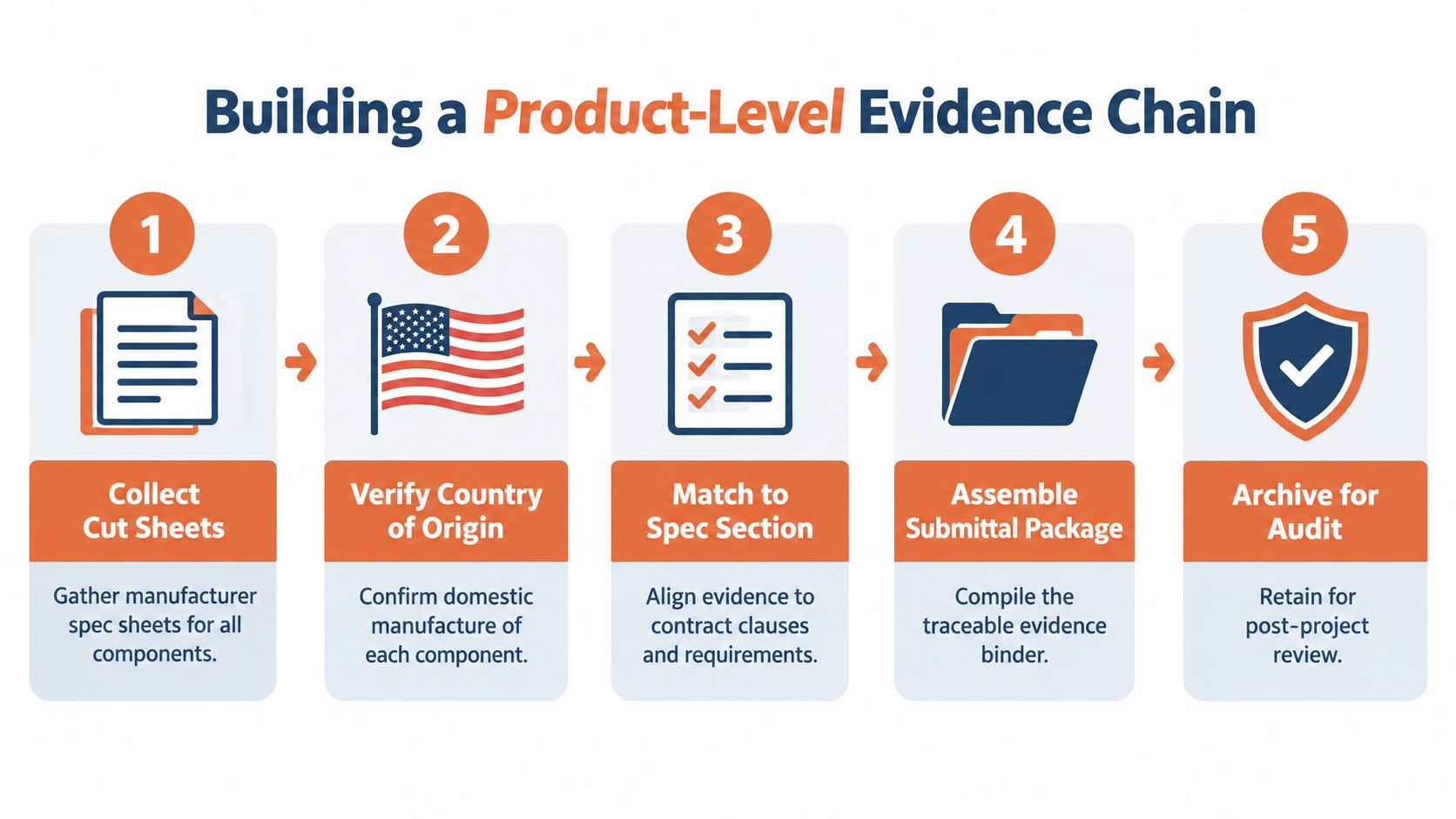
A practical sequence looks like this:
- Collect cut sheets, so the technical description matches the item on the BOM.
- Verify country of origin, component by component when the product is complex.
- Match to the contract clause, so the submittal uses the right rule set.
- Assemble the package, with traceable evidence tied to each line item.
- Archive for audit, because project teams rarely control when a review happens.
Keep the burden of proof where it belongs
Federal guidance places responsibility for documenting compliance on the manufacturer signing the certification, but that doesn’t remove the contractor’s recordkeeping risk. Recipients and contractors still need records that can survive agency review, especially on switchgear, transformers, cable assemblies, lighting, controls, and EV infrastructure assembled from globally sourced parts.
If the file can’t answer who made the component, where it came from, and which clause it satisfied, it isn’t ready.
For teams that need help turning a messy BOM into a procurement-ready package, ATEK Distribution can assist with product sourcing, manufacturer coordination, approved alternatives, and compliance documentation across electrical components, including circuit protection, distribution equipment, and lighting.
Sourcing Strategies for Electrical Infrastructure
Electrical infrastructure jobs usually slip on sourcing, not on the rule itself. The part was unavailable, the substitute was never vetted, or the compliance file was treated as an afterthought instead of part of procurement.
Treat COTS items carefully
Commercially available off-the-shelf items generally receive a waiver from the domestic-content test, but that waiver has a limit. A COTS product made wholly or predominantly of iron or steel does not get the same treatment, and COTS fasteners are specifically excluded from that limitation. For enclosures, supports, hardware, and similar electrical infrastructure items, material composition can change the compliance result even when the item looks standard. COTS rule and iron/steel limitation
Before approving a standard item, a buyer should check two things: whether it is COTS, and whether iron or steel predominates. If either answer changes, the clause review may change with it, and the product may no longer fit the original submittal.
Use alternates to protect the schedule
A qualified alternate can keep the project moving when the specified product is unavailable or the paperwork is thin. The best alternates are identified before the job reaches the field, not after installation has already been delayed. That usually means screening substitutions against the bill of materials, comparing like-for-like items, and keeping the number of separate compliance packages under control.
For lighting packages, see ATEK’s guide to BAA-compliant LED products before approving substitutes. For broader electrical packages, ATEK Distribution is one example of a sourcing partner that can help with alternate screening and consolidation when the team needs to keep procurement orderly.
Source selection should make the audit file easier, not harder.
A tighter sourcing strategy gives procurement teams a cleaner submittal, fewer mismatched part numbers, and less time spent chasing missing attestations after material release.
Managing Nonavailability and Waivers
A domestic part that doesn’t exist in sufficient commercial quantity is a real procurement problem, not a paperwork inconvenience. The mistake is treating nonavailability like a brand preference issue, when federal rules care about whether an acceptable domestic supply exists for the class of item being acquired.
The exception is narrow on purpose
The Buy American Act includes a nonavailability exception when products or components of the required class or kind aren’t mined, produced, or manufactured in the United States in sufficient and reasonably available commercial quantities and satisfactory quality. That means the question is broader than a preferred part number. It’s about whether a technically acceptable domestic source exists at all for the item class. Nonavailability exception guidance
For hard-to-source electrical components, the contracting officer has to apply the exception or waiver process, not just the distributor or end user. That’s important on breakers, fuses, controls, and distribution devices, where a procurement team may find plenty of substitutes but no compliant domestic source for the exact class.
How to document the problem
A defensible file usually starts with market research, then moves to technically acceptable alternates, and then to the approval path. Recent infrastructure rule changes make this even more project-specific, because older waiver assumptions can’t be reused automatically. For example, FHWA’s general waiver for manufactured products on federal-aid highway projects ended effective March 20, 2025, and FEMA maintains separate waiver paths for nonavailability and unreasonable cost, plus limited tribal exceptions on specified schedules. FHWA waiver changes and FEMA waiver paths
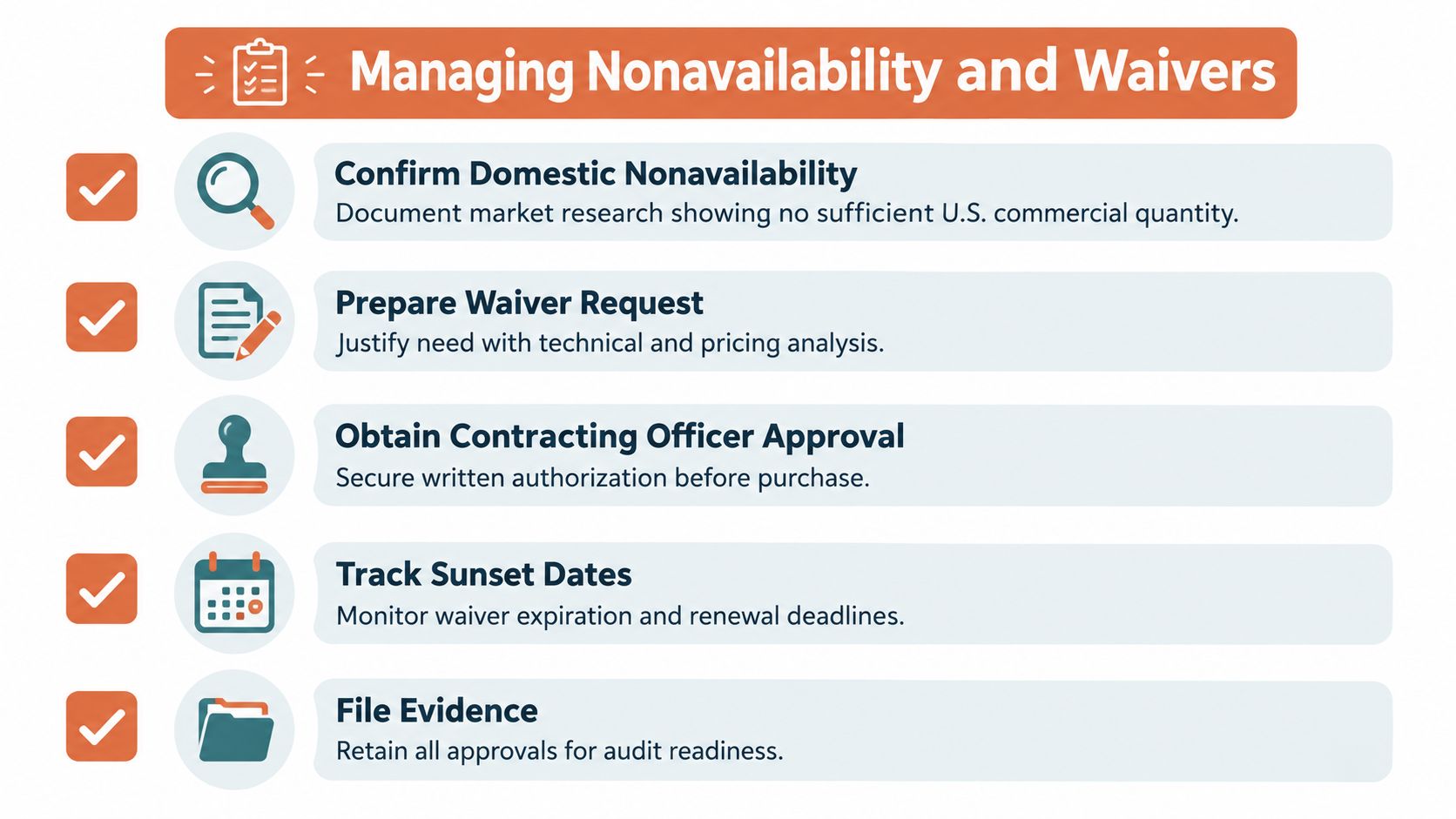
A practical response is to keep the waiver packet focused on facts:
- Confirm domestic nonavailability with documented market research.
- Compare technically acceptable alternates rather than only preferred brands.
- Route the request through the contracting officer before purchase.
- Track expiration dates if a waiver is time-bound.
- File every approval with the submittal and PO records.
When a project team handles this early, it avoids last-minute substitutions that blow up the submittal schedule. That’s especially true on electrical work, where the wrong replacement can create coordination issues, lead-time surprises, or installer confusion in the field.
Partnering for Compliant Procurement
The fastest way to slow down a federal electrical project is to treat sourcing and compliance as separate tasks. When procurement, engineering, and submittal review happen in silos, teams spend more time fixing documentation than installing equipment.
Make compliance part of the sourcing workflow
Specialized electrical distributors can reduce that friction by screening line items early, checking product categories against the applicable clause, and identifying approved alternates before a PO is issued. That matters on mission-critical jobs, where a missing origin statement or mismatched BOM can hold up a breaker, panelboard, or lighting package at the exact moment the schedule has no slack.
For teams that need a structured source of help, Where Contractors Source Electrical Equipment is one place to evaluate how a distributor fits into the procurement process. The goal isn’t just finding inventory, it’s reducing the administrative drag that follows a noncompliant submittal.
Good procurement support shortens the path from spec to install.
A partner that can coordinate manufacturer documentation, propose acceptable alternates, and consolidate materials gives contractors a cleaner route through submittals and audit review. That’s the practical advantage on federal work, where the product has to perform and the paper has to hold up.
If your next federal project needs Buy American Act compliance support, BOM review, or help sourcing hard-to-find electrical components, contact ATEK Distribution early in the buyout process. Visit ATEK Distribution to request sourcing assistance, product documentation, or alternate evaluations before the job gets tied up in submittal delays.