
You're usually not looking up PEX-A pipe support because the easy parts of the job are going well. You're looking because a long run is starting to belly between joists, an exposed corridor needs straighter lines, or an inspector wants to know exactly what support method you're using. That's where support stops being a minor accessory and becomes part of the system design.
PEX-A gives you speed and flexibility, but that flexibility cuts both ways. If you treat it like copper and hang it as an afterthought, it can sag, wander, rub, and telegraph every shortcut in the installation. If you support it correctly, it stays aligned, moves where it should, and looks intentional instead of improvised.
The trade mistake is thinking support is only about passing inspection. Code spacing matters, but it's only the floor. The better question is what kind of support keeps the pipe straight, protects fittings, manages movement, and fits the setting. A home run in a basement ceiling doesn't need the same strategy as a visible domestic-water main in a hospital corridor or a long hydronic run above a corridor grid.
Table of Contents
- Introduction to PEX A Pipe Support and Why It Matters
- How PEX A Pipe Support Works and Key Terminology
- Types of PEX A Pipe Supports and Clips Explained
- PEX A Support Spacing Requirements for Horizontal and Vertical Runs
- Continuous Support Channel Systems for Longer Spans
- Installation Best Practices for Secure and Movement Friendly Support
- Fire Ratings Insulation and Adjacency Considerations
- Quick Reference Lookup Cross References and Related Resources
Introduction to PEX A Pipe Support and Why It Matters
A crew can rough in PEX-A fast, pass the pressure test, and still leave behind a run that looks loose once the system heats up and settles. The call-back usually comes from the exposed work. A basement main starts to belly between supports, a corridor run waves under the lights, or a riser shifts enough at a floor penetration to make the whole installation look unfinished.
Support decides more than whether the tubing stays off the ceiling tile. It affects line straightness, thermal movement, fitting load, noise, and how the finished work reads to an owner or inspector. With PEX-A, that matters because the material is flexible by design. Good support uses that flexibility where it helps and controls it where it hurts.
Code spacing gets you compliance
Standard hanger spacing is the starting point for ordinary runs, and in a lot of concealed residential work, that is all you need. If the tubing is protected, the spans are short, and appearance is not part of the job, conventional support at code-accepted intervals will usually pass and perform fine.
Problems show up when installers treat that spacing rule as the whole design. A run can meet the minimum and still droop, snake sideways, or move enough with temperature change to telegraph every hanger location. That is not a code failure. It is a performance and appearance failure.
The real choice is standard support versus controlled support
For short branch lines and home runs above a framed ceiling, regular hangers or approved plastic suspension clips are often the right answer. They install fast, cost less, and allow the tubing to move naturally.
For long visible mains, mechanical room headers, corridor runs, and other exposed work, continuous support channel changes the result. It gives PEX-A a straighter profile, closer to what people expect from copper, while still letting the tube expand and contract in a controlled way. That improves the look of the installation and reduces the tendency for the pipe to dip between points or pull awkwardly at fittings.
That trade-off matters on real jobs.
Where support selection pays off
A few conditions usually justify more thought up front:
- Exposed runs: Straightness becomes part of the finished workmanship.
- Long horizontal mains: Standard spacing may pass inspection but still leave visible sag.
- Risers and floor transitions: Better control keeps the pipe aligned through penetrations and near supports.
- Warm-water and hydronic piping: Thermal movement is more noticeable and needs room to happen without noise or side loading.
Plumbers look at support one way. Specifiers look at it another. Owners usually notice only when the pipe looks crooked.
The best support method matches the run. Use standard hangers where they are enough. Use continuous support where the job calls for a straighter line, better movement control, or a finish that does not look like an afterthought.
How PEX A Pipe Support Works and Key Terminology
PEX-A support isn't one device. It's a group of parts that each do a different job. If you mix up those jobs, the installation may hold pipe in place while still creating stress, noise, or poor alignment.
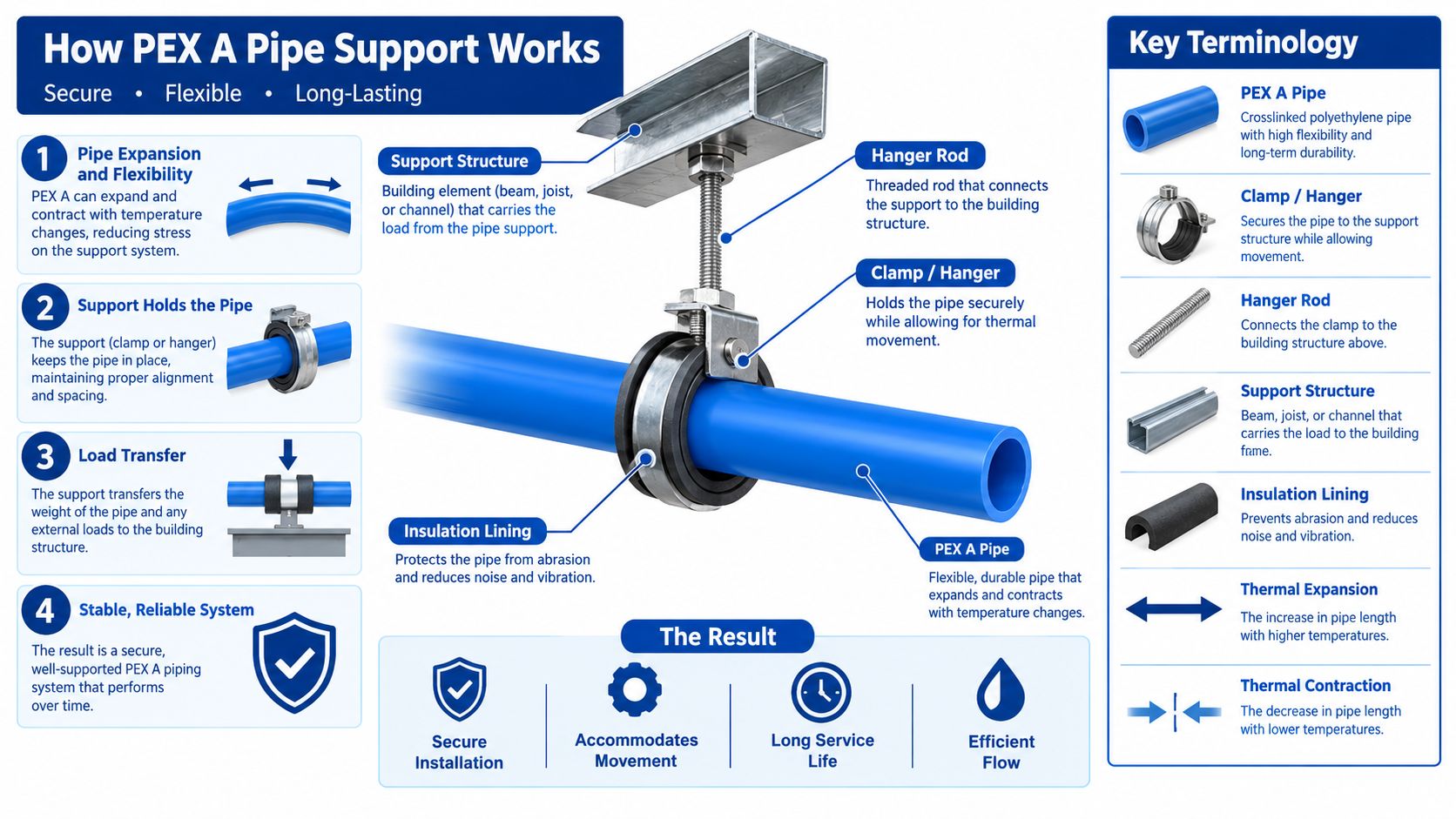
The basic terms that actually matter on site
A support carries the pipe's weight. That can be a clip, clamp, hanger, bracket, or channel assembly. Its first job is load.
A hanger suspends the pipe from structure. Clevis hangers and loop hangers are common examples overhead. Hangers hold the pipe up, but depending on how they're installed, they may either allow movement or fight it.
A clamp grips the pipe more directly. Some clamps are meant to locate tubing in framing or on strut. Others are meant to hold position more firmly. Clamp selection matters because too much grip can prevent the tubing from moving as it expands and contracts.
A guide keeps the pipe tracking in a controlled direction while still allowing axial movement. In practice, a guide is what helps a long run stay orderly rather than wandering side to side.
A fixed point is where you intentionally restrain movement. That's important near valves, at direction changes, and at terminations. A support system that has lots of hangers but no real fixed-point strategy can still let the system push load into the wrong place.
A continuous support channel is different from isolated clips or hangers. It backs the pipe along a longer length rather than only at selected intervals. That changes deflection, appearance, and how the run behaves.
Why PEX-A support is not the same as copper support
PEX-A is flexible by design. That makes it easier to route, especially in framed walls and overhead spaces with obstacles. It also means the pipe responds more visibly to heat, gravity, and support spacing than rigid metallic pipe.
That difference changes your support logic:
- Copper thinking: Hold line and elevation with rigid spacing and the pipe largely stays there.
- PEX-A thinking: Support the load, allow planned movement, and control the shape of the run.
A support that's too tight can be as wrong as one that's too far apart.
In a domestic water layout, a clip at a framing member may be enough to keep a branch organized. In a hydronic main overhead, that same clip pattern may leave the run looking loose. In other words, the same tubing may need a different support strategy depending on where it lives and how visible it is.
Types of PEX A Pipe Supports and Clips Explained
There isn't one universal support for PEX-A. The right choice depends on whether the run is concealed or exposed, whether movement needs to be guided or restrained, and how much rigidity the finished work should show.
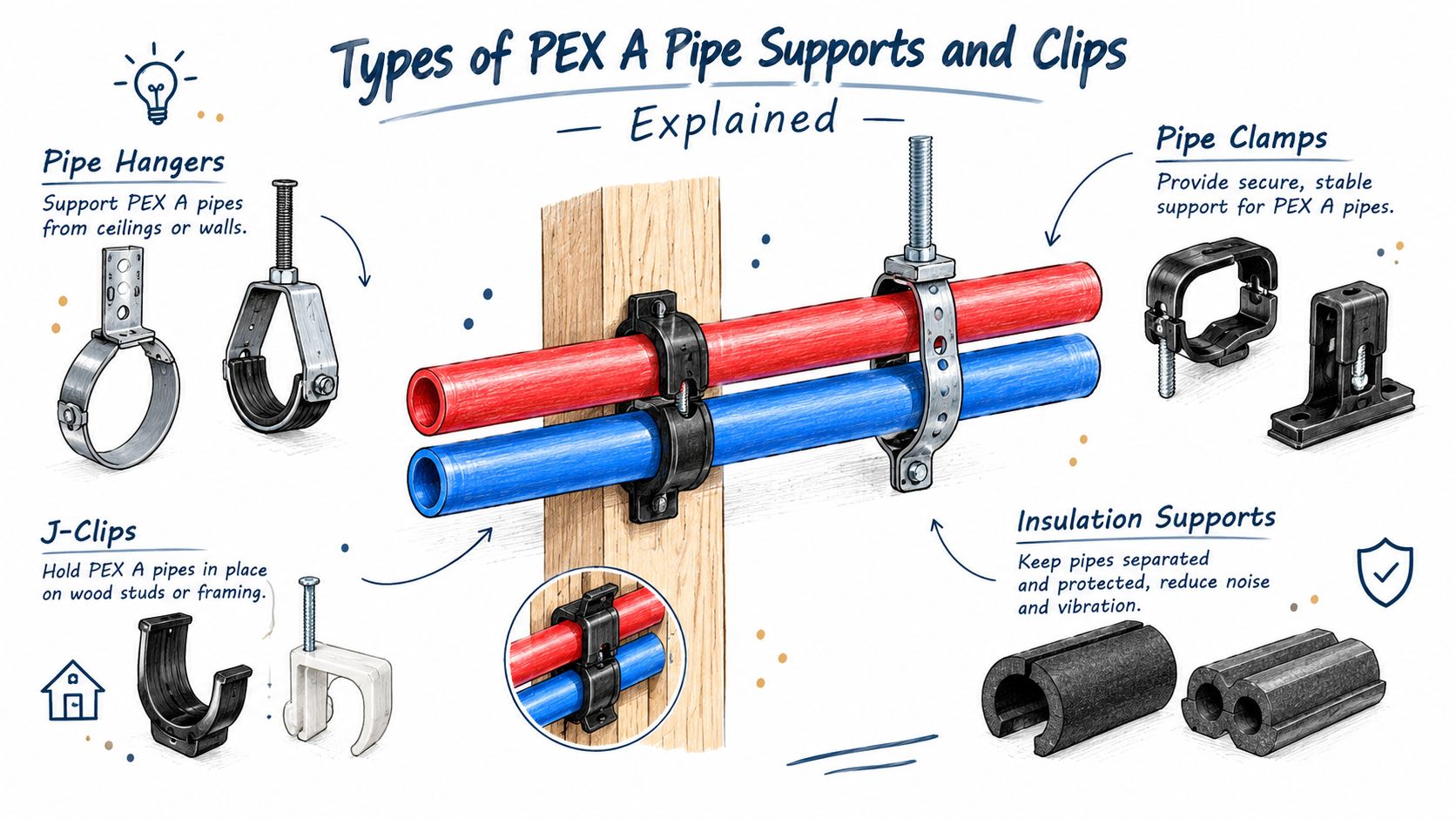
Snap clips and simple framing supports
Plastic snap clips are common for branch lines and organized tubing runs in wood or light-gauge framing. They're fast, inexpensive, and good at keeping spacing tidy in concealed work.
They're not what you use when you want the pipe to look rigid. They also need to be selected carefully so the tubing isn't pinched or forced against rough edges.
Cushioned clamps and metal restraints
Metal clamps with cushioning are useful where the pipe needs a cleaner hold or where vibration and contact noise are concerns. These show up in mechanical spaces, utility rooms, and transitions where tubing comes off equipment or enters more structured support assemblies.
They work well when you need a more intentional mounting point. They work poorly when someone overtightens them and turns the clamp into a brake.
Clevis and loop hangers overhead
For overhead work, clevis and loop-type hangers are familiar hardware and still useful with PEX-A when they're sized and arranged correctly. They help with suspension from rod and strut assemblies and make sense in shared support systems.
Their limitation is appearance and control over long straight runs. A suspended run on isolated hangers can still look uneven even when it technically meets spacing.
Strut-mounted supports and trapeze style assemblies
When a job has multiple parallel lines, strut starts making sense. It gives you a repeatable support plane, cleaner alignment, and easier coordination with other trades. It also makes future changes less painful because the support path is already there.
For support hardware and related mounting options, contractors often source through suppliers that handle broader fasteners and hardware inventory. That matters most when pipe support has to coordinate with framing, anchors, strut, rod, and attachment points from the same package.
Continuous galvanized support channels
PEX-A behaves more like a deliberately aligned system than a flexible tube hanging in space. A continuous support channel carries the tubing along its run, cuts down visible sag, and gives exposed work a much straighter line.
Use it when appearance matters, when spans are longer, or when you need better control of geometry near fittings and mains.
Quick selection cues
- Concealed residential branches: Snap clips or simple tubing supports are usually enough.
- Mechanical room transitions: Cushioned clamps help with control and contact protection.
- Parallel overhead runs: Strut-mounted supports keep the layout orderly.
- Exposed commercial mains: Continuous channel is often the cleaner choice.
- Near valves and changes in direction: Think restraint and fixed-point logic, not just hanger count.
If the support hardware makes the pipe look accidental, it probably isn't the right support for exposed work.
PEX A Support Spacing Requirements for Horizontal and Vertical Runs
A run can pass rough inspection at standard hanger spacing and still look loose by finish day. That happens all the time with PEX-A on long horizontals, especially where the piping stays exposed and the owner expects straight lines instead of soft dips between clips.
For baseline support intervals, use the common PEX benchmark noted earlier in this article: horizontal runs are typically supported at 32 inches on center for 2 inch and smaller tubing, and vertical runs at 10 feet on center for 2 inch and smaller tubing. Separate code-acceptance guidance also recognizes 10 foot vertical spacing with a mid-story guide for those sizes (Plastic Pipe Institute code acceptance guidance).
Another installation reference notes a similar pattern: 32 inches is a common horizontal limit for 1 inch and smaller, some larger diameters may be permitted at wider intervals depending on code, and vertical runs often call for support at floor levels plus a mid-story guide (PEX plumbing design and installation guide excerpt).
Standard PEX support spacing by orientation
| Orientation | Pipe Size | Maximum Spacing | Notes |
|---|---|---|---|
| Horizontal | 2 inches and smaller | 32 inches | Common benchmark for standard point supports |
| Vertical | 2 inches and smaller | 10 feet | Confirm whether a mid-story guide is required |
| Horizontal | 1 inch and smaller | 32 inches | Common benchmark in design guidance |
| Horizontal | Larger diameters | Varies by code and size | Verify the listing, manufacturer instructions, and local code |
| Vertical | Riser applications | Floor-level support plus mid-story guide | Common method for riser control |
Those numbers answer the inspection question. They do not answer the performance question.
On concealed residential branches, 32 inch hanger spacing is usually fine. The tubing is out of sight, the runs are shorter, and a little natural sweep between supports does not create a service problem. On an exposed basement main, overhead corridor run, or mechanical room distribution header, the same spacing often leaves the line looking wavy. That is not a code violation. It is still poor-looking work.
Inspectors usually check four things first:
- Support spacing
- Proper securement at the run
- Compatibility with the pipe and support hardware
- Compliance with the approved installation method and local code
Owners, maintenance staff, and other trades notice something else. They see sag between hangers, fittings pulled slightly out of line, movement at valves, and tubing that rubs framing or duct supports when hot water cycles through.
That is the trade-off. Standard hangers are often enough to meet minimum spacing rules. Continuous support becomes the better choice when you want the run to stay straighter, control thermal movement better, and read more like rigid piping.
A practical field check helps. Look at the run and answer these questions before laying out hangers:
- Is the piping concealed or exposed?
- Is the run short and broken up, or long and uninterrupted?
- Are there valves, branches, or transitions that need alignment control?
- Will thermal expansion make the tubing snake or rub if it hangs only at intervals?
If the run is concealed and ordinary, standard spacing is usually the right answer. If the run is exposed and expected to look organized, minimum spacing is only the starting point.
Local code, the pipe manufacturer, and the support system listing still govern the final layout. On site, the best support pattern is the one that passes inspection, keeps the tubing free to move where it should, and keeps the finished run straight enough that nobody asks why it looks like it was added later.
Continuous Support Channel Systems for Longer Spans
When people want PEX-A to look straighter and behave more like a rigid piping system, continuous support channel is usually the turning point. This is the method that changes the conversation from “How many hangers do I need?” to “How do I want this run to perform?”
An authoritative installation guide for PEX-A describes a 23-gauge galvanized-steel horizontal support channel and states it allows a maximum horizontal span of 8 ft for 3 in nominal and smaller piping, with 1-1/2 in and smaller fittings supported within 12 in. The same guide states that vertical PEX-A piping should be supported every 5 ft in-wall and at the base of each floor for risers (Uponor PEX hydronic piping support guidance).
What the channel actually changes
A continuous channel spreads support along the run instead of forcing the tubing to bridge from point to point. That does a few useful things at once:
- Cuts visible deflection
- Keeps fittings better aligned
- Produces cleaner parallel runs
- Makes exposed work read more like planned piping than flexible tubing
For long commercial corridors, hydronic mains, and visible domestic-water distribution, that difference is easy to see. It also helps in congested overhead spaces where keeping geometry consistent matters.
What it does not replace
Continuous support channel is not a free pass to ignore restraint design. The same guidance notes that clamps and fixed points still have to follow the PEX design and installation manual. In plain language, the channel supports the run, but it does not replace system control at changes in direction, valves, or terminations.
That's where some installations go wrong. The pipe is beautifully straight in the middle and poorly restrained at the ends. Then movement shows up where the system is most vulnerable.
For related support infrastructure in mixed-trade overhead systems, many teams also coordinate with suppliers handling conduit, raceway, and cable support products. The overlap is practical. Shared strut, trapeze support, and coordination space often affect how plumbing support can be laid out cleanly.
When to specify channel instead of isolated hangers
Choose continuous channel when:
- The run is long enough that standard spacing will telegraph sag
- The pipe stays exposed after turnover
- The layout needs copper-like visual discipline
- The job has repeated mains where consistency matters
Use isolated hangers when the run is short, concealed, or not appearance-sensitive. Channel isn't mandatory everywhere. It's just the better answer in the wrong places for ordinary clips and hangers.
Installation Best Practices for Secure and Movement Friendly Support
A PEX-A main can be fully within hanger spacing and still look bad or move badly after startup. I see it on jobs where the pipe was supported often enough to satisfy the spacing table, but the run still waves between hangers, rubs a stud edge, or shoves thermal movement into a valve body because the supports were installed with no plan.
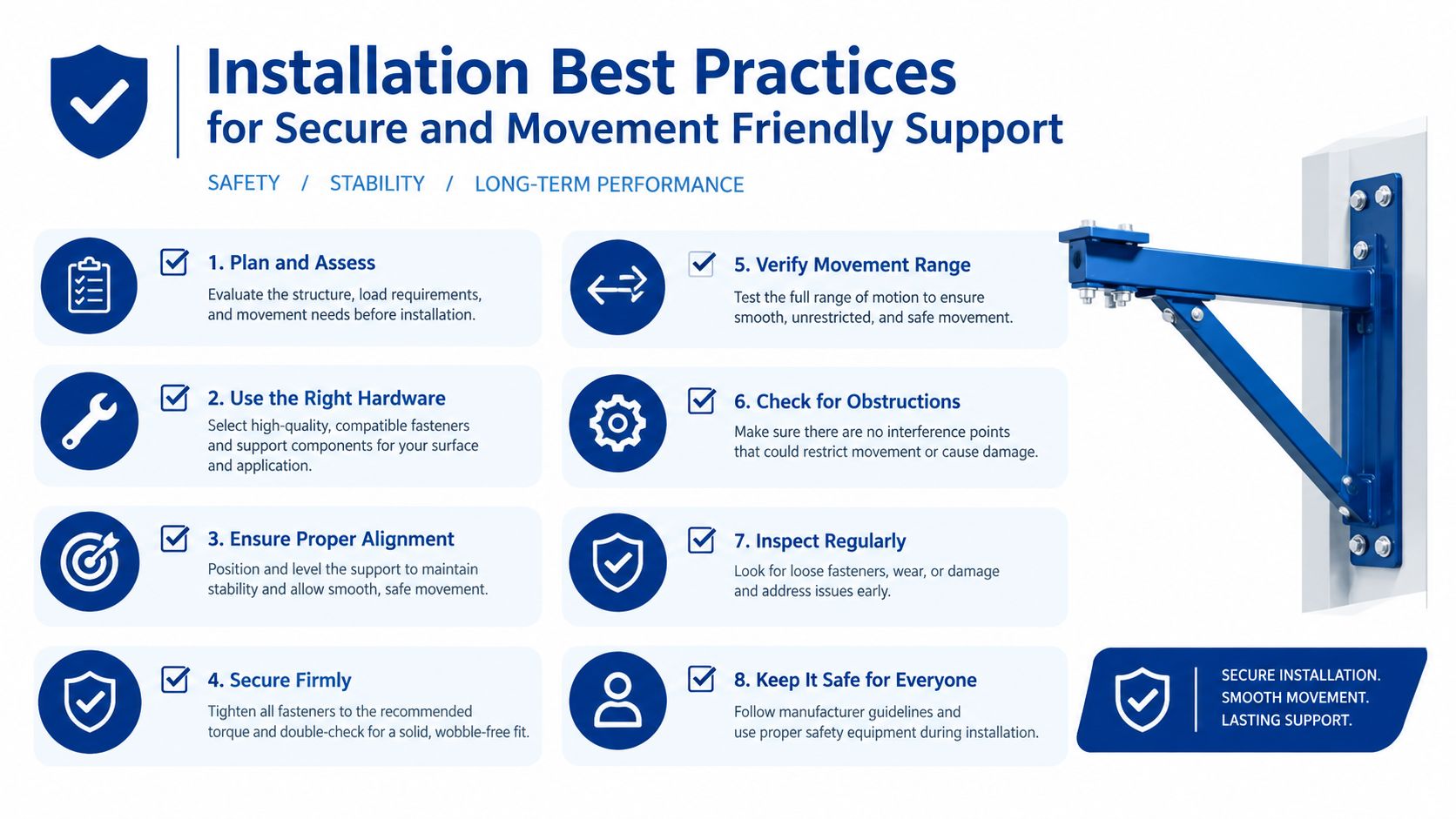
What good support installation looks like
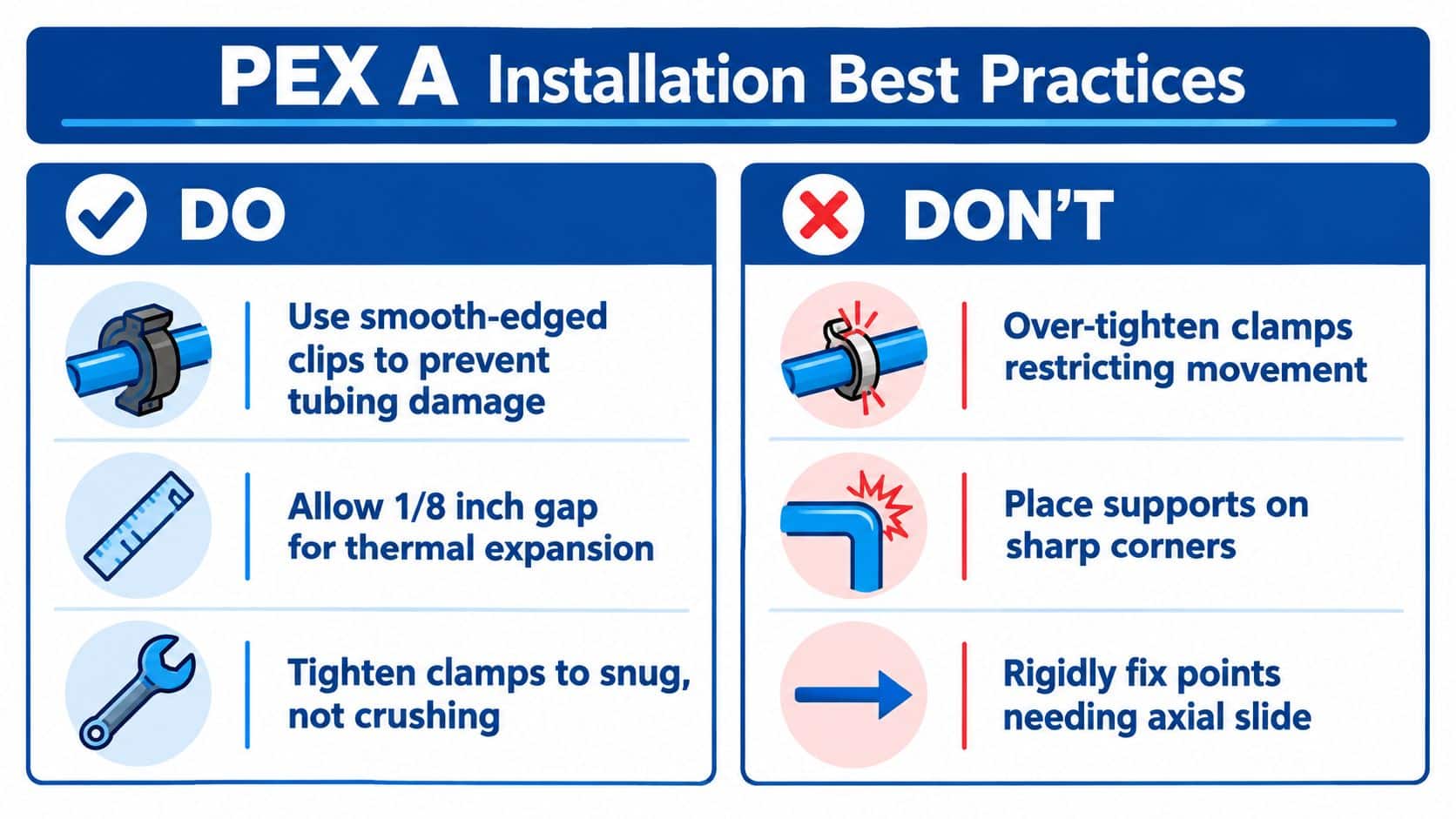
Good support does two jobs at once. It carries the weight of the tubing and water, and it lets the pipe move where the system is supposed to move. Manufacturer guidance is clear on the basics. Supports need to allow free tubing movement and avoid contact points that can nick, cut, or wear into the pipe over time.
That matters whether you are using standard hangers at code spacing or a continuous channel under a long exposed run. Standard hangers are often enough in short concealed runs where appearance is irrelevant and movement is modest. Continuous support earns its keep where the pipe stays visible, where a long main would telegraph sag, or where the owner expects the run to stay straight like copper.
A few field rules make the difference:
- Wood framing: Drill clean holes, sleeve or protect penetrations where required, and avoid clips that flatten the tubing.
- Metal studs: Treat every cut edge as a potential abrasion point. Use isolating bushings or support components that keep the tube off sharp steel.
- Masonry and concrete: Anchor to structure with hardware sized for the load, then use supports that cradle the pipe instead of pinching it.
- Strut and trapeze: Set the supports in line before snapping in the tube. A straight support layout produces a straight run.
Common mistakes that create callbacks
The usual callback is not an immediate leak. It is noise, a crooked exposed line, a rubbed spot, or a fitting area that takes movement it should never have seen.
These are the misses that show up later:
- Clamps tightened hard against the tube: The pipe cannot slide, so expansion gets pushed to fittings, branches, and changes in direction.
- Hangers with narrow or rough contact points: The pipe may pass test and still wear during normal thermal cycling.
- No support strategy near valves and heavier components: The tubing ends up carrying weight that should be transferred to structure.
- Supports installed by convenience instead of alignment: The run wanders, especially in open ceilings where every offset is visible.
Support the run where it needs control, not only where structure is easy to hit.
One simple check catches a lot. Sight down the run before test and before insulation. If it already has dips, doglegs, or side load at a fitting, fix it while everything is open. PEX-A will not straighten itself after the ceiling closes.
Match the support method to the result you want
If the goal is only to meet minimum spacing, isolated hangers may be enough. If the goal is a straight exposed main that moves in a controlled way and still looks disciplined at turnover, treat support as a performance and appearance decision. That usually means better alignment, better guidance at penetrations, and in some cases continuous support instead of point supports alone.
Crews also need to work safely while drilling overhead, setting anchors, and laying out trapeze or strut. A practical OSHA checklist for overhead fastening and support work helps cover the basics before the job turns into ladder, lift, and anchor work.
The cleanest installations come from crews who know which supports are carrying load, which supports are guiding movement, and where restraint has to occur so the pipe stays straight and the fittings stay out of trouble.
Fire Ratings Insulation and Adjacency Considerations
A PEX-A run can be perfectly spaced and still fail the job if it crosses a rated corridor, crowds a can light, or gets pinned hard against another service in the ceiling. I see that on remodels all the time. The tubing is supported, but the assembly around it was never checked.
Fire rating and listing conditions can change what support method is acceptable. As noted earlier in the manufacturer literature, some ASTM E84 use conditions depend on insulation at unsupported pipe or fittings, and the relaxed separation rules for parallel runs apply only when those conditions are met. That is not a detail to sort out after the run is already hung.
Why support decisions change in crowded ceilings
Open joist bays are forgiving. Rated chases and mixed-trade plenums are not.
In those spaces, support choice affects more than spacing compliance. It determines whether the tubing can hold its route, stay off heat-producing components, avoid abrasion at contact points, and maintain whatever insulation or assembly condition the listing calls for.
That matters with recessed lighting, vent connectors, duct takeoffs, cable tray, and access panels. PEX-A needs room to move with temperature change, but it also needs controlled position. If the run snakes between other trades on loose point supports, it can drift into a bad adjacency even though every hanger is technically present.
Continuous support helps, but it does not override the assembly
The performance-versus-appearance decision gets practical. Standard 32-inch hanger spacing is often enough for concealed utility piping where the main goal is code compliance and basic control. In exposed work, crowded ceilings, or rated routes where the pipe needs to stay exactly where it was designed, continuous support channel can do a better job of keeping the run straight and limiting side-to-side wander.
That extra control helps preserve clearance to nearby systems. It also gives the finished run a more disciplined look. But continuous support does not cancel fire-resistance or listing requirements. If an assembly calls for insulation, minimum separation, or specific treatment at penetrations, the straighter support method still has to follow those rules.
What to check before the ceiling closes
On site, I check four things before signing off on support in rated or congested areas:
- whether the fire-resistance or flame-spread condition requires insulation at exposed or unsupported sections,
- whether nearby fixtures or piping create heat or clearance problems,
- whether the support method keeps the tubing guided without hard rubbing,
- and whether the run will stay in place after insulation, other trades, and test conditions put it under load.
A neat run that ignores fire, insulation, or adjacency rules still fails inspection. A run that meets spacing but looks sloppy in open view is also a missed opportunity. Good support work does both. It protects the assembly and keeps the piping straight enough to look intentional.
Quick Reference Lookup Cross References and Related Resources
For quick field use, the decisions usually boil down to three checks. First, determine whether you're working from standard isolated support spacing or an approved continuous support channel system. Second, decide whether the run is concealed utility piping or appearance-sensitive exposed piping. Third, look at nearby conditions such as fittings, risers, heat sources, and shared ceiling space.
Fast lookup by situation
- Short concealed branch run: Standard clips or hangers are usually the practical choice.
- Visible overhead main: Consider continuous support if straightness matters.
- Riser through multiple levels: Treat it like a controlled vertical run, not just a stack of loose supports.
- Congested ceiling or rated assembly: Check insulation, adjacency, and movement requirements before choosing hardware.
Cross references that help on site
If you're deciding between hardware types, use these pairings:
| Question | Best section to revisit |
|---|---|
| Which support hardware fits this run? | Types of PEX A Pipe Supports and Clips Explained |
| What spacing will pass inspection? | PEX A Support Spacing Requirements for Horizontal and Vertical Runs |
| How do I keep a long run straighter? | Continuous Support Channel Systems for Longer Spans |
| How tight should supports be installed? | Installation Best Practices for Secure and Movement Friendly Support |
| What changes in rated or crowded spaces? | Fire Ratings Insulation and Adjacency Considerations |
Short glossary for practical use
- Guide: A support that controls path while allowing movement along the tubing.
- Fixed point: A deliberate restraint location used to control where movement goes.
- Isolated hanger: A single support point rather than a full-length backing system.
- Continuous channel: A support member that backs the tubing along a longer run.
- Mid-story guide: A vertical-run control point used between floor supports where required.
The main takeaway is that PEX-A pipe support is not only a spacing question. It's a decision about how the system will look, move, and age in the specific building you're working on. If you separate compliance from performance in your planning, support choices get much clearer.
ATEK Distribution supplies electrical and infrastructure support hardware that often intersects with mixed-trade overhead work, including clamps, mounting components, and support-related procurement help for coordinated installations. If your project needs sourced support hardware, compliance documentation, or help finding hard-to-get components around shared ceiling and utility systems, visit ATEK Distribution.
Drafted with Outrank tool