
Most advice gets the first part wrong. A 400 amp meter can is usually not a true 400 amp continuous device, it's a 320/400 class meter socket that utilities accept as a 400 amp service point, while the continuous rating is commonly 320 amps. If you spec it as if it can carry 400 amps continuously, you can end up with a rejected submittal, a bad field install, or a service that the utility won't energize.
Table of Contents
- Understanding 400 Amp Meter Can Ratings
- Why Continuous Versus Maximum Amperage Matters
- Self-Contained Versus CT Metering Options
- Meter Can Mounting and Physical Specifications
- Ring-Type and Ringless Meter Socket Configurations
- Meter-Main Integration and Future-Proofing
- Quick Reference Selection Guide
- Utility Compliance and Submittal Requirements
- Common Mistakes and Best Practices
Understanding 400 Amp Meter Can Ratings
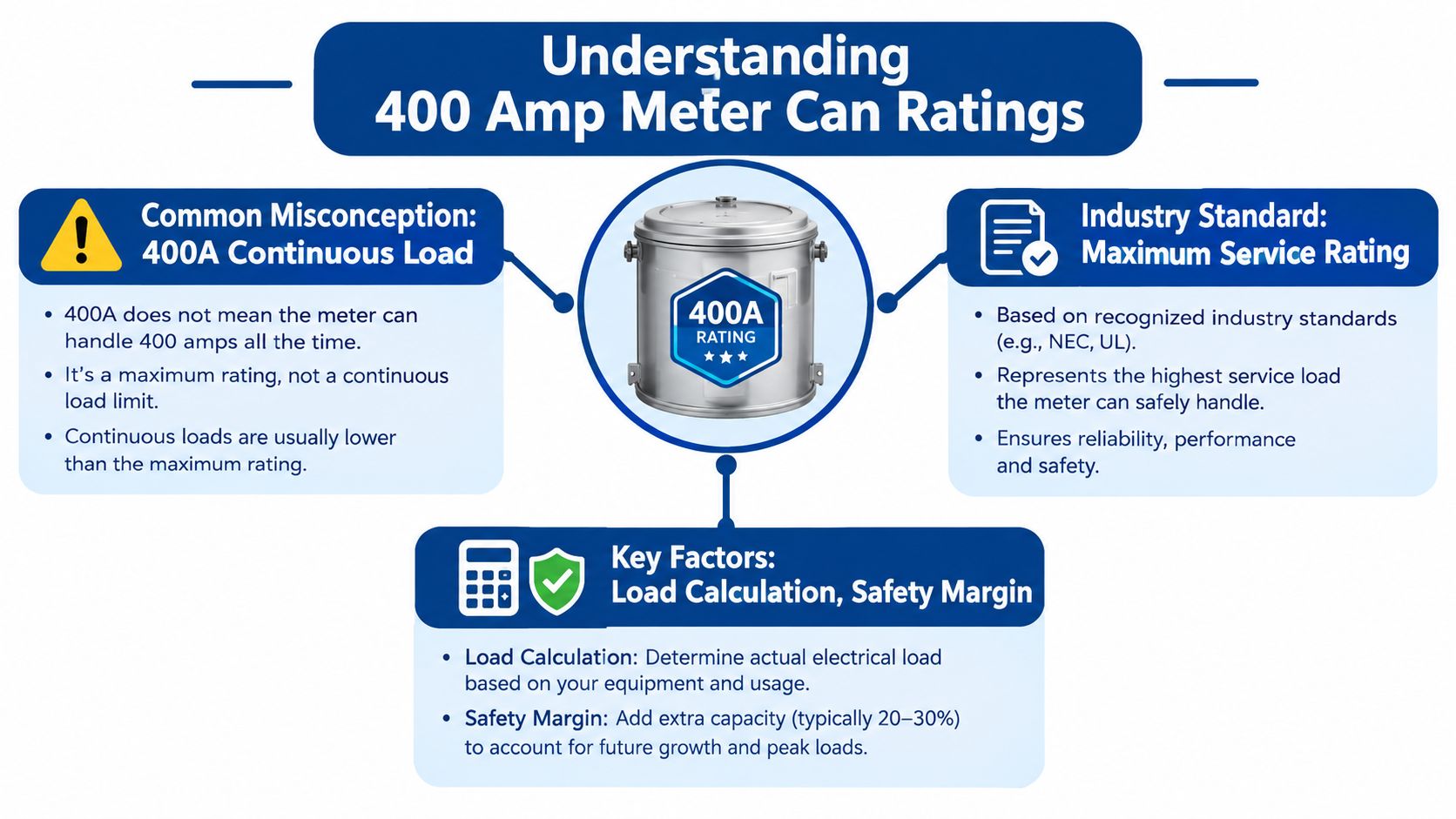
The label 400A is often misinterpreted. In utility practice, a 400 amp meter can is commonly a 320/400 amp class meter socket, which means the hardware may be accepted for 400 amp service without being rated for 400 amps continuous. That distinction matters before you order gear, because the utility, not the catalog title, decides what passes.
Read the rating the way the utility reads it
Skamania County PUD states that for 400-amp service, the required meter base is a Class 320 unit rated 120/240 volts and 320 amps continuous, with 4 jaws and a manual block bypass. It also says any structure needing more than 320 amps of continuous current requires CT metering instead Skamania County PUD guidance.
Practical rule: if the utility sheet says Class 320, spec and buy to that standard, not to the product headline.
That is why contractors have to read the nameplate, the utility service guide, and the approved equipment list together. A socket marked “400A” can still be a 320 continuous device with a 400 amp service rating. Those are not interchangeable terms.
Why the industry uses this convention
Utilities care about thermal limits and metering architecture. A socket can be acceptable for a 400 amp service while the meter element and service rules still cap continuous use at 320 amps. That is why many product listings and utility-approved standards use the same language instead of calling every large socket a true 400 amp continuous meter.
Legacy terminology adds another layer of confusion. A public utility approval document from 2018 says 400 Amp K-base meter socket[s] are no longer approved for several utilities, which shows how older forms were already being phased out by the late 2010s utility approval document.
A contractor who ignores this will often overspec the job and still miss the utility requirement. The safer approach is simple. Treat 400 amp as the service class, verify the continuous rating separately, and confirm the utility-approved configuration before ordering.
Why Continuous Versus Maximum Amperage Matters
A 400 amp meter can is often treated as if it means 400 amps continuous. In practice, the rating split matters more than the label on the cover. Many utility-approved self-contained sockets are sold as 400 amp service equipment while still carrying a 320 amp continuous limit, so the spec has to be checked against the service rules, not just the catalog title.
What changes in the field
That distinction affects load planning, conductor sizing, and protective device coordination. If the connected load will sit near the top of the continuous range for long periods, the utility may require a different metering arrangement instead of a larger-looking socket. Oversizing the can does not automatically increase usable capacity.
Utility acceptance is the decision point, not the catalog title.
Florida Power & Light's metering handbook requires 320-amp self-contained meters for all 400-amp services and prohibits K-base bolt-in meters, which is why the meter style matters as much as the socket body Florida Power & Light metering handbook. If the wrong configuration is ordered, the install can still fail review even when the rest of the work is clean.
Match the socket to the load profile
Contractors need to work from actual demand, not just service size. A large house, a light-commercial suite, or a mixed-load building may fit a 320A continuous / 400A class setup. Heavier or more sustained loading can push the project toward transformer-rated metering instead of a self-contained can.
Breaker selection belongs in the same review. Meter rating and overcurrent protection have to agree, especially when the service is split across panels or load centers. For a practical check on upstream protection choices, see circuit breaker selection considerations.
Self-Contained Versus CT Metering Options
A lot of 400 amp calls get misread at the start. The label sounds like a physical size, but the core decision is whether the utility will accept a self-contained meter socket or require CT metering. That distinction matters because a 400 amp service often sits in the gray zone where the hardware title, the continuous rating, and the utility breakpoint do not mean the same thing.
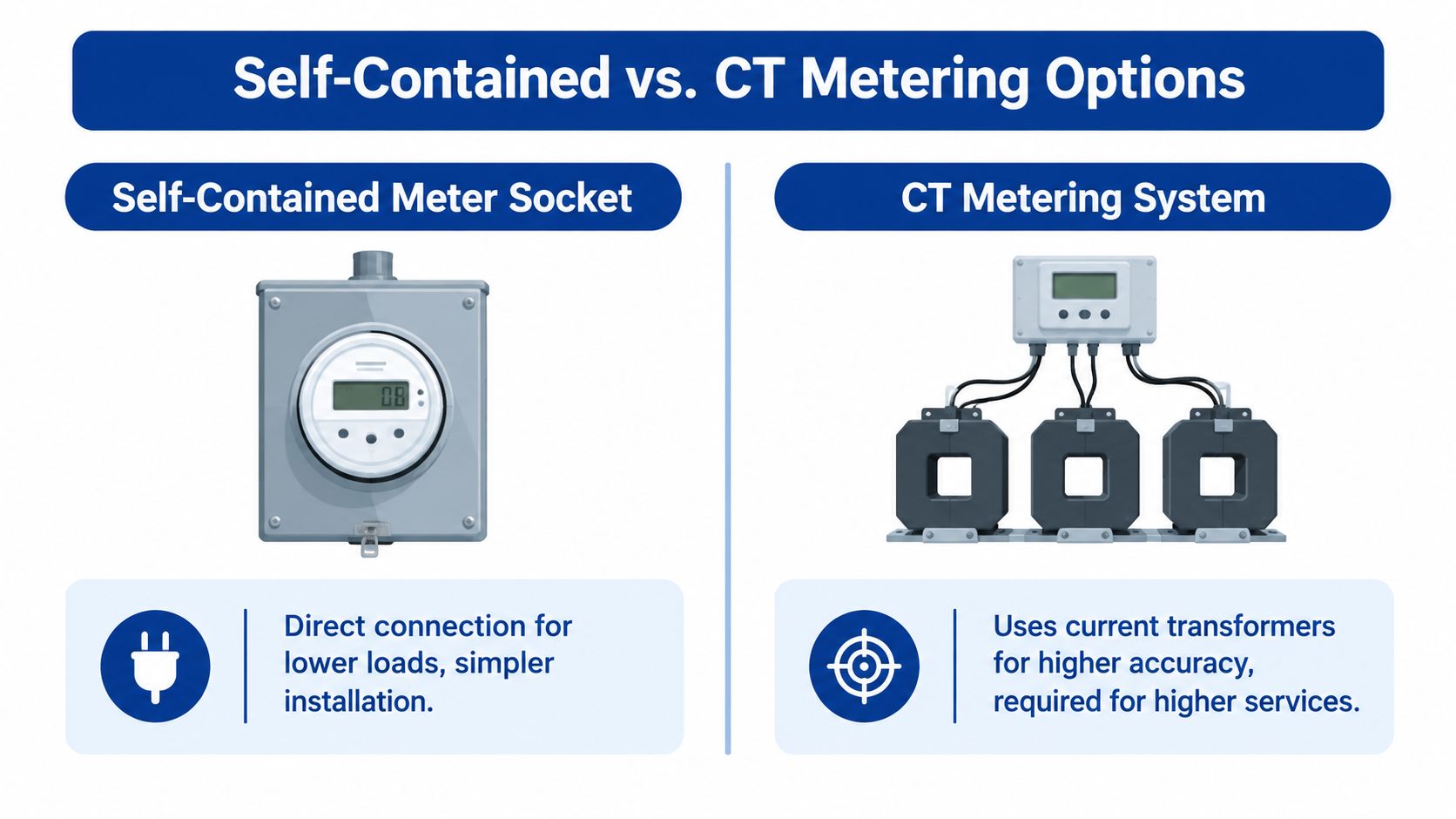
Side-by-side differences that matter
A published utility detail from Lehi shows approximate enclosure dimensions of 5 in. D x 13 in. W x 19 in. H for an overhead-service meter socket up to 400 A, with concentric knockouts, utility-approved hub sizes from 1-1/4 in. to 2-1/2 in., and bypass required Lehi utility detail. That gives contractors a clear boundary, the self-contained option is a defined utility assembly, not a generic cabinet that can be adapted later.
The same detail says any service over 400 A must shift to current-transformer metering in factory-built CT cabinets or compartments, with NEMA 3R weather rating, installed ahead of the main disconnect unless the utility approves another arrangement Lehi utility detail. Once a project crosses that breakpoint, specifying a larger-looking socket does not solve the metering requirement.
How to choose the right architecture
Use self-contained gear only when the utility allows it and the load fits the accepted class. A house, a small commercial suite, or another moderate service may stay in that range, but a heavier or more sustained load can push the job into CT metering even if the service number still sounds like a “400 amp” job.
Load profile drives the decision as much as service size. A project with panels split across multiple load centers, or one with sustained high demand, needs the metering method and the protective devices reviewed together so the service arrangement stays inside utility rules.
Meter Can Mounting and Physical Specifications
A good 400 amp submittal often fails on geometry, not on theory. The can may be right in electrical terms and still be wrong in the field because the hub size, knockout layout, or weather rating doesn't fit the installation. Product documentation from distributor channels shows how often 400 amp meter can listings are described as 400A, 320 continuous, and sold under overlapping names like 400 amp meter, 320 amp can, 400 amp term can, and meter pan Rexel product listing.
What to verify before ordering
Start with enclosure type and mounting orientation. Overhead and underground services don't always use the same entry pattern, and a utility-approved can needs to line up with the service route, not the other way around. The wrong knockout placement can force a field modification that no inspector wants to see.
Next, check the weather enclosure and bypass provision. Outdoor meter sockets commonly need NEMA 3R protection, and the utility may expect a manual bypass or a specific ringless or ring-type setup depending on service rules. That's not a cosmetic preference, it's part of the approved configuration.
The submittal should prove fit, not just intent.
Why contractors get tripped up
The terminology is part of the problem. A buyer may ask for a “400 amp meter can,” receive a product marked 400A, and still end up with a 320 continuous device that's perfectly legitimate for the utility but not what the job was mentally modeled around. That gap is why field coordination gets messy.
For outdoor placements, enclosure selection matters as much as electrical rating. A practical reference for weather-exposed gear is how to choose electrical enclosures for outdoor use, because the meter can still has to survive the environment it's installed in.
Ring-Type and Ringless Meter Socket Configurations
Ring-type and ringless sockets solve the same basic job, but they handle utility access differently. The utility's sealing and removal process, the service entrance layout, and the approved equipment list all influence which one belongs on the project. If you pick the wrong style, the rest of the install can be clean and still not meet the utility's preference.
Ring-type sockets use a ring that secures the meter, while ringless designs rely on a different retention method. In practice, the utility's local standard usually decides the issue more than the contractor's preference does. That's why the approved list matters more than the catalog photos.
Choosing based on service design
Overhead and underground services can both use either configuration, depending on utility rules and product approval. The key is terminal compatibility and the service entrance method. If the utility wants a specific jaw arrangement or bypass style, that requirement outranks the general product family.
Contractors should also watch for matching jaw count, phase arrangement, and voltage class. The commonly accepted combinations in utility standards include 120/240 V single-phase and other approved variants, but the exact configuration must match the utility's list. A ringless unit is not automatically better, and a ring-type unit is not automatically older or less capable.
The right move is to spec the configuration the utility already accepts, then confirm that the service conductors and termination points align with that decision. Guessing here creates avoidable delays.
Meter-Main Integration and Future-Proofing
A standalone meter can solve only part of the service problem. Many projects now use meter-main combinations or integrated distribution gear because the service is no longer just feeding lights and receptacles. It also has to support EV charging, all-electric loads, backup-ready layouts, and, in some cases, temporary power or phased expansion.
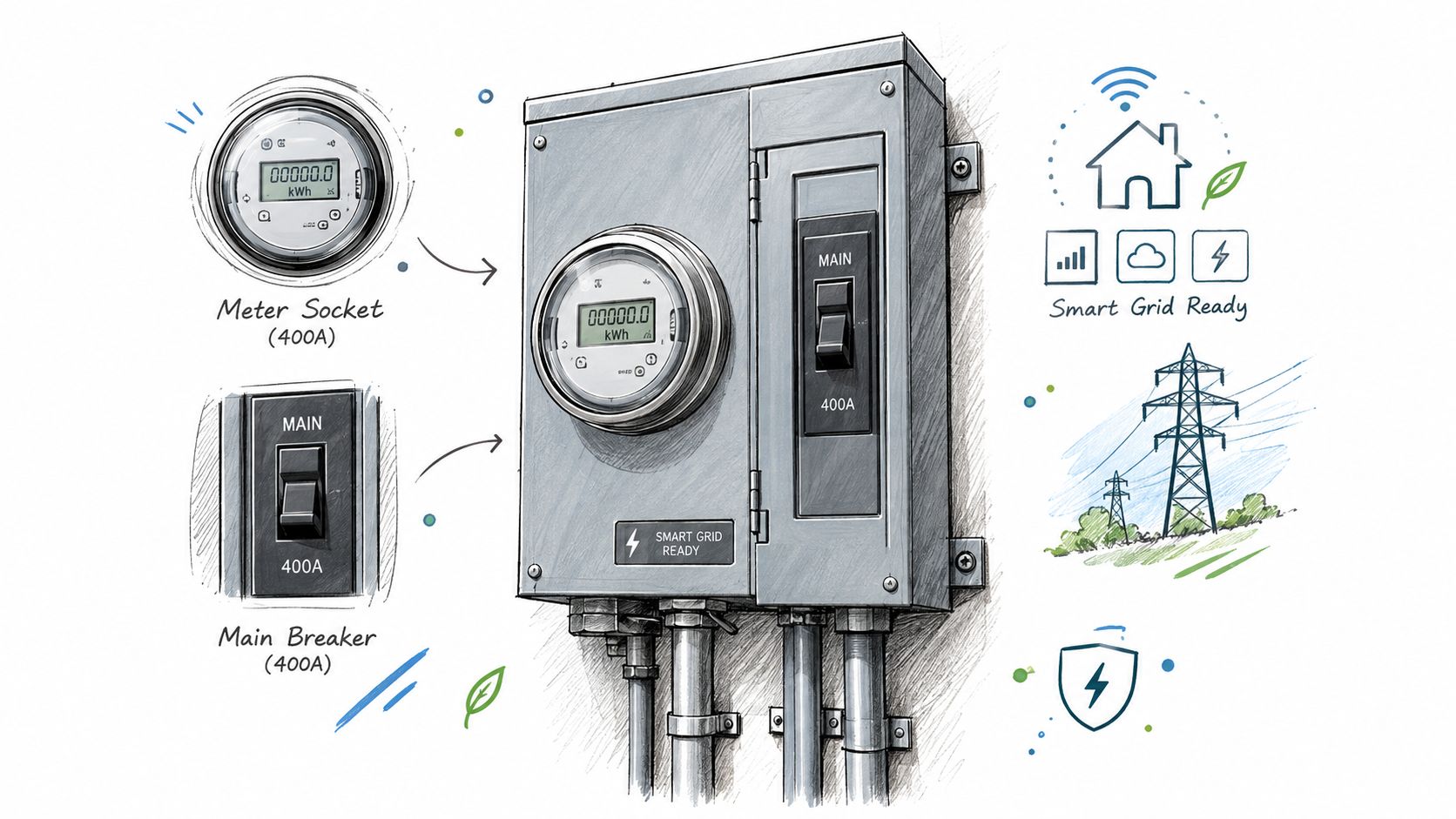
Product listings and guides tie this category to EV-heavy homes, all-electric buildings, small commercial loads, and construction power Home Depot meter-main combo category. That does not mean every project needs combo gear. It means the buyer should match the hardware to the present load and the likely next step.
Think beyond the meter alone
The choice is between a standalone socket and an integrated assembly. If the install may later need extra disconnects, backup interfaces, or staged load management, meter-main gear can reduce rework. If the service is straightforward and the utility wants a simple self-contained arrangement, a standalone can still be the cleanest option.
I've seen contractors choose for today's load and ignore tomorrow's additions. On electrification-driven jobs, that creates avoidable changes later. The client may not know whether solar, storage, or EV charging will be added next, but the service equipment should leave room for those decisions.
For a closer look at where metering infrastructure is heading, see ATEK's analysis of advanced metering infrastructure (AMI) solutions.
For projects that need metering strategy, utility coordination, and procurement support, ATEK Distribution can source meter sockets and meter centers for commercial, industrial, and government electrical work. Their team also handles technical review and RFQ-based sourcing, which helps when the project needs the right configuration instead of a generic part number.
Quick Reference Selection Guide
The fastest way to avoid a bad order is to match the project type to the utility-approved configuration before you look at price or lead time. A 400 amp meter can is not one universal product. It's a family of configurations that change based on load profile, phase, bypass style, and whether the utility wants self-contained or CT metering.
Selection cues that usually matter
- Single-family or light-commercial with standard utility acceptance: A 320/400 class self-contained socket is often the starting point, but only if the utility allows that arrangement.
- Higher sustained load or utility breakpoint exceeded: Move toward CT metering rather than forcing a bigger-looking self-contained can.
- Overhead service: Confirm hub size, entry orientation, and bypass requirements before you order.
- Underground service: Verify the enclosure layout and termination access, not just the amperage label.
- Ring-type versus ringless: Use the utility-approved style, not the style that happens to be in stock.
- Future add-ons like EV, solar, or storage: Favor a service architecture that won't be ripped out when the load grows.
What to verify on every submittal
Check the amp class, the continuous rating, the jaw count, the voltage, the bypass method, and the enclosure rating. Then confirm that the service architecture matches the utility's metering rules and the site's actual load plan. If any one of those items is unclear, the order isn't ready.
A simple rule keeps projects moving. If the product name says 400A but the utility sheet says Class 320, the utility sheet wins. If the site load exceeds the self-contained threshold, stop treating the can as the answer.
Utility Compliance and Submittal Requirements
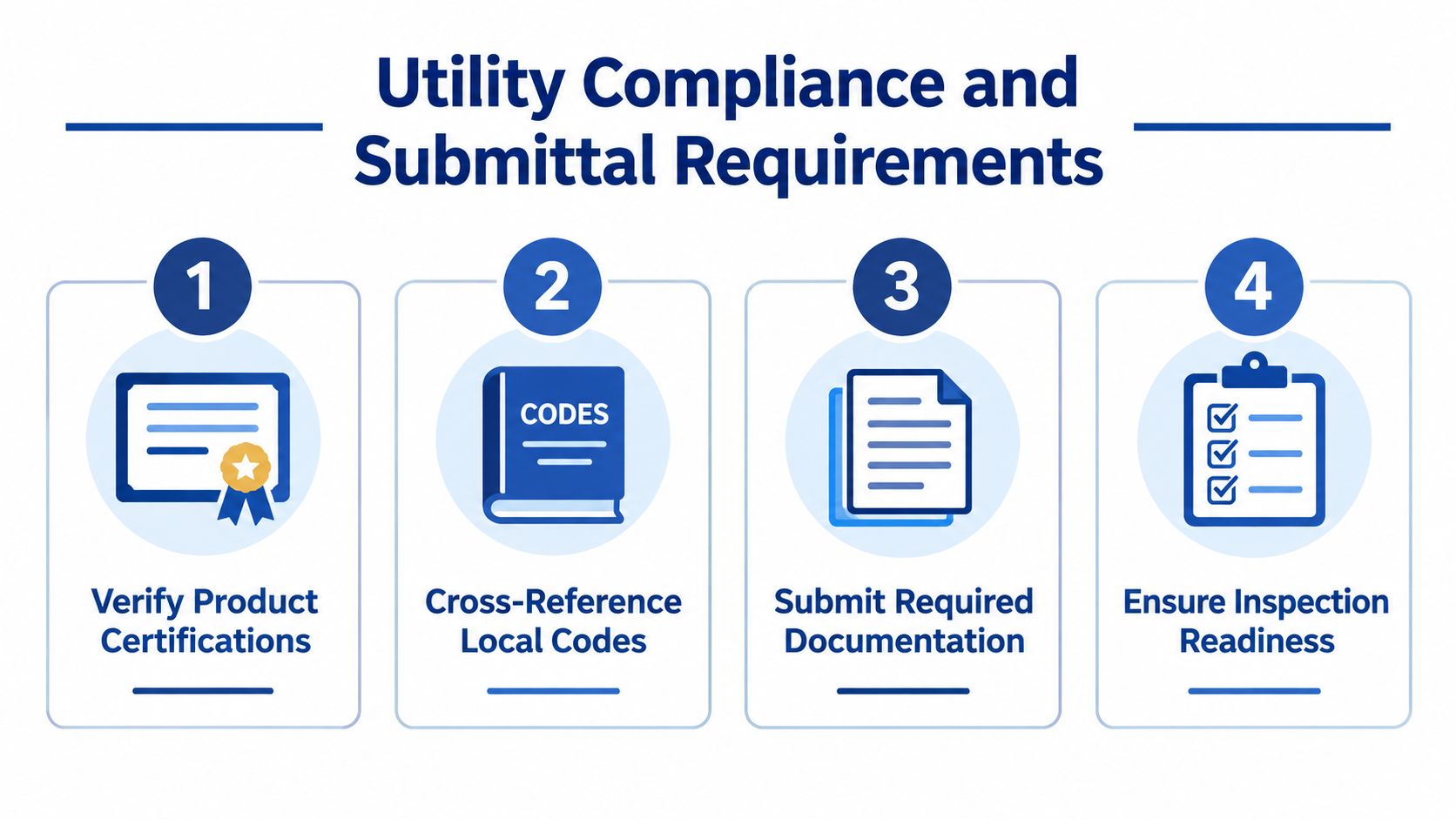
A compliant 400 amp submittal starts with the utility-approved list, not the distributor catalog. The utility decides what it will energize, and the inspector checks whether the installed hardware matches that decision. Legacy gear can disappear from approval quickly, so a familiar form is not enough if the utility has moved on.
Build the submittal around the utility file
First, verify that the exact meter socket or CT equipment is on the approved list. Then cross-check the local service standard and any municipal detail sheets. After that, submit the product cut sheet and make sure the ratings on the sheet match the utility's language, not just the seller's shorthand.
Check inspection readiness before the truck rolls. The bypass requirement should be satisfied, the enclosure type should be correct, and the service configuration should match the approved architecture. If the utility wants NEMA 3R or a particular jaw arrangement, that detail belongs in the submittal package, not in a note the reviewer has to hunt for.
The best submittal is the one that answers the utility's question before they ask it.
Avoid the classic documentation failures
The most common failure is a mismatch between the catalog description and the utility's terminology. Another is assuming an old approved form still passes because it looks familiar. Utilities update standards, and field crews do not get to negotiate after the fact.
A K-base example makes the point clearly. A form that was once common can fall out of approval, so the safe move is to verify the current utility sheet before you release the order.
Keep one clean packet for the meter socket, one for the service conductors, and one for the disconnecting means. That makes it easier for the AHJ and the utility to verify the whole service path without sorting through mixed paperwork.
Common Mistakes and Best Practices
The worst mistakes with a 400 amp meter can are simple and expensive. Contractors either buy to the marketing headline, ignore the utility's class language, or assume that a bigger socket automatically means more usable service. None of those shortcuts helps once the utility reviews the job.
What trips jobs up
- Buying by product title alone: A listing that says 400A may still be a 320 continuous socket, so the title can't be the only decision point.
- Skipping utility verification: If the utility wants Class 320, ringless, or CT metering, that rule controls the job.
- Missing bypass requirements: Some service standards require a manual bypass, and leaving it out can kill the submittal.
- Using the wrong legacy form: Older K-base equipment may already be out of approval in some jurisdictions.
- Ignoring future load growth: EV charging, all-electric equipment, or added distribution can change the right metering architecture later.
What experienced specifiers do differently
They read the utility sheet first, then compare the product cut sheet against it. They confirm the continuous rating separately from the service rating. They also check whether the project belongs in the self-contained category or the CT category before they write the purchase order.
A practical habit is to treat the meter can as part of a system, not a standalone purchase. The socket, the service conductors, the disconnects, and the utility requirements all have to line up. If one piece is off, the whole package slows down.
Contractors who get this right usually save the most time at the review stage, not during installation. The field work becomes routine because the paperwork already matches the hardware.
If you're sourcing a 400 amp meter can, meter-main combo, or related service equipment for a project that needs the right utility-approved configuration, start with ATEK Distribution. They help contractors, engineers, and procurement teams source electrical distribution products and support submittals with technical review, which is exactly the kind of help that keeps a service upgrade from turning into a rework cycle.