
The line stops, a drive reports undervoltage, and the PLC needs a restart. There's no damaged cable, no open breaker, and no obvious explanation for why production lost its sequence. Maintenance wants to replace the suspect component. Purchasing wants a part number. Neither team has enough evidence yet.
Power quality issues become expensive when teams buy a remedy before defining the disturbance. Before a retrofit, establish what happened at the equipment terminals, what the load needs to remain operational, and what the replacement equipment must demonstrate during commissioning.
Table of Contents
- Why Power Quality Is Now an Operations Problem
- The Six Core Power Quality Disturbances
- Why Voltage Sags Dominate Industrial Exposure
- How Harmonics Stress Equipment in Practice
- Diagnosing Power Quality Problems at the Facility Level
- When the Disturbance Is Not Inside Your Building
- Matching Mitigation Equipment to the Actual Disturbance
- Maintenance, Commissioning, and Sourcing Practices That Stick
Why Power Quality Is Now an Operations Problem
A utility interruption and a production interruption aren't the same thing. The incoming supply may recover quickly while operators still need to clear faults, restore control states, inspect work in progress, and restart machinery. For a plant manager, the meaningful measure is time until the process is stable, not merely time until voltage returns.
The transition to digitally controlled and electronically automated operations made this distinction economically important. A U.S. Department of Energy report reviewing EPRI research estimated historical annual interruption and power-quality costs of approximately $79 billion, including about 4.3 momentary interruptions per customer site associated with roughly $52 billion in losses, and approximately 1.2 sustained outages, totaling about 106 minutes, associated with another $26 billion; commercial customers accounted for more than 70% of estimated interruption costs, industrial customers for nearly 26%, and residential customers for less than 2%.
Those are historical estimates, not a current forecast or a calculation of your plant's exposure. Their practical value is the distinction between a short electrical event and a much longer operational consequence.
Budget around the process consequence
For a retrofit, identify which loads determine whether production continues. A control-power supply, PLC rack, contactor coil, or drive may be more consequential than its purchase price suggests. Protecting the whole facility isn't automatically the most economical approach.
- Document the restart burden. Record fault clearing, manual intervention, sequence recovery, and inspection requirements.
- Separate damage from interruption. Equipment can stop without suffering a permanent failure.
- Define acceptable behavior. Specify whether the process must continue, pause safely, or shut down in a controlled state.
- Assign ownership. Operations defines the consequence, engineering defines the electrical requirement, and procurement obtains supporting product documentation.
Procurement rule: Buy against an operating requirement, not against a disturbance label.
A purchase order that says “power protection” leaves too much unresolved. A useful specification identifies the protected load, measured exposure, required response, installation constraints, and acceptance evidence. That gives maintenance a testable remedy and purchasing a defensible basis for comparing alternatives.
The Six Core Power Quality Disturbances
When a drive trips or a control resets, the alarm describes the equipment's response, not necessarily the cause. Use disturbance terms to frame the investigation, then compare them with monitoring evidence before selecting equipment or writing a purchase specification. IEEE thresholds can support classification, but the measured event and the protected load's response must guide the decision.
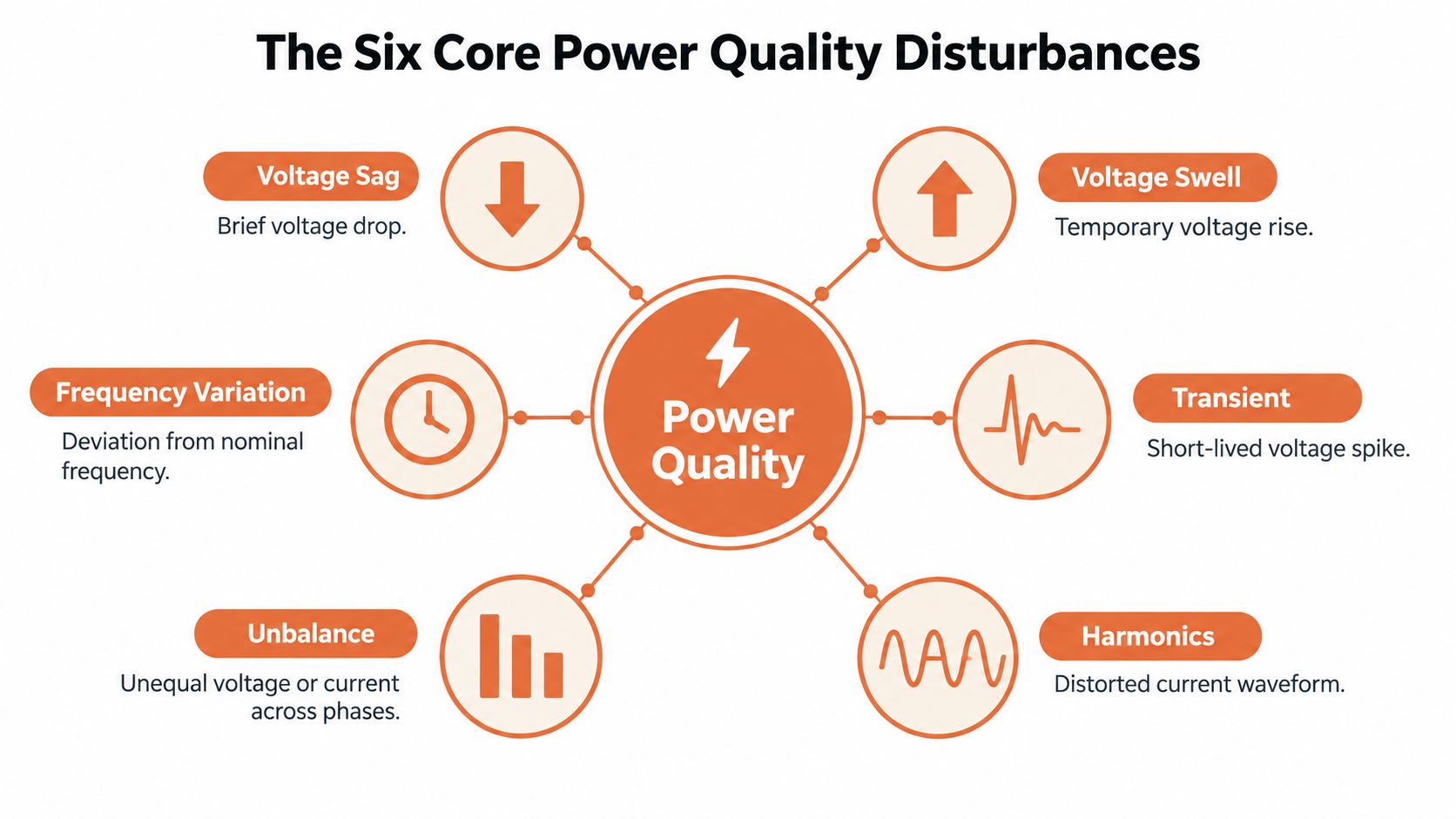
Voltage sags are reductions in RMS voltage, while swells are increases. Transients are abrupt deviations from the normal waveform. Harmonics and interharmonics are waveform components at integer and noninteger multiples of the fundamental frequency. Frequency variation affects the fundamental frequency itself, and voltage unbalance describes differences among phase voltages.
The diagram groups the six disturbance categories. Use it to orient the investigation, not to diagnose a facility.
Power Quality Disturbance Quick Reference
These duration and magnitude descriptions are qualitative screening terms, not universal limits. Causes and symptoms are leads for investigation, not proof. Confirm the event with measurements before comparing mitigation products.
| Disturbance | Typical Duration | Typical Magnitude | Common Cause | Typical Symptom |
|---|---|---|---|---|
| Voltage sag | Brief event | Reduced RMS voltage | Motor starting, welding, upstream faults | Contactor dropout or control reset |
| Voltage swell | Event-dependent | Increased RMS voltage | Investigate switching and operating-state changes | Equipment overvoltage alarm |
| Transient | Abrupt event | Impulsive or oscillatory deviation | Investigate switching activity and lightning exposure | Electronic reset or failure requiring waveform confirmation |
| Harmonics and interharmonics | Present during contributing operation | Distorted waveform | Nonlinear loads and converter operation | Heating or communication interference |
| Frequency variation | Operating-state dependent | Departure from nominal frequency | Investigate source and control response | Frequency-related equipment alarm |
| Voltage unbalance | Persistent or load-dependent | Unequal phase voltages | Investigate load allocation and phase connections | Uneven equipment behavior requiring phase measurements |
Flicker deserves separate attention rather than being forced into one disturbance category. For complaints limited to dimmed lighting, this resource on how to stop dimmer lights from flickering offers a lighting-specific starting point. It does not replace an industrial power-quality study.
Before sourcing a remedy, establish whether affected equipment shares a panel, feeder, or operating cycle. Then compare alarm records with power-quality measurements. Undervoltage, overvoltage, and thermal alarms call for different evidence, and a loose connection, equipment defect, or control-program problem can mimic a supply disturbance.
Use the disturbance label to make the work order specific. Use commissioning measurements to confirm that the selected equipment addresses the event recorded at the facility.
Why Voltage Sags Dominate Industrial Exposure
A feeder fault or motor start can pull voltage down long enough to reset a control system, even when the equipment looks normal by the time maintenance arrives. For procurement, that creates a specific problem: choose protection against measured exposure, not a generic product label.
The EPRI Distribution System Power Quality Monitoring Survey recorded 107,834 three-phase RMS-variation measurements across 146,661 monitoring days, using 277 instruments from June 1, 1993, through June 1, 1995. Average monitored-site rates included approximately 1.18 annual incidents in the 85%–90% voltage band, 0.38 interruptions below 10% of nominal, and a 95% confidence interval of 14–20 annual events below 0.70 per-unit voltage. These historical results show how sag exposure can be quantified, but they do not predict conditions at a specific plant or support a universal share of industrial power-quality events.
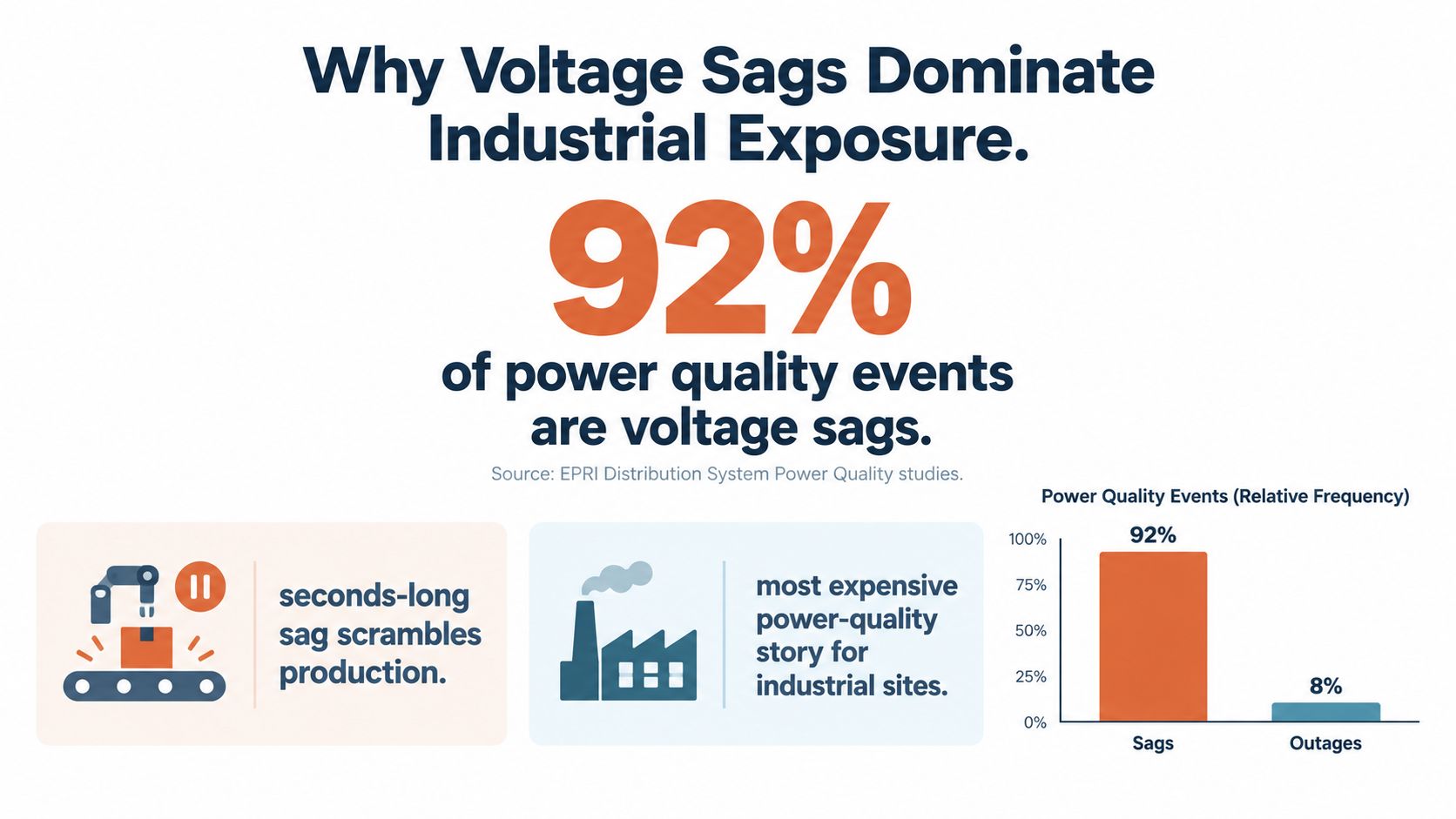
Treat the graphic's percentage as illustrative, not as a design basis. The survey results above do not establish that claim, so it should not drive specifications or financial justification.
Specify ride-through around the load
Ride-through capability describes whether equipment stays in an acceptable operating state during a defined disturbance. A useful specification states voltage depth, duration, affected phases, loading, and acceptable recovery behavior. “Sag resistant” gives suppliers too little to prove.
NIST's power-quality troubleshooting guidance identifies motor starting, welding equipment, and upstream faults as common sag causes. Before sourcing equipment, establish whether the event removes control power, trips a drive, drops a contactor, or disrupts recovery. That distinction determines whether control-only support is sufficient or the process load also needs protection.
Require documented performance against the specified sag envelope, then test recovery during commissioning. Continued operation and a safe restart are separate acceptance conditions. Use monitored voltage-duration exposure to compare UPS systems, dynamic voltage restorers, and control-power conditioning. Select against the recorded event and the plant's operating requirement, not the broad phrase “power quality.”
How Harmonics Stress Equipment in Practice
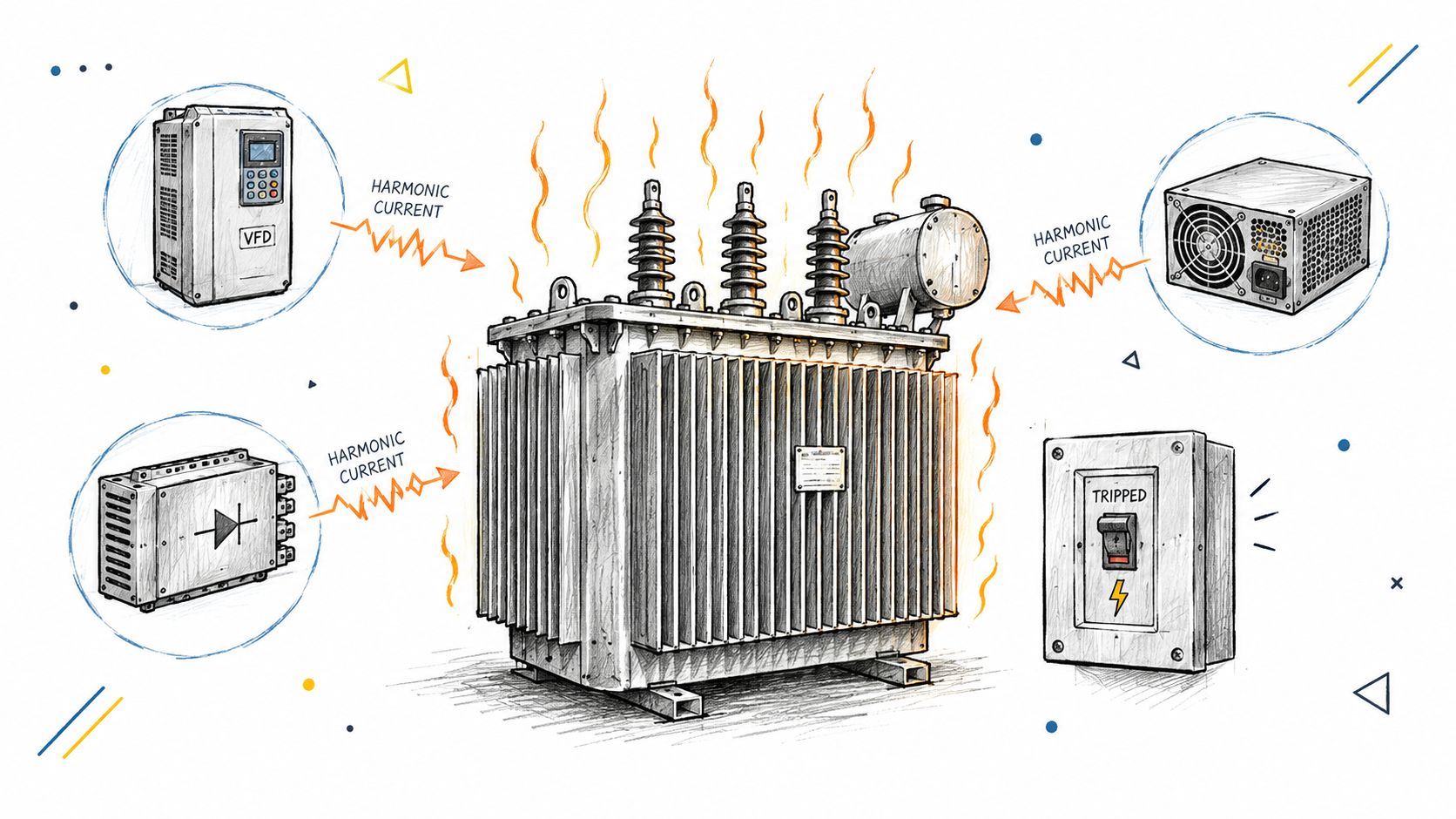
A transformer that runs hot during production may be carrying harmonic losses that a spot current reading will miss. Harmonic distortion needs to be assessed alongside load and temperature, especially where drives, switched-mode supplies, LED drivers, UPS rectifiers, or electronic chargers operate.
Nonlinear loads draw harmonic currents. System impedance converts those currents into voltage distortion, so readings depend on both where the loads connect and how strong the supply network is. The renewable-energy integration guidance supports assessing distortion at the connection point, rather than relying on a converter's nameplate.
Total harmonic distortion, or THD, summarizes distortion but does not identify which conductors are heating or which harmonic orders dominate. A procurement decision based on THD alone can therefore miss the equipment duty that determines transformer sizing, filter selection, and commissioning acceptance.
In a three-phase, four-wire system, triplen harmonics add in the neutral instead of canceling. Harmonic currents can also circulate in a delta-connected transformer secondary, creating heat that primary overcurrent protection may not adequately detect, as the NIST guidance discussed earlier notes.
Before specifying a replacement or filter, require evidence that connects operating conditions to equipment stress:
- Measure individual orders. Keep the harmonic spectrum, not just a summary value.
- Measure neutral current. Phase readings alone cannot confirm neutral loading is acceptable.
- Log temperature with load. Compare similar production conditions when evaluating a change.
- Correlate communications complaints. Check whether interference coincides with converter operation before assigning the fault to network equipment.
A cooler replacement transformer does not prove that harmonic emissions meet the project's requirements.
For IEEE 519 coordination, identify the applicable point of common coupling and obtain the governing project limits before issuing a purchase specification. The cited integration guidance gives a 5% total current-distortion threshold and a 2.5% voltage harmonic-distortion criterion for certain interconnection contexts. These figures are not universal IEEE 519 limits.
Choose filters against the measured spectrum and operating range, then verify performance during commissioning. A transformer designed for the thermal duty can address heating, but it does not establish acceptable emissions or confirm downstream controls will keep operating.
Diagnosing Power Quality Problems at the Facility Level
A defensible study should produce evidence that an engineer can use and a buyer can put into a specification. A report containing only a worst-case THD screenshot or a list of alarms won't support a reliable equipment selection.
IEC 61000-4-30 defines repeatable in-situ measurement methods for 50 Hz and 60 Hz systems, covering frequency, voltage magnitude, flicker, dips, swells, interruptions, transients, unbalance, harmonics, interharmonics, mains signalling, rapid voltage changes, and current measurements, according to the IEC measurement standard description. It is a measurement and interpretation standard, not a standalone set of acceptable facility limits.
The diagnostic sequence should be agreed before instruments are installed.
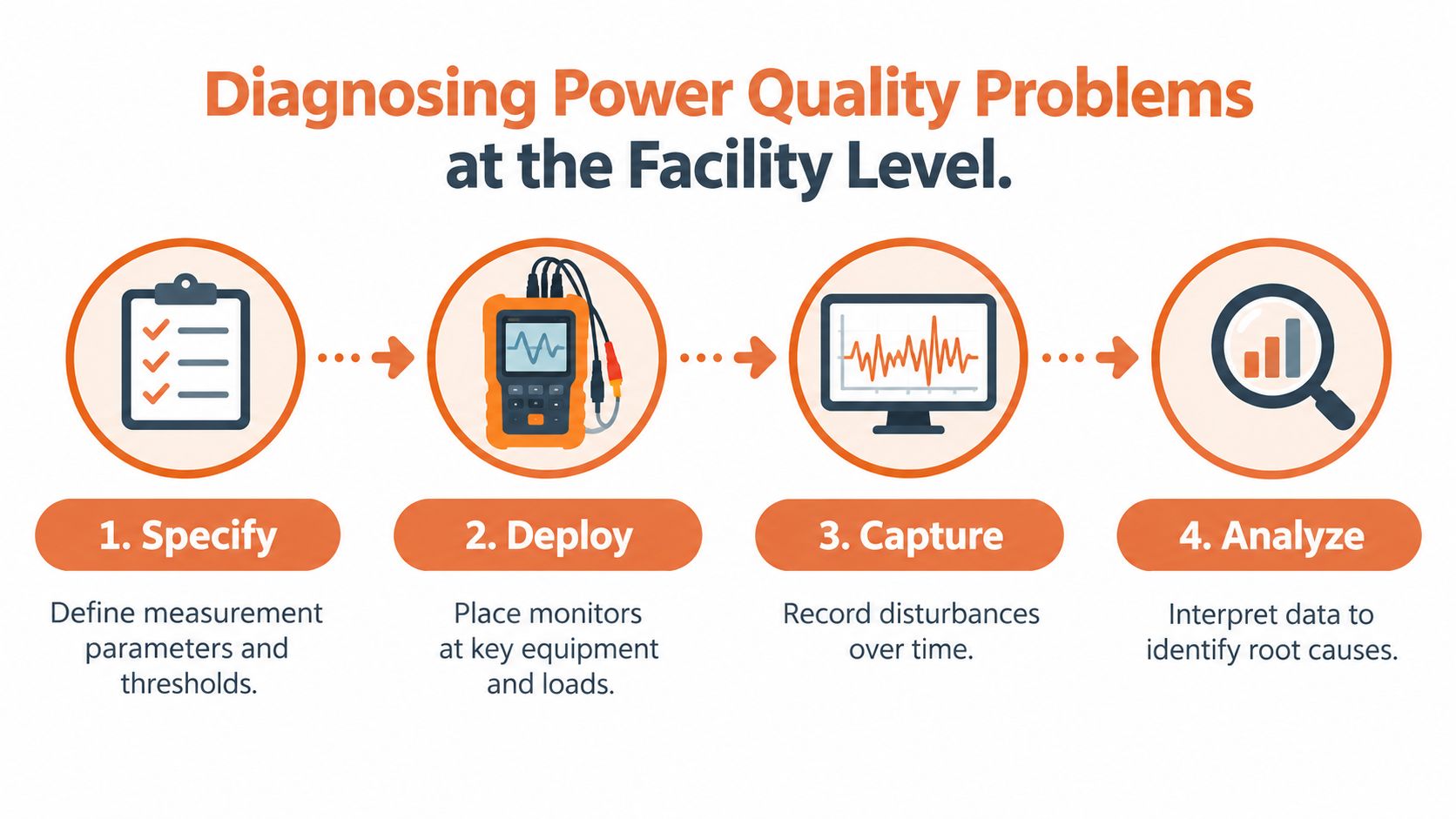
Specify the evidence chain
- Define the study. Name the phenomena, measurement method, trigger settings, monitored operating states, and required deliverables.
- Deploy at useful boundaries. Use synchronized monitors at the service entrance and critical distribution points so events can be compared.
- Capture more than alarms. Retain RMS voltage, event duration, phase angle, waveform triggers, harmonic spectrum, and relevant current measurements.
- Correlate with operations. Compare captures against motor starts, welding cycles, utility fault records, feeder loading, and equipment trip timestamps.
Ask who owns the raw recordings and whether the contractor will provide instrument settings and time-synchronization details. Those records matter when a utility, manufacturer, or third-party engineer needs to examine the same event.
Keep energy records and electrical evidence distinct
Facilities managing several energy streams may also use resources such as Blue Gas Express's mobile gas energy data solutions. Keep those operational records separate from electrical waveform evidence; shared timestamps can support correlation, but energy-use records don't establish the cause of a voltage disturbance.
The final study should distinguish measured condition, equipment susceptibility, and applicable limit. An event may meet a utility agreement yet still interrupt a sensitive process. Conversely, an equipment trip doesn't by itself prove a utility violation.
Require the assessor to explain that distinction before accepting a turnkey mitigation quotation.
When the Disturbance Is Not Inside Your Building
A fault observed inside the plant doesn't prove that the plant generated the disturbance. Shared feeders, neighboring loads, and upstream operating changes belong in the investigation when local evidence doesn't explain the event.
An analysis of U.S. residential sensor readings near data-center activity examined approximately 770,000 readings and reported that three-quarters of the most distorted readings occurred within 50 miles, while more than half of households with the worst distortion were within 20 miles. That geographic association warrants investigation, but proximity alone doesn't establish causation or responsibility for a particular facility's problem.
Build a cross-boundary record
Compare synchronized recordings at the incoming service and affected downstream buses. Where access and agreements permit, request corresponding utility or neighboring-site measurements. Preserve baseline records from before major energization changes and compare equivalent operating conditions afterward.
- Establish timing. Determine whether the incoming disturbance precedes the internal response.
- Compare current and voltage. Their relationship helps engineers investigate contribution rather than merely detect distortion.
- Document operating changes. Include major load additions, switching events, and changes in source configuration.
- Agree responsibility criteria. Use the applicable utility agreement, connection requirements, and engineering assessment.
The distinction between broad operational visibility and event-level evidence also matters when considering advanced metering infrastructure capabilities. Specify the measurements needed for the investigation rather than assuming every metering platform captures suitable waveforms.
Capital decision: Locate the disturbance before committing to a permanent mitigation package.
The remedy may be internal, utility-side, or shared. Even when local protection is justified to maintain production, document whether it addresses susceptibility or the originating condition.
That distinction affects cost allocation, acceptance testing, and future expansion. A local device that keeps one machine running doesn't necessarily resolve the condition affecting the surrounding distribution system.
Matching Mitigation Equipment to the Actual Disturbance
Choose mitigation by verified function under the intended operating conditions. Product category names are useful for screening, but they aren't performance guarantees.
A surge protective device addresses transient overvoltage; it doesn't restore missing RMS voltage during a sag. A K-rated transformer accommodates specified harmonic heating duty, but it doesn't remove harmonic currents or provide ride-through. Grounding and bonding must be correct, yet neither should be sold as a universal cure for upstream voltage disturbances.
Mitigation Equipment vs. Disturbance Type
“Conditional” means the manufacturer must document the relevant function and operating range.
| Device | Sag | Swell | Transient | Harmonic | Unbalance |
|---|---|---|---|---|---|
| UPS | Ride-through within rating | Conditional | Conditional | Verify input emissions | Conditional |
| Surge protective device | No | Not sustained regulation | Intended function | No | No |
| Dynamic voltage restorer | Voltage support within rating | Conditional | Not default function | Conditional | Conditional |
| Power conditioner | Conditional | Conditional | Conditional | Conditional | Conditional |
| Passive harmonic filter | No | No | No | Tuned application | Not default function |
| Active harmonic filter | No | No | No | Compensation within rating | Conditional |
| K-rated transformer | No | No | No | Thermal accommodation | No |
| Grounding and bonding correction | Not voltage restoration | No | Supports protection installation | Not filtering | Not phase balancing |
Compare installation and operating trade-offs
A UPS introduces storage, maintenance, bypass, and input-emissions considerations. A dynamic voltage restorer requires confirmation that its compensation envelope fits the measured disturbance. Passive filters require careful application to the system, while active filters need verified compensation capacity across changing load states.
- At the service entrance, consider aggregate exposure and utility-interface requirements.
- At distribution panels, assess feeder-specific problems and space for mitigation.
- At equipment terminals, protect process-critical controls or loads where targeted support is justified.
Integrate the chosen remedy with switchgear selection and distribution planning, including access, isolation, protective-device coordination, and maintenance provisions.
Don't stack technologies just to make the specification look complete. Require each device to address an identified condition, and require the combined system to demonstrate acceptable behavior.
Maintenance, Commissioning, and Sourcing Practices That Stick
Commissioning should verify the conditions that justified the purchase, not merely confirm that the equipment energizes. Keep the original monitoring baseline, approved settings, acceptance criteria, and post-installation recordings together. Maintenance needs that package when the next load addition changes the system.
Start with routine thermal inspections and waveform captures under representative operating states. Record transformer loading, neutral current, filter status, and equipment alarms alongside temperatures. Retest ride-through after changes to drives, control supplies, transfer arrangements, or protection settings.
Test combinations, not isolated nameplates
Solar, batteries, EV charging, and flexible data-center loads require coordination among converters, protection, storage controls, and the supplying network. NERC's long-term reliability assessment describes inverter-control and coordination concerns and records 2025 Eastern Interconnection data-center load reductions of 1,800 MW, 1,300 MW, and 540 MW. These are system-level events, not predicted voltage disturbances at an individual plant.
Their procurement implication is practical: require operating scenarios and test evidence, not only nominal ratings.
- Model relevant configurations. Have the engineer determine the need for short-circuit analysis, harmonic scans, and electromagnetic transient studies.
- Check control modes. Review inverter tuning, transfer behavior, intentional load shedding, and protection coordination.
- Validate after energization. Compare waveforms across representative loading, charging, generation, and transfer states.
- Retain approved settings. Treat undocumented firmware or parameter changes as a commissioning concern.
Make replacement sourcing evidence-based
For a K-rated or otherwise specially engineered transformer, retain the documented thermal-duty basis rather than relying on the designation alone. For IEEE 519 coordination, retain the agreed point of common coupling, applicable limits, operating cases, and acceptance results.
A replacement drive, UPS, breaker, or filter should pass a compatibility review before purchasing approves an alternate. Compare interfaces, installation constraints, electrical ratings, protection requirements, documented emissions, and the operating behavior that matters to the process. Manufacturer approval and engineering acceptance should remain explicit.
Use electrical equipment pricing and lead-time planning to organize procurement discussions, but confirm actual availability and approved alternatives for the specific project. A distributor can support BOM review, hard-to-source replacements, manufacturer coordination, and compliance documentation; the responsible engineer still owns the design decision.
Managing power quality issues means preserving the evidence from diagnosis through replacement. That continuity prevents an emergency purchase from undoing the performance established during commissioning.
ATEK Distribution supports BOM and specification review, hard-to-source electrical components, manufacturer coordination, and documented alternatives for power protection and distribution projects. Visit ATEK Distribution with your monitoring findings, equipment requirements, and replacement priorities to discuss availability and project-specific procurement support.