
You're looking for “mega lugs for PVC,” but the first question isn't the pipe size. It's which PVC system you're working on. In water and wastewater construction, MEGALUG usually means a mechanical-joint restraint for PVC pressure pipe. In electrical work, PVC usually means conduit, and the required fittings are couplings, connectors, bodies, sweeps, adapters, or bushings. Those are different product categories with different installation methods.
That distinction matters before anyone orders material. A restraint gland for a mechanical-joint bell won't replace an electrical conduit fitting, and an electrical conduit accessory won't restrain a pressurized water main. The guide below focuses on EBAA Iron MEGALUG mechanical-joint restraint for PVC pressure pipe, including product families, pipe standards, sizing, gasket selection, torque, and field installation.
Table of Contents
- What Mega Lugs for PVC Actually Are
- The MEGALUG Product Families at a Glance
- Pipe Standards MEGALUG Is Designed For
- Sizing a MEGALUG to Your PVC Pipe
- Gaskets, Torque, and Mechanical-Joint Assembly
- Thrust Restraint Versus Thrust Blocks
- Compatibility Nuances by Pipe Class and Diameter
- What Mega Lugs Are Not Used For
- Quick Reference Card for Selection and Torque
- Frequently Asked Questions About MEGALUG on PVC
What Mega Lugs for PVC Actually Are
MEGALUG is a registered EBAA Iron product family, not a generic name for every PVC lug or a fitting used with electrical conduit. The product is a mechanical-joint restraint gland designed for PVC pressure pipe used with compatible mechanical-joint bells. EBAA Iron's documentation identifies the Series 2000PV for C900, C905, and IPS OD PVC pipe, with product sizes extending from 3 inches through 36 inches and larger-diameter versions reaching 42 inches and 48 inches in the broader product family (Series 2000PV PVC MEGALUG specifications).
The fitting has a segmented gland ring, gripping wedges, and side bolts that engage the mechanical-joint flange bolt circle. Once assembled correctly, the wedges grip the pipe while the gland transfers axial force into the joint hardware. The restraint therefore addresses pipe movement at a joint, rather than sealing the joint against leakage.
The two PVC meanings buyers commonly mix up
A waterworks buyer is usually searching for restraint on:
- AWWA C900 PVC pressure pipe
- AWWA C905 PVC pressure pipe
- IPS OD PVC pressure pipe
- Compatible mechanical-joint fittings and appurtenances
An electrical contractor may instead be searching for a fitting for PVC conduit, cable routing, or a duct bank. That work uses conduit-specific components, not a pressure-pipe restraint gland. Mechanical-joint restraint also isn't a method for pulling wire through conduit or joining cement-welded conduit sections.
In practical terms, MEGALUG can reduce dependence on concrete thrust blocks where the design permits restrained joints. That can help on congested easements, inside casings, or in soils where excavation and bearing conditions complicate a conventional block. It doesn't eliminate engineering review. The pipe standard, outside diameter, bell dimensions, gasket, joint configuration, and installation instructions still control.
Practical rule: Start with the pipe print line and joint type. Don't start with the word “PVC” in a search box.
The remaining selection process is straightforward. Identify the pipe standard, verify the outside diameter, choose the matching Series 2000PV family, then confirm gasket and torque requirements before assembly.
The MEGALUG Product Families at a Glance
The Series 2000PV family scales with the pipe, but it isn't one universal gland that fits every PVC dimension. The key procurement mistake is treating nominal size as sufficient. Nominal size only becomes useful after it's matched to the pipe's outside-diameter basis and mechanical-joint configuration.
The published product information supports a range from 3 inches through 36 inches, with larger installations extending to 42 inches and 48 inches (EBAA Iron Series 2000PV product information). The broad selection logic looks like this:
| Family | Nominal Size Range | Pipe Standards | Bolt Size |
|---|---|---|---|
| Series 2000PV, smaller sizes | 3 to 12 inches | C900, C905, and IPS OD PVC where specified | Published product data identifies smaller restraint hardware, including 3/4-inch T-bolts |
| Series 2000PV, mid-range sizes | 14 to 36 inches | Primarily larger-diameter C905 and compatible AWWA PVC applications | Published product data identifies larger hardware, including 1-inch bolts in the mid-range |
| Mega Series, large diameter | 42 to 48 inches | Large-diameter C905 PVC applications | Heavier hardware, with published torque ranges of 120 to 150 ft-lbs for these sizes (PVC MEGALUG data sheet) |
The smaller range is where C900 and IPS OD PVC commonly overlap in nominal size. That overlap doesn't mean the pipes have identical dimensions. The gland body may be selected by nominal size, while the gasket and pipe OD determine whether the assembly is compatible.
The 14- to 36-inch range addresses larger PVC pressure pipe, particularly C905 dimensions that follow a ductile-iron-pipe-equivalent outside diameter. The 42- and 48-inch versions are intended for major transmission applications and require closer attention to hardware, torque, joint design, and field access.
Treat the product family as a system of matched components. The bell, gland, bolts, wedges, gasket, pipe OD, and installation procedure must agree. A correct nominal size paired with the wrong OD basis is still a wrong selection.
Pipe Standards MEGALUG Is Designed For
The pipe standard tells you more than the material. It also points to the dimensional system that the restraint must grip. For PVC pressure pipe, the important distinction is between C900, C905, and IPS OD dimensions.
| Nominal Size | Pipe Standard | OD Basis | MEGALUG Family |
|---|---|---|---|
| 4 to 12 inches | AWWA C900 PVC | C900 outside diameter | Series 2000PV smaller sizes |
| 4 to 12 inches | IPS OD PVC | Iron-pipe-size outside diameter | Series 2000PV IPS-compatible selection |
| 14 to 48 inches | AWWA C905 PVC | Larger-diameter AWWA PVC, commonly aligned with ductile-iron-equivalent joint dimensions | Series 2000PV mid-range or large-diameter Mega Series |
| Matching mechanical-joint fittings | Ductile iron | Mechanical-joint bell dimensions | Compatible restraint selected for the actual pipe and joint |
The transition between 12 inches and 14 inches deserves special attention. C900 and C905 aren't interchangeable dimensionally because both are PVC pressure-pipe standards. An IPS OD pipe in that area also shouldn't be assumed to match a restraint designed around a ductile-iron-equivalent outside diameter.
A MEGALUG must grip the actual spigot OD, and the bell must accept the selected joint hardware. The product documentation identifies compatibility with C900, C905, and IPS OD PVC, but the specific catalog size and gasket still need to match the pipe on the project (Series 2000PV PVC restraint documentation).
For electrical projects, use conduit-specific catalog categories instead. ATEK's PVC electrical conduit fittings cover the type of couplings, connectors, elbows, adapters, reducers, and bushings used to build conduit systems. Those products serve a different installation purpose and shouldn't be substituted for pressure-pipe restraint.
Sizing a MEGALUG to Your PVC Pipe
Order from the pipe, not from memory and not only from the purchase order. The installer should confirm three items before selecting a gland:
- Nominal pipe size
- Outside diameter at the spigot
- Pipe standard printed on the barrel
The print line is especially valuable because C900, C905, and IPS OD PVC can share nominal sizes while using different dimensional conventions. A tape measure helps verify the physical pipe, but it doesn't replace the standard, DR, or manufacturer identification.
A practical field check
Clean the area where the gland will seat, then inspect the pipe for gouges, raised material, dirt, or damage that could interfere with the wedges or gasket. Measure the barrel OD where the restraint will engage, rather than measuring a bell, coupling, or protective coating.
| Nominal Size (in) | Pipe Standard | Series 2000PV Size | Note |
|---|---|---|---|
| 3 to 12 | C900 or compatible PVC selection | Matching nominal Series 2000PV size | Confirm the exact OD and product listing |
| 4 to 12 | IPS OD PVC | Matching nominal Series 2000PV IPS selection | Transition gasket may be required |
| 14 to 36 | C905 PVC | Matching Series 2000PV size | Confirm C905 dimension and joint configuration |
| 42 to 48 | Large-diameter C905 PVC | Matching Mega Series size | Confirm large-diameter hardware and torque |
Consider two nominally similar examples. An 8-inch DR18 C900 main maps to an 8-inch Series 2000PV restraint selected for the C900 dimension. An 8-inch IPS OD PVC service line may use the same nominal body size, but it requires the IPS-specific transition-gasket arrangement identified by the manufacturer.
That's why the size printed on the order isn't enough. The pipe that arrives on the truck controls the final check.
Gaskets, Torque, and Mechanical-Joint Assembly
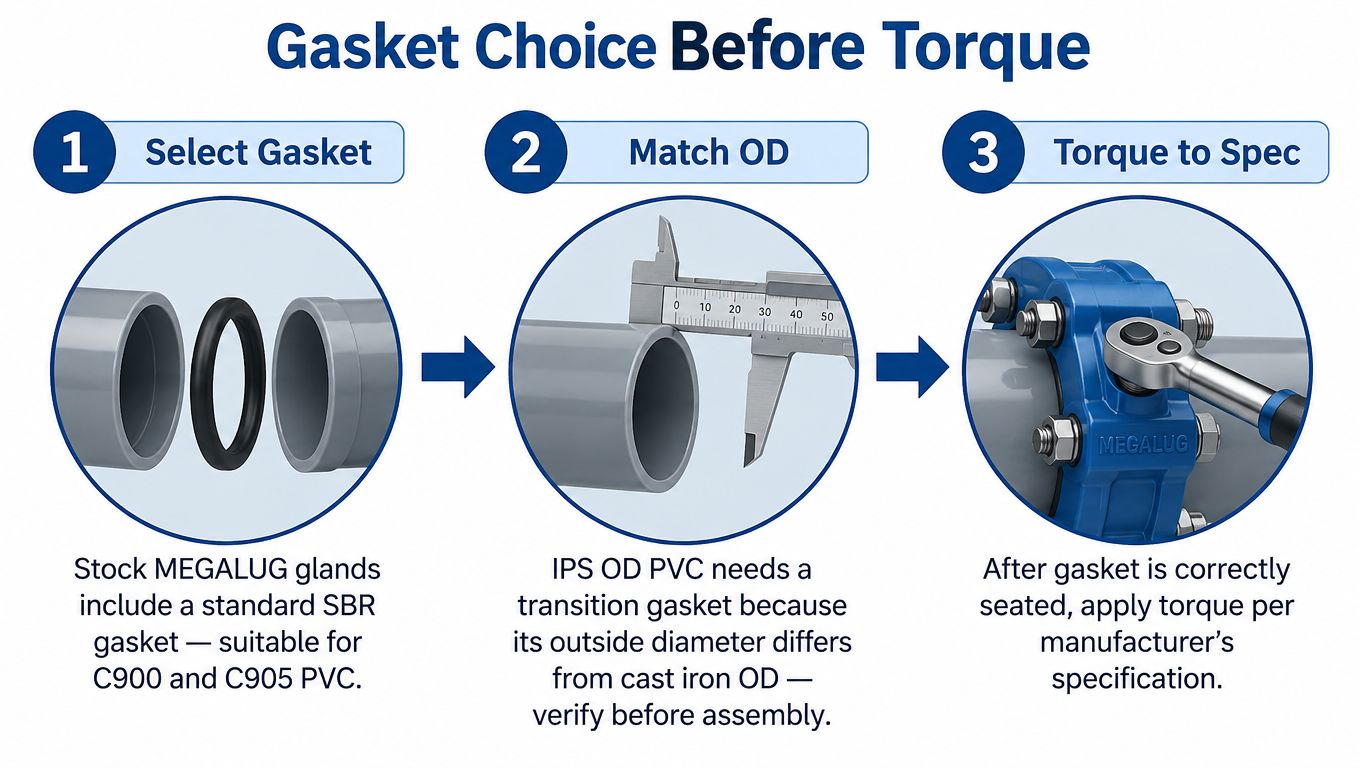
Gasket selection comes before torque. A properly torqued gland with the wrong gasket is still an incorrect assembly. Standard MEGALUG arrangements use a standard SBR gasket for compatible C900 and C905 PVC applications, while IPS OD PVC requires a transition gasket because its outside diameter differs from the cast-iron-equivalent dimension.
Assemble the joint in the right order
- Clean the socket: Remove soil, debris, old gasket material, and anything that can prevent the gasket from seating.
- Choose the gasket: Use the standard gasket for the listed compatible PVC dimension. Use the transition gasket for IPS plastic pipe where the instructions require it.
- Seat the gasket: Place it evenly in the bell recess. A twisted or partially seated gasket can create leakage or interfere with insertion.
- Insert the spigot: Bring the pipe into the bell to the required insertion mark or assembly position.
- Position the gland: Slide the gland over the pipe and align it with the mechanical-joint flange.
- Start the bolts: Hand-start the T-bolts and ensure the hardware engages without cross-threading.
- Torque in a star pattern: Tighten progressively and evenly so the gland seats uniformly around the pipe.
For the large 42-inch and 48-inch installations, the published torque range is 120 to 150 ft-lbs (PVC MEGALUG installation data). Smaller sizes use lower torque values specified by the applicable product data. Use a calibrated torque wrench and follow the manufacturer's sequence rather than applying the large-diameter value across the entire range.
Field caution: Never treat an IPS gland, cast-iron-dimension bell, and standard gasket as interchangeable parts. The joint has to be specified as a complete assembly.
The most common failure is skipping the transition gasket on IPS PVC. Another is mixing an IPS restraint with a bell intended for a different OD basis. The joint might hold during an initial pressure check, yet still lack the intended behavior under deflection or axial loading.
For project hardware and related requirements, procurement teams can also review ATEK's fasteners and hardware category. The restraint itself must still be selected and installed from the applicable MEGALUG documentation.
Thrust Restraint Versus Thrust Blocks
A thrust block and a mechanical restraint solve the same broad problem, but they rely on different mechanisms. A concrete thrust block transfers fitting thrust into the surrounding soil through a bearing face. Its performance depends on the block geometry, concrete placement, soil bearing conditions, and available excavation space.
A MEGALUG transfers axial force through the gland, wedges, pipe wall, bolts, and mechanical-joint bell. The manufacturer's documentation describes restraint performance testing to ASTM F1674, use with AWWA C600 and AWWA D2774, FM approval for applicable fire-protection service, and full-deflection capability (EBAA Iron Series 2000PV documentation).
| Factor | MEGALUG Restraint | Thrust Block |
|---|---|---|
| Load path | Gland and joint hardware transfer axial force through the pipe system | Concrete transfers force into surrounding soil |
| Soil dependence | Less dependent on a concrete bearing face | Strongly dependent on soil bearing and block placement |
| Excavation | Can suit congested alignments and constrained tie-ins | May require room for block excavation and placement |
| Installation timing | Doesn't depend on concrete cure time | Requires concrete placement and adequate curing |
| Deflection | Manufacturer documentation addresses full-deflection performance | A block doesn't itself create a restrained, deflectable joint |
| Design responsibility | Must match pipe, bell, gasket, and restraint | Must match fitting thrust, soil, and block design |
This isn't an argument that thrust blocks are always wrong. They remain a valid design method where soil conditions, geometry, access, and project specifications support them. The practical advantage of active restraint appears when a project has unstable or disturbed soil, limited easement width, a casing, or a retrofit tie-in that would require disruptive over-excavation.
For new PVC mains, the decision should come from the engineer's restraint design and the manufacturer's compatible product data. For difficult tie-ins, mechanical restraint often gives the crew a more controllable installation than trying to create a reliable concrete bearing surface in a crowded excavation. Teams handling larger infrastructure scopes can also use design-build engineering services for infrastructure when the procurement package needs technical coordination.
Compatibility Nuances by Pipe Class and Diameter
Pipe class and DR affect wall thickness, pressure capability, and how the gasket and gripping components interact with the spigot. A restraint selected by nominal size alone can miss those details. For C900, common DR designations include DR14, DR18, and DR25. C905 documentation can include DR14, DR18, DR21, DR25, DR32.5, and DR41. The applicable MEGALUG body and installation instructions still need to be checked against the actual pipe and joint.
| PVC Class | DR Ratio | Size Range (in) | Matching Series 2000PV | Service Note |
|---|---|---|---|---|
| C900 | DR14, DR18, DR25 | 4 to 12 | Smaller Series 2000PV selection | Confirm C900 OD and pressure-pipe application |
| C905 | DR14, DR18, DR21, DR25, DR32.5, DR41 | 14 to 48 | Mid-range Series 2000PV or large-diameter Mega Series | Confirm the C905 size and joint dimensions |
| IPS OD PVC | Project-specific DR or dimension | Commonly 4 to 12 | IPS-compatible Series 2000PV selection | Transition gasket required where specified |
| PVC appurtenance connection | Matching listed pipe dimension | Project-specific | Restraint selected for the connection | Confirm whether the joint is under continuous pressure service |
Wall thickness changes the fit, not the basic selection logic
A thinner-wall pipe can present a different seating condition than a thicker-wall pipe of the same nominal size. The gland must fully seat, the wedges must engage without damaging the pipe, and the gasket must remain correctly positioned. Don't compensate for an uncertain fit by increasing torque. Excessive or uneven tightening can damage the assembly rather than improve restraint.
Pressure service deserves the most conservative review because the joint sees operating pressure, transient loads, and axial thrust over its service life. Appurtenance-only restraint may have a different role, but it still requires a compatible listed configuration. The product isn't automatically suitable for every fitting, repair, or transition.
The same selection discipline applies at the upper end. The standard Series 2000PV range ends at 36 inches, while larger installations extend to 42 inches and 48 inches through the Mega Series product family (PVC MEGALUG specifications). That change in diameter brings heavier hardware, different torque requirements, and a greater need for planned access around the joint.
What Mega Lugs Are Not Used For
MEGALUG isn't an electrical PVC conduit fitting. It isn't a cable-tray support, a conduit body, a sweep, or a cement-welded coupling. It also isn't a repair coupling for cracked pipe, and it shouldn't be applied to an HDPE fusion joint without a specifically engineered transition.
Some buyers search for EB-35 or DB-120 duct-bank categories while using “mega lug” as a broad term for PVC infrastructure hardware. That search path can lead to the wrong catalog entirely. Electrical conduit systems need fittings designed for conduit dimensions, pull access, bonding or grounding requirements where applicable, and the installation method specified for that raceway system.
A mechanical-joint restraint on a pressure pipe doesn't become conduit hardware because both products involve PVC.
If the job involves wire pulling, conduit bodies, sweeps, threaded adapters, cement-welded couplings, or duct-bank assembly, source from an electrical PVC conduit catalog. Don't attempt to route cable through a pressure-pipe restraint or treat the gland as a code-recognized conduit connection. The words “PVC” and “lug” overlap in search results, but the engineering functions don't.
Quick Reference Card for Selection and Torque
Use this card as a procurement checkpoint, not as a substitute for the manufacturer's installation sheet or the project engineer's approved submittal.
| Series | Size (in) | PVC Standard | Gasket | Torque (ft-lbs) |
|---|---|---|---|---|
| Series 2000PV | 3 to 12 | C900 or compatible IPS OD PVC | Standard gasket for listed C900 applications, transition gasket for IPS where specified | Use the published value for the selected size |
| Series 2000PV | 14 to 36 | C905 | Standard gasket for the listed application | Use the published value for the selected size |
| Mega Series | 42 to 48 | Large-diameter C905 | Gasket specified for the listed assembly | 120 to 150, per published PVC data |
Before placing the order, confirm the nominal size, pipe standard, outside diameter, bell type, gasket, and bolt hardware. For IPS plastic pipe, verify the transition gasket requirement. For large-diameter installations, plan access for the heavier hardware and use the specified torque range.
Torque values assume a clean, properly seated assembly. A torque wrench can't correct a twisted gasket, contaminated socket, damaged spigot, or mismatched gland.
Frequently Asked Questions About MEGALUG on PVC
Does full deflection mean the joint can move freely? No. It means the listed restrained assembly is designed to accommodate the manufacturer's published deflection without joint separation when installed correctly.
When does IPS PVC need a transition gasket? IPS OD PVC requires the transition gasket where the manufacturer's instructions identify the outside-diameter difference from the cast-iron-equivalent joint dimension.
Are MEGALUG restraints useful for retrofit tie-ins? They can be practical where a thrust block would require excessive excavation, provided the pipe, bell, gasket, and service conditions are compatible.
What documentation should procurement request? Request the applicable submittal sheet, installation instructions, restraint-performance documentation, FM approval information where relevant, and AWWA installation references.
ATEK Distribution can help source compatible PVC conduit fittings, fasteners, hardware, and project documentation when your scope includes both electrical and infrastructure work. Confirm the pipe standard and restraint requirements first, then visit ATEK Distribution to request product sourcing or technical procurement support.