
You're probably here because someone asked for a car flex connector, and the term was too vague to order from. One person means a braided exhaust section. Another means a flex cable connector inside a display, sensor module, or control board. A third might even mean a liquidtight flexible conduit fitting used to route wiring in harsh vehicle-adjacent environments. That confusion is where misorders start.
In distribution, this is one of the more common avoidable mistakes. A buyer searches by slang, sees a part that looks close enough, and only later finds out the temperature range, retention method, mounting style, or mating side was wrong. By then the truck is down, the installer is waiting, or the panel shop has to rework a harness.
The useful way to handle a car flex connector request is simple. Start with function, then location, then environment, then interface. If the part carries exhaust gas, you're in one category. If it carries signals or power through a flexible cable, you're in another. If it protects conductors in a routed pathway, that's a third conversation entirely.
Table of Contents
- Introduction to Car Flex Connectors and How This Reference Works
- Two Meanings of Car Flex Connector You Must Distinguish First
- Carflex Flexible Conduit System Overview and Core Components
- How to Choose the Right Car Flex Connector for Your Application
- Detailed Connector Types and Specifications Explained
- Installation Guidance and Best Practices for Reliable Connections
- Common Compatibility Issues and Troubleshooting Solutions
- Quick Reference Glossary and Cross Reference Lookup
Introduction to Car Flex Connectors and How This Reference Works
A practical example makes the problem clear. A fleet buyer calls for a “front flex connector” after hearing vibration near the engine bay. The shop means an exhaust flex connector. Later that same day, a technician asks for a “flex connector” for a head unit repair and means a flat flex cable connector on a board. Those are unrelated parts with different materials, failure modes, and buying questions.
The term is broad enough that the wrong first assumption wastes time. Worse, it can send the job in the wrong direction. An exhaust buyer needs to think about placement, heat, movement, and construction. An electronics buyer needs to think about pitch, current, retention, insertion method, and service access.
What buyers usually need to confirm first
Before you compare brands or part families, pin down these basics:
- Function of the part. Is it moving exhaust gas, terminating a flex cable, or sealing conduit around conductors?
- Where it lives. Near manifold heat, behind a dashboard, inside a module, or at an enclosure entry.
- What causes failure. Vibration, thermal cycling, pullout, intermittent contact, fluid exposure, or bad insertion.
- What must mate with it. Pipe sections, FFC/FPC tails, flex-to-board interfaces, or threaded hubs and conduit.
That four-part check catches most bad line items early.
What's covered here
This guide stays focused on the two meanings that trip buyers most often. First, exhaust flex connectors used to absorb vibration and thermal expansion in the exhaust path. Second, electronics flex connectors such as FFC/FPC and flex-to-board styles used in modern vehicle electrical systems.
Because many buyers also use “Carflex” to describe flexible conduit systems and fittings, this reference also includes liquidtight flexible conduit connectors as a system-level comparison point. That matters most for contractors, upfitters, integrators, and maintenance teams routing conductors in wet, dirty, or vibration-prone areas.
Practical rule: If you can't name what the connector mates to on both ends, you're not ready to order it.
Two Meanings of Car Flex Connector You Must Distinguish First
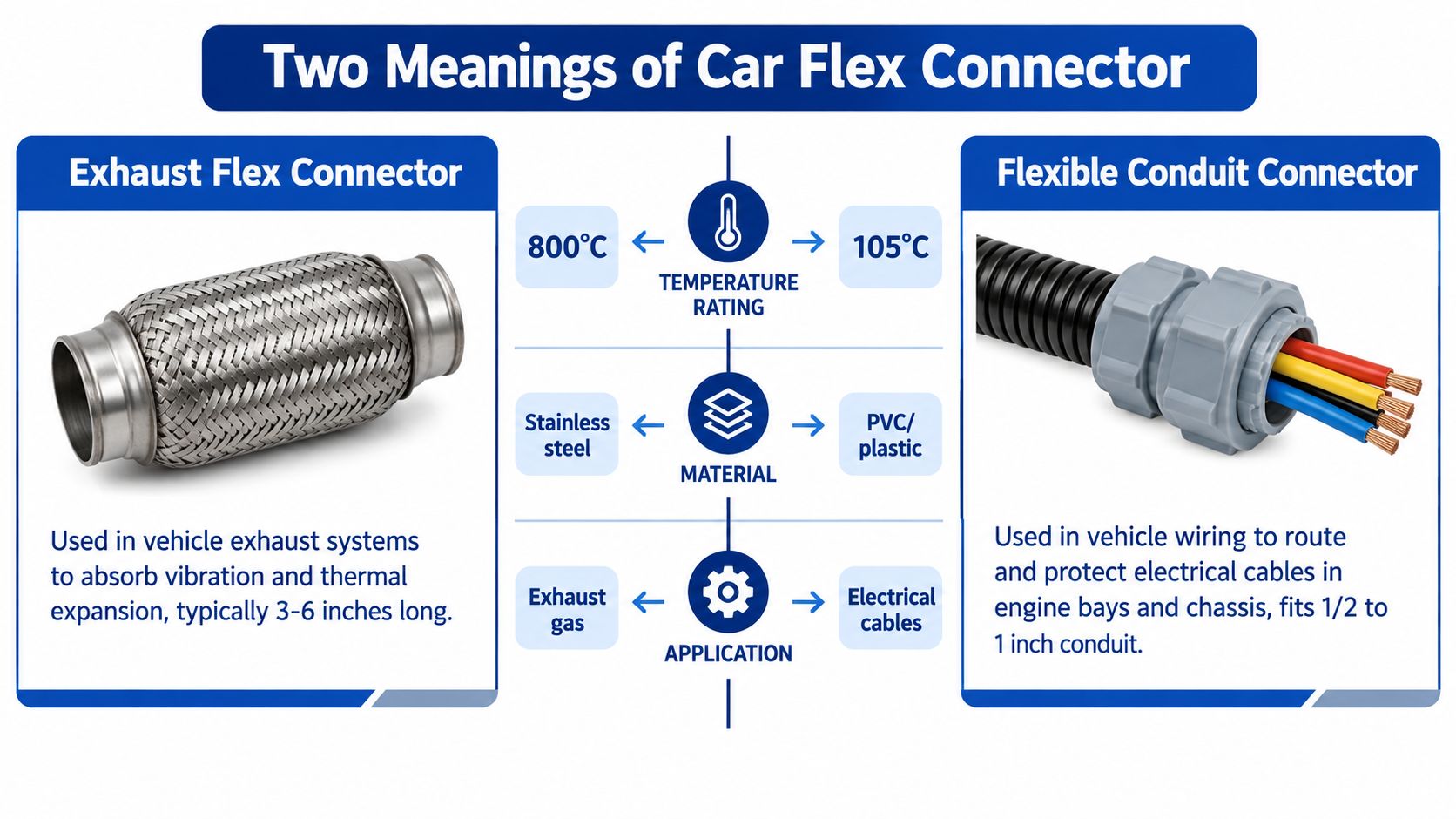
The biggest split is between exhaust flex connectors and electronics or wiring flex connectors. They solve completely different problems.
Exhaust flex connector
This is the braided or formed flexible section in the exhaust system. Its job is mechanical. It takes up movement from engine motion, road vibration, and thermal expansion so the rigid exhaust sections don't crack or transmit as much noise.
Industry guidance notes these parts were designed to reduce noise and vibration, are commonly installed between the exhaust manifold and front pipe in front-wheel-drive vehicles, and may need working ranges up to 650°C or 800°C depending on location, as described in Triscan's exhaust flexible connector guidance. That's why front-pipe placement and rear-muffler placement are not the same buying decision.
Typical buyer questions are different here:
- Where in the exhaust will it sit
- How much heat will it see
- How much movement must it absorb
- Is the failure from cracking, fraying, or poor fitment
Electronics flex connector
This one lives in the vehicle's electrical architecture. It joins a flexible flat cable or flexible printed circuit to a board, wire assembly, or compact module. The job here is electrical continuity in a small space, with enough retention to survive service handling and vehicle conditions.
This category exists because vehicle electronics became much denser over time. Connector history references trace flex cable connectors as a distinct category back to the 1970s, and by the 1990s rising wiring complexity and networked electronics had already pushed connector design toward higher reliability and compactness, according to the Connector Book connector timeline.
Fast self-selection test
If you need a quick divide, use this:
| Need on the vehicle | You likely need | What matters most |
|---|---|---|
| Absorb engine movement in exhaust path | Exhaust flex connector | Heat, placement, construction |
| Join a flat cable to a board or compact module | FFC/FPC or flex-to-board connector | Pitch, retention, current, temperature |
| Route and protect conductors through a flexible pathway | Flexible conduit connector | Seal, thread fit, conduit compatibility |
If the part carries gas, don't shop it like a signal connector. If it carries signal, don't shop it like a pipe repair part.
A lot of returns happen because buyers compare only the outside shape. Function has to come first.
Carflex Flexible Conduit System Overview and Core Components
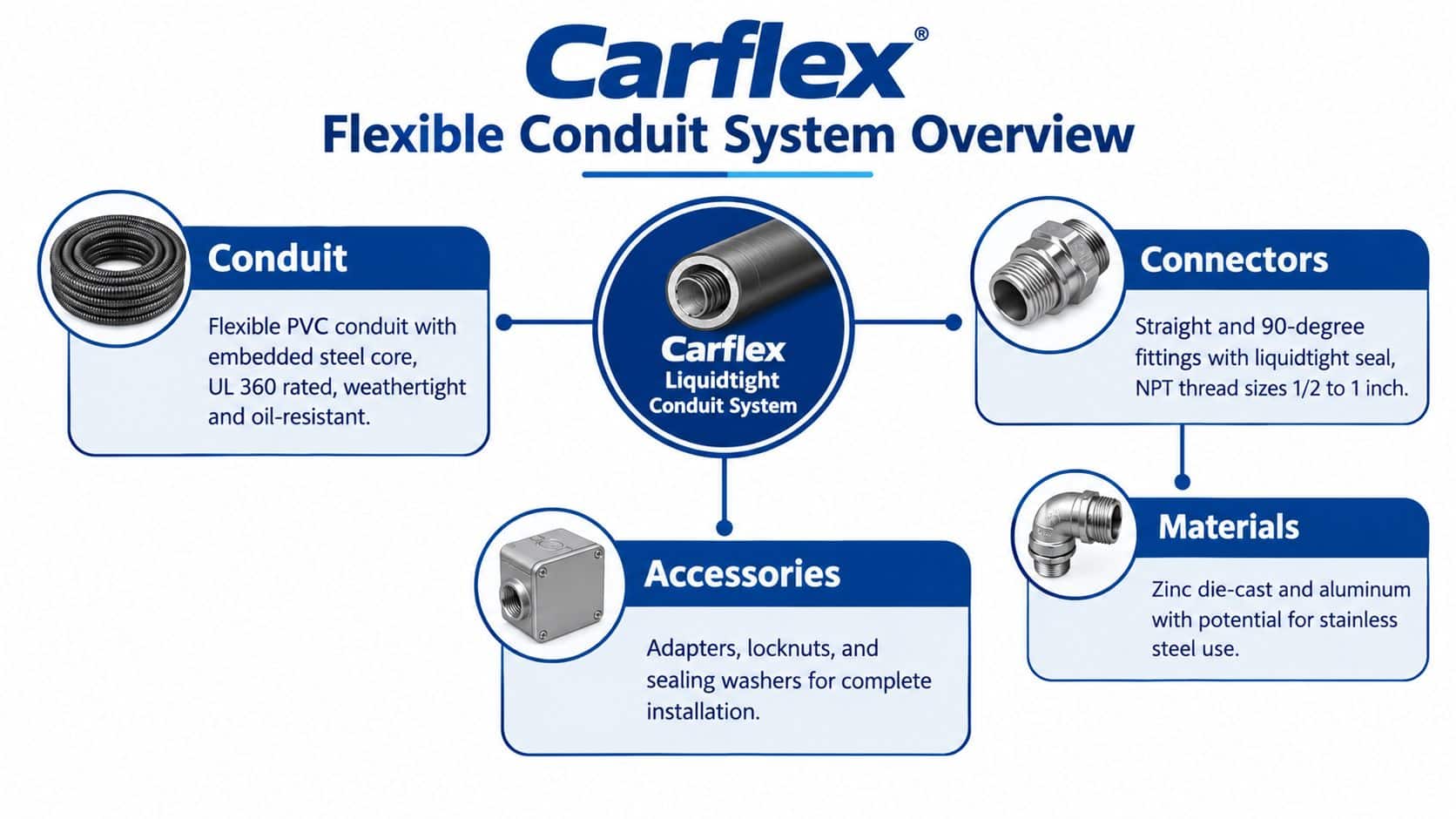
When buyers say “Carflex,” they sometimes mean a liquidtight flexible conduit system rather than an exhaust or board-level connector. That's common in electrical contracting, vehicle upfit work, industrial skids, and equipment enclosures where conductors need both protection and some movement tolerance.
What the system actually includes
A flexible conduit system is not just a tube with a fitting on the end. It's a matched set of parts:
- Conduit body for routing and bend allowance
- Connector or fitting for entry into a box, enclosure, or hub
- Locknut, sealing washer, or adapter depending on the mounting style
- Enclosure interface that has to match thread and sealing requirements
If one piece is mismatched, the whole run suffers. The usual field problem isn't dramatic failure. It's a slow issue like poor sealing, movement at the connector throat, or a conductor pathway that gets stressed because the fitting angle was wrong.
Why people choose flexible conduit systems
Rigid raceway works when the path is stable and space is generous. Flexible conduit gets chosen when the route has vibration, movement, awkward geometry, or wet and dirty exposure. That's why it shows up around machinery, equipment skids, roof penetrations, outdoor enclosures, and retrofit work where exact alignment is unrealistic.
For contractors comparing raceway options, ATEK's conduit, raceway, and cable support categories are the kind of product grouping that helps narrow whether the application calls for flexible conduit fittings or a different raceway family entirely.
The connector's real job
The connector in this system does more than “attach” the conduit. It has to:
- Maintain mechanical retention so the conduit doesn't back out under motion
- Preserve the seal where moisture, washdown, or grime are present
- Match the hub or entry point without improvised adapters that create leak paths
- Avoid over-compressing the conduit jacket during tightening
What works is using a fitting matched to both conduit type and enclosure entry. What doesn't work is assuming all flexible conduit fittings grab and seal the same way. They don't.
A connector that fits physically but doesn't compress the jacket correctly can look installed and still fail in service. That's the sort of mistake that stays hidden until inspection, corrosion, or intermittent electrical trouble shows up later.
How to Choose the Right Car Flex Connector for Your Application
Selection gets easier once you stop treating all flex connectors as one bucket. Buyers do better when they sort by application first, then by the few specs that control fit and life.
Start with the environment, not the catalog page
For exhaust flex connectors, begin with location in the system. Front-end positions closer to engine heat demand more thermal margin than rear sections. The “best” choice depends on installation location, thermal loading, and engine layout. That's where many general retail listings fall short. They show a generic replacement, not a use-case match.
For electronics flex connectors, the environment means vibration, service access, and operating temperature. A board-level connector in a compact infotainment assembly is not the same selection problem as one in a harsher module with more thermal cycling.
Use the core filters that actually matter
For electronics connectors, current market demand is rising because vehicles carry more electronics and more electrified subsystems. One market report values the global flexible flat cable connector market at $4.8 billion in 2025 and projects $9.1 billion by 2034 with a 7.3% compound annual growth rate. The same report says Asia Pacific held 48.6% of global revenue, and a single battery electric vehicle typically uses 90 to 150 individual FFC and FPC connectors across systems such as battery management, infotainment, ADAS, onboard chargers, and thermal modules. It also states global EV sales exceeded 17 million units in 2025. Those figures are from the Dataintelo flexible flat cable connector market report.
That trend matters because it changes the buying mindset. These aren't niche parts anymore. They're standard interconnect decisions in electronics-dense platforms.
Car Flex Connector Selection Matrix by Application
| Application | Key Requirement | Recommended Connector Attribute |
|---|---|---|
| Front exhaust section | Thermal load and movement absorption | Exhaust flex connector chosen by placement and heat exposure |
| Rear exhaust repair | Vibration isolation with lower thermal load than front location | Exhaust flex connector matched to downstream location |
| Infotainment flex tail | Compact board connection and controlled insertion | FFC/FPC connector with matching pitch and ZIF retention where service access matters |
| Sensor or compact module | Stable contact in small package | Flex-to-board connector with automotive-grade validation and controlled contact resistance |
| Vehicle-adjacent enclosure or equipment wiring | Sealed conductor entry with movement tolerance | Liquidtight flexible conduit connector matched to conduit and hub |
The practical decision tree
Use this order when reviewing a part line:
- Define the mating interface. Pipe to pipe, flex tail to board, or conduit to enclosure.
- Match the working environment. Heat, vibration, fluid exposure, or service handling.
- Check physical geometry. Pitch, orientation, angle, thread, hub, or install space.
- Review retention method. Braid construction, ZIF latch, contact system, or conduit compression seal.
- Confirm service expectations. One-time install, repeated access, or long-term fixed assembly.
A connector that barely fits on paper usually fails in the field. Leave room for assembly reality, not just drawing reality.
Detailed Connector Types and Specifications Explained
The part families separate cleanly. If you're buying by appearance alone, skip that habit. Construction details decide whether the connector survives the application.
Exhaust flex connectors by use case
An exhaust flex connector is selected around movement and heat, not signal specs. The main trade-off is simple. A unit installed near the manifold sees much harsher heat than one farther downstream, so the buyer has to account for location first. A generic “universal” listing often ignores that.
What works is specifying by actual placement. Front-pipe service and rear-section service are different jobs. What doesn't work is replacing a hotter-location connector with a lower-temperature option just because the diameter looks close.
Automotive flex-to-board connector families
For signal interconnects in vehicles, automotive qualification references matter more than marketing language. Product documentation for relevant connector families cites USCAR-T2V2 and LV-214 S3 as benchmark standards for high-reliability vehicle interconnects. One example flex-to-board family specifies 1.80 mm pitch, 1 A nominal current per contact, 60 VAC/VDC rating, 25 mΩ maximum initial contact resistance, 500 VAC dielectric withstand, and -40°C to +125°C operating range, as shown in this automotive connector solutions datasheet from Mouser.
Those numbers tell you what kind of application the connector belongs in. This is a compact signal interconnect envelope, not a catch-all power connector.
FFC and FPC ZIF connectors
A representative 0.50 mm-pitch right-angle ZIF connector specifies 30 mating cycles, 30 gf/pin FFC/FPC retention force, 100 gf minimum terminal and stator-plate retention, 50 V AC/DC rating, 0.5 A current rating, 500 MΩ minimum insulation resistance, and -40°C to +105°C operation, according to the Amphenol F305 FFC/FPC datasheet.
Those figures matter in a very practical way:
- Pitch controls fit. If the cable pitch is wrong, nothing else matters.
- Current rating sets limits. Don't treat a compact signal connector like a general-purpose power path.
- Mating cycle rating affects service decisions. Frequent bench rework or repeated field access can wear small ZIF styles faster than buyers expect.
- Retention force matters under vibration. A marginally supported tail can turn a good connector into an intermittent fault.
A lot of intermittent electronic faults come from cable-side mistakes, not bad connectors. Cable thickness, stiffener thickness, and insertion method all affect whether the ZIF mechanism holds as intended.
For buyers comparing fitting and conduit hardware rather than board-level parts, ATEK's flexible conduit fittings product category is one example of where straight, angled, and compatibility-specific fitting options are grouped by application.
Here's a quick visual before the install discussion gets more detailed.
Installation Guidance and Best Practices for Reliable Connections
Selection errors cause one class of problems. Installation errors cause another, and they often look like product defects when they aren't.

For conduit and fitting assemblies
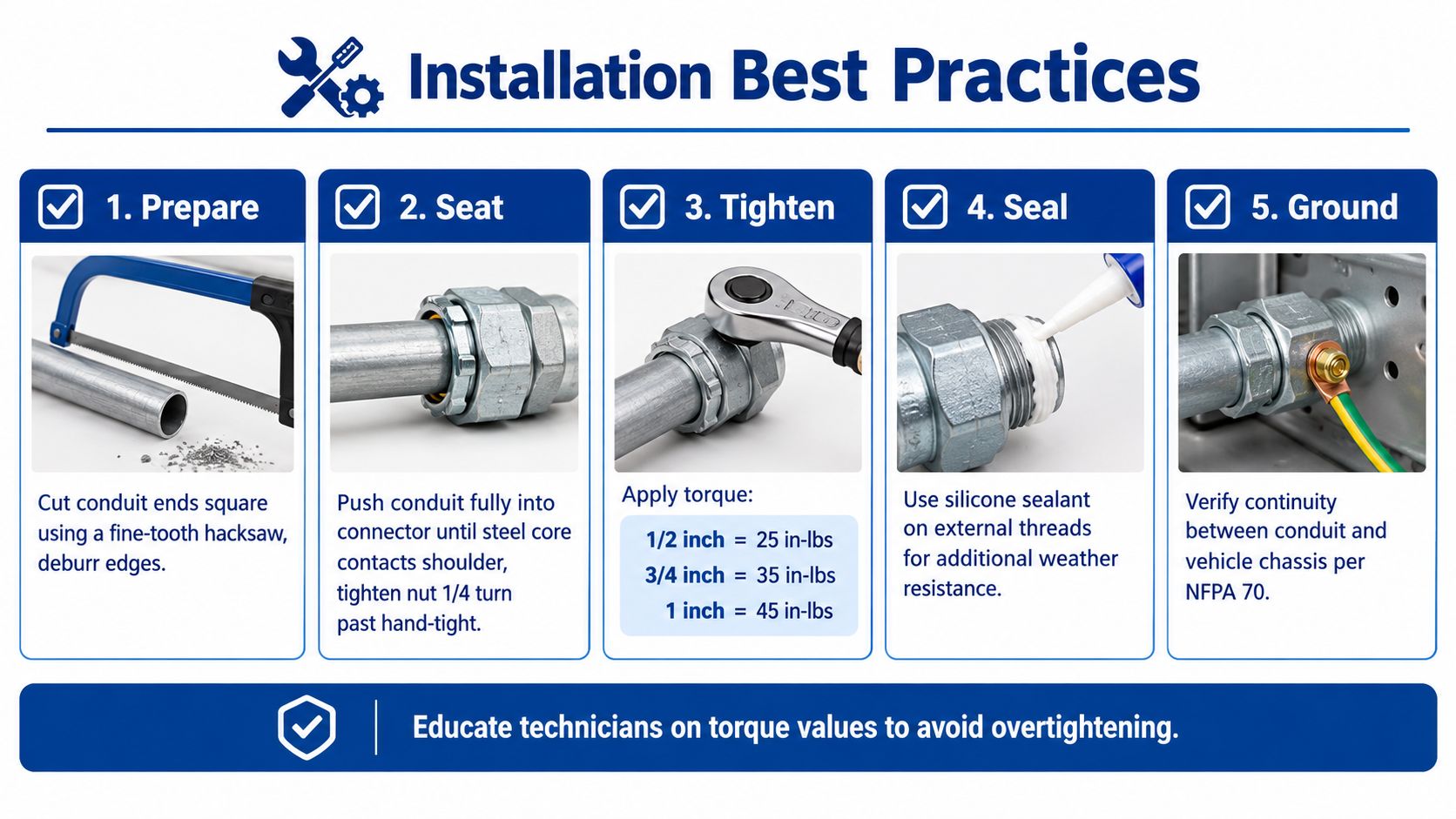
Most failures start at preparation. If the conduit end is rough, out of square, or not fully seated, the connector can't do its job. Installers then tighten harder to compensate, which often makes things worse.
Use a simple discipline:
- Cut cleanly so the end seats correctly.
- Inspect the jacket and core before insertion.
- Seat the conduit fully instead of stopping when resistance first appears.
- Tighten to secure, not crush. Over-tightening can distort the interface and shorten service life.
- Verify continuity and sealing after the assembly is fixed in place.
For FFC and FPC connectors
Small flex connectors fail most often during insertion. The common causes are crooked entry, upside-down contact orientation, wrong stiffener thickness, or forcing the actuator.
What works:
- Open the latch fully before insertion.
- Confirm the exposed conductor side matches the connector contact orientation.
- Insert the tail straight, not at an angle.
- Check that the stiffened tail seats evenly across the width.
- Close the latch without forcing it.
What doesn't work is “feeling it in” on a tiny connector in poor lighting. That's how traces get scarred and latches get cracked.
On ZIF parts, the cable usually tells the truth before the connector does. If the tail shows scrape marks, bent reinforcement, or uneven seating lines, pull it and correct the setup.
Inspection habits that prevent repeat failures
After installation, don't stop at continuity alone. A connector can pass an initial electrical check and still be one vibration cycle away from trouble.
Use a short verification routine:
- Mechanical check for pullout resistance or latch engagement
- Visual check for full insertion and no jacket damage
- Routing check so the cable or conduit isn't carrying strain at the connector throat
- Environmental check for heat, splash, abrasion, and unsupported movement
For termination supplies, accessories, and related install hardware, buyers often need the companion items as much as the connector itself. A category view like ATEK's wire termination and supplies is useful when the original issue is incomplete installation hardware rather than the connector body.
Common Compatibility Issues and Troubleshooting Solutions
Field troubleshooting goes faster when you match the symptom to the likely mismatch.
Exhaust noise or early repeat failure
If an exhaust flex connector fails early, the first question is placement. A connector chosen without enough thermal margin for its location won't last the way the buyer expects. The next check is movement. If the system is carrying more engine motion than the flex section was meant to absorb, the failure will come back even after replacement.
Corrective action is usually to verify actual install position, not just nominal pipe size.
Conduit fitting loosens or leaks
This usually traces back to one of three issues:
- Wrong conduit-to-fitting match
- Poor seating at the fitting throat
- Over-tightening that distorted the sealing interface
The fix isn't just “tighten again.” Remove, inspect the conduit end, confirm compatibility, and rebuild with the correct fitting geometry if necessary.
Intermittent board-level signal problems
On electronics flex connectors, intermittent faults are often dimensional. The cable may have the wrong pitch, wrong exposed-contact orientation, or the wrong tail build for the connector. In service work, the latch may also be partially closed over a misaligned tail.
Check these fast:
| Symptom | Likely cause | First correction |
|---|---|---|
| No contact on all positions | Wrong pitch or wrong orientation | Confirm cable and connector match |
| Some positions intermittent | Crooked insertion or poor latch closure | Reinsert and inspect tail alignment |
| Works on bench, fails in vehicle | Weak retention or poor strain routing | Support the tail and review retention method |
| Damage during service | Too many repeated insertions for the connector style | Replace worn connector and review service practice |
Overheating or discoloration
On signal connectors, overheating usually points to using a compact connector outside its intended current envelope or to poor contact integrity from bad insertion. On conduit systems, visible jacket distress near a fitting can indicate mechanical stress or exposure the assembly wasn't chosen for.
The shortest path to a real fix is to stop assuming all “flex connectors” are interchangeable. They aren't, even within the same general family.
Quick Reference Glossary and Cross Reference Lookup
This is the part most buyers end up bookmarking.
Glossary of terms buyers actually use
- Exhaust flex connector. Flexible section in the exhaust path that absorbs vibration and thermal expansion.
- FFC. Flexible flat cable used for compact electrical interconnects.
- FPC. Flexible printed circuit, often used similarly to FFC in compact vehicle electronics.
- ZIF connector. Zero insertion force connector that uses a latch or actuator to secure the flex tail.
- Flex-to-board connector. Connector family joining a flexible circuit or cable to a rigid board.
- Pitch. Center-to-center spacing of conductors or contacts. This must match.
- Retention force. Mechanical holding force that keeps the cable or terminal in place.
- Liquidtight flexible conduit connector. Fitting used to terminate flexible conduit into a box, enclosure, or hub while preserving a sealed pathway.
Fast reorder checklist
Before reordering a car flex connector, verify these items from the failed or existing part:
- Application identity. Exhaust, board-level electronics, or conduit system.
- Mating side details. Pipe ends, cable tail format, board connector series, or hub thread.
- Critical environment. Heat, vibration, moisture, chemical exposure, or service access.
- Dimensional fit. Pitch, orientation, angle, conduit size, or mounting style.
- Failure pattern. Leak, pullout, intermittent contact, worn latch, or thermal distress.
Cross reference by buying situation
If the request says “front exhaust flex,” start with location and heat exposure.
If the request says “radio ribbon connector” or “screen flex connector,” start with pitch, orientation, current, and retention style.
If the request says “Carflex connector” from a contractor or maintenance team, ask whether they mean a flexible conduit fitting entering a box or enclosure. In practice, that's often what they mean.
Buy by interface first, slang second. That one habit eliminates a surprising number of wrong orders.
The buyers who make the fewest mistakes don't memorize every connector family. They ask sharper first questions, capture the mating details, and refuse to substitute across categories just because a product title uses the same word.
ATEK Distribution helps contractors, fleet support teams, engineers, and procurement buyers source conduit fittings, electrical infrastructure components, and hard-to-match accessories when a vague “car flex connector” request needs to become a correct line item. If you need help narrowing conduit-related options, reviewing compatibility, or sourcing difficult electrical products, visit ATEK Distribution.