
You open a panel, look at the raceway terminations, and realize the conductors are already in. Big feeders. Tight bend space. Shutdown window is short, or maybe there isn't one. A standard grounding bushing would mean backing up the job and pulling wire just to get the fitting on. That's where a split grounding bushing stops being a throwaway line item and starts being a real field solution.
A lot of people treat these as a specialty version of a plastic throat bushing. That's not what they are. A split grounding bushing is a bonding fitting first, with conductor protection built into it. The split body lets you install it around existing conductors and over the raceway end without disturbing a completed pull. On retrofit work, service upgrades, troubleshooting, and inspection corrections, that design can save a lot of unnecessary labor.
What matters in the field is simple. You need the right fitting for the raceway, the right lug range for the bonding conductor, and the right listing for the application. If any one of those is wrong, the fitting may still go on, but it won't solve the inspection issue and it may not satisfy the installation requirement that drove the call in the first place.
Table of Contents
- Introduction to Split Grounding Bushings and Why They Matter
- What a Split Grounding Bushing Does for Bonding and Protection
- Split Versus Solid Grounding Bushings and When to Choose Each
- Anatomy and Materials of a Split Grounding Bushing
- Compatibility Guide for Conduit Types and Trade Sizes
- Code and Application Reference for When Grounding Bushings Are Required
- Installation Tips and Field Best Practices
- Quick Reference Lookup and Cross References and Procurement Support
Introduction to Split Grounding Bushings and Why They Matter
The classic split grounding bushing job goes like this. Feeders are already pulled into a switchboard or gutter. Someone catches that the raceway termination needs a bonding means and conductor protection at the enclosure entry. The solid one-piece bushing sitting in the gang box won't help unless the conductors come back out.
That's why the split design exists.
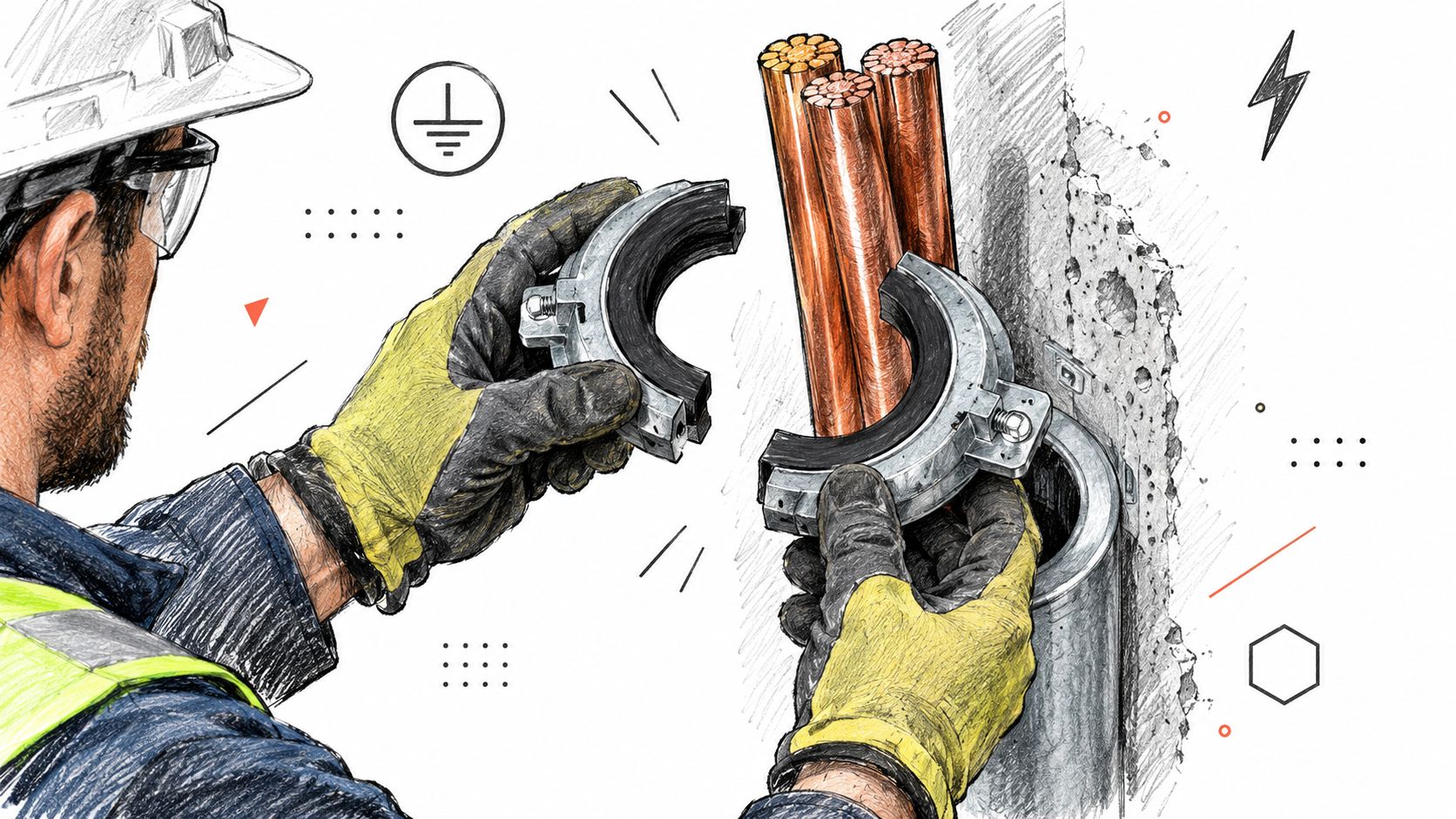
A split grounding bushing is built to go on after the pull. The body separates so it can fit around existing conductors, then closes onto the raceway end. It gives you an insulated throat at the conduit opening and a lug for the bonding connection. That combination is what makes it useful on service raceways, large feeders, gear replacements, and correction work after an inspector calls out the termination.
Why the split feature matters in the real world
On new construction, if the raceway is empty, a standard solid grounding bushing may be fine. On retrofit work, it often isn't practical. Nobody wants to disturb an existing pull if they can avoid it. Large conductors don't slide out and back in like branch circuit wire. You're dealing with pulling tension, wire makeup, termination space, and schedule risk.
Field reality: The value of a split grounding bushing isn't the part itself. It's the pull you don't have to redo.
The people who benefit most are the ones who get handed these problems late in the job. Contractors doing service work. Maintenance teams working in occupied facilities. Specifiers and purchasing teams trying to keep submittals clean before material lands on site. If you're buying or installing for service entrances, transformer secondary feeders, panelboard replacements, or switchgear retrofits, this fitting deserves more attention than it usually gets.
What a Split Grounding Bushing Does for Bonding and Protection
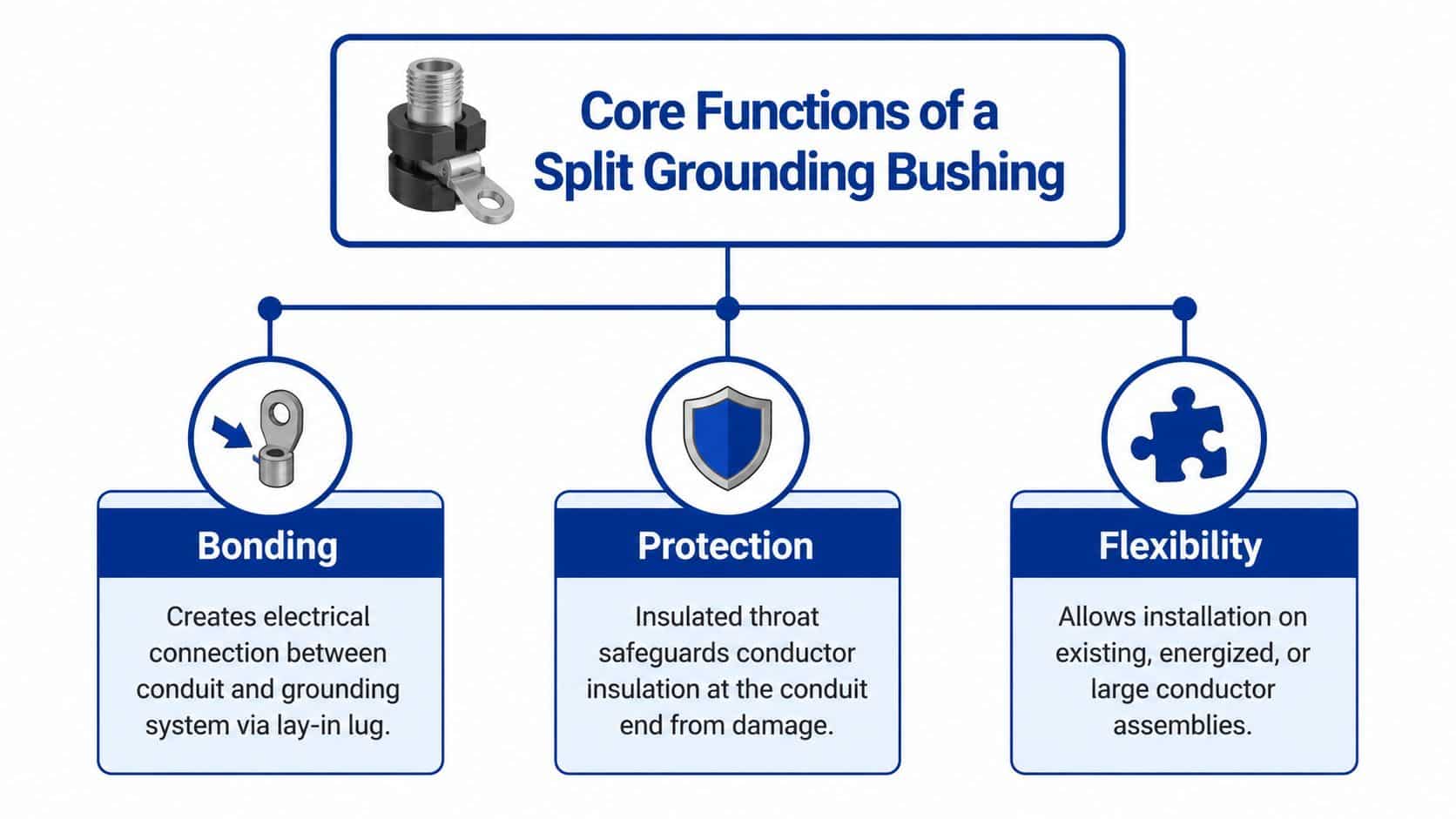
A split grounding bushing does three jobs at once. It protects conductor insulation at the raceway end, it gives you a means to bond the raceway, and it solves installations where a one-piece fitting can't be installed after conductors are already in place.
It is bonding equipment, not just a wire protector
This is the first thing that gets missed. The insulated throat matters, but the fitting's real purpose is bonding continuity. The lug on the bushing lets you land a bonding jumper so the metallic raceway is tied into the grounding and bonding path the way the installation requires.
That's why it helps to think of this fitting as part of the raceway bonding assembly, not as a comfort accessory for the conductors. If you're dealing with metallic conduit entries at service equipment, switchboards, panelboards, or similar enclosures, that distinction matters.
Bridgeport's installation literature ties this type of product to UL 514B and UL 467 for threaded RMC and IMC fittings and references NEC Articles 250.64, 250.92, 344.46, and 300.4(G), including applications involving conductors 4 AWG or larger in certain setups, as shown in the Bridgeport grounding bushing installation manual.
The three practical functions
- Bonding the raceway: The lug accepts the bonding conductor so the raceway termination isn't relying on questionable metal-to-metal contact alone where a positive bonding means is expected.
- Protecting the insulation: The insulated throat separates conductor insulation from the conduit edge at the point of entry.
- Handling retrofit conditions: The split body installs around existing conductors, which is the whole reason people ask for this fitting in the first place.
For related enclosure and accessory categories that often get ordered alongside these fittings, it helps to review broader electrical boxes and accessories when you're matching raceway terminations to cabinets, pull boxes, or equipment housings.
A split grounding bushing earns its keep when the conduit is already terminated, the conductors are already landed, and the only bad option is pulling everything back out.
What failure looks like without one
In the field, the problem usually shows up one of two ways. Either the conductor jacket is bearing against a rough raceway edge, or the raceway bonding path at the enclosure entry isn't being accepted as installed. Both problems tend to surface late, when the gear is set and the conductors are already where they need to stay.
That's why these fittings show up so often on punch lists and service corrections. They solve two issues at the same location with one listed fitting, provided the trade size and lug range are right.
Split Versus Solid Grounding Bushings and When to Choose Each
Most ordering mistakes happen because somebody chooses by appearance instead of job condition. Split and solid grounding bushings do the same broad job, but they do not fit the same installation sequence.
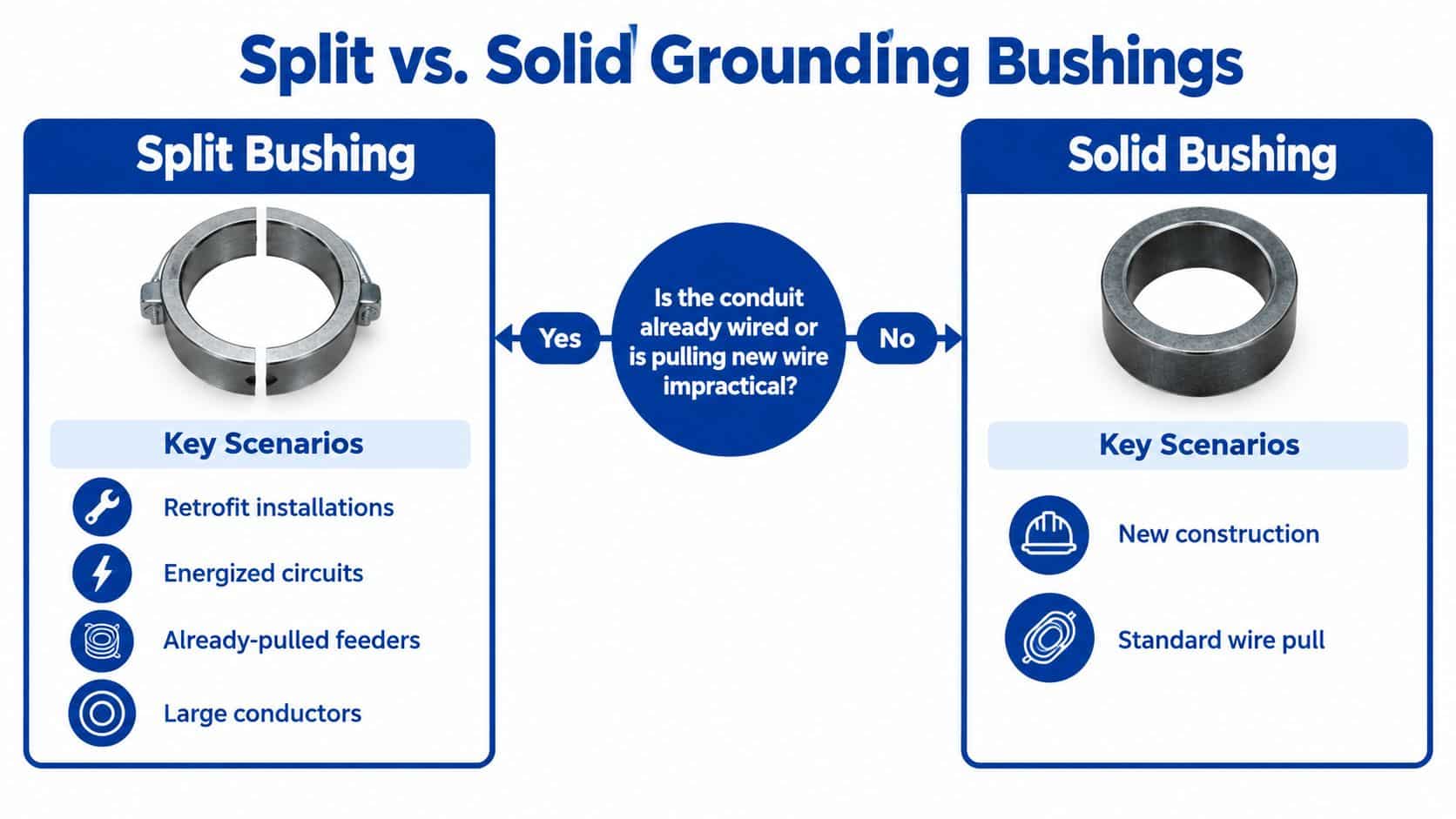
If the conduit is empty and you're still in rough-in or early trim, a solid grounding bushing is usually the straightforward choice. If the conductors are already pulled, terminated, or difficult to remove, the split style is usually the one that saves the day.
The basic rule for choosing
Use a split grounding bushing when:
- conductors are already installed
- shutting down and disconnecting is a problem
- the feeder pull would be expensive or risky to disturb
- the work is corrective, retrofit, or tied to an inspection deficiency
Use a solid grounding bushing when:
- the raceway is not yet wired
- you can install the fitting before the pull
- it's standard new construction with no access problem
- there's no need for post-pull installation
Split vs Solid Grounding Bushing Decision Matrix
| Condition | Split Bushing | Solid Bushing |
|---|---|---|
| Existing feeders already in conduit | Best fit | Usually impractical |
| New construction before conductors are pulled | Acceptable, but often unnecessary | Best fit |
| Service correction after failed inspection | Strong choice | Often requires rework |
| Large conductors with limited slack | Strong choice | Often difficult |
| Quick replacement without disturbing terminations | Best fit | Weak fit |
The trade-offs nobody should ignore
Split bushings solve access problems, but they also demand more attention at ordering. You need to confirm that the split design matches the raceway type, trade size, and conductor situation. Installers also need to make sure the two-piece body seats correctly and the insulated throat is doing its job all the way around the conductor entry.
Solid bushings are simpler when the install sequence is clean. Fewer moving parts. Less chance of someone ordering the wrong retrofit style for a straightforward rough-in. But once the conductors are in, that simplicity disappears fast.
Practical rule: Don't buy a split grounding bushing just because it sounds more versatile. Buy it because the installation sequence requires it.
From a distributor side, many submittal errors start here. People assume “grounding bushing” is specific enough. It isn't. You need to call out split or solid, raceway type, trade size, and lug range. If the buyer leaves any of that vague, the field crew may get a perfectly good fitting that still can't be installed.
Anatomy and Materials of a Split Grounding Bushing
A split grounding bushing looks simple until you compare submittals side by side. Then you see where quality and compatibility live. Body material, insulator rating, lug alloy, and hardware all matter because this fitting is doing both mechanical and electrical work at a raceway termination.
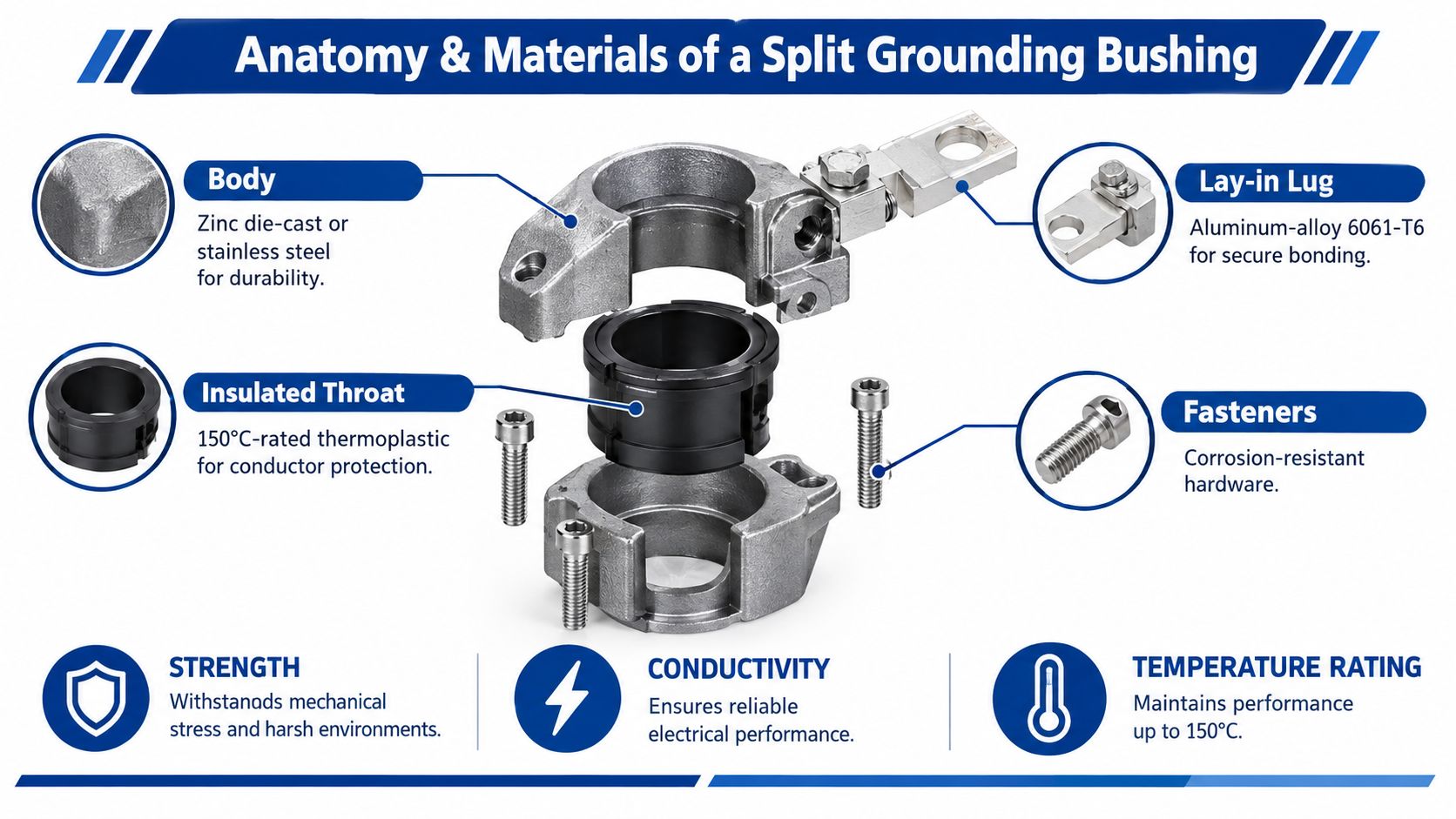
Seattle City Light's field standard is useful here because it spells out what a split-type grounding insulated throat bushing is expected to include. It identifies the split type as non-threaded, with zinc die-cast or stainless-steel construction, an aluminum-alloy 6061-T6 grounding lug, and a 150°C-rated thermoplastic insulator, with a grounding wire range of #6 AWG to 3/0 in that standard, as shown in the Seattle City Light grounding bushing standard.
What each piece is doing
The body gives the fitting its clamp strength and physical durability. Zinc die-cast is common and practical for many indoor and general applications. Stainless-steel versions make sense where corrosion exposure is more of a concern.
The insulated throat protects conductor insulation where it enters the enclosure through the raceway. The rating matters because this part sits right at the contact point that can otherwise scar insulation during installation or over time.
The lay-in lug is where the bonding conductor lands. On split designs, this part matters as much as the body. If the lug range doesn't match the conductor you need to terminate, the fitting is wrong even if the raceway size is correct.
What to look for in submittals and stock descriptions
- Body construction: Check whether the body is zinc die-cast or stainless steel, and whether that matches the environment.
- Insulator material: Confirm the throat is insulated and rated as specified for the application.
- Lug construction: Verify the lug material and conductor range before release.
- Mounting style: Don't assume all grounding bushings are threaded. Split types are often selected specifically because they clamp on after the pull.
For buyers comparing rigid and IMC fitting families, this is also where it helps to look at broader rigid and IMC conduit fittings so the bushing choice stays aligned with the rest of the raceway package.
A cheap listing description that only says “grounding bushing” is not enough. If the material, lug, and split-body details aren't clear, ask before it ships.
Compatibility Guide for Conduit Types and Trade Sizes
Compatibility is where these fittings either solve the problem or create a second one. A split grounding bushing can be exactly what the job needs, but only if it matches the raceway and the bonding conductor you're using.
Start with raceway type, not catalog habit
The first check is whether the fitting is intended for the conduit system on the job. Manufacturer literature commonly ties split grounding bushings to threaded RMC or IMC applications. That matters because many crews casually say “conduit” and leave it at that. In purchasing, that shortcut causes misses.
If you're working in an environment that uses multiple raceway systems, don't assume a bushing selected for rigid or IMC crosses over to every other fitting family. For raceway package review, some buyers also compare adjacent product categories such as EMT conduit fittings so they don't mix hardware across systems.
Check trade size and lug range together
A common mistake is matching the raceway size and forgetting the grounding conductor range at the lug. That's how you end up with a bushing that physically fits the conduit but won't accept the bonding conductor you planned to land.
Seattle City Light's standard gives a clear example of a split type with a lug range of #6 AWG to 3/0. That doesn't mean every product on the market uses that same range. It means you should treat lug compatibility as a separate verification item every time.
Split Grounding Bushing Size and Wire Range Lookup
| Trade Size | Conduit Type | Lug Wire Range |
|---|---|---|
| Match manufacturer listing | Threaded RMC | Verify by product submittal |
| Match manufacturer listing | Threaded IMC | Verify by product submittal |
| Larger feeder raceways | Threaded RMC or IMC | Confirm lug accepts planned bonding conductor |
| Service raceway terminations | Threaded RMC or IMC | Check conductor range before approval |
| Split type per field standard example | As specified by product standard | #6 AWG to 3/0 |
Practical selection cues from the field
For a smaller feeder raceway, the main concern is usually straightforward fit. For a larger service raceway, the question becomes whether the bushing will sit correctly at the conduit end, whether there's room around existing conductors, and whether the lug can be landed cleanly without crowding adjacent hardware.
When I review these for submittal support, I look for four things right away:
- Exact trade size listed by the manufacturer
- Conduit system compatibility stated plainly
- Lug wire range shown in the product data
- Listing references included in the cut sheet or installation sheet
The fastest way to create a field delay is to approve a split grounding bushing by trade size alone.
Also watch the termination area itself. Some enclosure entries are crowded enough that the lug orientation matters. A fitting may technically fit the conduit and still be awkward once the bonding conductor, locknut, and neighboring raceways are all in play. That's not a code issue. It's a jobsite reality issue.
Code and Application Reference for When Grounding Bushings Are Required
People either overstate the requirement or undersell it. The safe path is to stay tied to product listing and installation literature, then apply that to the actual raceway condition in front of you.
Where the standards fit
Split grounding bushings are not some off-book field fix. UL 467 formally covers grounding and bonding equipment, and the 2022 edition explicitly lists grounding bushings among the equipment it governs. The current edition is UL 467 Ed. 11-2022, published on November 1, 2022, as shown in the UL 467 standard listing.
That matters during submittal review because it confirms grounding bushings remain part of an actively maintained safety standard used for grounding systems and bonding equipment.
Where inspectors commonly expect to see them
Manufacturer installation literature is often the cleanest practical guide. The Bridgeport manual cited earlier references NEC Articles 250.64, 250.92, 344.46, and 300.4(G) and points to situations involving threaded RMC or IMC fittings, bonding requirements, and conductors 4 AWG or larger in certain setups. In practice, that puts these fittings in the conversation around:
- service raceway terminations
- switchgear and switchboard entries
- panelboard and gutter terminations
- transformer and distribution equipment enclosures
- larger conductor entries where insulation protection is part of the requirement
What inspectors are usually checking
They're typically looking for a listed bonding means that fits the raceway method and the application. If the installation needs a grounding bushing, the inspector wants to see a fitting intended for that job, not a standard insulating bushing standing in for a bonding device.
They may also look at whether the bonding jumper is landed and whether the fitting used is consistent with the raceway type. A split grounding bushing can satisfy the installation condition well, but only if the product is listed and installed as part of the bonding path, not just snapped in place as edge protection.
If the raceway termination needs bonding continuity and conductor protection, a plain insulated throat by itself may not answer the callout.
For service equipment and larger feeder work, this is why listing language belongs in the submittal package. It reduces field arguments before the carton is even opened.
Installation Tips and Field Best Practices
A split grounding bushing goes in fast when the prep work is right. It turns into a callback when the installer rushes the fit check or treats the lug like an afterthought.
A clean field sequence
Start with safe work practice. De-energize where required, verify the condition of the equipment, and make sure you have room to work at the raceway end. Split fittings are often used where access is already tight, so don't skip the layout check.
Then install in this order:
- Verify the raceway and fitting match. Confirm trade size, conduit type, and lug range before opening the package.
- Inspect the raceway end. If the conduit end is damaged, out of round, or rough, fix that first. The bushing won't correct bad pipe prep.
- Place the split body around the conductors and onto the raceway. Make sure both halves seat correctly.
- Secure the fitting fully. The insulated throat should sit where it protects the conductor entry, not half engaged or cocked to one side.
- Land the bonding conductor in the lug. Use the correct conductor for the lug range and terminate it cleanly.
- Complete your final checks. Look at mechanical fit, throat position, bonding path continuity, and enclosure connection.
What goes wrong most often
The most common problem is ordering the wrong size. Right behind that is using a fitting with the wrong lug range. Third is poor seating of the split body, where one side looks closed but the throat isn't really protecting the conductor entry the way it should.
Other misses show up in the bonding jumper installation:
- Loose planning: The crew has the right bushing but no conductor that matches the lug.
- Bad access choices: The lug ends up oriented where it can't be landed properly.
- Half-finished bonding: The bushing is installed, but the enclosure bond isn't completed as intended.
- Inspection surprises: The fitting is physically on the job, but the listing or application match can't be shown.
Why the split design saves real time
On occupied facilities and maintenance work, the split feature keeps crews from reopening terminations and disturbing feeders that are already dressed and landed. That's the whole advantage. If the fitting avoids a repull and still gives you the required bonding and insulation protection, it has done its job.
The mistake is thinking the split design excuses sloppy verification. It doesn't. It just changes the installation sequence in your favor.
Quick Reference Lookup and Cross References and Procurement Support
When you're buying or approving a split grounding bushing, speed matters, but detail matters more. The part has to fit the raceway, accept the bonding conductor, and arrive with the right listing trail for the job file.
Fast glossary for field and purchasing teams
- Grounding bushing: A fitting used to provide a bonding connection at a raceway termination, often with an insulated throat for conductor protection.
- Bonding jumper: The conductor that ties the fitting or raceway into the required bonding path.
- Insulated throat: The protective insulating surface at the raceway entry that helps prevent conductor insulation damage.
- RMC: Rigid Metal Conduit.
- IMC: Intermediate Metal Conduit.
Cross references worth checking on the same takeoff
A split grounding bushing rarely stands alone in a submittal. Depending on the termination detail, you may also need to review bonding locknuts, grounding locknuts, hubs, locknuts, bushings, and enclosure accessories that support the same raceway entry condition.
That's also where one body mention is appropriate. ATEK Distribution can support sourcing and submittal review for electrical fittings and related conduit termination hardware when contractors or procurement teams need help verifying listing coverage, material compatibility, or hard-to-find sizes.
Submittal checklist that prevents bad approvals
- Listing coverage: Verify the fitting is identified under the standards and literature required for the application.
- Trade size match: Confirm the exact raceway size, not just a generic conduit range.
- Conduit type match: Check whether the fitting is intended for threaded RMC, IMC, or another system.
- Lug range: Make sure the bonding conductor you intend to use fits the lug.
- Supplemental listing marks: Review whether the product literature shows items commonly referenced in submittals such as NEMA FB-1, Federal Specification A-A-50553, and cULus when those matter to the project, as noted in the manufacturer literature discussed earlier.
- Material fit for environment: Match zinc die-cast or stainless construction to the job conditions.
- Documentation quality: Don't approve off a one-line catalog description if the application is sensitive.
If you treat a split grounding bushing like a commodity, you'll eventually buy the wrong one. If you treat it like a retrofit bonding solution, you'll ask the right questions before the order leaves the warehouse.
If you're trying to match a split grounding bushing to an inspection correction, a service raceway, or a hard-to-source conduit fitting package, ATEK Distribution can help review the requirement, verify the fit, and support the procurement side with compliance documentation and sourcing options. That's especially useful when the job can't afford a wrong submittal or a second trip just to replace a small but critical fitting.
Prepared with Outrank tool