
You're standing in front of a panel or motor whip with a length of FMC in one hand and a fitting in the other, and the last cut is the one that decides whether the connector seats cleanly or fights you all the way in. A bad end turns into a bent armor strip, a loose fit, a burr that chews insulation, or a rework call after inspection. A flexible metal conduit cutter guide makes more sense when it starts there, because the main issue in the field isn't finding a tool, it's choosing the right cut for the space, the size, and the finish the job needs.
This reference is written for contractors, maintenance teams, specifiers, and anyone who has to make FMC behave on a clock. It puts cutter choice, cut quality, and workmanship checks in one place so you can match the tool to the job instead of forcing the job to fit the tool. The details below are organized by conduit size, access, and finish quality, with practical cross-references for the steps and checks that matter before you pull conductors or set a fitting. For fitting compatibility and related FMC hardware, start with the flexible conduit fittings category.
Table of Contents
- Introduction to Flexible Metal Conduit Cutting
- What Flexible Metal Conduit Is and Why Cut Quality Matters
- Categories of Flexible Metal Conduit Cutters at a Glance
- Detailed Tool Entries With Practical Examples
- How to Cut Flexible Metal Conduit for a Clean Square Finish
- How to Choose the Right Cutter for Your Application
- Safe Practices Tool Care and Workmanship Checks
- Quick Reference Glossary and Related Resources
Introduction to Flexible Metal Conduit Cutting
A service call can go sideways fast when the end of FMC is cut rough enough that the connector won't start straight. The crew may blame the fitting, but the problem is usually the edge, the angle of the cut, or the way the conduit was supported while it was being cut. When the armor strip opens up or the end goes out of square, the installer loses time on site and the inspector gets a reason to pause the work.
What this guide is built to solve
Flexible metal conduit is one of those products where the tool and the technique have to match the material. A flexible metal conduit cutter doesn't just need to sever metal, it has to leave an end that seats properly, protects the conductors, and doesn't fight the connector. That's why the practical question is rarely “what's the strongest cutter,” but “what gives me a clean, square end in this exact condition?”
Practical rule: If the cut end looks torn, flared, or cocked, don't assume the fitting will “pull it in.” FMC usually tells the truth at the first connection point.
The guide is organized for quick lookup. You can jump from the construction basics to the cutter categories, then to tool entries, cutting technique, and the decision factors that matter on the job. If you already know the workspace and conduit size, you can use the comparison sections as a field shortcut instead of reading straight through. If you're checking tool inventory, the entries later in the article separate what works in tight panel spaces from what belongs in the shop.
The focus here is not brand loyalty or sales language. It's workmanship, finish quality, and the trade-offs that show up when a helper is cutting in a cramped mechanical room or an apprentice is batching conduit in the shop. For a standard reference on conduit-related hardware, the internal connections in this article are meant to help you move from the cut to the fitting without losing time to guesswork.
What Flexible Metal Conduit Is and Why Cut Quality Matters
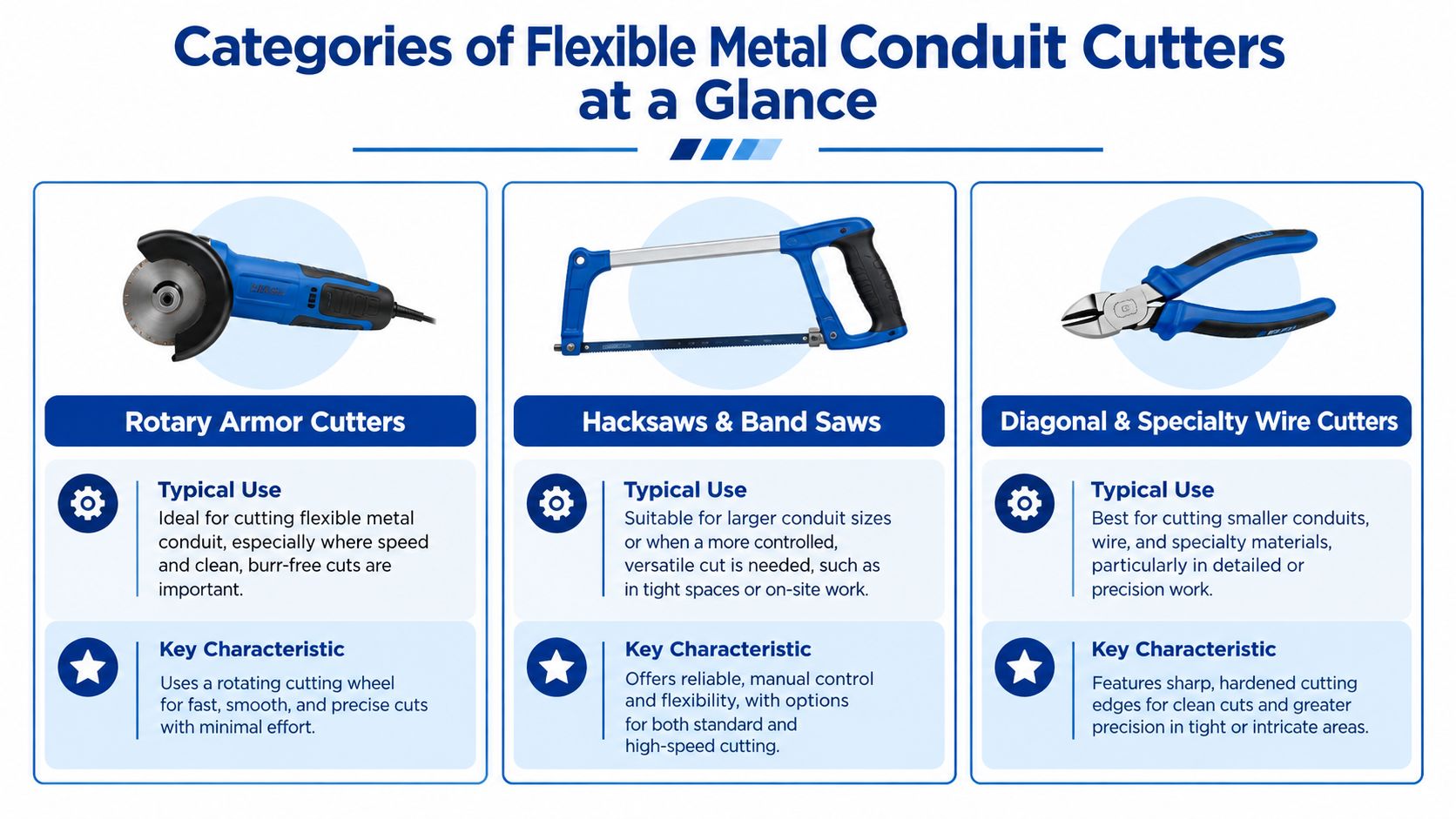
A flexible metal conduit cutter only earns its keep if the end of the conduit still fits the connector cleanly. FMC is built from a helically wound, interlocked metal strip, so a cut can pull, unwind, or flare if the tool and support are wrong. The spiral that gives the conduit its flexibility also makes the cut behave differently from rigid pipe. In the field, that is where workmanship shows up fast.
What the conduit itself demands
The Canadian standard CSA C22.2 No. 56-2017 covers trade sizes 12 (3/8) through 103 (4), excluding 14 (7/16), and it supersedes earlier editions back through 1938 (manufacturer reference PDF). That size range matters because a cutter that behaves well on a small equipment whip can start opening the armor on larger conduit. A tool that feels fine in one room may leave a different result in the next.
Cut quality matters because FMC has to meet the connector without fighting it. A square, burr-free end gives the fitting a better chance to seat properly and lowers the risk of conductor damage at the entry point. A rough cut can leave sharp edges, loose armor, or a crooked termination, and those problems usually show up after the run is already in place.
For fitting and connector work, see the flexible conduit fittings reference at ATEK Distribution.
Why finish quality and tool geometry go together
Field guidance for FMC cutting recognizes rotary armor cutters, hacksaws, and wire cutters such as diagonal cutters. Tool geometry affects the result. For hand hacksaws, 24 to 32 teeth per inch is cited, while band saw guidance runs 24 to 34 teeth per inch at 300 to 350 feet per minute (NEC wiki reference). A sharp hacksaw blade with at least 32 teeth per inch is also recommended for FMC and LFMC, and larger sizes benefit from tape wrapped around the conduit before cutting to reduce flaring or unwinding (Electri-Flex user manual).
A clean FMC cut is about control, not force. Let the tool sever the armor, and keep the conduit supported so the spiral does not open up.
Categories of Flexible Metal Conduit Cutters at a Glance
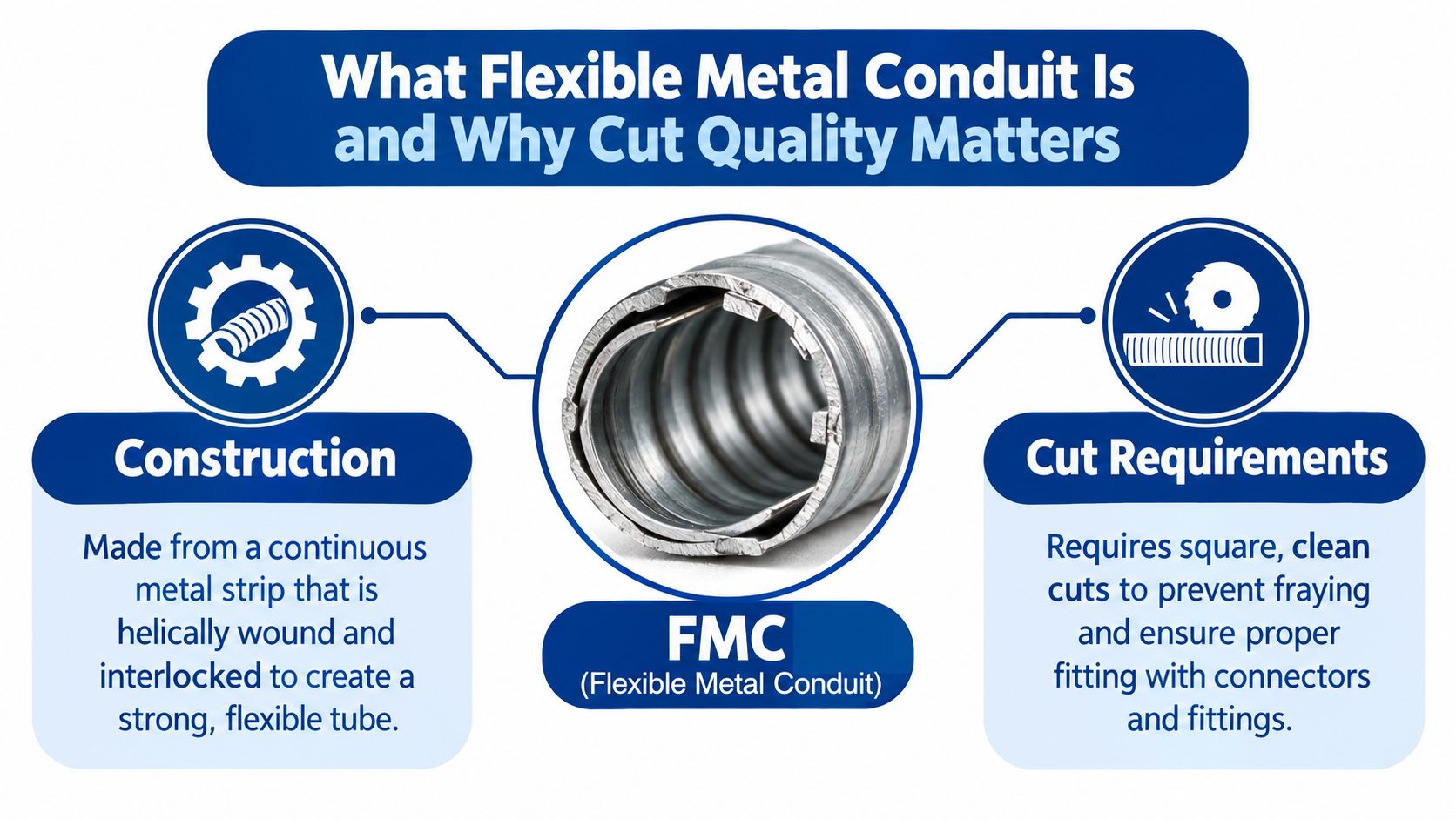
The quickest way to sort a flexible metal conduit cutter is by the job condition, not by the badge on the handle. Some tools are better for cramped field work, some are better for repetitive shop cutting, and some are best used as trim tools after the first cut is already made. The main categories below line up with how electricians use them.
Rotary armor cutters
Rotary armor cutters are the category you reach for when you want a compact tool that is purpose-built for the spiral armor. They're useful in tight spaces, especially where a saw stroke is awkward or where you don't want sparks, heat, or a long setup. The finish is usually cleaner than a rough hand cut, and the tool tends to shine when the cut has to happen right at the point of installation.
Hacksaws and band saws
Hacksaws are the classic field answer, and band saws are the shop answer. Both work by controlling the cut more than by brute force, which is why blade selection matters so much. The right blade geometry produces a cleaner edge, and the workpiece support is what keeps the conduit from opening up while you cut.
Diagonal and specialty wire cutters
Diagonal cutters and similar specialty wire cutters are not the first choice for every full-length cut, but they're useful when you need to trim tabs, clean up a stubborn edge, or work in a place where larger tools can't fit. They give you flexibility at the end of the process, especially when the conduit is already severed and you're refining the fit.
Field takeaway: Think in terms of finish level. Rotary tools and saws handle the main cut, wire cutters often help with cleanup, and the final fit depends on support and inspection as much as on the tool itself.
The practical distinction is simple. Rotary cutters are about portability and controlled cutting. Saws are about predictability and blade choice. Wire cutters are about access and finishing touches. If you identify the constraint first, the category choice gets much easier.
Detailed Tool Entries With Practical Examples
Rotary armor cutter
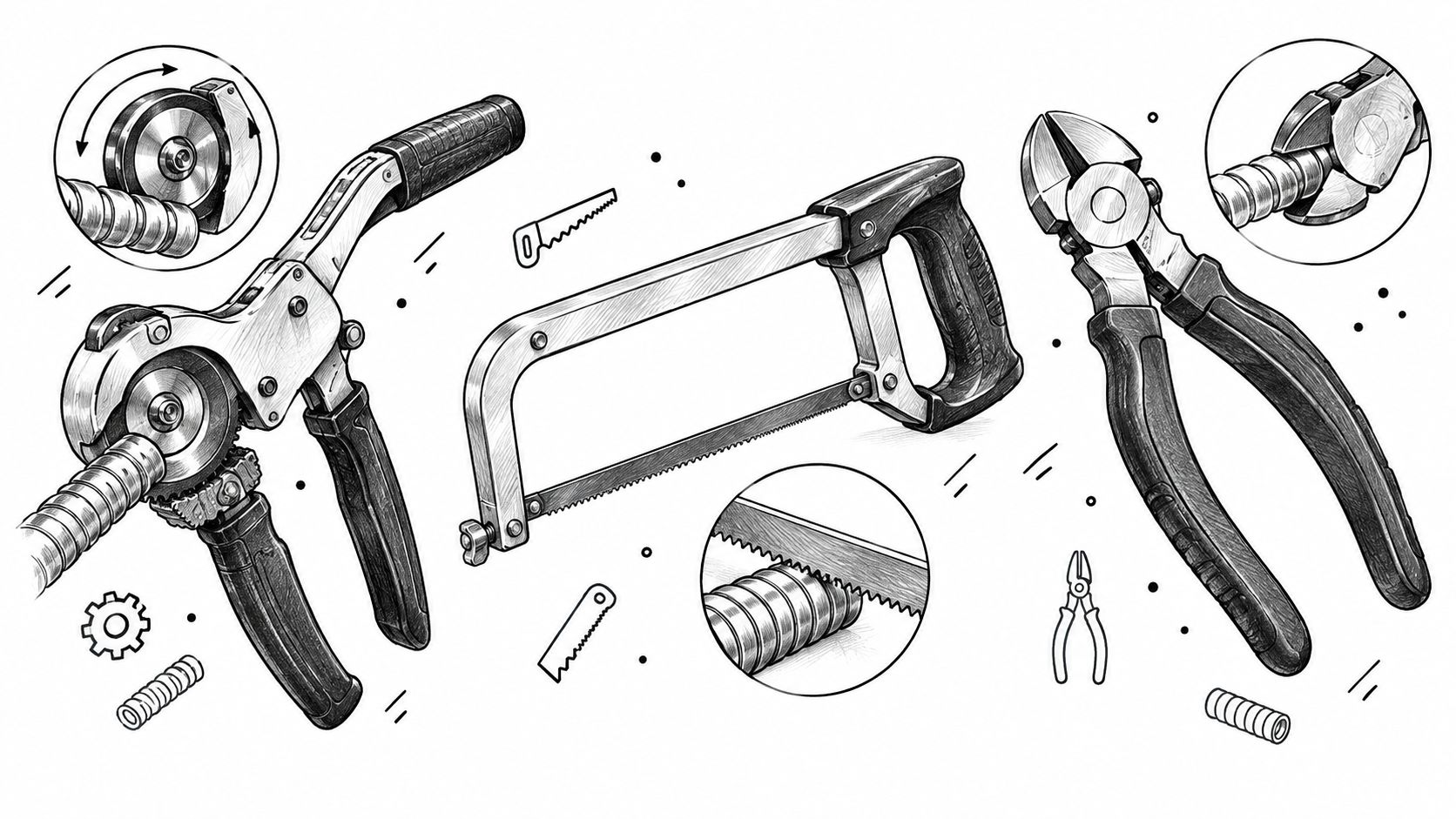
A rotary armor cutter fits the jobs that happen inside a cabinet, on a ladder, or at the end of a whip in a cramped corner. It earns its keep when access is tight and the cut has to happen where the conduit already sits. The main advantage is control, because the tool is made for armor and usually leaves a cleaner field cut than a rushed hand attempt.
I reach for it on a single whip in a crowded enclosure or when a service call leaves no room for a saw stroke. The trade-off is capacity and force. Larger conduit can push the tool past its comfortable range, and springy conduit or a bent cut point can make the tool fight the material instead of guiding it. Match the cutter to the job, and check the finished end before you reach for the fitting.
Hacksaw
A hacksaw stays in the truck because it solves a lot of ordinary cuts without much fuss. It is inexpensive, simple, and dependable when the blade is correct and the conduit is supported. Use the fine-tooth range detailed earlier for FMC and LFMC, since that blade choice is what keeps the edge cleaner and reduces tearing at the spiral.
Use it for a one-off cut, a supported length on the bench, or a spot where you can keep the stroke square from start to finish. A hacksaw moves slower than powered tools, but it gives good control and needs very little room. If the cut wanders or the spiral starts to open, look first at the setup and how the conduit is being held. A sharp blade helps, but it does not fix poor support.
Band saw
A band saw belongs in the shop or the prep area when several lengths need to be cut the same way. It gives repeatable results that are hard to match with hand tools over a full run. Use the cut-quality specifications noted earlier for FMC work, then focus on feed control and support so the conduit stays straight while it goes through the blade.
This is the right tool for batch work when you have enough room to stage material and keep the end from bouncing. It is less useful on installed conduit or in a finished space where the setup footprint has to stay small. The finish is usually cleaner than a rough hand cut, but only if the material is held correctly and the operator resists forcing the cut.
Diagonal and specialty wire cutters
Diagonal cutters are a cleanup tool first. They help trim bent tabs, knock down sharp spots, or finish a short section after the main cut has already been made. In tight access areas, they can save time because they fit where larger tools cannot.
They are also the right answer when the conduit is already severed and the issue is finish quality rather than length. A good field crew keeps one around for that last bit of correction that makes the fitting seat without fighting the edge. For a broader tool selection, see tools and testing products, since the right cutter often depends on whether the job calls for main cutting or cleanup. The practical rule is simple, use the cutter that matches the cut, then use the cleanup tool only for the defect that remains.
How to Cut Flexible Metal Conduit for a Clean Square Finish
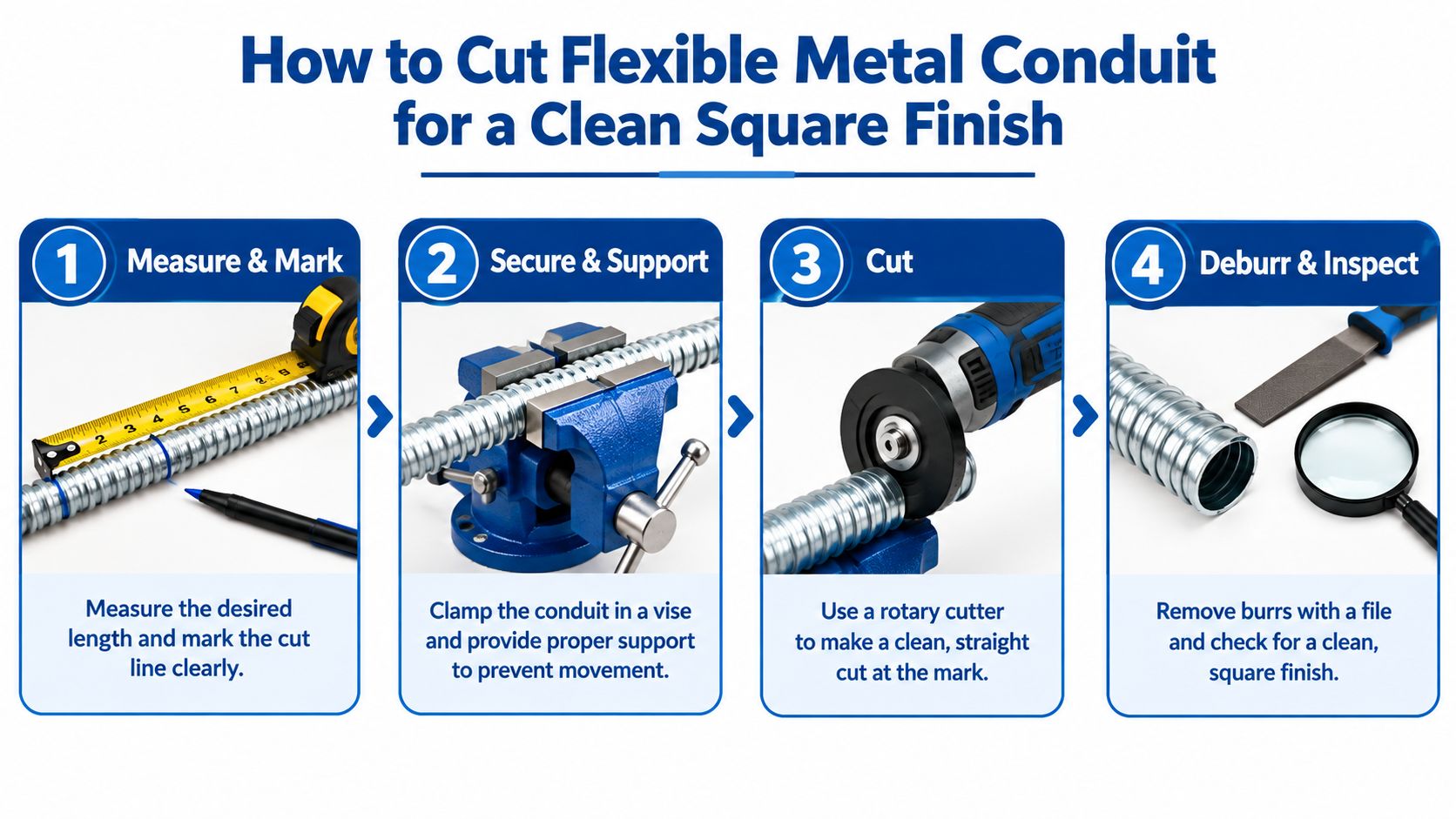
A clean FMC cut comes from the sequence, not from forcing one pass. Measure first, support the conduit so it cannot unwind, make the cut under control, then inspect the end before the fitting goes on. That is what keeps a small cut from turning into rework.
The cut sequence that holds up on site
Measure and mark. Mark the length clearly and leave room for the connector and any adjustment. A clean mark keeps the cut where the installer intended.
Secure and support. Hold the conduit so the spiral cannot twist open. On larger sizes, tape the cut zone before cutting if you need to keep the end from flaring or unwinding, as noted earlier in the FMC prep guidance.
Cut square. Use the selected tool and keep the feed steady. For hacksaw work, use the blade guidance already covered in the cutter selection section, then let the blade do the work instead of forcing the cut. That matters more than speed.
Deburr and inspect. Check both the inside and outside edges for sharp spots. The end should be square, smooth, and ready for connector installation before any conductors are pulled.
Workmanship check: If the conduit end springs open after the cut, stop and clean it up before you chase the fitting. The connector will not fix a bad end.
How to Choose the Right Cutter for Your Application
The right cutter depends on four things, trade size, access, finish quality, and volume. A single whip in a finished space doesn't ask the same thing from a tool as a shop order that needs repeated prep work. Once you sort the job by those constraints, the choice usually gets obvious fast.
Decision matrix for common job conditions
| Scenario | Recommended Cutter Type | Why It Fits |
|---|---|---|
| Single whip in a crowded enclosure | Rotary armor cutter | Compact, controlled, easy to use where a saw won't swing |
| One-off field cut with room to work | Hacksaw | Portable and dependable when blade choice and support are right |
| Multiple lengths in a prep area | Band saw | Consistent cuts and efficient batch work |
| End trim or cleanup after the main cut | Diagonal or specialty wire cutters | Good for finishing tabs and tight access corrections |
| Larger conduit where flaring is a concern | Hacksaw with tape support, or band saw in the shop | Better control over the spiral and a cleaner end |
| Mixed work across a site | Keep one rotary option and one saw-based option available | Covers both access limitations and finish expectations |
How to balance speed and rework risk
If the work is repetitive, the tool should reduce the chance of a bad end, not just move metal quickly. A powered saw in the shop can save time when you've got quantity, but it doesn't help much when the conduit is already mounted and the access is poor. A rotary cutter often gives better field flexibility, while a hacksaw gives you the most universal fallback when conditions are unpredictable.
Finish quality matters more as the termination gets more visible or the fit gets tighter. If the run ends in a crowded box, a cleaner cut saves time at the connector. If the conduit is being prepped in batches, consistency matters more than portability. That's the trade-off, and it's the one buyers and foremen should use when they stock cutters for the crew.
Safe Practices Tool Care and Workmanship Checks
A good cut can still fail if the crew rushes the handling. Sharp armor edges, loose workpieces, and dull blades all create problems before the fitting ever sees the conduit. The safest field habit is to treat the cut and the inspection as one operation.
What to check before and after the cut
- Protect your eyes and hands. Metal fragments and burrs are the everyday hazards here, and they show up fastest when the blade bites unevenly.
- Hold the conduit securely. A moving workpiece is the fastest way to turn a square cut into a jagged one.
- Keep conductors clear. If wire is already present, protect it before the tool touches the armor.
- Deburr both ends. The outside edge can cut hands, and the inside edge can damage insulation if it's left sharp.
- Inspect blade condition. A dull blade tears more than it cuts, which usually means more cleanup and a rougher finish.
- Check the armor strip. The conduit should stay intact at the cut end, not unravel or flare in a way that weakens the termination.
The maintenance habit matters too. When cutters go out of alignment or blades lose their edge, the tool starts demanding more pressure from the installer. That extra force is usually what ruins the cut. A sharper blade and better support solve more problems than pushing harder ever will.
For a broader procurement and jobsite safety reference that pairs well with cutter upkeep and pre-task checks, use the industrial safety equipment checklist as a companion resource. Keep the focus on the same sequence every time, cut cleanly, verify the edge, then install the fitting.
Quick Reference Glossary and Related Resources
A field glossary helps when someone on the crew uses a term loosely and the whole job depends on getting the same thing right. Keep the terms short, keep the meaning practical, and use the same language when you're ordering tools or checking a submittal. That's how you avoid confusion between the cutting method, the conduit type, and the fitting style.
Quick definitions
- FMC: Flexible metal conduit, a helically wound metal raceway used where flexibility is needed.
- LFMC: Liquidtight flexible metal conduit, FMC with a jacket for added environmental protection.
- Armor: The interlocked metal strip that forms the flexible body of the conduit.
- Rotary cutter: A tool designed to cut the spiral armor with controlled pressure.
- TPI: Teeth per inch, the blade density that affects how cleanly a saw cuts FMC.
- Burr: A sharp raised edge left after cutting that needs to be removed before installation.
Related lookup points
If you're sorting tool choice, keep the category comparison near the top of the article in mind. If you're checking finish quality, the cutting sequence section gives the field order that keeps the end square and usable. If you're deciding what to stock, the selection matrix shows how job constraints map to tool type without dragging you through brand talk.
For related conduit and connector work, FMC fittings and tools are usually reviewed together because the end condition affects termination quality. The internal links above are placed so you can move from the conduit, to the cut, to the installation hardware without hunting through unrelated material. That's the fastest way to keep the job moving and the workmanship consistent.
ATEK Distribution helps contractors, engineers, and facility teams source flexible conduit fittings, FMC, and related electrical products with the technical support needed to keep installs moving. If you're matching cutter choice to conduit size or trying to avoid rework at the termination, visit ATEK Distribution to review available products and coordinate the next order.
Prepared with Outrank